
CINE-499 · Lesson 3 of 12 · 30 min
Script breakdown and shot design with the director
With the look agreed, the director and DP turn the script into a plan for shooting. This is the most detailed creative work of prep: reading the script beat by beat, deciding what each moment needs visually, drawing overheads, writing the shot list and sketching the lighting plot for key scenes. CINE-401 covered shot design, blocking and coverage strategies in general. In the capstone you apply them to every scene of your own film and produce documents that the whole crew will use.
The aim is not a rigid plan that ignores the actors. It is a clear plan that leaves room for discovery, so that on the day you can adapt quickly without losing the shots the story needs.
Breaking down the script
Read the script several times. On the first read, simply experience the story. On the second, mark beats: moments where something changes for a character. On the third, note visual opportunities and problems.
- Number every scene and note its location, time of day, characters and page length in eighths of a page.
- Mark the beats within each scene and the emotional shift at each one.
- Note point of view: whose experience the scene follows.
- Flag practical needs: props that must read, screens that must be shot, reflections, mirrors, windows, rain, smoke, effects.
- Identify the visual heart of the film, usually one or two scenes that deserve the most time and care.
Producers and assistant directors break down the script for scheduling and budget. The DP's breakdown is about images, but the two should agree on page counts and locations, so share them.
Worked problem
Counting pages in eighths
A scene runs 1 full page and 3 lines of a 55-line page. Script pages are measured in eighths. What is the length to the nearest eighth?
Show solution
- One eighth of a page is about 55 ÷ 8 ≈ 6.9 lines.
- 3 lines ÷ 6.9 ≈ 0.43 of an eighth, which rounds up to 1/8 because any fraction counts as at least one eighth.
- Length = 1 1/8 pages.
Answer: About 1 1/8 pages. Eighths make it easy to add up page counts for scheduling.
Beats, point of view and coverage strategy
For each scene, decide how the camera will tell it. The same scene can be covered in many ways: a single master with no cuts, a master plus singles, a sequence of over-the-shoulders, a moving one-take, or an observational style that follows the action. The choice follows from the visual concept and the beats.
- A oner gives continuity and tension but leaves no editorial escape; plan it carefully and shoot a safety.
- Master and coverage gives the editor control over pace but costs set-ups.
- Shooting only from one character's side can keep the audience in their point of view.
- Save the tightest shot for the most important beat, so the close-up means something.
- Decide where the cuts are likely to be before deciding how many set-ups to shoot.
Talk through each scene with the director and write the agreed strategy in one line above the shot list for that scene.
Overheads and blocking
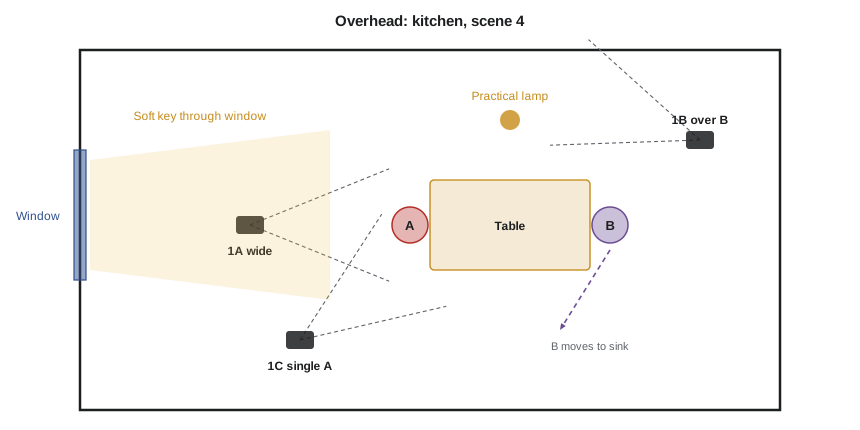
An overhead is a plan view of the set showing walls, furniture, windows, actor positions and movements, camera positions and lights. It is the most useful single document on set because it lets everyone see the plan at a glance.
- Draw the location to rough scale using your scout measurements.
- Mark actor start and end positions with letters and arrows for movement.
- Mark each camera position with the set-up number and an arrow showing the lens direction and field of view.
- Mark the main light sources, including windows and practicals.
- Mark where video village, the sound cart and the base for equipment will go.
Worked problem
Fitting the lens to the room
In a kitchen, the camera can sit at most 4.2 m from the actors (the far wall). The director wants a two-shot about 2.6 m wide at the actors. The camera sensor is 24.9 mm wide. What is the longest focal length that frames the two-shot?
Show solution
- Using similar triangles, focal length f = sensor width × distance ÷ subject width.
- f = 24.9 × 4,200 ÷ 2,600 ≈ 40 mm.
Answer: About 40 mm is the longest lens that fits; a 35 mm prime gives a little margin. The overhead should note the camera position against the wall.
The shot list
The shot list turns the plan into numbered set-ups. Each line describes one camera set-up, not each cut.
| Column | Content | Example |
|---|---|---|
| Scene and set-up | Scene number and set-up letter | 4B |
| Shot size and angle | Wide, medium, close-up; height and angle | MCU, eye level |
| Subject | Who or what is in frame | B over A's shoulder |
| Movement | Static, pan, dolly, handheld | Slow push |
| Lens | Focal length | 50 mm |
| Notes | Action covered, special needs | Covers lines 12–30; practical on |
| Priority | Must, should or nice to have | Must |
| Estimated time | Minutes to light and shoot | 25 |
Priority is the most important column on a low-budget shoot. When time runs out, the "nice to have" shots go first, and Lesson 9 shows how to make those decisions quickly.
Worked problem
Estimating a day from the shot list
Day 2 has 14 set-ups. The first set-up of each scene needs 45 minutes to light and shoot; each later set-up in the same scene needs 20 minutes. There are 3 scenes. The shooting day has 9.5 hours after the first shot, with a 30-minute meal break. Will it fit?
Show solution
- First set-ups: 3 × 45 = 135 minutes.
- Later set-ups: (14 − 3) × 20 = 220 minutes.
- Total: 135 + 220 = 355 minutes ≈ 5.9 hours.
- Available time: 9.5 − 0.5 = 9 hours of shooting time.
Answer: About 5.9 hours of work in 9 hours available, so it fits with margin for company moves, resets and problems.
Storyboards and shot sketches
Not every film needs full storyboards, but sketches help for complex shots: stunts, effects, oners, car scenes and anything that crosses departments. Stick figures are fine. What matters is the frame edges, the size of the subject in frame and the direction of movement. Many teams also photograph rough blocking on location with stand-ins and a phone, using a director's viewfinder app to check focal lengths. These photoboards are quick and accurate.
- Board the shots that involve other departments, such as stunts, effects and art.
- Use photoboards on location to test angles and lenses.
- Keep boards loose; actors may find better blocking in rehearsal.
Lighting plots for key scenes
For at least two key scenes, prepare a lighting plot: an overhead showing every fixture, its type, position, height, direction, modifiers and power. CINE-301 covered lighting plans; here you draw them for your own locations with the gaffer.
- Start from the motivating source in the look book.
- Add key, fill, back and practical units, with the type and wattage of each.
- Note diffusion, flags and bounce.
- Mark power drops, distribution and cable runs.
- Calculate the total load and check it against the available circuits.
- Add a list of fixtures and accessories for the gaffer's order.
Worked problem
Checking a lighting plot against household power
An apartment plot uses an LED panel at 400 W, two LED fresnels at 200 W each, a tube kit at 4 × 60 W and a practical at 60 W. The apartment has 15 A circuits at 120 V. How many circuits are needed if each is loaded to no more than 80 % of its rating?
Show solution
- Total load = 400 + 2 × 200 + 4 × 60 + 60 = 1,100 W.
- One circuit at 80 %: 0.8 × 15 × 120 = 1,440 W.
- 1,100 W is below 1,440 W, so it could run on one circuit.
- In practice, spread the load across two circuits because other appliances may share the circuit.
Answer: The load fits on one 15 A circuit at 80 %, but spread it over two circuits for safety and confirm which outlets are on which breaker.
The camera and pipeline document
Alongside the creative documents, write a short technical document so that the camera team, DIT, editor and colourist work from the same plan.
- Camera body, recording format, resolution, frame rate, shutter angle and aspect ratio with frame lines.
- Lenses, filters and support equipment.
- Exposure index and the exposure strategy (for example, protect highlights and use false colour targets).
- Monitoring LUT, show look and CDL workflow.
- Data workflow: media, backups, checksums, naming and reports.
- Deliverables expected at the end (Lesson 11).
CINE-430 covered pipelines for streaming delivery. For a capstone, keep the pipeline simple and reliable; the goal is a clean master you can grade, not an elaborate system that fails on day one.
Reviewing the plan with the team
Before tests and the shoot, hold a walk-through with the director, first assistant director, gaffer, key grip, production designer and sound. Walk the locations if you can. Read the shot list aloud, scene by scene, and invite questions. Changes found now are cheap. Record every agreed change in the shot list and overheads, then re-issue them with a new date.
Common breakdown mistakes and how to avoid them
First-time DPs often make the same few mistakes in prep. The most common is planning shots without checking the space: a beautiful shot list that needs the camera to stand inside a wall or a lens that cannot fit the room. Always check shot plans against measurements and photographs from the scout. A second mistake is planning every scene with the same coverage, which produces a flat film and wastes time on scenes that need only one or two set-ups. Let the beats decide how much coverage a scene deserves. A third is ignoring sound: a shot list full of wide masters with dialogue makes it hard for the boom operator to get close, so the mix suffers. A fourth is forgetting continuity of light across a scene shot over several hours; note the time of day for each set-up and plan when to shoot the wides.
- Check every set-up against scout measurements and photographs.
- Vary coverage with the importance and rhythm of each scene.
- Discuss boom positions with sound before locking framing for dialogue.
- Note the planned time of day for each set-up and shoot wides when the light is most consistent.
- Share the shot list with the editor if one is already attached, and ask what they would want.
Common mistakes
MistakeThe shot list lists every cut in the finished film.
InsteadEach line is a camera set-up; several cuts can come from one set-up.
MistakeOverheads are only for big productions.
InsteadOverheads are the quickest way for a small crew to understand a set-up, blocking and lighting.
MistakeEvery shot on the list has the same importance.
InsteadPriorities let you drop the right shots when time runs out.
MistakeA lighting plot is just a pretty diagram.
InsteadIt lists every fixture, modifier and power need so the gaffer can order and the load can be checked.
MistakeThe DP's breakdown can ignore the AD's breakdown.
InsteadPage counts and locations should agree so the schedule and the shot plan match.
Summary and key terms
- The DP's breakdown marks beats, point of view, visual opportunities and problems for every scene.
- Choose a coverage strategy for each scene from the visual concept and the beats.
- Overheads show the set, blocking, camera positions and light sources on one page.
- The shot list numbers set-ups with lens, movement, notes, priority and estimated time.
- Use storyboards or photoboards for complex shots that involve other departments.
- Lighting plots list fixtures, modifiers and power and should be checked against available circuits.
- A short camera and pipeline document keeps the technical team aligned.
- Script breakdown
- A scene-by-scene analysis of a script for planning purposes.
- Beat
- A moment where something changes for a character within a scene.
- Eighth of a page
- The unit used to measure script length for scheduling.
- Coverage
- The set of shots taken to give the editor options for a scene.
- Oner
- A scene played in a single continuous shot.
- Overhead
- A plan view showing set, blocking, cameras and lights.
- Set-up
- One camera position and lighting arrangement, which may produce several takes and cuts.
- Photoboard
- A storyboard made from photographs of stand-ins on location.
- Lighting plot
- A plan showing every fixture, its position, modifiers and power.
- Walk-through
- A meeting where the team reviews the plan on location before shooting.
Practice problems
Work each problem on paper first, then reveal the answer to check.
What does the DP mark on the second read of a script?
Show answer
Beats: the moments where something changes for a character.
How long is a scene of 2 pages and 4 lines on a 55-line page, in eighths?
Show answer
About 2 1/8 pages (4 lines is less than one eighth, which rounds up to 1/8).
Name two coverage strategies and a trade-off for each.
Show answer
A oner gives continuity but no editorial escape; master and coverage gives control but costs set-ups.
What goes on an overhead?
Show answer
Walls, furniture, windows, actor positions and moves, camera positions with direction, lights and support areas.
The camera is 3 m from actors and needs a 2 m-wide frame on a 24.9 mm sensor. What focal length?
Show answer
24.9 × 3,000 ÷ 2,000 ≈ 37 mm.
Why is a priority column important?
Show answer
It shows which shots to drop first when time runs out.
Day plan: 2 scenes, 10 set-ups, 45 minutes for each first set-up and 20 for the rest. How long?
Show answer
2 × 45 + 8 × 20 = 250 minutes.
A plot totals 1,600 W on 15 A, 120 V circuits loaded to 80 %. How many circuits at minimum?
Show answer
1,600 ÷ 1,440 ≈ 1.1, so 2 circuits.
What belongs in a camera and pipeline document?
Show answer
Camera, format, frame rate, lenses, exposure strategy, LUT and CDL workflow, data workflow and deliverables.
When are plan changes cheapest?
Show answer
In prep, before tests and the shoot.
Lesson quiz · 5 questions
Score 60% or more to complete this lesson.
Create a free account to save your progress, take quizzes and earn a certificate.