
CINE-430 · Lesson 6 of 12 · 34 min
Deliverables: IMF packages, masters and versions
A streaming title is delivered as a set of files and documents, not as a single movie file. The picture alone may include an HDR master, an SDR version, textless backgrounds, alternative versions for different territories and inserts for titles and credits, all of which must line up exactly with dozens of audio tracks and subtitle files. Streaming services handle this complexity with the Interoperable Master Format (IMF), a family of SMPTE standards that packages picture, sound, text and metadata into components that can be reused and recombined. This lesson explains what IMF is, how packages are structured, what other masters services ask for, how frame rates and safe areas affect delivery and how to estimate storage. Cinematographers do not usually build IMF packages, but understanding them explains many requests that come back from finishing and QC.
The deliverables list
Every production receives a deliverables list or schedule from the service or distributor. It lists each item, its format and deadline. A typical picture section might include:
- HDR master: IMF package with JPEG 2000 picture, PQ, Rec. 2020 container, with Dolby Vision metadata.
- SDR version: derived via metadata or delivered as a separate IMF composition or file.
- Textless elements: the picture without burned-in titles, subtitles or graphics, so titles can be replaced for other languages.
- Inserts: localized title cards, credits and on-screen text for other languages.
- Trailers and promotional materials, which may have their own specifications.
- Archival or legacy formats, such as ProRes files for partners.
The sound, timed text, artwork, metadata and legal sections add many more items. Missing or late deliverables delay a title's launch, so post supervisors track them closely.
What IMF is
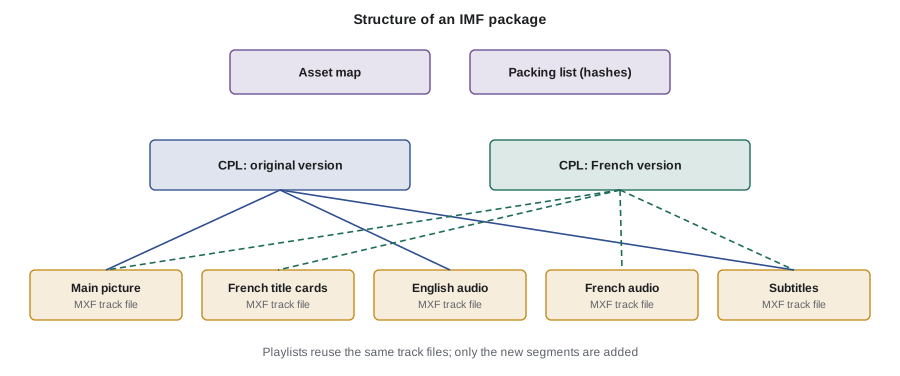
IMF is defined by the SMPTE ST 2067 family of standards. Instead of baking every version into a separate file, IMF stores the content as track files and uses playlists to describe how to assemble them. Key parts:
- Track files: MXF files that each hold one kind of essence, such as the main picture, one audio language or one subtitle language.
- Composition playlist (CPL): an XML file that lists which parts of which track files make up a version, in order, with timing. One package can hold several CPLs, such as the original version and a localized version.
- Packing list (PKL): an XML file that lists every file in the package with its size and hash, so delivery can be verified.
- Asset map: an XML file that tells systems where each file is located.
- Output profile list (OPL): optional XML instructions for how to make a specific output, such as scaling or converting to a particular format.
- Application: a set of constraints for a particular use. Application 2E (SMPTE ST 2067-21) is widely used for UHD and HDR content with JPEG 2000 picture; other applications cover ProRes picture or ACES image data.
Supplemental packages and versioning
One of IMF's strengths is versioning. If a title needs a French version with French title cards and credits, the finishing team does not render a whole new picture. Instead, it creates a supplemental package containing only the new title-card segments and a new CPL that points to the original picture for most of the runtime and to the new segments where needed. The same approach handles censorship edits for some territories, corrected shots after QC and new audio or subtitle languages.
Worked problem
Storage saved by a supplemental package
A 55-minute episode's picture track uses about 280 GB. A localized version replaces 2 minutes of title cards and credits. How much picture data does a supplemental package need, compared with a full new render?
Show solution
- Data per minute: \( 280 \div 55 \approx 5.1 \) GB per minute.
- Supplemental picture: \( 2 \times 5.1 \approx 10.2 \) GB.
- Full render: about 280 GB.
Answer: About 10 GB instead of 280 GB, roughly 4 % of the data. Across many languages and episodes, this saves large amounts of storage, transfer time and QC.
Picture encoding in IMF
For UHD and HDR deliveries, many services ask for JPEG 2000 picture in IMF, often lossless or visually lossless, at 10 or 12 bits. JPEG 2000 compresses each frame independently, which keeps editing and quality control simple. Some services accept or request ProRes-based IMF or separate ProRes master files for certain uses. Data rates depend on content, resolution and settings: grainy, detailed images need more data than clean, simple ones.
| Format | Typical data rate | About GB per hour |
|---|---|---|
| ProRes 422 HQ | about 700 Mb/s | about 320 |
| ProRes 4444 | about 1,050 Mb/s | about 470 |
| ProRes 4444 XQ | about 1,600 Mb/s | about 720 |
| JPEG 2000 lossless (varies with grain) | about 800 to 1,500 Mb/s | about 360 to 680 |
Use the figures in the table only for planning. For exact ProRes data rates, check Apple's ProRes documentation; for JPEG 2000, measure a sample of your own content.
Worked problem
Storage for a season of masters
A season has 8 episodes of 52 minutes. The HDR master IMF averages 1,100 Mb/s and an SDR ProRes 4444 XQ archive file is also required at about 1,600 Mb/s. How much storage do both masters need for one copy?
Show solution
- Season runtime: \( 8 \times 52 = 416 \) minutes, or about 6.93 hours.
- HDR IMF: \( 1\,100 \div 8 = 137.5 \) MB/s; per hour \( 137.5 \times 3\,600 = 495\,000 \) MB ≈ 495 GB; season \( 495 \times 6.93 \approx 3.43 \) TB.
- SDR ProRes: \( 1\,600 \div 8 = 200 \) MB/s; per hour 720 GB; season \( 720 \times 6.93 \approx 4.99 \) TB.
Answer: About 8.4 TB for one copy of both masters. With a working copy and two backups, plan for at least 25 TB, plus textless elements, inserts and audio.
Textless elements and inserts
Textless elements are copies of every shot that carries text, such as titles, locations, captions or graphics, without the text. They let localization teams add translated text without re-grading. Some services want textless versions of whole episodes; others want only the affected shots, delivered with handles (a few extra frames before and after). Inserts are the localized or alternative segments themselves. For the cinematographer, the main point is to make sure the textless backgrounds are graded identically to the texted versions and that frames with on-screen text are noted early in the grade.
Frame rates, conversions and pulldown
Masters are delivered at the project frame rate, but some partners or territories need other rates. Common conversions:
- 23.976 to 29.97 fps: 2:3 pulldown repeats fields in a pattern, so four film frames become five video frames (ten fields). Modern streaming rarely needs this, but some broadcast partners still do.
- 24 or 23.976 to 25 fps: usually done by playing the picture about 4.1 % or 4.3 % faster, which shortens runtime and raises audio pitch unless pitch-corrected.
- Frame-rate conversion by interpolation: used for some difficult conversions, but it can create artefacts.
Worked problem
Runtime after a PAL speed-up
A 23.976 fps episode runs 52 minutes 0 seconds. A European partner wants a 25 fps version made by speed-up. What will the runtime be?
Show solution
- Ratio: \( 23.976 \div 25 = 0.95904 \).
- New runtime: \( 52 \times 0.95904 \approx 49.87 \) minutes, or about 49 minutes 52 seconds.
Answer: About 49 minutes 52 seconds, roughly 2 minutes shorter. Audio must be sped up and usually pitch-corrected, and subtitles must be retimed.
Worked problem
Pulldown cadence
In 2:3 pulldown, film frames A, B, C and D become fields A A, B B B, C C, D D D. How many video frames result, and how many contain fields from two different film frames?
Show solution
- Fields: \( 2 + 3 + 2 + 3 = 10 \), which makes 5 video frames of 2 fields each.
- Frames: AA, BB, BC, CD, DD; frames 3 and 4 mix two film frames.
Answer: Four film frames become five video frames, and two of the five mix fields from different film frames. This is why pulldown material looks slightly different in motion and must be removed carefully if it is converted back.
Safe areas and active picture
Delivery specifications often refer to safe areas, which come from broadcast practice and help protect important picture content and text on different displays.
- Action safe: the area inside which all important action should stay, often about 93 % of width and height (SMPTE ST 2046-1 recommends this).
- Title safe or graphics safe: the area for text and graphics, often about 90 %.
- Active picture: the part of the frame that contains image, excluding letterbox bars. For a 2.39:1 picture in a 3,840 × 2,160 container, active picture is about 3,840 × 1,607.
Many streamers allow text closer to the frame edge than broadcast did, but subtitles, captions and graphics must still avoid being cut off on devices that crop or overscan. Lesson 8 covers subtitle placement.
Worked problem
Safe-area coordinates
For a 3,840 × 2,160 frame, what are the pixel dimensions of a 90 % graphics-safe area, and how far is its edge from the frame edge horizontally?
Show solution
- Width: \( 3\,840 \times 0.9 = 3\,456 \) pixels; height: \( 2\,160 \times 0.9 = 1\,944 \) pixels.
- Horizontal margin each side: \( (3\,840 - 3\,456) \div 2 = 192 \) pixels.
Answer: The safe area is 3,456 × 1,944, with a 192-pixel margin left and right and a 108-pixel margin top and bottom.
Delivering the files
IMF packages and other masters are delivered over high-speed file transfer services or, sometimes, on physical drives. Delivery systems check file hashes against the PKL, validate the package against the IMF application rules and run automated QC. Errors at this stage, such as a missing file or a wrong frame rate in the CPL, cause immediate rejection. Finishing facilities use IMF validation tools before sending. For a cinematographer, the relevant points are to know the delivery deadline, to finish grading and approvals in time for packaging and QC, and to be available if QC flags picture issues.
Worked problem
Transfer time
An 8.4 TB delivery is sent over a connection that sustains 1 Gb/s. How long will it take?
Show solution
- Size in bits: \( 8.4 \times 10^{12} \times 8 = 6.72 \times 10^{13} \) bits.
- Time: \( 6.72 \times 10^{13} \div 10^9 = 67\,200 \) s ≈ 18.7 hours.
Answer: About 19 hours, before any retries. Large deliveries need planning, especially near deadlines.
Common mistakes
MistakeIMF is a single movie file.
InsteadIMF is a package of track files, playlists and lists that describe how to assemble each version.
MistakeA localized version needs a full new picture render.
InsteadA supplemental package can add only the changed segments and a new composition playlist.
MistakeTextless elements can be graded later without matching.
InsteadTextless backgrounds must match the texted shots exactly, so plan them in the grade.
MistakeConverting 23.976 to 25 fps changes nothing but the number.
InsteadSpeed-up shortens runtime by about 4 % and raises audio pitch unless corrected.
MistakeThe PKL is optional.
InsteadThe packing list allows hash checking of every file and is part of the package.
Summary and key terms
- Deliverables lists set every picture, sound, text, artwork, metadata and legal item a title needs.
- IMF stores essence in MXF track files and uses composition playlists to assemble versions.
- Supplemental packages add only changed segments, saving storage and QC.
- Many services use IMF Application 2E with JPEG 2000 picture for UHD HDR masters.
- Data rates vary with content; use vendor figures and samples to plan storage.
- Frame-rate conversions such as pulldown and PAL speed-up change cadence or runtime.
- Safe areas and active picture definitions protect action, text and letterboxing.
- IMF
- Interoperable Master Format, the SMPTE ST 2067 family of standards for component-based masters.
- Track file
- An MXF file holding one kind of essence, such as picture, one audio language or subtitles.
- CPL
- Composition playlist: an XML file describing how track files assemble into a version.
- PKL
- Packing list: an XML file listing package files with sizes and hashes.
- OPL
- Output profile list: optional instructions for making a specific output from a composition.
- Application 2E
- The IMF application (ST 2067-21) widely used for UHD HDR content with JPEG 2000.
- Supplemental package
- An IMF package containing only new or changed elements for another version.
- Textless element
- Picture without burned-in text, used for localization.
- 2:3 pulldown
- A cadence that converts 23.976 fps frames into 29.97 fps video fields.
- Title safe
- The area of the frame where text and graphics are kept to avoid cropping.
Practice problems
Work each problem on paper first, then reveal the answer to check.
What does a CPL describe?
Show answer
Which parts of which track files make up a version, in order and with timing.
What is the speed-up from 23.976 to 25 fps?
Show answer
About 4.27 %.
A 45-minute 23.976 episode is sped up to 25 fps. What is the new runtime?
Show answer
45 × 0.95904 ≈ 43.2 minutes.
How many video frames come from four film frames in 2:3 pulldown?
Show answer
Five.
At 1,600 Mb/s, how many GB per hour?
Show answer
1,600 ÷ 8 = 200 MB/s; × 3,600 = 720 GB.
Why are textless elements needed?
Show answer
So localized text can be added without re-grading.
What is the 93 % action-safe width of a 3,840-pixel frame?
Show answer
About 3,571 pixels.
Why do supplemental packages save QC time?
Show answer
Only the new segments need checking, not the whole picture.
How long does 4 TB take at 1 Gb/s?
Show answer
4 × 10^12 × 8 ÷ 10^9 = 32,000 s ≈ 8.9 hours.
Which XML file allows hash checking of a package?
Show answer
The packing list (PKL).
Lesson quiz · 5 questions
Score 60% or more to complete this lesson.
Create a free account to save your progress, take quizzes and earn a certificate.