
CINE-430 · Lesson 1 of 12 · 32 min
The streaming landscape and why technical specs exist
A film or series made for a streaming service travels a long way after the last shot. It is graded, mixed, subtitled, packaged into files, checked by machines and people, encoded into dozens of versions and finally played on phones, laptops, televisions and projectors in many countries. Every step can damage the picture or the sound if the people involved do not agree on what the files should contain. Streaming services publish technical specifications so that thousands of production companies, post houses and vendors deliver files that work the same way. For a cinematographer, those specifications reach all the way back to prep: they shape the choice of camera, the recording format, the monitoring on set, the look-up tables and the way the grade is built. This course follows the path from camera approval to archive. It builds on CINE-310, which covered grading craft, HDR placement and SDR trims, and on CINE-202, which introduced the HDR standards. Here the focus is on delivery: what a streamer asks for, why it asks and how a cinematographer protects the image through every technical gate.
Who the streamers are and how they commission work
Streaming services fall into a few broad groups. Global subscription services such as Netflix, Prime Video, Disney+, Apple TV+ and Max commission original series and films and license libraries from studios. Broadcaster services such as CBC Gem, Crave and the streaming arms of US networks carry their own programs plus licensed titles. Free, advertising-supported services (often called FAST channels) stream linear channels of older content. Video platforms such as YouTube host creator content and some premium series. Each group has different technical expectations, but the premium subscription services set the highest bar, and their specifications have become a reference point for the whole industry.
- An original is commissioned and usually fully financed by the service, which then owns or controls the rights and sets the technical requirements from the start.
- A licensed or acquired title was made elsewhere and is bought for a territory and term; it must still pass the service's delivery and quality checks.
- A co-production shares financing between partners, so delivery schedules may have to satisfy a streamer, a broadcaster and public funders at the same time.
- A creator or platform upload is usually checked mostly by automated systems and has looser requirements.
For originals, the technical relationship starts in pre-production. The service assigns a production technology or post contact who reviews the camera plan, the colour pipeline and the post schedule. For licensed titles, the technical relationship starts at delivery, when the files arrive and are checked.
Why specifications exist
Technical specifications are not arbitrary rules. Each one protects something.
- Consistency across a catalogue: viewers move from one title to the next, and the service wants brightness, colour and loudness to feel consistent.
- Future-proofing: a title may stay in the library for decades, so the service wants the highest-quality master it can get, often in HDR and 4K even if most viewers watch in HD today.
- Encoding quality: streaming encoders work best from clean, high-quality sources. Noise, compression artefacts and banding in the master get worse after encoding.
- Automation: services ingest thousands of hours a month. Files that follow a standard structure can be checked and processed by machines.
- Accessibility and localization: subtitles, captions, audio description and dubbing need predictable timing, layout and audio stems.
- Legal protection: delivery schedules include rights documents, music cue sheets and clearances that let the service distribute the title worldwide.
When a cinematographer understands why a rule exists, it becomes easier to make good decisions when the rule does not cover a situation exactly, and easier to explain a creative choice to the service's technical team.
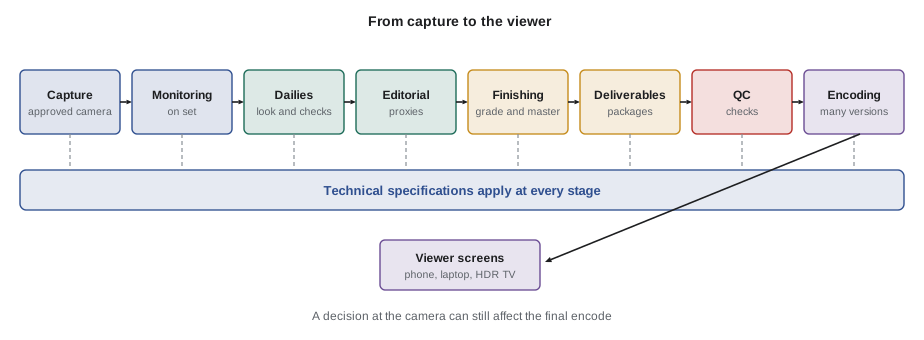
The delivery chain in one picture
A streaming title passes through a chain of stages. At each stage, someone checks that the work meets the specification before it moves on.
- Capture: an approved camera records in an approved format, with a known colour space and log or raw encoding.
- On-set monitoring: the DP and director view a transform of the camera image on calibrated monitors, often in both HDR and SDR.
- Dailies: the DIT or lab creates viewing files with the agreed look and checks the original files.
- Editorial: editors cut with lightweight proxy files and a consistent look.
- Finishing: the conform links the edit back to the original camera files, visual effects are dropped in and the colourist grades the HDR master and derives the SDR version.
- Deliverables: the finished picture, sound, subtitles and metadata are packaged in the formats the service asks for.
- Quality control (QC): the service or a vendor checks every file against the specification and reports faults.
- Encoding and distribution: the service's systems encode the master into many bitrates and formats for different devices and networks.
The cinematographer is most involved at the start and in finishing, but choices at the camera echo through every stage. A camera recorded at too low a bit depth can produce banding in the grade. A mistake in frame lines can leave the director's framing unusable for a different aspect ratio. A missing grey card or chart can make it hard to match cameras in finishing.
What a technical specification document contains
Streamers publish their requirements in partner help centres, delivery specifications and style guides. The details change over time, so always read the current version supplied for your production rather than relying on memory or on an old project. Most specification packages contain similar sections.
| Section | What it covers | Who reads it most |
|---|---|---|
| Capture requirements | Approved cameras, resolution, bit depth, codecs, frame rates | DP, camera team, production technology |
| Colour and HDR pipeline | Working colour space, monitoring, LUTs, mastering display | DP, DIT, colourist |
| Picture deliverables | Master formats, IMF packages, resolutions, frame rates, HDR metadata | Post supervisor, finishing facility |
| Sound deliverables | Mix formats, loudness, stems, music and effects | Re-recording mixer, post supervisor |
| Timed text | Subtitles, captions, forced narratives, style guides | Localization vendor |
| Artwork and metadata | Key art, synopses, credits, title information | Marketing, production |
| Legal and documentation | Rights, music cue sheets, clearances, chain of title | Producers, lawyers |
| Quality control | QC process, severity levels, redelivery rules | Post supervisor, QC vendor |
A cinematographer does not need to memorize every section, but should read the capture and colour sections closely during prep and know where to find the picture deliverables section when questions come up in finishing.
Approved, preferred and exceptions
Several services keep lists of cameras and capture formats they accept for original productions. Netflix, for example, has long published an approved camera list and has publicly stated that a large share of a program's final runtime must come from approved cameras, while allowing exceptions for some kinds of material such as archival footage, crash cameras, drones or specialty shots. The exact rule, list and exceptions change, and they differ between services and between scripted and unscripted work. Lesson 2 looks at capture requirements in detail. The important idea for now is that a camera choice is no longer only a creative and budget decision. It is also a delivery decision that may need written approval from the service before the first shooting day.
Different specs for different viewers
Viewers watch streaming titles on many kinds of screens. A premium HDR television may reach 1,000 nits or more of peak brightness and a wide colour gamut. A typical laptop or older television shows standard dynamic range at around 100 to 300 nits. Phones vary widely and are often watched in bright surroundings. Streamers deal with this range by asking for a high-quality HDR master and an SDR version, and by encoding many versions for different devices. The service's player then picks the best version a device can show. This is why delivery usually includes:
- An HDR master graded on a reference display, often with dynamic metadata that helps HDR televisions adapt the picture to their capabilities.
- An SDR version, either graded separately as a trim pass or derived from the HDR grade, for screens that cannot show HDR.
- Separate audio mixes for home theatre and for stereo listening.
- Subtitles and captions in many languages.
The cinematographer's job is to make sure the creative intent survives in each version. That means attending or supervising the HDR grade and the SDR trims, checking reference viewing at home-like brightness and approving the final versions.
Worked problem
How many versions might reach viewers?
An illustrative service encodes each title at 8 picture quality levels for SDR and 6 for HDR, with 2 frame-rate variants and 3 audio formats. Ignoring languages, how many combinations of picture and audio might the player choose between?
Show solution
- Picture versions: (8 + 6) × 2 = 28.
- Combined with audio: 28 × 3 = 84.
Answer: About 84 combinations before languages are counted. The master must be good enough that every one of them looks right, which is why services insist on clean, high-quality masters.
Worked problem
Library value over time
A series earns an illustrative 2 million dollars in streaming value in its first year, then 40 % of the previous year's value each year after that. What is its total value over 5 years, and what does that suggest about mastering quality?
Show solution
- Year 1: 2.0 million; year 2: 0.8 million; year 3: 0.32 million; year 4: 0.128 million; year 5: about 0.051 million.
- Total: 2.0 + 0.8 + 0.32 + 0.128 + 0.051 ≈ 3.3 million dollars.
Answer: About 3.3 million dollars, with about 40 % earned after the first year. Titles keep earning for years, and future display technology will expose weaknesses in a poor master, so services ask for the best possible master now.
The cinematographer's role in delivery
Delivery is usually managed by the post supervisor and the finishing facility, but the cinematographer has three responsibilities that cannot be handed off.
- Protect the image at capture: choose an approved camera and format, expose well, record clean metadata and shoot charts so that finishing has what it needs.
- Define and communicate the look: build show LUTs and a colour pipeline with the DIT and colourist that will survive HDR and SDR finishing.
- Approve the final image: attend the HDR grade and SDR trims where possible, review the QC-ready master and agree on any fixes.
Many productions write a camera and pipeline document during prep. It lists the cameras, formats, frame rates, LUTs, monitoring setup, data handling and the deliverables the service expects. Sharing it with the service's technical contact early prevents surprises later.
Working across Canada and the United States
Streaming productions often cross borders. A series may shoot in Toronto or Vancouver, finish in Los Angeles and deliver to a global service, or a Canadian series may be co-financed by a Canadian broadcaster, a public funder and a US streamer. Technical specifications from global services are usually the same in both countries, but other requirements differ.
In Canada, productions financed with Canadian public money, tax credits or broadcaster licences also deliver to those partners. Funders such as Telefilm Canada and the Canada Media Fund, and broadcasters such as CBC/Radio-Canada and Bell Media, publish their own delivery requirements, including accessibility files and, in some cases, preservation copies. Lesson 11 looks at the Canadian regulatory context, including the Online Streaming Act and Canadian content certification.
How specifications change
Technical specifications are living documents. Services update them when new cameras appear, when display technology changes, when standards bodies publish new versions and when they learn from problems in deliveries. A cinematographer who worked on a series three years ago may find that requirements for cameras, HDR metadata or audio have changed. Good habits help:
- Always ask for the current specification package for the production, with its version number and date.
- Read release notes or change logs when a service updates its documents.
- Confirm any exception in writing with the service's technical contact.
- Keep a record of which version of each specification the production followed, in case questions arise at QC.
This course quotes some published figures as examples, such as common loudness targets or mastering display brightness. Treat these as examples to understand the principles; the current documents for your production always take precedence.
Worked problem
Planning around a spec change
A series shoots season 1 under a specification that requires an approved camera for at least 90 % of runtime. Before season 2, the service adds a new requirement for a minimum recording bit depth that the production's B camera format does not meet. The B camera supplies 25 % of runtime. What are the options?
Show solution
- Option 1: change the B camera to an approved model and format that meets the new bit depth.
- Option 2: change the B camera's recording format, if the camera supports one that meets the requirement.
- Option 3: apply for a written exception, with test footage and reasons.
- Check the effect on the 90 % rule: if the B camera became non-compliant, compliant runtime could drop to 75 %, below the limit.
Answer: The production must change the B camera or its format, or obtain a written exception before shooting. Leaving it unresolved risks a failed delivery or costly reshoots.
Common mistakes
MistakeSpecifications only matter in post-production.
InsteadCapture, monitoring and pipeline decisions made in prep affect whether the final files can meet the specification.
MistakeAn old project's specification is good enough for a new one.
InsteadAlways use the current specification package for the production, because requirements change.
MistakeIf most viewers watch in HD, there is no reason to master in 4K HDR.
InsteadServices want the best possible master for the long life of the library and for future displays.
MistakeExceptions can be agreed verbally on set.
InsteadGet every exception confirmed in writing by the service's technical contact.
MistakeThe post supervisor handles delivery, so the DP has no role.
InsteadThe DP protects the image at capture, defines the look and approves the final HDR and SDR versions.
Summary and key terms
- Streaming services publish technical specifications to keep a large catalogue consistent, future-proof and easy to process.
- Originals bring the service's technical team into pre-production; licensed titles meet the specification at delivery.
- Specifications cover capture, colour pipeline, picture, sound, timed text, metadata, legal documents and QC.
- Camera choice is a delivery decision that may need approval before shooting.
- Services usually ask for an HDR master and an SDR version so every screen gets a suitable picture.
- The cinematographer protects the image at capture, defines the look and approves the final versions.
- Specifications change, so productions should work from the current dated version and confirm exceptions in writing.
- Technical specification
- A document from a service or distributor that sets the required formats, quality and structure of delivered files.
- Original
- A title commissioned and usually financed by the service, which sets requirements from the start.
- Licensed title
- A title made elsewhere and bought for distribution in a territory for a term.
- Deliverables
- The complete set of picture, sound, text, metadata and documents delivered to a distributor.
- Quality control (QC)
- Checking delivered files against the specification and reporting faults.
- Approved camera
- A camera and recording format a service accepts for original productions.
- HDR master
- The highest-quality finished picture, graded for high dynamic range on a reference display.
- SDR version
- The standard dynamic range picture for screens that cannot show HDR.
- Encoding ladder
- The set of compressed versions at different bitrates and resolutions that a service streams.
- Pipeline document
- A prep document that lists cameras, formats, LUTs, monitoring, data handling and deliverables.
Practice problems
Work each problem on paper first, then reveal the answer to check.
Name three things technical specifications protect.
Show answer
Any three of consistency, future-proofing, encoding quality, automation, accessibility and legal protection.
How does the technical relationship differ for an original and a licensed title?
Show answer
For an original it starts in pre-production; for a licensed title it starts at delivery.
Why might a camera choice need approval before shooting?
Show answer
Many services accept only approved cameras and formats for most of the runtime.
An illustrative service encodes 10 SDR and 5 HDR picture levels, each in 2 frame rates, with 2 audio formats. How many combinations?
Show answer
(10 + 5) × 2 × 2 = 60.
Why do services ask for both HDR and SDR versions?
Show answer
Viewers use screens with very different brightness and gamut, and the player needs a suitable version for each.
What three delivery responsibilities belong to the cinematographer?
Show answer
Protect the image at capture, define and communicate the look, and approve the final image.
What should a production record about specifications?
Show answer
Which dated version of each document it followed and any written exceptions.
A title earns 1 million dollars in year 1 and half the previous year's value each year after. What does it earn over 4 years?
Show answer
1 + 0.5 + 0.25 + 0.125 = 1.875 million dollars.
What document lists cameras, formats, LUTs and deliverables during prep?
Show answer
A camera and pipeline document.
Why are clean masters important for encoding?
Show answer
Noise, artefacts and banding in the master get worse when encoded at lower bitrates.
Lesson quiz · 5 questions
Score 60% or more to complete this lesson.
Create a free account to save your progress, take quizzes and earn a certificate.