
CINE-410 · Lesson 9 of 12 · 31 min
Underwater and marine cinematography
Water transforms light. It absorbs colours unevenly, scatters light from particles, bends rays at every glass surface and pressure-tests every seal on a camera housing. It also brings serious risks to people: drowning, cold, decompression illness and entanglement. Underwater cinematography, from a shallow pool scene to a deep ocean sequence, is therefore one of the most specialized fields in the industry. Marine work on the surface, from boats and docks, has its own challenges with motion, spray and safety. This lesson explains how water changes light and optics, how housings and ports work, how underwater lighting is planned, how dive operations are organized and regulated, and how the DP supervises underwater work without being a diver.
How water changes light
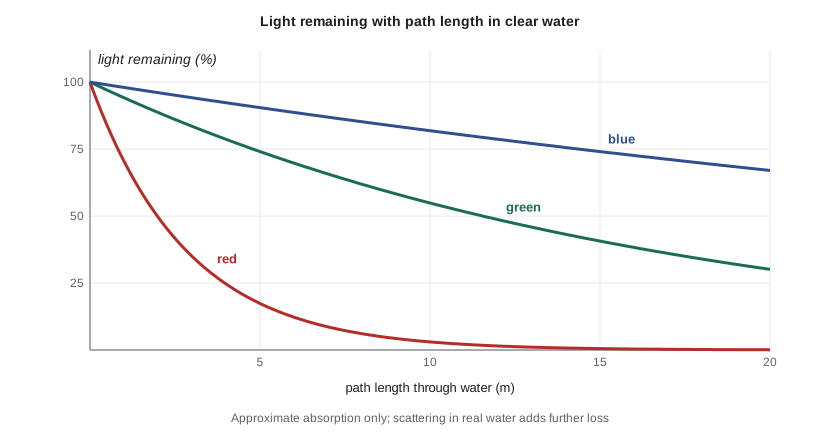
Water absorbs light, and it absorbs long wavelengths (reds) much more strongly than short ones (blues and greens). Sunlight that reaches a subject underwater has travelled down from the surface and then across to the camera, so the total path length matters, not just the depth.
Here I is the remaining intensity, I₀ the starting intensity, k the absorption coefficient for that wavelength and x the path length through water. In clear water k for red light is roughly 0.3 to 0.4 per metre, while for blue-green light it is much smaller. Suspended particles add scattering and further loss, and in coastal and lake water absorption and scattering are often far higher.
Worked problem
How much red light is left?
A diver films a subject 5 m below the surface and 2 m from the camera in clear water. Using k = 0.35 per metre for red light and 0.06 per metre for green light, estimate the remaining red and green sunlight at the camera, and the difference in stops. Then estimate the red loss for light from a lamp on the camera.
Show solution
- Sunlight path: down 5 m to the subject and 2 m across to the camera, about 7 m in total.
- Red: e^(−0.35 × 7) = e^(−2.45) ≈ 0.086, so about 8.6 % remains, a loss of about 3.5 stops.
- Green: e^(−0.06 × 7) = e^(−0.42) ≈ 0.66, so about 66 % remains, a loss of about 0.6 stop.
- Difference: about 2.9 stops more loss in red than in green.
- A lamp on the camera lights the subject over 2 m out and 2 m back, a 4 m path: red e^(−1.4) ≈ 0.25, a loss of about 2 stops.
Answer: About 9 % of the red sunlight and 66 % of the green remain, so red is nearly 3 stops weaker than green. Light from a lamp near the camera loses only about 2 stops of red over the short path, which is why underwater cinematographers work close and add light to restore colour.
Practical consequences follow directly. Work as close to the subject as possible with wide lenses to minimize the water between lens and subject. Use artificial light for close subjects and white balance carefully, or use filters for ambient-light shooting in shallow water. Expect visibility, not just colour, to limit what can be filmed.
Housings and ports
Underwater cameras sit in waterproof housings, usually made of aluminium alloy or engineered plastics, sealed with O-rings and fitted with controls that pass through the housing to the camera. The lens looks out through a port, either flat or dome-shaped, and the port changes the optics.
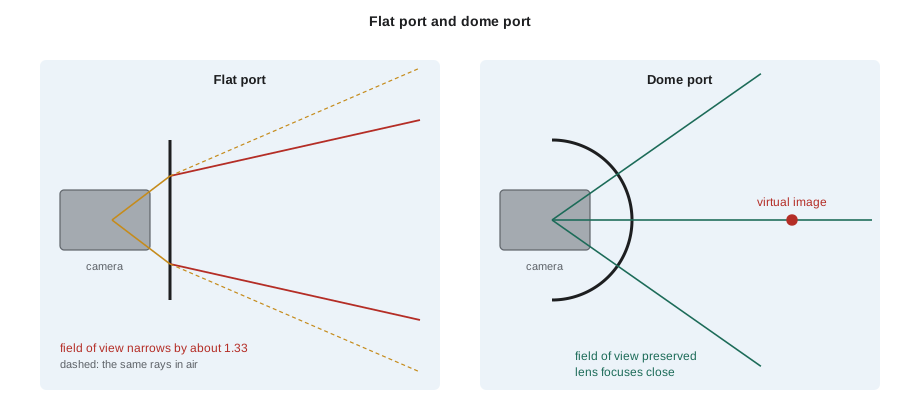
- Flat ports: a flat window in front of the lens. Light passing from water to air bends at the flat surface, which makes subjects appear about 1.33 times closer and larger and narrows the field of view. Flat ports suit macro and longer lenses but cause distortion and colour fringing at wide angles.
- Dome ports: a curved window centred on the lens's entrance pupil. A dome largely preserves the lens's field of view in water, but it creates a virtual image of the scene a short distance in front of the dome, so the lens must focus close, often with a dioptre.
- Pressure ratings: each housing has a depth rating; never exceed it, and allow a margin.
- Seals and maintenance: O-rings are cleaned, inspected and lightly greased before each dive, and the housing is tested for leaks in shallow water or with a vacuum check before the camera goes deep.
Worked problem
Field of view behind a flat port
A full-frame camera (36 mm wide) uses a 24 mm lens behind a flat port. Its horizontal angle of view in air is about 73.7°. What is the approximate angle of view in water, and what focal length does it behave like?
Show solution
- Half-angle in air: 36.9°, so tan 36.9° ≈ 0.750.
- In water the tangent of the half-angle is divided by about 1.33: 0.750 ÷ 1.33 ≈ 0.564, giving a half-angle of about 29.4°.
- Full angle in water: about 58.8°.
- Equivalent focal length: 24 × 1.33 ≈ 32 mm.
Answer: About 59° in water, behaving roughly like a 32 mm lens in air. To keep a wide view underwater with a flat port you need a wider lens, or better, a dome port.
Worked problem
Where does the dome port's virtual image form?
A dome port has a radius of 100 mm and is centred on the lens's entrance pupil. Distant objects in water form a virtual image about three times the dome radius in front of the dome surface. Where must the lens focus?
Show solution
- Virtual image distance in front of the dome surface: about 3 × 100 = 300 mm.
- Distance from the lens's entrance pupil at the centre of the dome: 300 + 100 = 400 mm.
Answer: The lens must focus at about 400 mm, even for distant subjects. Many wide lenses cannot focus that close without a dioptre, so housings often include a close-up dioptre matched to the dome.
Lighting underwater
Underwater lighting fights absorption and scattering.
- Place lights to the side of the camera, not next to the lens, so particles in the water are not lit directly toward the camera; this reduces backscatter, the "snow" effect of lit particles.
- Use wide, soft sources close to the subject for faces and close work.
- Plan power: underwater lights are often battery-powered or fed by umbilicals from the surface, with strict electrical safety rules such as ground-fault protection.
- In studio tanks, light from above through the surface, add underwater units and control reflections from tank walls.
- White balance on a grey card at the working distance, and keep notes as the depth or distance changes.
Organizing an underwater shoot
An underwater sequence is planned as a dive operation as well as a camera operation.
- Dive plan: depths, durations, breathing gas, decompression limits, entry and exit points and emergency procedures, approved by the dive supervisor.
- Team: underwater DP or camera operator, camera assistant and diving support, safety divers for cast and crew, a dive supervisor and surface support.
- Performers: actors must be assessed for water confidence and, where needed, trained; safety divers stay close with breathing gas for breath-hold performers.
- Communication: hand signals agreed in advance, underwater speakers for directions, and surface communication systems.
- Locations: studio tanks give control of light, temperature, visibility and safety; open water gives realism but adds weather, current, cold and visibility risks.
- Time limits: depth and dive time are limited by decompression rules, breathing-gas supply and cold, not by the shooting schedule.
Worked problem
Dive time limits and the schedule
A sequence needs 90 minutes of underwater shooting at about 18 m depth. The dive supervisor applies a no-decompression limit of about 50 minutes at that depth for this team, with a minimum surface interval between dives. The plan uses dives of 40 minutes for margin. How many dives are needed, and what does that mean for scheduling?
Show solution
- Dives needed: 90 ÷ 40 = 2.25, so at least three dives.
- Each dive also needs set-up, descent, ascent, safety stops and surface intervals, so three dives may take most of a day.
- Repetitive dives also reduce allowable time on later dives, which the dive supervisor calculates with tables or dive computers.
Answer: At least three dives, probably filling the day. Scheduling must follow the dive plan; the production cannot add "one more dive" without the supervisor's approval.
Rules for occupational diving in Canada
In Canada, diving at work is regulated by provincial and federal occupational health and safety laws, which require dive teams with defined roles, qualified divers, dive plans and emergency procedures. CSA Z275.2, the occupational safety code for diving operations, and CSA Z275.4, the competency standard for diving, hyperbaric chamber and remotely operated vehicle operations, are referenced by many jurisdictions. For example, Ontario regulates diving under its Diving Operations regulation and British Columbia under Part 24 of its occupational health and safety regulation. Film and television productions are workplaces, so these rules apply to crew and performers who dive. Boats used in marine filming must meet Transport Canada's small vessel and safety equipment requirements.
Surface and marine work
Not all water work is underwater. Shooting from boats, docks and in surf brings its own techniques.
- Splash bags and splash housings: protect cameras close to the waterline and allow half-in, half-out shots with a dome port.
- Stabilization: boats roll and pitch; gyro-stabilized heads, gimbals and wide lenses help, and long lenses are hard to hold steady.
- Spray and salt: rain covers, spinning rain deflectors, fresh-water rinses and careful cleaning after every day.
- Marine safety: personal flotation devices, a vessel master in charge of the boat, man-overboard procedures and weather limits.
- Cold water: even in summer, cold water is dangerous; immersion can cause cold shock and loss of muscle control within minutes.
The DP's role when not diving
Many DPs do not dive. They still lead the look.
- Agree the look, lenses, ports, lighting style, frame rate and colour pipeline with the underwater DP in prep.
- Watch live video from underwater on monitors at the surface, communicating through the dive supervisor or underwater speakers.
- Match underwater footage to surface scenes in light direction, time of day and colour intent.
- Review dailies with the underwater team and the colourist.
- Respect the dive plan: time, depth and safety decisions belong to the dive supervisor.
Common mistakes
MistakeThinking depth alone decides colour loss
InsteadThe total path length through water, down to the subject and across to the camera, decides how much light is lost
MistakeUsing a wide lens behind a flat port and expecting the same field of view
InsteadFlat ports narrow the field of view by about 1.33; use a wider lens or a dome port
MistakeForgetting to focus on the dome port's virtual image
InsteadFocus close, often with a matched dioptre, because the virtual image forms near the dome
MistakePlacing underwater lights next to the lens
InsteadMove lights to the side and forward to reduce backscatter
MistakeAdding a dive because the schedule needs it
InsteadFollow the dive plan; depth, time and repetitive dive limits are set by the dive supervisor
Summary and key terms
- Water absorbs red light far faster than green and blue, so underwater images lose colour with path length.
- Intensity falls as I = I₀ e^(−kx); working close and adding light restores colour.
- Flat ports magnify by about 1.33 and narrow the field of view; dome ports preserve it but form a virtual image near the dome.
- Underwater lighting is placed to the side to reduce backscatter and needs strict electrical safety.
- Underwater shoots are dive operations with dive plans, supervisors, safety divers and time limits.
- Canada regulates occupational diving through provincial and federal OHS law and CSA Z275 standards; the US through OSHA's commercial diving standard.
- Marine work needs stabilization, spray protection, vessel safety and awareness of cold water.
- Absorption coefficient
- A measure of how quickly a medium absorbs light of a particular wavelength per unit distance
- Backscatter
- Light reflected back toward the lens from particles in the water
- Housing
- A waterproof enclosure that protects a camera underwater
- Flat port
- A flat window in front of the lens in a housing
- Dome port
- A curved window centred on the lens that preserves field of view underwater
- Dioptre
- A close-up lens that lets a camera lens focus at shorter distances
- Dive supervisor
- The person who controls a dive operation and its safety
- No-decompression limit
- The maximum time at a depth that allows direct ascent without decompression stops
- Safety diver
- A diver assigned to watch and assist performers or crew underwater
- Splash bag
- A flexible waterproof cover for filming close to or partly in the water
Practice problems
Work each problem on paper first, then reveal the answer to check.
In clear water with k = 0.35 per metre for red, how much red light remains after 4 m?
Show answer
e^(−1.4) ≈ 0.25, about 25 %, a loss of about 2 stops
Why do underwater cinematographers use wide lenses close to the subject?
Show answer
To reduce the amount of water between lens and subject, which reduces colour loss and scattering
A 20 mm lens is used behind a flat port. Roughly what focal length does it behave like underwater?
Show answer
About 20 × 1.33 ≈ 27 mm
A dome has an 80 mm radius. About where must the lens focus?
Show answer
About 3 × 80 + 80 = 320 mm from the entrance pupil
What causes backscatter and how is it reduced?
Show answer
Light reflected from particles toward the lens; move lights to the side and away from the lens axis
A sequence needs 100 minutes underwater in 35-minute dives. How many dives are needed?
Show answer
100 ÷ 35 ≈ 2.9, so three dives
Who decides the depth and time limits of a dive?
Show answer
The dive supervisor, following the dive plan and applicable rules
Name two marine safety measures on a boat shoot.
Show answer
Any two of personal flotation devices, a vessel master in charge, man-overboard procedures and weather limits
Why must housing O-rings be checked before each dive?
Show answer
A damaged or dirty O-ring can leak and flood the housing
Why does cold water need special respect even in summer?
Show answer
Sudden immersion can cause cold shock and rapid loss of muscle control
Lesson quiz · 5 questions
Score 60% or more to complete this lesson.
Create a free account to save your progress, take quizzes and earn a certificate.