
CINE-410 · Lesson 5 of 12 · 28 min
Aerial cinematography from helicopters and planes
Before drones became common, almost every aerial shot in a film came from a helicopter or a light aircraft. They are still essential for shots that need altitude, speed, range or a heavy camera and long lens: following a jet or a car chase on a highway, crossing mountain ranges, flying over a city at night or holding a long lens steady at hundreds of metres. This lesson explains the aircraft and camera systems, the physics of stability and motion blur, how aerial shots are planned and flown, and the rules and safety culture around low-level filming.
Platforms: helicopters, planes and their uses
Each type of aircraft suits different shots.
- Helicopters: can hover, fly slowly, fly sideways and turn tightly, and can land in small spaces. They are the most flexible camera platforms and the most common for film work.
- Light fixed-wing aircraft: faster, longer range and cheaper per hour than many helicopters, useful for high-altitude scenics, following other aircraft and covering large distances, but they cannot hover.
- Jets and specialized camera aircraft: used for air-to-air work with fast aircraft, sometimes with dedicated camera pods or nose mounts.
- Airships and tethered platforms: rare, but used for very steady, long-duration aerial views at events.
The aviation company and pilot decide what each aircraft can do safely. The DP's job is to describe the shot, the speed and altitude needed, and the lens and frame, then let the aerial specialists plan the flight.
Gyro-stabilized camera systems
Aircraft vibrate and move constantly. Early aerial cinematographers used hand-held cameras or simple vibration-isolating mounts, with limited lens lengths. Modern aerial work uses gyro-stabilized heads, often in a ball-shaped housing mounted on the nose or side of the helicopter. Gyroscopes sense rotation, and motors drive the camera in the opposite direction to cancel it, while the operator inside the aircraft controls pan, tilt, roll, zoom and focus remotely.
- Axes: most systems stabilize at least pan, tilt and roll; some add a fourth or fifth axis to reduce residual motion.
- Payload: systems are rated for a maximum camera and lens weight, which limits large-format bodies and long zooms.
- Mounting: the mount must be approved for the aircraft type, usually through engineering documents and aviation authority approval.
- Operators: aerial camera operators are specialists who can frame smoothly at long focal lengths while the aircraft moves.
Why long lenses need extreme stability
The longer the lens, the smaller the angle each photosite covers, and the more any vibration shows on screen. A useful measure is the angle covered by one photosite.
Here p is the photosite pitch and f the focal length, both in the same units, giving an angle in radians.
Worked problem
How steady must a long lens be?
A camera with a 6 µm photosite pitch is used with a 1,000 mm lens. What angle does one photosite cover, and what does that mean for the gyro-stabilized head?
Show solution
- Pitch: 6 µm = 0.006 mm.
- Angle per photosite: 0.006 ÷ 1,000 = 6 × 10⁻⁶ radians, or 6 microradians.
- Converting: 6 × 10⁻⁶ rad × 57.3 ≈ 0.00034°.
- To keep the image steady to within a pixel or two, residual motion during an exposure must be on the order of a few microradians.
Answer: Each photosite covers about 6 microradians (about a third of a thousandth of a degree). Only high-end multi-axis stabilized systems hold a 1,000 mm lens that steady from a vibrating aircraft, which is why long-lens aerial work needs specialist systems and operators.
Motion blur and shutter in the air
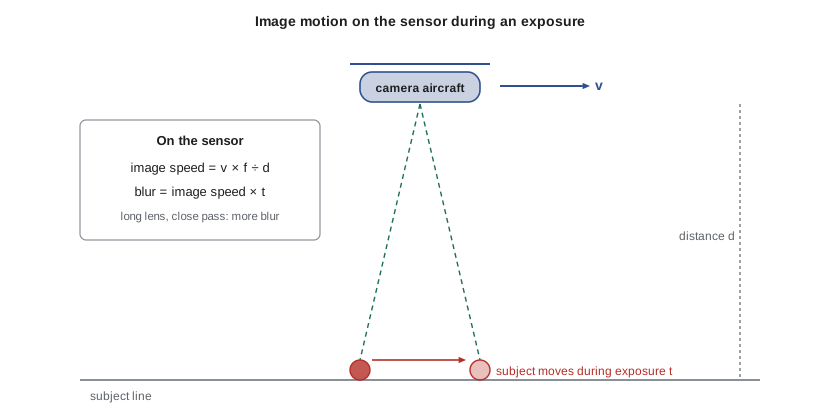
Motion blur depends on how fast the subject's image moves across the sensor during the exposure. For a subject moving past the camera at right angles, the image speed on the sensor is approximately the relative speed multiplied by the focal length divided by the distance.
Worked problem
Blur on a passing shot
A helicopter flies parallel to a train at a relative speed of 40 m/s (144 km/h) and 200 m away. The camera uses a 50 mm lens on a full-frame sensor with 6 µm photosites, shooting at 24 fps with a 180° shutter (1/48 s). How much does the background blur on the sensor, in photosites?
Show solution
- Image speed: 40 × 0.05 ÷ 200 = 0.01 m/s = 10 mm/s on the sensor.
- Exposure: 1/48 s ≈ 0.0208 s.
- Blur: 10 × 0.0208 ≈ 0.21 mm.
- In photosites: 0.21 ÷ 0.006 ≈ 35 photosites.
Answer: About 35 photosites of blur. That reads as natural motion at 24 fps, while the train itself, tracked by the operator, stays sharp. A shorter shutter would reduce blur but can make movement look staccato; most narrative aerials keep a 180° shutter unless there is a specific reason to change it.
Planning an aerial day
A typical aerial planning process involves the director, DP, aerial coordinator, pilot, first AD and location manager.
- Shot list and storyboards with altitude, speed, direction, lens range and time of day for each shot.
- Route and timing: positioning flights, fuel stops, landing zones and the order of shots to make the best use of light.
- Ground coordination: where picture vehicles, actors, crew and safety personnel will be, and how they communicate with the aircraft.
- Airspace and approvals: low-flight approvals, notices to other airspace users, coordination with air traffic services near airports, and any landowner or municipal permissions for landing zones.
- Weather limits: wind, visibility, cloud ceiling and turbulence limits agreed with the pilot.
- Briefings: a safety briefing for everyone involved before the first flight and a debrief after.
The pilot in command has final authority over the aircraft. If the pilot decides a manoeuvre is unsafe, it does not happen.
Worked problem
Flight time and cost for an aerial day
An aerial day plans 1.2 hours of positioning flights to and from the location, 3.5 hours of filming flights and a 15 % allowance for repositioning and holds. At an illustrative rate of 3,200 per flight hour for the helicopter and pilot, plus a 6,500 day rate for the gyro-stabilized system and operator, estimate the cost.
Show solution
- Flight hours before allowance: 1.2 + 3.5 = 4.7 hours.
- With 15 % allowance: 4.7 × 1.15 ≈ 5.4 hours.
- Aircraft cost: 5.4 × 3,200 ≈ 17,280.
- Total with camera system: 17,280 + 6,500 = 23,780.
Answer: Roughly 23,800 for the day at these illustrative rates. Positioning time, minimum hours and weather policies vary by company and must be confirmed in the quote.
Air-to-air and following vehicles
Filming another aircraft, a boat or a car chase from a helicopter is among the most complex aerial work.
- Air-to-air: both pilots plan formation positions, separation distances, break-away procedures and radio calls in detail. Only highly experienced pilots fly formation for filming.
- Car and train chases: the helicopter coordinates with ground vehicles through radio, with road closures and safety zones planned by the stunt coordinator and police where required (car work is covered in Course CINE-330).
- Boats and ships: maritime coordination, safe distances and landing options over water.
Simple shapes and clear speeds make these shots repeatable: a straight line at a constant speed is safer and easier to cut than an improvised pursuit.
Rules for low-level filming in Canada
In Canada, Transport Canada regulates aviation under the Aeronautics Act and the Canadian Aviation Regulations (CARs). Section 602.14 sets minimum altitudes and distances: over built-up areas or open-air assemblies of people, aircraft must normally fly at least 1,000 ft above the highest obstacle within a 2,000 ft radius; elsewhere, at least 500 ft from any person, vessel, vehicle or structure. Low-level film work below these limits needs specific authorization from Transport Canada, typically through the operator's air operator certificate and an approved special flight operations certificate or exemption, along with the aviation company's procedures. Productions should hire an operator experienced in film work who already holds the necessary approvals and works with NAV CANADA when flying in controlled airspace.
Safety culture in aerial filming
Aerial filming has a long history of serious accidents, including fatal crashes during film and television production. Lessons from those accidents shape today's practices.
- Never pressure the pilot. Time and light pressures are real, but the pilot's decision to abort, refuel or wait for weather is final.
- Minimize people near the aircraft and under the flight path. Keep non-essential crew away from landing zones and low-level passes.
- Brief and rehearse. Walk through every manoeuvre on the ground with models or maps before flying it.
- Respect fatigue limits for pilots and aerial crews.
- Plan for emergencies: landing options, fire and rescue coverage, medical response and communication with emergency services.
Course CINE-340 covered production safety systems. On aerial days, these systems are not paperwork; they keep people alive.
Matching aerial footage to the rest of the film
Aerial shots are often shot by a second unit, sometimes weeks apart from main unit, so the DP must plan how they will match.
- Use the same camera family, recording settings and show LUT where possible.
- Match time of day, weather and light direction to the scenes they connect with.
- Agree frame rate, shutter and aspect ratio, including any IMAX or PLF expanded-ratio requirements.
- Provide reference stills from main unit for the aerial team.
- Review aerial dailies alongside main unit dailies to catch mismatches early.
Common mistakes
MistakeAsking the pilot to fly lower or closer to finish a shot
InsteadAccept the pilot's authority and redesign the shot within safe limits
MistakePutting a 1,000 mm lens on an inadequate mount
InsteadUse a multi-axis stabilized system rated for the payload and lens, with a specialist operator
MistakePlanning only filming time and forgetting positioning flights
InsteadBudget positioning, holds and minimum hours, and order shots to use the light efficiently
MistakeAssuming a production can arrange low-level filming approvals itself at short notice
InsteadHire an operator with existing low-level approvals or waivers and plan approvals well ahead
MistakeShooting aerials with different settings from main unit
InsteadMatch camera family, settings, LUT, frame rate, shutter and light so aerials cut with the film
Summary and key terms
- Helicopters are the most flexible manned camera platforms; planes and jets suit speed, range and air-to-air work.
- Gyro-stabilized heads cancel aircraft motion and let operators frame long lenses smoothly from inside the aircraft.
- One photosite covers about p ÷ f radians, so long lenses need stability on the order of microradians.
- Image speed on the sensor is about v × f ÷ d; multiplying by the exposure time gives the motion blur.
- Aerial days are planned around shot lists, routes, airspace, weather limits and briefings, with the pilot in final command.
- Low-level film flying below normal minimum altitudes requires operators with specific aviation approvals.
- Aerial footage must be planned to match main unit in camera, settings, light and aspect ratio.
- Gyro-stabilized head
- A remotely operated camera system using gyroscopes and motors to cancel aircraft or vehicle motion
- Pilot in command
- The pilot with final authority over the safety and operation of an aircraft
- Positioning flight
- A flight to or from the location that is not used for filming but is usually billed
- Air-to-air
- Filming one aircraft from another in flight
- Minimum safe altitude
- The legal minimum height and distance an aircraft must keep from people, vehicles and structures
- Payload
- The weight a camera system or aircraft can safely carry
- Photosite pitch
- The spacing between photosites on a sensor
- Microradian
- One millionth of a radian, a unit for very small angles
- Landing zone
- A planned area where a helicopter can land or take off safely during a shoot
- Second unit
- A smaller crew that shoots aerials, inserts and action separately from main unit
Practice problems
Work each problem on paper first, then reveal the answer to check.
What angle does one 5 µm photosite cover behind a 500 mm lens?
Show answer
0.005 ÷ 500 = 10 microradians
A subject passes at 30 m/s, 300 m away, filmed with a 100 mm lens. What is the image speed on the sensor?
Show answer
30 × 0.1 ÷ 300 = 0.01 m/s, or 10 mm/s
At 10 mm/s image speed and 1/48 s exposure, how much blur is there?
Show answer
About 0.21 mm
Who decides whether an aerial manoeuvre is safe?
Show answer
The pilot in command
An aerial day has 4 flight hours plus a 20 % allowance at 2,500 per hour. What is the aircraft cost?
Show answer
4 × 1.2 × 2,500 = 12,000
Name two things on an aerial shot list besides the action.
Show answer
Any two of altitude, speed, direction, lens range and time of day
Why do aerial cameras often need multi-axis stabilization?
Show answer
Aircraft vibration and movement would otherwise show strongly, especially at long focal lengths
What is the general minimum altitude over built-up areas in both Canada and the US?
Show answer
About 1,000 ft above the highest obstacle within a 2,000 ft radius, unless specifically authorized otherwise
Why should aerial dailies be reviewed with main unit dailies?
Show answer
To catch mismatches in look, light, settings or framing early
Give one lesson from past aerial accidents.
Show answer
Never pressure the pilot, keep people away from the flight path, rehearse manoeuvres, respect fatigue limits or plan for emergencies
Lesson quiz · 5 questions
Score 60% or more to complete this lesson.
Create a free account to save your progress, take quizzes and earn a certificate.