
CINE-410 · Lesson 6 of 12 · 30 min
Drones for cinematography: platforms, gimbals and flight planning
Drones have changed aerial cinematography more than any technology since the gyro-stabilized helicopter mount. A shot that once needed a helicopter, a pilot, an aerial operator and a large budget can often be done by a small team with a drone for a fraction of the cost, and drones can fly lower, closer and through spaces no helicopter can enter. They also have limits: short flight times, small payloads, sensitivity to wind and cold, and strict rules about where and how they can fly. This lesson covers the types of drones used in film and television, cameras and gimbals, flight time and battery planning, footprints and resolution from altitude, and how a drone team works on set. Lesson 7 covers the regulations in detail.
Categories of camera drones
Drones used on productions fall into a few broad categories. Models change every year, so think in categories rather than brands.
| Category | Typical take-off weight | Camera | Typical uses | Main limits |
|---|---|---|---|---|
| Small integrated camera drone | Under 250 g to about 1 kg | Built-in camera on a small gimbal | Scouting, behind-the-scenes, simple aerials, social media | Small sensors, wind sensitivity, limited lens choice |
| Prosumer and professional integrated | About 1 to 4 kg | Built-in or interchangeable-lens camera, sometimes Super 35 | Documentary, commercials, many TV aerials | Payload fixed, moderate flight times |
| Heavy-lift cinema drone | About 10 to 25 kg | Cinema camera and lens on a separate stabilized gimbal | High-end features and commercials | Short flight times, larger crew, stricter rules |
| FPV (first-person view) | About 0.25 to 2 kg | Small action camera or compact cinema camera | Fast, immersive moves through spaces | Requires highly skilled pilots, no gimbal or limited stabilization |
| Tethered | Varies | Varies | Long-duration static or slow aerials | Limited to the tether length and position |
Drones over 25 kg exist and are being integrated into aviation rules, but they are uncommon in film work and need special approvals.
Cameras, lenses and gimbals
On integrated drones, the camera and gimbal are part of the aircraft. On cinema drones, a three-axis gimbal carries a cinema camera, and the camera operator controls pan, tilt and sometimes roll and focus with a separate remote. Gimbals stabilize the camera well, but there are trade-offs.
- Payload: the drone and gimbal must carry the camera, lens, filters, follow-focus motors and transmitters within their rated limits, and every added gram reduces flight time.
- Lens choice: wide and medium focal lengths work best; long lenses magnify vibration and wind buffeting.
- Balance: the camera must be balanced on the gimbal for every lens and accessory change.
- Remote control: wireless video and control links must be reliable at the planned distance, with a clear plan for lost-link behaviour.
- Matching the main camera: a cinema drone carrying the same camera family as main unit makes the footage easier to match in the grade.
Two operators: pilot and camera
For complex shots, professional teams split the job.
- The pilot flies the aircraft, manages altitude, speed, position and safety, and keeps the drone within visual line of sight.
- The camera operator controls the gimbal and framing, and on cinema rigs may also control focus or work with a remote focus puller.
- The visual observer watches the airspace and surroundings and warns of hazards such as birds, aircraft, power lines or people entering the area.
This separation lets the pilot concentrate on the aircraft while the operator composes, much as a helicopter pilot and aerial operator work together.
Flight time and batteries
Drone flight time depends on the energy stored in the batteries, how much of it can safely be used and the power the aircraft draws.
Here E is the battery energy in watt-hours, u is the usable fraction (pilots usually land with a reserve) and P is the average power draw in watts. The result is in hours.
Worked problem
Flight time for a heavy-lift drone
A heavy-lift cinema drone carries two batteries of 300 Wh each. The pilot plans to land with 25 % remaining. With a cinema camera and lens, it draws about 1,800 W in hover and gentle flight. Estimate the usable flight time.
Show solution
- Total energy: 2 × 300 = 600 Wh.
- Usable energy: 600 × 0.75 = 450 Wh.
- Time: 450 ÷ 1,800 = 0.25 h = 15 minutes.
Answer: About 15 minutes per flight. In cold weather, wind or aggressive flying the time drops further, so pilots plan shots in short, rehearsed segments.
Battery planning also affects the day: each flight may need a battery change, and batteries need time to charge and cool. Lithium batteries are dangerous goods for shipping and air travel, as Course CINE-320 explained for camera batteries.
Worked problem
How many battery sets for a day?
A drone team expects to fly 16 flights in a shooting day. Each battery set lasts one flight and takes 75 minutes to recharge, with a 20-minute cooling period before charging. Flights happen on average every 25 minutes. How many battery sets keep the drone flying without waiting?
Show solution
- Turnaround per set: 20 minutes cooling + 75 minutes charging = 95 minutes before it can fly again.
- Flights per 95 minutes at one every 25 minutes: 95 ÷ 25 = 3.8, so a set is needed for about four flights in that window.
- Add the set in the air and one spare: about 4 + 1 + 1 = 6 sets.
Answer: About six battery sets, plus enough chargers and power on location to charge several at once. In cold weather add more, since batteries perform worse and need warming.
Footprint and resolution from altitude
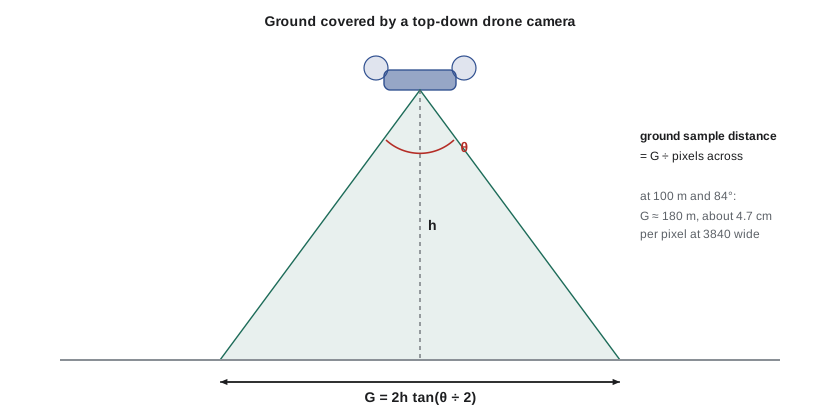
When a drone camera looks straight down, the width of ground it covers depends on the altitude and the horizontal angle of view.
G is the ground width covered, h the height above ground, θ the horizontal angle of view and N the number of horizontal pixels.
Worked problem
Coverage of a top-down shot
A drone flies at 100 m (about 330 ft) above a field, looking straight down. The camera's horizontal angle of view is 84° and it records 3840 pixels across. How wide is the ground covered, and what is the ground sample distance?
Show solution
- Half-angle: 42°; tan 42° ≈ 0.900.
- Ground width: 2 × 100 × 0.900 = 180 m.
- Ground sample distance: 180 ÷ 3840 ≈ 0.047 m, about 4.7 cm per pixel.
Answer: The frame covers about 180 m of ground, with each pixel representing about 4.7 cm. To show a person clearly from directly above, fly lower or use a narrower lens.
Wind and speed
Wind affects drones much more than helicopters.
- Ground speed equals air speed plus or minus the wind component; a drone flying into a strong headwind may barely move over the ground and drain its battery quickly.
- Gusts disturb the gimbal and the framing; long lenses make this worse.
- Manufacturers publish maximum wind resistance figures, but teams usually set lower limits for filming.
- Wind near buildings, cliffs and trees is turbulent and unpredictable.
Worked problem
Timing a move into wind
A drone can fly at 15 m/s air speed while filming smoothly. The shot needs a 600 m pass into a steady headwind of 6 m/s, and then the drone must return downwind. How long does each leg take, and what is the round trip?
Show solution
- Into wind: ground speed 15 − 6 = 9 m/s; time 600 ÷ 9 ≈ 67 s.
- Downwind: ground speed 15 + 6 = 21 m/s; time 600 ÷ 21 ≈ 29 s.
- Round trip: about 96 s, plus time for turns, take-off and landing.
Answer: About 67 seconds out and 29 seconds back, roughly 1.6 minutes for the pass. Repeated takes into wind use flight time quickly.
FPV cinematography
First-person-view drones are flown with video goggles that show the pilot the camera view, letting them fly fast, close and acrobatically: diving down buildings, threading through windows, chasing athletes and cars. FPV shots have become popular in action films, sports and commercials.
- FPV pilots are highly skilled specialists, often from drone racing or freestyle backgrounds.
- Most FPV craft have no gimbal; stabilization is done in software or in post, and framing depends on the pilot's flying.
- Goggles mean the pilot cannot see the drone directly, so rules usually require a visual observer and specific approvals.
- FPV flights near actors or crew need careful risk assessment, rehearsals and protective measures.
FPV is expressive but hard to control precisely. Plan exact paths, rehearse at low speed and cover the moment with other cameras.
The drone team on set
A professional drone team works within the camera department and the safety system.
- Pre-production: shot planning, site surveys, airspace checks, permits and risk assessments.
- Daily briefing: shots, hazards, flight boundaries, emergency procedures and radio channels.
- Pre-flight checks: aircraft, propellers, batteries, firmware, compass and positioning systems, control links and camera settings.
- Exclusion zones: areas around take-off and landing points and under the flight path cleared of uninvolved people.
- Logs: flight times, battery cycles, incidents and maintenance.
- Coordination: the first AD integrates drone shots into the schedule and calls "drone up" and "drone down" so everyone knows when the aircraft is flying.
Data and look
Drone footage must match the rest of the film.
- Record in a log or raw format with the same colour pipeline as the main cameras when possible.
- Match frame rates and shutter, using ND filters to hold a 180° shutter in daylight.
- Avoid over-sharpening and heavy noise reduction from small integrated cameras.
- Check rolling-shutter artefacts and propeller shadows in the frame.
Common mistakes
MistakePlanning drone shots with the full battery capacity
InsteadPlan flights using usable energy with a landing reserve, and reduce estimates for cold, wind and aggressive flying
MistakeUsing a long lens on a light drone in gusty wind
InsteadChoose wide and medium lenses, set lower wind limits and use heavier, more stable platforms for long-lens work
MistakeHaving one person fly and frame a complex move
InsteadSplit the roles between a pilot and a camera operator, with a visual observer
MistakeBringing too few battery sets and chargers
InsteadCalculate flights per day, charging and cooling time, and add spares, especially in cold weather
MistakeLetting FPV pilots improvise near people
InsteadPlan paths, rehearse at low speed, set exclusion zones and secure the required approvals
Summary and key terms
- Camera drones range from small integrated craft to heavy-lift cinema drones, FPV craft and tethered systems.
- Gimbals stabilize cinema cameras but limit payload and lens choice; every gram reduces flight time.
- Professional teams split pilot, camera operator and visual observer roles.
- Flight time is about usable battery energy divided by power draw, often only 10 to 25 minutes for cinema drones.
- Top-down coverage is G = 2h tan(θ/2), and ground sample distance is G divided by the pixels across.
- Wind changes ground speed and stability and uses flight time quickly.
- FPV drones create immersive fast moves but need specialist pilots, rehearsals and approvals.
- Gimbal
- A motorized mount that stabilizes a camera on two or three axes
- Heavy-lift drone
- A drone able to carry a full cinema camera and lens, typically weighing 10 to 25 kg at take-off
- FPV
- First-person view, flying a drone with goggles that show the camera view
- Usable fraction
- The share of battery energy used before landing with a planned reserve
- Ground sample distance
- The ground width represented by one pixel in a top-down image
- Visual line of sight
- Being able to see the drone directly with unaided eyes while it flies
- Lost-link procedure
- The planned automatic behaviour of a drone when its control link fails
- Exclusion zone
- An area cleared of uninvolved people during drone take-off, landing and flight
- Air speed
- The drone's speed relative to the air
- Ground speed
- The drone's speed over the ground, equal to air speed plus or minus the wind
Practice problems
Work each problem on paper first, then reveal the answer to check.
A drone has 400 Wh of batteries, lands with 20 % left and draws 1,600 W. What is its flight time?
Show answer
400 × 0.8 ÷ 1,600 = 0.2 h = 12 minutes
A camera with an 80° horizontal angle flies at 60 m looking down. How wide is the ground covered?
Show answer
2 × 60 × tan 40° ≈ 2 × 60 × 0.839 ≈ 101 m
If 101 m is covered by 3840 pixels, what is the ground sample distance?
Show answer
About 2.6 cm per pixel
A drone at 12 m/s air speed flies into a 4 m/s headwind. What is its ground speed?
Show answer
8 m/s
Why do cinema drone teams split the pilot and camera operator roles?
Show answer
So the pilot can focus on safe flight while the operator concentrates on framing
Name two things checked before every flight.
Show answer
Any two of aircraft, propellers, batteries, firmware, compass and positioning, control links and camera settings
Why do FPV pilots usually need a visual observer?
Show answer
They wear goggles and cannot see the drone directly, so someone must watch the airspace and surroundings
Why might a long lens be a poor choice on a light drone?
Show answer
Long lenses magnify vibration and wind buffeting
What causes rolling-shutter artefacts in drone footage?
Show answer
Fast movement or vibration while the sensor reads out line by line
How can a drone team keep a 180° shutter in bright daylight?
Show answer
Use ND filters to reduce exposure
Lesson quiz · 5 questions
Score 60% or more to complete this lesson.
Create a free account to save your progress, take quizzes and earn a certificate.