
CINE-220 · Lesson 4 of 12 · 25 min
LED fixtures
Light-emitting diodes have transformed set lighting more than any technology since the HMI. In little more than a decade, LED fixtures went from dim, green-tinged panels to powerful, colour-accurate lights that can produce any colour temperature, saturated colours, effects and cues at the touch of a tablet, while drawing a fraction of the power of tungsten and running cool. Most productions now light largely or entirely with LEDs. This lesson covers how LEDs produce light, colour mixing systems from bi-colour to RGBWW and beyond, the main LED fixture types, output and efficiency, colour quality and metrics, dimming and pulse-width modulation, LED-specific issues, battery power, and choosing LED fixtures.
How LEDs produce light
An LED is a semiconductor that emits light when current flows through it. A single LED emits a narrow band of wavelengths determined by its materials: red, green, blue, amber and others. White LEDs usually combine a blue LED with a phosphor coating that absorbs some blue light and re-emits it as a broad yellow-green-red band, producing white light whose colour temperature depends on the phosphor. LEDs are far more efficient than tungsten, with modern white LEDs producing well over 100 lumens per watt at the chip level, though fixture efficiency is lower after optics, electronics and cooling. LEDs produce little heat in the beam, but the chips themselves generate heat that must be removed by heat sinks and fans, and their output and colour change as they heat up, so good fixtures manage temperature carefully.
Colour mixing systems
LED fixtures produce white and coloured light in several ways:
- Single-colour fixtures use white LEDs of one colour temperature, such as 5,600 K or 3,200 K, with high colour quality and output but no colour adjustment.
- Bi-colour fixtures combine warm and cool white LEDs, mixing them to produce any colour temperature in a range such as 2,700 to 6,500 K. They are simple and accurate but cannot produce saturated colours, and output may drop in the middle of the range.
- RGB fixtures mix red, green and blue LEDs, producing saturated colours but poor white light, because the spectrum has large gaps.
- RGBW, RGBA and RGBWW fixtures add white, amber or warm and cool white LEDs, improving white light quality while keeping colour flexibility.
- Multi-emitter fixtures, using five to seven or more LED colours, such as red, green, blue, amber, cyan, lime and white, offer the widest gamut, high-quality whites at any colour temperature, adjustable green-magenta tint, and colour modes that emulate gels, tungsten, HMI and daylight spectra.
Advanced fixtures let users choose a colour temperature and tint, enter coordinates on a colour chart, select a gel by its manufacturer name and number, or emulate light sources such as candle, fire or specific street lights. Some fixtures offer source matching modes that reproduce the spectrum of tungsten or daylight more closely, improving rendering of skin and fabrics.
| LED type | Whites | Saturated colours | Typical use |
|---|---|---|---|
| Single colour (daylight or tungsten) | Excellent, fixed | None | Workhorse keys, high output |
| Bi-colour | Good, adjustable | None | Interviews, run-and-gun, general lighting |
| RGB | Poor | Strong | Effects, backgrounds, events |
| RGBWW / RGBACL multi-emitter | Very good, adjustable with tint | Wide range | Feature and TV lighting, colour work |
LED fixture types
LED fixtures come in many forms, often replacing traditional sources:
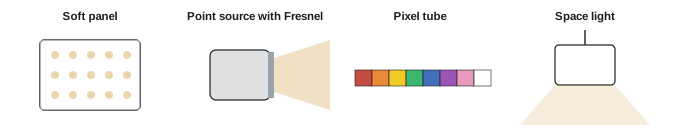
- Panels and soft lights: flat or curved arrays, from small on-camera panels to large panels such as the Arri SkyPanel series, producing soft, even light, often with diffusion, honeycomb grids and soft boxes.
- LED Fresnels and point sources: single powerful chip arrays behind a Fresnel lens or reflector, producing hard light like a tungsten or HMI Fresnel, with spot-flood control. Monolight-style point sources with Bowens mounts, from companies such as Aputure, Nanlite, Godox and others, accept a wide range of modifiers.
- Tubes: battery-powered LED tubes, such as those from Astera, Quasar Science and others, with pixel-controllable segments, used as practicals, hidden in sets, for effects and in arrays.
- Space lights and overhead sources: LED replacements for tungsten space lights, and large modular panels and tiles that create soft overhead light over big sets.
- Ellipsoidals and moving lights: LED ellipsoidals for accents and patterns, and automated moving-head fixtures, borrowed from concerts, which pan, tilt, zoom and change colour remotely.
- LED walls and volumes: large video walls used as backgrounds and light sources in virtual production, discussed in CINE-302.
Output and efficiency
LED fixtures vary greatly in output. A large LED panel might draw about 400 to 800 watts and produce output comparable to a 2 to 4 kW tungsten soft light; powerful LED point sources of 1,000 to 2,000 watts rival 2.5 to 4 kW HMIs in some configurations, though the largest HMIs remain more powerful. Efficiency in lumens per watt is typically two to five times that of tungsten, depending on colour mode: saturated colours and some colour temperatures produce less output than the fixture's best white, and full-spectrum emulation modes may sacrifice output for quality. Manufacturers publish photometric data showing illuminance at given distances for each mode, which is the best basis for comparison (Lesson 5). LEDs also need no colour correction gels to switch between daylight and tungsten balance, avoiding the light loss that gels cause.
Colour quality and metrics
Because LED spectra can be uneven, colour quality varies widely. A light may look white to the eye but render skin grey or magenta on camera, or make fabrics change colour. Several metrics help evaluate colour quality:
- CRI (Colour Rendering Index, Ra): compares how a light renders eight pastel test colours with a reference source. It is widely quoted but limited, since it ignores saturated colours and was designed for the human eye.
- R9: the CRI value for a saturated red, important for skin tones; inexpensive LEDs often score poorly on R9.
- TLCI (Television Lighting Consistency Index): developed by the European Broadcasting Union to predict how a light will look on a camera after colour correction, on a scale to 100.
- TM-30 (IES TM-30): a newer standard giving fidelity (Rf) and gamut (Rg) scores across 99 colour samples.
- SSI (Spectral Similarity Index): developed by the Academy of Motion Picture Arts and Sciences, comparing a light's spectrum directly with a reference such as tungsten or daylight on a scale to 100, a useful predictor of how similar the light will look across different cameras.
For film and television work, look for CRI and TLCI of 95 or higher, R9 values above 90, and good SSI values relative to the chosen reference. Spectrometers measure these values on set.
Worked problem
Comparing two LED panels
A gaffer compares two bi-colour panels at 5,600 K. Panel A: CRI 96, R9 92, TLCI 97, SSI (D56) 78. Panel B: CRI 92, R9 45, TLCI 85, SSI (D56) 62. Which is better for close-ups of faces?
Show solution
- R9, the saturated red that matters for skin, is much higher in Panel A (92 versus 45).
- TLCI, predicting appearance on camera, is higher in Panel A (97 versus 85).
- SSI, similarity to a daylight reference spectrum, is higher in Panel A.
- Panel B may render skin slightly grey or green on camera and require more correction.
Answer: Panel A, with higher R9, TLCI and SSI, will render skin more accurately.
Dimming and pulse-width modulation
LEDs can be dimmed smoothly to very low levels without changing colour temperature, a major advantage over tungsten and HMI. Fixtures dim either by reducing current (constant current reduction) or by pulse-width modulation (PWM), switching the LEDs on and off rapidly and varying the proportion of time they are on. If the PWM frequency is too low, cameras can record flicker or rolling bands, especially at high frame rates, high shutter speeds or with rolling-shutter sensors. Professional fixtures use high PWM frequencies, often tens of kilohertz, or offer selectable frequencies to avoid interference with specific cameras and frame rates. Dimming curves, linear, square law, S-curve or tungsten emulation, can be selected on many fixtures so that dimming feels natural to operators.
LED-specific issues
LEDs bring their own challenges. Multiple-emitter fixtures can produce coloured shadows or fringes when the emitters are not well mixed, especially close up; good optics and diffusion reduce this. Cheap fixtures may flicker, shift colour as they warm up, or vary between units of the same model. Fans can be noisy for dialogue recording; most professional fixtures offer quiet or passive cooling modes, sometimes with reduced output. LED colour may differ between firmware versions, so productions often update all fixtures to the same version. Saturated LED colours, particularly deep blues and violets, may fall outside cameras' colour gamuts and render unpredictably (CINE-202). And because LEDs make colour so easy to change, there is a temptation to overuse coloured light; restraint and motivation (CINE-221) still matter.
Battery power
Many LED fixtures run on batteries, such as V-mount or Gold-mount camera batteries or built-in batteries in tubes and small panels. Battery operation removes cables, speeds up setup and makes lighting possible in places without power, such as cars, forests and rooftops. Battery capacity is rated in watt-hours: a 98 Wh battery powering a 100 W fixture lasts just under an hour, less in cold weather. Larger fixtures can run from portable power stations and battery-powered distribution systems, which are increasingly used to replace small generators on location, reducing noise and emissions. Lithium-ion batteries must be stored, charged and transported safely, following airline rules for travel (CINE-201).
Choosing LED fixtures
When choosing LED fixtures for a production, consider output at the distances and colour modes you need; colour quality metrics measured by independent tests; colour flexibility, from bi-colour to full colour; beam quality and the modifiers available; size, weight and rigging options; power requirements and battery options; noise; control options such as DMX, wireless and apps (Lesson 7); flicker performance at the frame rates you plan to use; and reliability and rental availability. Testing candidate fixtures on camera, with skin tones and colour charts, reveals differences that specifications hide.
LED tubes and pixel effects
Battery-powered LED tubes have become one of the most versatile tools on modern sets. They can be hidden behind furniture, taped inside cars, hung in rows as overhead sources, built into practical fixtures, or used visibly as stylized elements in the frame. Pixel-controllable tubes allow each segment to display a different colour and intensity, creating effects such as passing car headlights, flickering firelight, police lights, the glow of a television, or a train moving past a window. Effects can be programmed on a console, triggered from an app, or driven by video content mapped onto the pixels, synchronizing light with screens or virtual backgrounds.
Overhead LED sources
Large overhead LED sources have replaced many traditional space lights and soft boxes. Modular panels, tiles and soft boxes hung over sets provide soft, even top light that can be dimmed and recoloured instantly, allowing a set to change from daylight to dusk to night without rerigging. Some productions build ceilings of LED fixtures controlled as a single canvas, with zones that can be brightened or warmed to suggest windows, lamps or skylights. The power efficiency of LEDs makes such large installations practical where tungsten equivalents would require enormous power and cooling.
Mixing LED brands
Productions often use LED fixtures from several manufacturers. Although each may be set to the same colour temperature, their spectra differ, and they can look different on camera, particularly on skin and saturated fabrics. Gaffers test fixtures side by side on camera before production, choose one family for faces where possible, and adjust tint and colour temperature on each fixture to match, noting the settings in the lighting documentation.
Common mistakes
MistakeJudging LEDs by CRI alone.
InsteadCheck R9, TLCI, TM-30 and SSI and test on camera.
MistakeUsing RGB-only fixtures for skin.
InsteadUse RGBWW or multi-emitter fixtures for white light on faces.
MistakeIgnoring PWM flicker at high frame rates.
InsteadTest flicker and select high PWM frequencies.
MistakeMixing fixtures with different firmware.
InsteadUpdate fixtures to the same version.
MistakeOverusing saturated colour because it is easy.
InsteadUse colour with motivation and restraint.
Summary and key terms
- LEDs produce light efficiently with cool beams but need thermal management.
- Colour systems range from single-colour to multi-emitter fixtures.
- LED fixture types include panels, Fresnels, tubes, space lights and moving lights.
- Output varies with mode; compare photometric data.
- CRI, R9, TLCI, TM-30 and SSI describe colour quality.
- LEDs dim without colour shift, but PWM can cause flicker.
- Batteries free LEDs from cables; choose fixtures by testing on camera.
- LED
- Light-emitting diode.
- Phosphor-converted LED
- Blue LED with phosphor producing white light.
- Bi-colour
- Fixture mixing warm and cool white LEDs.
- RGBWW
- Red, green, blue plus warm and cool white emitters.
- Multi-emitter
- Fixture with many LED colours for wide gamut and quality whites.
- R9
- CRI value for saturated red.
- TLCI
- Television Lighting Consistency Index.
- TM-30
- IES colour rendition method with fidelity and gamut scores.
- SSI
- Spectral Similarity Index comparing spectra with a reference.
- PWM
- Pulse-width modulation dimming.
Practice problems
Work each problem on paper first, then reveal the answer to check.
How do most white LEDs produce white light?
Show answer
A blue LED with a phosphor coating.
What can bi-colour fixtures not produce?
Show answer
Saturated colours.
Why is RGB poor for white light?
Show answer
Its spectrum has large gaps.
Name three LED fixture types.
Show answer
Panels, Fresnels, tubes, space lights, moving lights.
Why does output vary by mode?
Show answer
Colours and emulation modes use emitters less efficiently.
What does R9 measure?
Show answer
Rendering of saturated red.
Who developed SSI?
Show answer
The Academy of Motion Picture Arts and Sciences.
What target values suit film work?
Show answer
CRI and TLCI of 95 or more, R9 above 90.
What causes LED flicker on camera?
Show answer
Low-frequency PWM dimming.
Run time of a 98 Wh battery on a 60 W fixture?
Show answer
About 1.4 hours.
Lesson quiz · 5 questions
Score 60% or more to complete this lesson.
Create a free account to save your progress, take quizzes and earn a certificate.