
CINE-220 · Lesson 3 of 12 · 25 min
HMI and other discharge fixtures
When cinematographers need large amounts of daylight-balanced light, to light a set through windows, fill shadows on a sunny exterior or simulate the sun on a stage, they have long turned to HMI lights. HMIs produce three to four times more light per watt than tungsten, at a colour temperature close to daylight, and in very large sizes. Although LEDs now replace HMIs in many roles, the largest and punchiest daylight sources on most productions are still HMIs. This lesson covers how HMI lamps work, ballasts and flicker, HMI fixture types, colour and its variation, efficiency and output, striking and restriking, safety including ultraviolet radiation and high voltage, other discharge sources such as fluorescents and plasma, and when to choose HMIs.
How HMI lamps work
HMI stands for hydrargyrum medium-arc iodide: hydrargyrum is the Latin name for mercury. An HMI lamp produces light from an electric arc between two electrodes inside a quartz globe containing mercury vapour and metal halide salts. The arc excites the gases, which emit light at many wavelengths that together approximate daylight. Unlike a filament, an arc cannot run directly from mains power: it needs a ballast, an electronic or magnetic device that provides a very high voltage pulse to strike the arc and then regulates the current. HMI lamps were developed by Osram in the late 1960s for German television, and they became widely used in film production through the 1970s and 1980s.
Ballasts and flicker
Early HMIs used magnetic ballasts, which supplied alternating current at the mains frequency. Because the arc's brightness rises and falls with each half-cycle, magnetic-ballast HMIs flicker at twice the mains frequency, 120 times per second in North America and 100 times per second in 50 Hz regions. Filming with them requires frame rates and shutter speeds that integrate whole cycles of flicker, such as 24 fps with a 144-degree shutter or 30 fps with a 180-degree shutter in North America, or "safe" combinations at 25 fps elsewhere, and crystal-controlled camera speeds; off-speed filming causes visible flicker (CINE-201). Electronic ballasts, now standard, drive the lamp with a square wave that is almost constant in brightness, often called flicker-free, allowing any frame rate and shutter angle within the ballast's rated range. Many electronic ballasts offer a high-frequency mode for high-speed photography, sometimes at the cost of more audible noise, and a silent mode with lower output for dialogue scenes. Ballasts also offer dimming, typically from 100 % down to about 50 % of output.
| Ballast type | Flicker | Notes |
|---|---|---|
| Magnetic | Flickers at twice mains frequency | Heavy, robust; safe frame rate and shutter combinations required |
| Electronic (square wave) | Effectively flicker-free | Lighter, dimmable to about 50 %, high-speed modes |
| Electronic (silent mode) | Low flicker, quiet | Reduced output for dialogue scenes |
HMI fixture types
HMIs come in several forms:
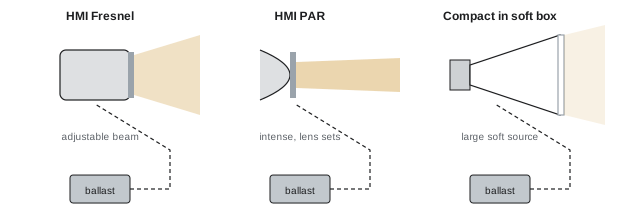
- HMI Fresnels: from 200 W to 24 kW, with the same spot-flood control as tungsten Fresnels, used as hard keys, through-window sources and sun simulation. The 18 kW Fresnel has long been the standard big sun on features.
- HMI PARs: fixtures with a parabolic reflector and interchangeable lenses, producing much more output than Fresnels of the same wattage. Common sizes include 575 W, 1.2 kW, 2.5 kW, 4 kW, 6 kW, 12 kW and 18 kW. They are popular for bouncing, pushing through large diffusion and lighting through windows.
- Hybrid designs, such as the Arri M-series (for example the M18 and M90), use an open-face reflector design that combines high output with a cleaner beam than traditional PARs, and fixtures such as the Joker and Bug-a-Boo series offer compact, versatile HMIs from 200 W to 1.6 kW that can be fitted with lenses or inserted into soft boxes and lanterns.
- Balloon lights and large soft sources, which use HMI or tungsten lamps inside helium-filled or self-supporting balloons to create soft, wide illumination for large night exteriors.
Colour temperature and variation
HMIs are rated at about 5,600 K, but their colour varies. A new lamp often runs cooler and may have a magenta or green bias; as it ages, its colour temperature drops and its tint shifts, often toward green. Colour also changes with the ballast, the lamp model, the voltage and when dimmed: dimming an HMI typically makes it cooler and bluer, the opposite of tungsten. Because several HMIs on a set may differ slightly, gaffers measure each with a colour meter and correct with small amounts of colour correction gel, such as quarter CTO or quarter minus green, so that they match each other and the cinematographer's chosen balance. HMI spectra are discontinuous, with peaks at certain wavelengths, but good lamps achieve CRI values above 90.
Efficiency and output
HMIs typically produce about 85 to 108 lumens per watt, three to four times the efficiency of tungsten. A 4 kW HMI PAR can therefore produce light comparable to a 12 to 16 kW tungsten unit while drawing a quarter of the power. This efficiency made HMIs indispensable for location shooting, where generator capacity is limited, and for daylight work, where correcting tungsten with blue gel would waste most of its output. Fixture output in lux at a given distance, rather than wattage alone, is the best way to compare lights (Lesson 5).
Worked problem
Replacing a corrected tungsten unit with an HMI
A gaffer needs a daylight-balanced source through a window. A 10 kW tungsten Fresnel with full CTB loses about 1.5 stops. How much tungsten-equivalent output remains, and how would a 4 kW HMI Fresnel compare in power use?
Show solution
- 1.5 stops is a factor of \(2^{1.5} \approx 2.8\), so the 10 kW unit gives the light of about 3.5 kW of uncorrected tungsten.
- A 4 kW HMI produces roughly 3.5 times the light of a 4 kW tungsten unit, comparable to about 12–14 kW of tungsten, without gel.
- The HMI therefore gives about three to four times more daylight-balanced light while drawing 4 kW instead of 10 kW.
Answer: The corrected 10K delivers only about 3.5 kW-equivalent; a 4 kW HMI gives much more daylight output at less than half the power.
Striking and restriking
HMIs take time to reach full output after being switched on, typically one to three minutes, during which colour and brightness stabilize. Most traditional HMIs cannot be restruck immediately after being switched off, because the hot lamp has high gas pressure and needs several minutes to cool; hot restrike ballasts allow immediate restriking for some fixtures, but repeated hot restrikes shorten lamp life. On set, electricians therefore keep HMIs running between takes rather than switching them off, and use flags, blackwrap or the ballast's dimming to control them. Lamps have rated lives of a few hundred to a few thousand hours and should be replaced before they fail, since failed lamps can rupture.
Safety
HMIs involve several specific hazards. The ballast generates ignition pulses of tens of thousands of volts to strike the lamp, so head cables, connectors and fixtures must be in good condition, connected before switching on, and never opened while powered; safety interlocks prevent the lamp from striking when the lens or door is open. HMI arcs emit ultraviolet radiation, which can cause skin and eye injuries similar to sunburn and welder's flash; the glass lens or UV-filtering safety glass on every HMI must be intact, and fixtures with cracked or missing lenses must not be used. Lamps contain mercury and operate under high pressure; they must be handled with care, allowed to cool, and disposed of as hazardous waste. HMIs and their ballasts also generate heat and should be kept dry and well ventilated; outdoors, ballasts must be protected from rain and placed on insulating mats or stands. Ground-fault protection appropriate for the equipment is essential (Lesson 11).
Fluorescent and other discharge sources
Fluorescent lamps are also discharge sources, using mercury vapour to produce ultraviolet light that excites a phosphor coating on the tube. Kino Flo fixtures, introduced in the late 1980s, made high-frequency, flicker-free fluorescent tubes with daylight and tungsten balanced phosphors a staple of film lighting, prized for their soft, wrapping light, low heat and ease of hiding in sets. Fluorescent tubes in practical fixtures on locations, such as offices and stores, often have poor colour rendering and a green tint, which gaffers correct with minus-green gel on the tubes or plus-green on other lights, or replace with film-quality tubes. Plasma lights, using radio frequency energy to excite a sulphur or metal halide plasma, briefly offered efficient, full-spectrum light. Today, LEDs have largely replaced fluorescents and many discharge sources on set (Lesson 4), but HMIs remain essential for the highest outputs.
When to choose HMIs
HMIs are the best choice when a production needs very high output in daylight balance: a hard sun through windows on a stage, large fills on sunny exteriors, lighting large night exteriors with moonlight effects from cranes, or bounces into big frames that need far more power than LEDs can provide efficiently. They are less suitable when fast, frequent colour changes are needed, when dimming must be smooth over a wide range, when fixtures must be very quiet for intimate dialogue scenes, or when only household power is available. Many productions combine HMIs for big sources with LEDs for everything else, a balance that continues to shift as LED fixtures grow more powerful.
HMI sizes and their uses
Each HMI size has typical roles on set. Small units of 200 W to 1.2 kW act as accents, back lights, hard keys in small spaces and sources inside lanterns and soft boxes. Units of 2.5 kW to 4 kW are versatile workhorses, pushing through 8 × 8 or 12 × 12 frames for soft daylight keys, bouncing into boards and lighting medium windows. Units of 6 kW to 12 kW light large windows, fill sunny exteriors and act as moonlight on night exteriors from lifts. The largest units, 18 kW and 24 kW, simulate direct sunlight through windows on stages and light large areas at night. Lighting plans often specify HMIs by size and accessories, such as "a 4K PAR through a 12 × 12 grid cloth" or "an 18K through the windows with half CTO".
HMI lenses and accessories
HMI PARs come with sets of spread lenses that change the beam from very narrow to wide, sometimes called super spot, spot, medium flood and wide flood, and frosted lenses that soften the beam. Choosing the lens determines how far the light can throw and how much area it covers. Fresnel HMIs use spot-flood like tungsten Fresnels. Accessories include barn doors, scrims, snoots, gel frames, chimeras and lanterns for soft light, and specialized speed rings for attaching soft boxes. Because HMIs run hot, gel and diffusion must be heat-resistant and kept at safe distances.
HMIs on location
On location, HMIs are often placed outside windows on stands, scaffolding or lifts, with ballasts on the ground and long head cables. Rain covers, ballast stands and ground-fault protection protect equipment and crew. HMIs placed outside also need security, since they are valuable and attract attention. When a scene requires the look of sunlight streaming into a room, one or two large HMIs outside can provide consistent "sun" all day, removing dependence on the weather, a technique so common that real sunlight is often only a reference.
The future of HMIs
LED technology continues to advance, and powerful LED Fresnels and point sources now replace HMIs up to several kilowatts in many applications. Large HMIs remain unmatched for raw output in some situations, but productions increasingly choose LEDs for their colour control, silence and power efficiency. Knowledge of HMIs remains essential, however, because they are still standard on many sets and in rental inventories worldwide.
Common mistakes
MistakeFilming off-speed with magnetic-ballast HMIs.
InsteadUse electronic flicker-free ballasts or safe combinations.
MistakeOperating HMIs with cracked or missing lenses.
InsteadRemove them from service to prevent UV exposure.
MistakeSwitching HMIs off between takes.
InsteadKeep them running and control light with flags or dimming.
MistakeAssuming all HMIs match in colour.
InsteadMeter each lamp and correct with small gels.
MistakeLeaving ballasts exposed to rain.
InsteadProtect ballasts and use ground-fault protection.
Summary and key terms
- HMIs produce daylight-balanced light from a metal halide arc.
- Ballasts strike and regulate the arc; electronic ballasts are flicker-free.
- HMIs come as Fresnels, PARs, hybrids, compacts and balloons.
- Colour varies with age, ballast and dimming; meter and correct each lamp.
- HMIs are three to four times more efficient than tungsten.
- Warm-up and restrike delays affect set practice.
- UV, high voltage, mercury and moisture require strict safety practices.
- HMI
- Hydrargyrum medium-arc iodide discharge lamp.
- Ballast
- Device that strikes and regulates a discharge lamp.
- Flicker-free
- Ballast output with effectively constant brightness.
- Square wave
- Electronic ballast waveform reducing flicker.
- Head cable
- Cable connecting a ballast to its lamp head.
- Hot restrike
- Restarting a hot discharge lamp immediately.
- UV radiation
- Ultraviolet light emitted by arc lamps.
- HMI PAR
- HMI fixture with a parabolic reflector and lenses.
- Kino Flo
- Brand of high-frequency fluorescent film fixtures.
- Minus green
- Magenta gel that removes green from light.
Practice problems
Work each problem on paper first, then reveal the answer to check.
What does HMI stand for?
Show answer
Hydrargyrum medium-arc iodide.
Why does an HMI need a ballast?
Show answer
To strike and regulate the arc.
At what rate do magnetic-ballast HMIs flicker in North America?
Show answer
120 times per second.
What is the advantage of electronic ballasts?
Show answer
Flicker-free operation at many frame rates.
What does dimming an HMI do to its colour?
Show answer
Makes it cooler and bluer.
Approximate HMI efficiency?
Show answer
About 85–108 lumens per watt.
Why keep HMIs running between takes?
Show answer
Warm-up and restrike delays.
Why must HMI lenses be intact?
Show answer
They block harmful UV radiation.
How are green fluorescent practicals corrected?
Show answer
Minus-green gel on tubes or plus-green on other lights.
When are HMIs the best choice?
Show answer
Very high daylight output such as sun through windows.
Lesson quiz · 5 questions
Score 60% or more to complete this lesson.
Create a free account to save your progress, take quizzes and earn a certificate.