
CINE-201 · Lesson 4 of 12 · 26 min
Sensor sizes, formats and aspect ratios
The physical size of the sensor is one of the most consequential choices in a camera package. It determines which lenses can be used, what field of view a given focal length produces, how much of the scene falls into shallow focus, how the image renders perspective at a given framing, and, together with the photosite design, how much light the sensor collects. Sensor sizes for motion pictures range from the 2/3-inch sensors of broadcast cameras to large-format sensors bigger than a 35 mm still frame. This lesson explains the common formats and their origins, crop factors and equivalence, the effects of sensor size on depth of field and noise, lens coverage, aspect ratios, and anamorphic and open-gate capture.
Where the formats come from
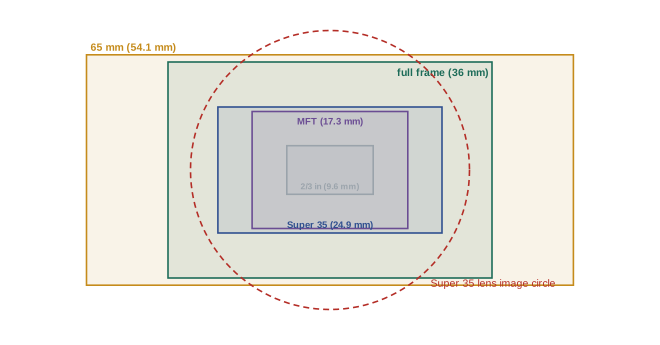
Digital cinema formats inherit their names and sizes from film. Standard 35 mm motion picture film runs vertically through the camera, with the image four perforations tall; its "Academy" aperture of about 22 × 16 mm was the standard for decades. Super 35 extended the image into the area once reserved for the soundtrack, giving a frame about 24.9 mm wide, and became the reference size for digital cinema sensors, often simply called "Super 35" or "S35". Still photography's 35 mm format ran the film horizontally with an image 36 × 24 mm, the "full-frame" size, and the motion picture VistaVision format did the same, with an eight-perforation horizontal frame. Larger formats, such as 65 mm film used for epics and IMAX, have their digital counterparts in large-format sensors. Smaller formats, such as 16 mm and Super 16, correspond roughly to the sensors of some compact cameras.
| Format | Approximate active size (mm) | Diagonal (mm) | Crop factor (vs full frame) | Typical cameras |
|---|---|---|---|---|
| 2/3-inch broadcast | 9.6 × 5.4 | 11 | 3.9 | Broadcast and studio cameras |
| Micro Four Thirds | 17.3 × 13.0 | 21.6 | 2.0 | Panasonic and Blackmagic compact cameras |
| Super 35 (16:9) | 24.9 × 14.0 | 28.6 | 1.5 | Many cinema cameras |
| APS-C | About 23.5 × 15.6 | 28.2 | 1.5 | Mirrorless and DSLR cameras |
| Full frame | 36 × 24 | 43.3 | 1.0 | Large-format cinema and mirrorless cameras |
| ARRI LF | 36.7 × 25.5 | 44.7 | 0.97 | ALEXA LF and Mini LF |
| 65 mm digital | 54.1 × 25.6 | 59.9 | 0.72 | ALEXA 65 |
Crop factor and field of view
A lens of a given focal length projects an image of a given size; a smaller sensor captures only the central part of it, giving a narrower field of view. The crop factor is the ratio of a reference format's diagonal, usually full frame (43.3 mm), to the sensor's diagonal. Multiplying a lens's focal length by the crop factor gives the focal length that would produce the same field of view on the reference format. Cinematographers trained on Super 35 often use it as their own reference, in which case full frame has a "crop factor" of about 0.67 relative to Super 35.
Field of view itself depends on sensor width and focal length: the horizontal angle of view is \(2\arctan(w / 2f)\), where \(w\) is the sensor width. A 35 mm lens on a Super 35 sensor 24.9 mm wide gives a horizontal angle of about 39°; on a full-frame sensor 36 mm wide it gives about 54°.
Depth of field and equivalence
Depth of field, the range of distances that appear acceptably sharp, depends on the aperture, the focal length, the subject distance and the acceptable blur, which scales with sensor size. When a larger sensor is used with a longer lens to keep the same framing from the same position, the depth of field at the same f-number becomes shallower. The concept of equivalence captures this: to produce the same field of view and the same depth of field, both the focal length and the f-number scale by the crop factor.
Worked problem
Equivalent settings between formats
A shot is designed on a Super 35 camera (crop factor 1.5 relative to full frame) with a 50 mm lens at T2.8. What lens and stop on a full-frame camera would give the same field of view and depth of field from the same position?
Show solution
- Equivalent focal length: 50 × 1.5 = 75 mm.
- Equivalent stop for depth of field: 2.8 × 1.5 ≈ 4.2, roughly T4.
- At T4 on full frame, each photosite in an equivalent sensor receives less light per unit area, but the larger sensor collects the same total light, so noise in the final image is similar if ISO is raised by about one stop.
Answer: About a 75 mm lens at T4 on full frame. Equivalence means that, for the same framing, depth of field and total light, formats behave similarly; larger formats simply make shallower depth of field easier to achieve.
Equivalence explains a common misunderstanding: large sensors do not have inherently shallow depth of field, but they make shallow depth of field easier to reach with available lenses, and they allow a deep-focus look to be traded for lower noise by stopping down further. Many cinematographers choose large format for its rendering at wide angles and close distances, with a sense of space and separation that some describe as more immersive, while others prefer Super 35 for its deeper focus at practical stops, the wide range of classic lenses designed for it, and easier focus pulling.
Sensor size, light and noise
At the same exposure, that is the same f-number, shutter and scene brightness, light per unit area is the same regardless of sensor size, so a larger sensor collects more total light in proportion to its area. A full-frame sensor has about 2.25 times the area of Super 35, so at the same f-number it collects about 2.25 times as much light, giving better signal-to-noise ratio in the final image, roughly a stop more. If the full-frame camera instead stops down by the crop factor to match depth of field, the advantage disappears. This is equivalence applied to noise, and it explains why larger sensors are associated with cleaner low-light images when shooting wide open.
Lens coverage and image circles
Every lens projects a circular image, its image circle, which must cover the sensor's diagonal. A lens designed for Super 35 typically has an image circle of about 30 to 33 mm, enough for Super 35 but not for full frame, where it would produce dark or soft corners (vignetting). Large-format sensors need lenses with image circles of about 44 mm or more. Many cameras offer recording modes that use only part of the sensor, such as a Super 35 crop on a full-frame camera, allowing Super 35 lenses to be used. Lens coverage charts from manufacturers and rental houses show which lenses cover which camera modes, and cinematographers test coverage, since the edges of an image circle are often softer and darker even where they technically cover the sensor.
Aspect ratios
The aspect ratio is the ratio of image width to height. Common ratios include 1.33:1 (4:3), the historical Academy ratio and older television; 1.78:1 (16:9), the standard for television and streaming; 1.85:1, the common North American theatrical "flat" ratio; 1.90:1, the full DCI 4K container (4096 × 2160); 2.00:1, used by some streaming productions; 2.39:1, the widescreen "scope" ratio; and vertical 9:16 for social media. Productions often record a larger area than the final frame and crop in post, so that framing can be adjusted and versions for different platforms extracted. Frame lines in the viewfinder and monitors show the intended composition.
Anamorphic capture
Anamorphic lenses squeeze the image horizontally, typically by a factor of 2, 1.8, 1.5 or 1.3, so that a wide field of view fits onto a narrower sensor area; the image is unsqueezed in post-production or projection. The classic 2× anamorphic format used a 4:3 area of 35 mm film to produce a 2.39:1 image. Digital cameras support anamorphic with sensor modes close to 4:3 or 6:5 for 2× lenses, and with 16:9 sensors for 1.3× or 1.5× lenses. Beyond the aspect ratio, anamorphic lenses are chosen for their distinctive look: oval out-of-focus highlights, horizontal flares, characteristic distortion and a particular depth-of-field rendering.
Worked problem
Anamorphic squeeze and sensor area
What final aspect ratio results from (a) a 2× anamorphic lens on a 4:3 (1.33:1) sensor area, and (b) a 1.5× anamorphic lens on a 16:9 (1.78:1) sensor area?
Show solution
- (a) 1.33 × 2 = 2.66:1, usually cropped slightly to 2.39:1.
- (b) 1.78 × 1.5 = 2.67:1, also cropped to 2.39:1.
- A 1.3× lens on 16:9 gives 1.78 × 1.3 = 2.31:1, close to 2.39:1 with little cropping.
Answer: About 2.66:1 and 2.67:1 before cropping, each typically framed for 2.39:1.
Open gate and sensor modes
Many cameras offer an open-gate mode that records the full sensor area, often close to 3:2, rather than a 16:9 or 17:9 crop. Open gate gives the most flexibility for reframing, stabilization, anamorphic lenses and extracting multiple aspect ratios, such as a 2.39:1 theatrical version and a 9:16 social version from the same take, at the cost of higher data rates. Other sensor modes trade area for frame rate or data rate, such as windowed modes for high-speed recording. Each mode changes the effective sensor size, and therefore the crop factor, field of view and lens coverage, so the camera team must record which mode was used.
Format and perspective
Perspective, the relative size of near and far objects, depends only on camera position, not on sensor size or focal length. Changing the format changes the focal length needed for a given framing, but if the camera stays in the same position, perspective stays the same. What changes with format is the depth of field at a given f-number and the way lenses of different designs render the image. Many cinematographers feel that large-format images have a distinctive quality, sometimes described as more dimensional, partly because wide-angle lenses for large format can be designed with less distortion and partly because of the shallower depth of field at practical stops.
Focus pulling and format
Shallower depth of field on large formats makes focus pulling harder. A close-up on full frame at T2 may have only a few centimetres of depth of field, so small movements of the actor take them out of focus. Focus pullers use distance measuring devices, careful marks and monitors with focus aids, and cinematographers often stop down slightly on large format to give the focus puller a workable margin. When choosing a format, consider the demands it places on focus and the experience of the focus puller, as well as the look.
Choosing a format for a project
Format choices balance look, lenses and practicality. Super 35 offers an enormous range of classic and modern lenses, deeper focus for ensemble scenes, and smaller, lighter lenses. Full frame and larger formats offer a different rendering, shallower focus where desired and, at the same f-number, cleaner low-light images, but need larger lenses with appropriate coverage and more careful focus. Smaller formats, such as Micro Four Thirds and 2/3-inch, offer deep focus and compact zoom lenses, valuable for documentary, news and live events. Many projects mix formats, such as a large-format main camera with a smaller drone or crash camera, and plan the lenses so that shots intercut well.
Sensor size and lens availability
The range of lenses available for each format, at rental houses and in the market, often settles format choices in practice. Classic Super 35 cinema primes and zooms are plentiful, while large-format sets are newer and fewer, though growing quickly.
Common mistakes
MistakeAssuming large sensors always give shallow depth of field.
InsteadDepth of field depends on equivalent focal length and stop.
MistakeUsing Super 35 lenses on full frame without checking coverage.
InsteadCheck image circles and test corners.
MistakeForgetting that sensor modes change the crop factor.
InsteadRecord the sensor mode and recalculate field of view.
MistakeFraming only for one aspect ratio when several are needed.
InsteadProtect for all delivery ratios with frame lines.
MistakeComparing noise between formats at the same f-number only.
InsteadConsider equivalent settings for a fair comparison.
Summary and key terms
- Digital formats inherit sizes from film: Super 35, full frame, 65 mm and others.
- Crop factor is 43.3 mm divided by the sensor diagonal.
- Equivalent focal length and f-number scale by the crop factor.
- Larger sensors collect more total light at the same f-number.
- Lenses must have image circles covering the sensor mode used.
- Common aspect ratios include 1.78, 1.85, 2.00 and 2.39:1.
- Anamorphic and open-gate modes change how the sensor area is used.
- Super 35
- Film-derived format about 24.9 mm wide.
- Full frame
- 36 × 24 mm format.
- Large format
- Sensors larger than Super 35, usually full frame or more.
- Crop factor
- Ratio of reference diagonal to sensor diagonal.
- Equivalence
- Matching field of view, depth of field and light across formats.
- Image circle
- Circular area a lens illuminates.
- Vignetting
- Darkening toward the frame edges.
- Aspect ratio
- Width-to-height ratio of the image.
- Anamorphic
- Lens squeezing the image horizontally.
- Open gate
- Recording the full sensor area.
Practice problems
Work each problem on paper first, then reveal the answer to check.
Crop factor of a sensor with a 28.6 mm diagonal?
Show answer
43.3 / 28.6 ≈ 1.5.
Full-frame equivalent of a 25 mm lens on Micro Four Thirds?
Show answer
50 mm.
Horizontal angle of view, 50 mm lens on a 36 mm wide sensor?
Show answer
2 arctan(0.36) ≈ 39.6°.
Equivalent of 35 mm T2 on S35, on full frame?
Show answer
About 52 mm at T3.
How much more light does full frame collect than S35 at the same stop?
Show answer
About 2.25 times.
What happens if a lens's image circle is too small?
Show answer
Dark or soft corners (vignetting).
Name three common aspect ratios.
Show answer
1.78:1, 1.85:1, 2.39:1 (also 2.00:1, 1.33:1).
Aspect ratio of a 2× anamorphic on 6:5 (1.2:1)?
Show answer
2.4:1.
Why shoot open gate?
Show answer
Flexibility for reframing and multiple aspect ratios.
What changes when switching to a S35 crop mode?
Show answer
Crop factor, field of view and required lens coverage.
Lesson quiz · 5 questions
Score 60% or more to complete this lesson.
Create a free account to save your progress, take quizzes and earn a certificate.