
CHEM-263 · Lesson 9 of 12 · 24 min
Carbonyl condensations: aldol and Claisen reactions
▶ Video coming soon A video version of this lesson is on the way.
Lesson 8 made an enolate and gave it an alkyl halide as the electrophile. What happens if the electrophile is another carbonyl compound? The enolate of one molecule attacks the carbonyl carbon of a second, forming a new carbon–carbon bond between the α-carbon of one and the carbonyl carbon of the other. These carbonyl condensation reactions are among the most important ways of building carbon skeletons. With aldehydes and ketones, the reaction is an addition, the aldol reaction, and it gives β-hydroxy carbonyl compounds and, after loss of water, α,β-unsaturated carbonyl compounds. With esters, the reaction is a substitution, the Claisen condensation, and it gives β-keto esters. The difference echoes lesson 1: aldehydes and ketones add, esters substitute. Living cells use both reactions in central metabolism, and synthetic chemists use them to build rings and chains.
The aldol reaction
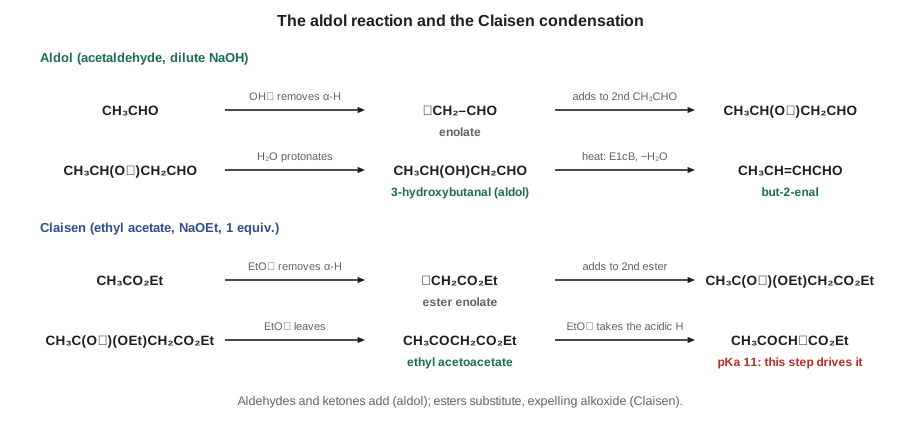
In 1872 Charles-Adolphe Wurtz and, independently, Alexander Borodin, the chemist who is better remembered as a composer, found that acetaldehyde in dilute aqueous base forms 3-hydroxybutanal. Wurtz called the product aldol, from aldehyde and alcohol, and the name has spread to the whole reaction. The mechanism has three steps. Hydroxide removes an α-hydrogen from one acetaldehyde molecule, forming a small equilibrium amount of the enolate. The enolate adds to the carbonyl carbon of a second acetaldehyde molecule, giving an alkoxide. The alkoxide takes a proton from water, regenerating hydroxide. The product, a β-hydroxy aldehyde, has a new C–C bond between the α-carbon of one molecule and the carbonyl carbon of the other.
The aldol addition is reversible. For most aldehydes the equilibrium favours the product, but for ketones it usually favours the starting materials, because the more crowded ketone carbonyl is less electrophilic and the product is more hindered. Acetone gives only a few parts in a hundred of its aldol product, 4-hydroxy-4-methylpentan-2-one, at equilibrium. Retro-aldol reactions, in which a β-hydroxy carbonyl compound breaks into two carbonyl compounds, are equally important, especially in biochemistry.
Dehydration to enones
If the aldol reaction is heated, or run with stronger base or acid, the β-hydroxy carbonyl product loses water to form an α,β-unsaturated carbonyl compound, an enone or enal. 3-Hydroxybutanal gives but-2-enal, also called crotonaldehyde. In base, the dehydration goes by an E1cB mechanism, introduced in CHEM-261 lesson 10: the acidic α-hydrogen is removed first to form an enolate, which then expels hydroxide from the β-carbon. Hydroxide is ordinarily a poor leaving group, but here the conjugated product is stable enough to drive the reaction. Because dehydration removes the product from the reversible aldol equilibrium, it pulls even unfavourable aldol additions of ketones forward. The overall process, aldol addition followed by dehydration, is the aldol condensation; a condensation is any reaction in which two molecules join with loss of a small molecule such as water.
Crossed aldol reactions
If two different carbonyl compounds that both have α-hydrogens are mixed with base, each can act as the nucleophile and each as the electrophile, giving four aldol products, more if dehydration and stereoisomers are counted. Such a mixture is useless. A crossed or mixed aldol reaction is clean only when the partners are chosen so that one can serve only as the electrophile and the other only as the nucleophile.
The usual strategy is to choose an electrophile that has no α-hydrogens and so cannot form an enolate: formaldehyde, benzaldehyde and other aromatic aldehydes, or 2,2-dimethylpropanal. Benzaldehyde is also more electrophilic than a ketone, so it reacts with a ketone enolate faster than the ketone reacts with itself. The reaction of benzaldehyde with acetone in aqueous ethanolic sodium hydroxide, a Claisen–Schmidt condensation, gives benzalacetone or, with two equivalents of benzaldehyde, dibenzalacetone, a yellow solid used in sunscreens. A second strategy, developed in the 1970s and 1980s, is to form the enolate of one partner completely with LDA at −78 °C and then add the other partner, so that only one enolate is ever present.
Worked problem
Planning a crossed aldol condensation
Cinnamaldehyde, C₆H₅CH=CHCHO, is the flavour of cinnamon. Show how it could be made by an aldol condensation, and explain why the reaction gives one main product.
Show solution
- Disconnect the C=C of the enal: the β-carbon (attached to the ring) came from a carbonyl carbon, and the α-carbon from an enolate. The partners are benzaldehyde and acetaldehyde.
- Benzaldehyde has no α-hydrogens, so it can be only the electrophile; acetaldehyde provides the enolate.
- Add acetaldehyde slowly to benzaldehyde and base, so that its enolate meets benzaldehyde more often than another acetaldehyde molecule.
- The aldol product dehydrates readily, because the new C=C is conjugated with both the ring and the C=O, giving (E)-cinnamaldehyde.
Answer: Benzaldehyde + acetaldehyde, NaOH, with slow addition of acetaldehyde; dehydration gives (E)-3-phenylprop-2-enal.
Intramolecular aldol reactions
A molecule with two carbonyl groups can undergo an aldol reaction with itself, forming a ring. Rings of five and six members form easily, much faster than the intermolecular reaction and with little strain. Hexane-2,5-dione in base gives 3-methylcyclopent-2-enone, and heptane-2,6-dione gives 3-methylcyclohex-2-enone. When a dicarbonyl compound could form rings of different sizes, the five- or six-membered ring wins, because smaller rings are strained and larger ones form more slowly; since the aldol is reversible, the more stable product accumulates.
The Robinson annulation, reported by Robert Robinson in 1935, combines two reactions to build a new six-membered ring onto a ketone. First the ketone enolate adds to methyl vinyl ketone in a conjugate addition, called the Michael reaction, at the β-carbon of the enone; then the resulting 1,5-diketone closes by an intramolecular aldol condensation to a cyclohexenone. Robinson annulation was used to build the ring systems of steroids, and Robinson received the 1947 Nobel Prize for his work on natural products.
Conjugate addition: the Michael reaction
The Robinson annulation depends on a property of α,β-unsaturated carbonyl compounds that deserves its own name. Resonance spreads the electrophilic character of the carbonyl carbon to the β-carbon, so nucleophiles can add there, at the end of the conjugated system, in a 1,4- or conjugate addition. Stabilized, weakly basic nucleophiles, such as enolates of 1,3-dicarbonyl compounds, amines, thiolates and organocopper reagents, add at the β-carbon; strongly basic, hard nucleophiles such as Grignard reagents and LiAlH₄ add directly to the carbonyl carbon. The conjugate addition of a carbon nucleophile is the Michael reaction, after Arthur Michael, who described it in 1887.
The Claisen condensation
Esters also have acidic α-hydrogens, and in 1887 Ludwig Claisen found that ethyl acetate treated with sodium ethoxide gives ethyl acetoacetate, CH₃COCH₂CO₂Et. The first two steps mirror the aldol reaction: ethoxide forms a small amount of the ester enolate, which adds to the carbonyl carbon of a second ester molecule. The tetrahedral intermediate, however, carries an ethoxy group, a leaving group, and it collapses to expel ethoxide, giving a β-keto ester. The Claisen condensation is a nucleophilic acyl substitution, the subject of lesson 10, with an enolate as the nucleophile.
The equilibrium for the first three steps actually lies on the side of the starting esters. What drives the Claisen condensation is a fourth step: the β-keto ester product has a CH₂ between two carbonyls with a pKa of about 11, much more acidic than ethanol, so ethoxide removes that proton essentially completely, forming a stabilized enolate. That irreversible deprotonation pulls the whole sequence forward. As a result, the Claisen condensation needs a full equivalent of base, not a catalytic amount, and it fails for esters that have only one α-hydrogen, because their products have no acidic hydrogen left to remove. The neutral β-keto ester is obtained by adding acid at the end.
The base must match the ester. Using sodium methoxide with an ethyl ester would scramble the alkoxy groups by transesterification, and hydroxide would hydrolyse the ester to a carboxylate. So ethyl esters are condensed with sodium ethoxide, methyl esters with sodium methoxide.
Variations parallel those of the aldol reaction. A crossed Claisen condensation works well when one ester has no α-hydrogens, such as ethyl benzoate, ethyl formate or diethyl carbonate. A ketone enolate can attack an ester to give a 1,3-diketone. And the intramolecular version, the Dieckmann condensation, reported by Walter Dieckmann in 1894, closes diesters into five- or six-membered cyclic β-keto esters: diethyl hexanedioate gives ethyl 2-oxocyclopentanecarboxylate. Followed by the hydrolysis and decarboxylation of lesson 8, these routes make cyclic ketones.
| Reaction | Nucleophile | Electrophile | Product |
|---|---|---|---|
| Aldol addition | aldehyde or ketone enolate | aldehyde or ketone | β-hydroxy carbonyl compound |
| Aldol condensation | as above, with heat | aldehyde or ketone | α,β-unsaturated carbonyl compound |
| Claisen–Schmidt | ketone enolate | aromatic aldehyde (no α-H) | aryl enone |
| Intramolecular aldol | enolate of a dicarbonyl | carbonyl in the same molecule | cyclopentenone or cyclohexenone |
| Michael addition | stabilized enolate | α,β-unsaturated carbonyl | 1,5-dicarbonyl compound |
| Robinson annulation | ketone enolate | methyl vinyl ketone | cyclohexenone fused to the ketone |
| Claisen condensation | ester enolate | ester | β-keto ester |
| Dieckmann condensation | ester enolate | ester in the same molecule | cyclic β-keto ester |
Condensations in living cells
Biochemistry is full of aldol and Claisen reactions run by enzymes in water at neutral pH. In glycolysis, the enzyme aldolase splits fructose 1,6-bisphosphate into two three-carbon fragments by a retro-aldol reaction; in photosynthesis and in gluconeogenesis the same enzyme runs the reaction forward. Class I aldolases, found in animals and plants, form an enamine with a lysine side chain instead of an enolate, which avoids the need for a strong base. Class II aldolases, in bacteria and fungi, use a zinc ion as a Lewis acid to stabilize the enolate.
The first step of the citric acid cycle is a Claisen-like condensation in which citrate synthase joins the enolate of acetyl coenzyme A, a thioester, to the ketone of oxaloacetate, forming citrate. Fatty acids are built two carbons at a time by a Claisen condensation of thioesters, the malonyl unit being decarboxylated as it reacts so that loss of CO₂ drives the step. Thioesters are used because their α-hydrogens are more acidic and their carbonyls more reactive than those of oxygen esters, as lesson 10 explains.
Inspired by the class I aldolases, Benjamin List, Richard Lerner and Carlos Barbas reported in 2000 that the amino acid proline catalyses aldol reactions between acetone and aldehydes, giving one enantiomer of the product in excess, through an enamine like the one in the enzyme. In the same year David MacMillan reported a related small-molecule catalyst that works through iminium ions. Their asymmetric organocatalysis, which uses small organic molecules instead of metals or enzymes, earned List and MacMillan the 2021 Nobel Prize in Chemistry.
A program: products, atom economy and crossed aldol counts
import re
MASS = {'C': 12.011, 'H': 1.008, 'O': 15.999, 'N': 14.007}

def parse(f):
    c = {}
    for s, n in re.findall(r'([A-Z][a-z]?)(\d*)', f):
        c[s] = c.get(s, 0) + (int(n) if n else 1)
    return c

def fmt(c):
    return ''.join(f'{e}{c[e] if c[e] > 1 else ""}' for e in ('C', 'H', 'N', 'O') if c.get(e))

def combine(a, b, lose=None):
    c = parse(a)
    for k, v in parse(b).items():
        c[k] = c.get(k, 0) + v
    if lose:
        for k, v in parse(lose).items():
            c[k] -= v
    return c

def mass(c):
    return sum(MASS[k] * v for k, v in c.items())

def atom_economy(product, *reactants):
    return 100 * mass(product) / sum(mass(parse(r)) for r in reactants)

reactions = [
    ('aldol of acetaldehyde', 'C2H4O', 'C2H4O', None),
    ('aldol condensation (loses water)', 'C2H4O', 'C2H4O', 'H2O'),
    ('benzaldehyde + acetaldehyde -> cinnamaldehyde', 'C7H6O', 'C2H4O', 'H2O'),
    ('Claisen: 2 ethyl acetate -> ethyl acetoacetate', 'C4H8O2', 'C4H8O2', 'C2H6O'),
]
for name, a, b, lose in reactions:
    p = combine(a, b, lose)
    print(f'{name:48s} product {fmt(p):9s} atom economy {atom_economy(p, a, b):5.1f} per hundred')

def crossed_aldol_products(a_has_alpha_h, b_has_alpha_h):
    """Count addition products (ignoring stereoisomers): each enolizable partner can
    be a nucleophile; each partner can be an electrophile."""
    nucleophiles = [x for x, h in (('A', a_has_alpha_h), ('B', b_has_alpha_h)) if h]
    return [n + '-enolate + ' + e for n in nucleophiles for e in ('A', 'B')]

for label, flags in (('acetaldehyde + propanal', (True, True)),
                     ('benzaldehyde + acetone', (False, True))):
    prods = crossed_aldol_products(*flags)
print(f'{label:26s} {len(prods)} possible aldol products: {", ".join(prods)}')aldol of acetaldehyde product C4H8O2 atom economy 100.0 per hundred aldol condensation (loses water) product C4H6O atom economy 79.6 per hundred benzaldehyde + acetaldehyde -> cinnamaldehyde product C9H8O atom economy 88.0 per hundred Claisen: 2 ethyl acetate -> ethyl acetoacetate product C6H10O3 atom economy 73.9 per hundred acetaldehyde + propanal 4 possible aldol products: A-enolate + A, A-enolate + B, B-enolate + A, B-enolate + B benzaldehyde + acetone 2 possible aldol products: B-enolate + A, B-enolate + B
The atom economy, the share of reactant mass that ends up in the product, is 100 for the aldol addition, which loses nothing, and drops when water or ethanol is lost; the Claisen condensation wastes about a quarter of its mass as ethanol. Crossed aldol counting shows why partners are chosen with care: two enolizable aldehydes give four products, while benzaldehyde with acetone can give only two, one of which, acetone reacting with itself, is slow compared with attack on the more electrophilic benzaldehyde.
Common mistakes
MistakeThe Claisen condensation needs only a catalytic amount of base.
InsteadA full equivalent is needed, because deprotonation of the β-keto ester product drives the reaction.
MistakeAny two aldehydes give a clean crossed aldol product.
InsteadIf both have α-hydrogens, four products form; one partner should lack α-hydrogens or be preformed as an enolate.
MistakeAldol dehydration is an E2 reaction.
InsteadIn base it is E1cB: the enolate forms first and then expels hydroxide.
MistakeMethyl esters can be condensed with sodium ethoxide.
InsteadThe alkoxide must match the ester to avoid transesterification.
MistakeGrignard reagents add to the β-carbon of enones.
InsteadHard nucleophiles such as RMgX add to the carbonyl carbon; stabilized enolates and cuprates add at the β-carbon.
MistakeIntramolecular aldols give the smallest possible ring.
InsteadThey give five- or six-membered rings, the most stable and fastest-forming.
Summary and key terms
- In the aldol reaction an enolate adds to an aldehyde or ketone to give a β-hydroxy carbonyl compound; the reaction is reversible.
- Heating or strong base dehydrates aldol products by E1cB to conjugated enones, driving the overall condensation.
- Crossed aldols work when one partner has no α-hydrogens or when one enolate is preformed with LDA.
- Dicarbonyl compounds close by intramolecular aldol reactions to five- and six-membered rings; the Robinson annulation combines a Michael addition and an aldol.
- In the Claisen condensation an ester enolate attacks an ester and expels alkoxide; deprotonation of the β-keto ester product drives it, so a full equivalent of matching alkoxide is needed.
- Aldolases, citrate synthase and fatty acid synthase use these reactions; proline and other organocatalysts make them enantioselective.
- Aldol reaction
- Addition of an enolate to an aldehyde or ketone, giving a β-hydroxy carbonyl compound.
- Aldol condensation
- An aldol reaction followed by dehydration to an α,β-unsaturated carbonyl compound.
- Condensation
- A reaction joining two molecules with loss of a small molecule such as water.
- Michael reaction
- Conjugate addition of a carbon nucleophile to the β-carbon of an α,β-unsaturated carbonyl compound.
- Robinson annulation
- A Michael addition followed by an intramolecular aldol, building a cyclohexenone.
- Claisen condensation
- Reaction of an ester enolate with an ester to form a β-keto ester.
- Dieckmann condensation
- An intramolecular Claisen condensation forming a cyclic β-keto ester.
Practice problems
Work each problem on paper first, then reveal the answer to check.
Draw the aldol addition and condensation products of propanal with NaOH.
Show answer
Addition: 3-hydroxy-2-methylpentanal. Condensation: (E)-2-methylpent-2-enal.
Which carbonyl compound gives 3-methylcyclohex-2-enone by an intramolecular aldol condensation?
Show answer
Heptane-2,6-dione: the enolate of the C1 methyl attacks the C6 carbonyl, closing a six-membered ring.
Predict the Claisen condensation product of ethyl propanoate with sodium ethoxide.
Show answer
Ethyl 2-methyl-3-oxopentanoate, CH₃CH₂COCH(CH₃)CO₂Et.
Why does ethyl 2-methylpropanoate, (CH₃)₂CHCO₂Et, fail to undergo a normal Claisen condensation with NaOEt?
Show answer
The product would have no hydrogen between its two carbonyls to remove, so the driving deprotonation step is lost and the equilibrium lies on the side of the starting materials.
Design a crossed Claisen condensation to make ethyl 3-oxo-3-phenylpropanoate, C₆H₅COCH₂CO₂Et.
Show answer
Ethyl benzoate (no α-hydrogens) with ethyl acetate and NaOEt; ethyl acetate supplies the enolate.
What nucleophile and acceptor would a Michael reaction use to make 2-(3-oxobutyl)cyclohexanone?
Show answer
The enolate (or enamine) of cyclohexanone adding to methyl vinyl ketone.
Lesson quiz · 5 questions
Score 60% or more to complete this lesson.
Create a free account to save your progress, take quizzes and earn a certificate.