
CHEM-263 · Lesson 1 of 12 · 24 min
Why carbonyls and aromatics: the chemistry of everyday molecules
▶ Video coming soon A video version of this lesson is on the way.
CHEM-261 built the core of organic chemistry: structure and bonding, the shapes of molecules in three dimensions, acids and bases, curved-arrow mechanisms, substitution and elimination at saturated carbon, and the addition reactions of alkenes and alkynes. This course, the second half of the introduction, applies those ideas to the functional groups that dominate the molecules of everyday life: aromatic rings, alcohols and ethers, aldehydes and ketones, carboxylic acids and their derivatives, and amines. Almost every flavour, fragrance, dye, fibre, plastic, medicine and biological molecule you can name contains at least one of them. Vanillin, the main flavour compound of vanilla, has an aromatic ring, an aldehyde, an ether and a phenol. The polyester in a drink bottle is a chain of aromatic esters. Proteins are long chains of amides, and the sugars in your blood are alcohols and aldehydes that close into rings.
The good news is that you already have most of the tools. A carbonyl group, C=O, is a polar π bond whose carbon is electrophilic, so it reacts with nucleophiles. An aromatic ring is a special kind of conjugated π system that reacts with electrophiles but resists addition. An alcohol is a weak acid and, once converted into a better leaving group, a substrate for substitution and elimination. An amine is a base and a nucleophile because of the lone pair on nitrogen. Each of these statements is an application of ideas from CHEM-261: electronegativity, resonance, pKa, nucleophilicity and the stability of intermediates. This lesson surveys the territory and sets out the four or five ideas that will organize the whole course.
The functional groups of this course
The table below lists the groups we will study and where each appears. Look at how many of them contain oxygen bonded to carbon. Organic chemists often classify these groups by the oxidation level of the carbon that carries the heteroatom, a scheme introduced in CHEM-261 lesson 3. An alcohol carbon has one bond to oxygen (level 1), an aldehyde or ketone carbon has two (level 2, counting the double bond twice), and a carboxylic acid or ester carbon has three (level 3). Moving up a level is an oxidation and moving down is a reduction, so the scheme tells you at a glance which reagents connect two groups.
| Group | Structure | Example and use | Lessons |
|---|---|---|---|
| Arene (aromatic ring) | benzene ring, C₆H₅– | toluene, a solvent; styrene, the monomer of polystyrene | 3, 4 |
| Conjugated diene | C=C–C=C | buta-1,3-diene, a monomer of synthetic rubber | 2 |
| Alcohol | R–OH | ethanol; menthol, the cooling compound of mint | 5 |
| Phenol | Ar–OH | phenol; the antioxidant BHT in food packaging | 3, 5 |
| Ether | R–O–R′ | diethyl ether, a solvent; anisole, a fragrance note | 6 |
| Epoxide | three-membered C–C–O ring | ethylene oxide, made on a huge scale for antifreeze | 6 |
| Thiol and sulfide | R–SH, R–S–R′ | methanethiol, the smell added to natural gas | 6 |
| Aldehyde | R–CHO | vanillin; cinnamaldehyde, the flavour of cinnamon | 7, 8, 9 |
| Ketone | R–CO–R′ | acetone; carvone, the smell of spearmint | 7, 8, 9 |
| Carboxylic acid | R–COOH | acetic acid in vinegar; citric acid | 10 |
| Ester | R–COOR′ | isoamyl acetate, the smell of bananas; fats and oils | 10 |
| Amide | R–CONR′₂ | nylon; the peptide bonds of proteins | 10, 11 |
| Amine | R–NH₂, R₂NH, R₃N | the bases of DNA; many alkaloids | 11 |
Four ideas that organize the course
The first idea is that the carbonyl group is electrophilic at carbon. Oxygen is more electronegative than carbon, and a second resonance form puts a positive charge on the carbon and a negative charge on the oxygen. A nucleophile therefore attacks the carbonyl carbon, pushing the π electrons onto oxygen. What happens next depends on whether the carbonyl carbon carries a leaving group. Aldehydes and ketones have only carbon or hydrogen attached, which cannot leave, so the tetrahedral intermediate is protonated and the result is an addition product: lesson 7. Carboxylic acid derivatives carry a leaving group such as chloride or an alkoxide, so the intermediate collapses and expels it, giving substitution: lesson 10. This one distinction, addition or substitution, organizes most of carbonyl chemistry.
The second idea is that the carbon next to a carbonyl, called the alpha carbon, is acidic. Removing a proton from it gives an enolate ion whose negative charge is shared with the oxygen by resonance. The pKa of the α-hydrogens of acetone is about 19, compared with about 50 for an ordinary alkane C–H. Enolates are nucleophiles, so a carbonyl compound can act as an electrophile at its carbonyl carbon and as a nucleophile at its α-carbon. When one molecule plays each role, the result is a carbon–carbon bond-forming condensation such as the aldol and Claisen reactions of lesson 9, among the most important ways of building carbon skeletons in synthesis and in living cells.
The third idea is aromaticity. A planar ring of p orbitals holding 4n + 2 π electrons, where n is a whole number, is unusually stable. Benzene, with six π electrons, is about 150 kJ/mol more stable than a hypothetical cyclohexatriene with three isolated double bonds. This stability changes the chemistry: alkenes add electrophiles, but benzene substitutes them, keeping its aromatic ring. Lesson 3 explains aromaticity with molecular orbitals and lesson 4 develops electrophilic aromatic substitution and the way existing substituents direct new ones.
The fourth idea is that lone pairs on oxygen and nitrogen make alcohols, ethers and amines nucleophiles and bases, with amines far more basic than alcohols. Nitrogen is less electronegative than oxygen and holds its lone pair less tightly: the conjugate acid of an amine has a pKa near 10, while that of an alcohol has a pKa near −2. Whether a lone pair is available also depends on resonance. The nitrogen lone pair of an amide is delocalized into the carbonyl, so amides are hardly basic at all, and the nitrogen lone pair of pyrrole is part of the aromatic sextet. Recognizing when a lone pair is tied up in resonance is one of the most useful skills you will develop.
A fifth, unifying theme is synthesis. By the end of the course you will know enough reactions to plan the synthesis of moderately complex molecules from simple starting materials, working backward from the target by retrosynthetic analysis, as introduced in CHEM-261 lesson 12. The capstone, lesson 12, puts the course reactions together on targets such as fragrance esters, the monomers of nylon and a ketone found in raspberries.
The carbonyl group up close
Because the carbonyl group is the centre of so much of this course, it is worth looking at its structure carefully. The carbonyl carbon is sp² hybridized and trigonal planar, with bond angles close to 120°. The C=O bond, about 121 pm long in ketones, is shorter and stronger than a C=C bond: its bond energy is about 740 kJ/mol in aldehydes and ketones, compared with about 610 kJ/mol for C=C. The π bond is formed by overlap of a carbon p orbital with an oxygen p orbital, and the oxygen also carries two lone pairs in the plane of the molecule.
The bond is strongly polarized. The dipole moment of acetone is 2.9 D, compared with essentially zero for propene. In resonance terms, a minor contributor puts a full positive charge on carbon and a full negative charge on oxygen. That charge-separated form is not dominant, because it leaves carbon without an octet, but it signals where the electrophilic site is. In molecular orbital terms, the lowest unoccupied molecular orbital (LUMO) of the carbonyl, the π* orbital, has its larger lobe on carbon, so a nucleophile's electron pair is best donated there. The nucleophile approaches not at right angles to the C=O bond but at an angle of about 107° to it, the Bürgi–Dunitz angle, found by Hans-Beat Bürgi and Jack Dunitz from crystal structures in the 1970s.
The lone pairs on the carbonyl oxygen are weakly basic. Protonating a ketone requires strong acid: the conjugate acid of acetone has a pKa of about −7. Even so, protonation or coordination of a Lewis acid to the oxygen makes the carbon much more electrophilic, which is why so many carbonyl reactions are acid catalysed. You will see the same choice again and again: make the nucleophile stronger with base, or make the electrophile stronger with acid.
Aromatic rings up close
Benzene, C₆H₆, is a flat hexagon of six sp² carbons. All six C–C bonds are 139 pm long, between the typical single bond (154 pm) and double bond (134 pm). Each carbon contributes one p orbital perpendicular to the ring, and the six p orbitals overlap continuously around the ring to form a delocalized π system above and below the plane. The Kekulé structures with alternating single and double bonds are resonance forms of a single real structure, not two molecules in rapid equilibrium.
Aromatic rings are everywhere. The amino acids phenylalanine, tyrosine and tryptophan contain them, as do the nucleotide bases of DNA, which are aromatic rings containing nitrogen, and a large fraction of all medicines. Polystyrene, polycarbonate, polyester and aramid fibres such as Kevlar have aromatic rings in their backbones, which make them stiff. Graphite and graphene are extended sheets of fused aromatic rings. The petrochemical industry obtains benzene, toluene and the xylenes from the catalytic reforming of naphtha and from the by-products of steam cracking. In Canada, aromatics production is concentrated in Sarnia, Ontario, and in Alberta, where petrochemical plants use refinery and upgrader streams.
Molecules of flavour and fragrance
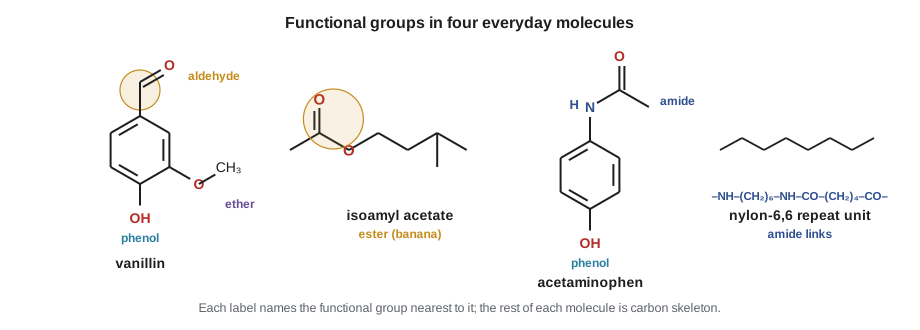
Flavour and fragrance chemistry makes a good thread through this course because the molecules are small, familiar and safe to discuss, and because their chemistry illustrates almost every functional group. Many fruit smells are esters: isoamyl acetate smells of banana, ethyl butanoate of pineapple, octyl acetate of orange and methyl salicylate of wintergreen. Aldehydes give the smells of cinnamon (cinnamaldehyde), almond (benzaldehyde) and vanilla (vanillin). Ketones give spearmint and caraway (the two enantiomers of carvone, met in CHEM-261 lesson 6) and the smell of raspberries (raspberry ketone, 4-(4-hydroxyphenyl)butan-2-one). Terpene alcohols such as menthol and geraniol give mint and rose. Thiols are responsible for some of the strongest smells known: the human nose detects some thiols at concentrations below one part per billion.
Vanillin shows how industry chooses routes. Natural vanilla extract comes from cured vanilla pods and is expensive; most vanillin sold is made by synthesis, historically from lignin in pulp-mill waste and today mainly from guaiacol, a petrochemical. Canada was once a centre of lignin-based vanillin, made from sulfite pulping liquors, and interest in the route has returned because it uses a renewable feedstock. A molecule of synthetic vanillin is identical to one from a vanilla pod; the differences in flavour between natural and artificial vanilla come from the hundreds of other compounds in the natural extract.
Reading a molecule: a worked example
Worked problem
Identifying functional groups and predicting reactive sites
Vanillin is 4-hydroxy-3-methoxybenzaldehyde, C₈H₈O₃. Identify its functional groups, calculate its degree of unsaturation, and predict its most electrophilic and most acidic sites.
Show solution
- Groups: a benzene ring; an aldehyde (–CHO) at C1; a methyl ether (–OCH₃) at C3; a phenol (–OH) at C4.
- Degree of unsaturation: (2 × 8 + 2 − 8)/2 = 5. The benzene ring accounts for four (one ring and three π bonds) and the C=O for one.
- Most electrophilic site: the aldehyde carbon, which is attacked by nucleophiles.
- Most acidic hydrogen: the phenol O–H. Phenol itself has a pKa of 10.0, and the aldehyde para to the OH stabilizes the phenoxide by resonance, lowering the pKa of vanillin to about 7.4.
- The aldehyde hydrogen and the methyl hydrogens are not acidic; the ring hydrogens are replaced only by strong electrophiles.
Answer: Aromatic ring, aldehyde, ether and phenol; DoU = 5; the aldehyde carbon is the electrophilic site and the phenolic O–H the acidic site (pKa about 7.4).
A program: degree of unsaturation and functional groups
The program below revisits the degree-of-unsaturation calculator from CHEM-261 and applies it to some molecules of this course. A degree of unsaturation of four or more with six or more carbons often signals a benzene ring.
import re

def parse(formula):
    counts = {}
    for sym, num in re.findall(r'([A-Z][a-z]?)(\d*)', formula):
        counts[sym] = counts.get(sym, 0) + (int(num) if num else 1)
    return counts

def dou(c):
    x = sum(c.get(h, 0) for h in ('F', 'Cl', 'Br', 'I'))
    return (2 * c.get('C', 0) + 2 + c.get('N', 0) - c.get('H', 0) - x) // 2

molecules = [
    ('benzene', 'C6H6', 'arene'),
    ('vanillin', 'C8H8O3', 'arene, aldehyde, phenol, ether'),
    ('isoamyl acetate', 'C7H14O2', 'ester'),
    ('cinnamaldehyde', 'C9H8O', 'arene, alkene, aldehyde'),
    ('raspberry ketone', 'C10H12O2', 'arene, phenol, ketone'),
    ('acetaminophen', 'C8H9NO2', 'arene, phenol, amide'),
    ('caprolactam', 'C6H11NO', 'cyclic amide'),
    ('menthol', 'C10H20O', 'alcohol (ring)'),
]
for name, f, groups in molecules:
    d = dou(parse(f))
    hint = 'benzene ring likely' if d >= 4 and parse(f)['C'] >= 6 else ''
print(f'{name:17s} {f:9s} DoU={d} {groups:32s} {hint}')benzene C6H6 DoU=4 arene benzene ring likely vanillin C8H8O3 DoU=5 arene, aldehyde, phenol, ether benzene ring likely isoamyl acetate C7H14O2 DoU=1 ester cinnamaldehyde C9H8O DoU=6 arene, alkene, aldehyde benzene ring likely raspberry ketone C10H12O2 DoU=5 arene, phenol, ketone benzene ring likely acetaminophen C8H9NO2 DoU=5 arene, phenol, amide benzene ring likely caprolactam C6H11NO DoU=2 cyclic amide menthol C10H20O DoU=1 alcohol (ring)
Menthol has a degree of unsaturation of one, which is its ring; it has no π bonds at all. Caprolactam, the monomer of nylon-6, has two: its ring and its C=O.
Safety in the laboratory
The compounds in this course include flammable solvents such as diethyl ether, corrosive acids and bases, lachrymatory acid chlorides and toxic aromatic compounds such as benzene, which is a known human carcinogen and has been replaced by toluene in most teaching laboratories. Before handling any substance, read its safety data sheet, work in a fume hood with volatile or toxic materials, wear eye protection and gloves suited to the chemical, and dispose of waste in the correct containers. Ethers can form explosive peroxides when stored, which lesson 6 explains. These are general rules for teaching laboratories; any reaction in this course would be carried out only under supervision with a written procedure.
Common mistakes
MistakeAldehydes and ketones undergo substitution like esters.
InsteadThey have no leaving group on the carbonyl carbon, so nucleophiles add; esters and acid chlorides undergo substitution.
MistakeThe carbonyl oxygen is the electrophilic site because it carries the double bond.
InsteadThe carbonyl carbon is electrophilic; the oxygen is the electron-rich, weakly basic site.
MistakeThe Kekulé structures of benzene are two molecules in equilibrium.
InsteadThey are resonance forms of one structure with six equal C–C bonds of 139 pm.
MistakeAny ring with alternating double bonds is aromatic.
InsteadThe ring must be planar, fully conjugated and hold 4n + 2 π electrons.
MistakeAmides are basic like amines.
InsteadThe amide nitrogen lone pair is delocalized into the carbonyl, so amides are very weak bases.
MistakeSynthetic vanillin is a different compound from natural vanillin.
InsteadThe molecule is identical; natural extracts contain many additional compounds.
Summary and key terms
- CHEM-263 covers aromatic compounds, alcohols, ethers, aldehydes, ketones, carboxylic acid derivatives and amines.
- The carbonyl carbon is electrophilic: aldehydes and ketones undergo addition, acid derivatives undergo substitution.
- α-Hydrogens next to a carbonyl are acidic (pKa about 19 for acetone), and enolates are carbon nucleophiles.
- Planar cyclic conjugated rings with 4n + 2 π electrons are aromatic and unusually stable; benzene substitutes rather than adds.
- Lone pairs make alcohols and amines bases and nucleophiles; resonance can tie up a lone pair, as in amides.
- Flavours, fragrances, polymers and biomolecules illustrate every group in the course.
- Carbonyl group
- A carbon–oxygen double bond, C=O, polarized with δ+ on carbon.
- Alpha carbon
- The carbon atom directly bonded to a carbonyl carbon.
- Enolate ion
- The anion formed by removing an α-hydrogen, with charge shared between carbon and oxygen.
- Aromatic compound
- A cyclic, planar, fully conjugated molecule with 4n + 2 π electrons.
- Arene
- A hydrocarbon containing an aromatic ring.
- Bürgi–Dunitz angle
- The angle of about 107° between the approaching nucleophile and the C=O bond.
- Oxidation level
- The number of bonds from a carbon to heteroatoms, used to classify functional groups.
Practice problems
Work each problem on paper first, then reveal the answer to check.
Classify each as addition or substitution at the carbonyl: (a) ethanal with sodium borohydride; (b) acetyl chloride with methanol.
Show answer
(a) Addition: an aldehyde has no leaving group; hydride adds to give ethanol after protonation. (b) Substitution: chloride leaves, giving methyl acetate.
Calculate the degree of unsaturation of cinnamaldehyde, C₉H₈O, and account for it.
Show answer
(18 + 2 − 8)/2 = 6: a benzene ring (4), the C=C (1) and the C=O (1).
Rank by basicity: ethanol, ethylamine, acetamide.
Show answer
Ethylamine (pKaH about 10.7) > ethanol (pKaH about −2) ≈ acetamide (pKaH about −0.5, protonating on oxygen); the order of the last two is close, but both are far weaker than the amine.
Why is the carbonyl carbon attacked at about 107° rather than 90°?
Show answer
The nucleophile donates into the π* orbital, which is antibonding and has a node; approaching at an obtuse angle maximizes overlap with the carbon lobe and minimizes repulsion with the oxygen's filled orbitals.
Give the oxidation level of the carbon bearing oxygen in ethanol, ethanal and ethanoic acid.
Show answer
1, 2 and 3: one, two and three bonds to oxygen.
Which hydrogen in raspberry ketone is the most acidic, and what is its approximate pKa?
Show answer
The phenol O–H, pKa about 10; the α-hydrogens of the ketone have pKa about 19.
Lesson quiz · 5 questions
Score 60% or more to complete this lesson.
Create a free account to save your progress, take quizzes and earn a certificate.