
CHEM-263 · Lesson 8 of 12 · 23 min
Enols and enolates: alpha substitution
▶ Video coming soon A video version of this lesson is on the way.
Lessons 7 and 10 treat the carbonyl carbon as an electrophile. This lesson turns to the other half of carbonyl chemistry: the carbon next to the carbonyl, the alpha (α) carbon, and the hydrogens attached to it. These α-hydrogens are unusually acidic, and removing one gives an enolate ion, a nucleophile at carbon. A small amount of the neutral enol form, with a C=C double bond and an OH, is also present in equilibrium with every carbonyl compound that has an α-hydrogen. Enols and enolates react with electrophiles at the α-carbon, replacing an α-hydrogen. These alpha-substitution reactions, halogenation and alkylation, make carbon–carbon bonds next to carbonyl groups and are the foundation for the condensation reactions of lesson 9.
Keto–enol tautomerism
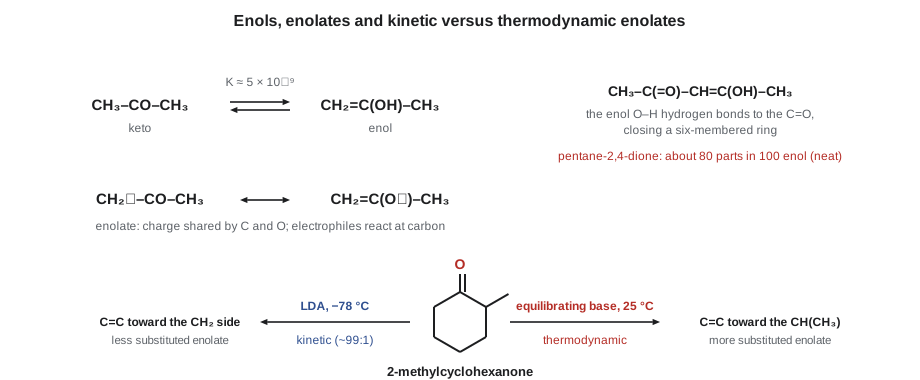
A carbonyl compound with an α-hydrogen is in equilibrium with its enol isomer, in which that hydrogen has moved to the oxygen and the double bond has moved between the carbonyl carbon and the α-carbon. The two forms are tautomers: constitutional isomers that interconvert rapidly by the movement of a proton and a double bond. They are not resonance forms, because a hydrogen atom changes position; they are different compounds in equilibrium.
For simple aldehydes and ketones the keto form is much more stable, mainly because a C=O bond is stronger than a C=C bond. At equilibrium in water, acetone contains about one enol molecule for every 200 million keto molecules, and cyclohexanone about one in a million. The enol content rises sharply when the enol is stabilized. In pentane-2,4-dione, CH₃COCH₂COCH₃, the enol is conjugated with the second carbonyl and forms an intramolecular hydrogen bond in a six-membered ring, and in the pure liquid about 80 parts in 100 are enol; in water, where the solvent competes for hydrogen bonds, the proportion falls to about 15. In phenol, the enol form is aromatic and the keto form, cyclohexa-2,4-dienone, is not, so phenol is essentially all enol.
Tautomerization is catalysed by both acid and base. In acid, the carbonyl oxygen is protonated and a base, often water, removes an α-hydrogen, forming the enol. In base, the α-hydrogen is removed first, forming the enolate, which is protonated on oxygen. Either way, the α-carbon is temporarily sp², which has an important stereochemical consequence: a stereocentre at the α-carbon racemizes when its compound is treated with acid or base. Optically active (R)-3-phenylbutan-2-one, for example, loses its optical activity in aqueous base as the enolate forms and is reprotonated on either face.
The acidity of α-hydrogens
Removing an α-hydrogen gives an enolate whose negative charge is delocalized between the α-carbon and the oxygen. Because most of the charge sits on the electronegative oxygen, enolates are much more stable than ordinary carbanions, and α-hydrogens are far more acidic than ordinary C–H bonds: about pKa 19 to 20 for acetone and 17 for acetaldehyde, compared with about 50 for ethane. Esters are less acidic, about 25 for ethyl acetate, because the ester oxygen already donates electrons into the carbonyl by resonance and leaves less room for the enolate charge. Amides are less acidic still.
When a CH₂ lies between two carbonyl groups, the charge can be shared over both oxygens and the acidity rises dramatically: pentane-2,4-dione has a pKa of 9, ethyl acetoacetate 11 and diethyl malonate 13. These 1,3-dicarbonyl compounds are deprotonated completely by alkoxide bases. Nitriles and nitro compounds are also acidic at the α-carbon for the same reason; nitromethane has a pKa of 10.
| Compound | Acidic hydrogen | Approximate pKa |
|---|---|---|
| Ethane | CH₃–H | 50 |
| Ethyl acetate | H–CH₂CO₂Et | 25 |
| Acetonitrile | H–CH₂CN | 25 |
| Acetone | H–CH₂COCH₃ | 19 |
| Acetaldehyde | H–CH₂CHO | 17 |
| Diethyl malonate | EtO₂C–CH₂–CO₂Et | 13 |
| Ethyl acetoacetate | CH₃CO–CH₂–CO₂Et | 11 |
| Nitromethane | H–CH₂NO₂ | 10 |
| Pentane-2,4-dione | CH₃CO–CH₂–COCH₃ | 9 |
Choosing a base
The pKa table tells you which bases can form an enolate completely. As CHEM-261 lesson 4 explained, an acid–base equilibrium favours the side with the weaker acid. Hydroxide (water pKa 15.7) or ethoxide (ethanol pKa 16) deprotonates acetone only to a small extent, a few molecules in ten thousand at equilibrium, but that small amount is enough for reactions in which the enolate is consumed, such as halogenation and the aldol reaction. For 1,3-dicarbonyl compounds, ethoxide gives essentially complete deprotonation.
To convert a simple ketone or ester completely into its enolate, chemists use a much stronger base whose conjugate acid is far weaker than the carbonyl compound. The standard choice is lithium diisopropylamide, LDA, made from diisopropylamine (pKa about 36) and butyllithium. LDA is very strong but also very bulky, so it removes protons without adding to the carbonyl carbon as a nucleophile. With LDA at −78 °C in THF, a ketone is converted completely and irreversibly into its lithium enolate, which can then be treated with an electrophile.
Kinetic and thermodynamic enolates
An unsymmetrical ketone such as 2-methylcyclohexanone has α-hydrogens on two different carbons, and removing each gives a different enolate. The more substituted enolate, with the more substituted C=C, is more stable, like a more substituted alkene. The less substituted enolate forms faster, because its α-hydrogens are less hindered and there are more of them.
Which enolate you get depends on the conditions, exactly as with kinetic and thermodynamic control in CHEM-261 lesson 8 and the diene additions of lesson 2. With LDA at −78 °C, deprotonation is fast and irreversible, and the bulky base removes the most accessible hydrogen: the kinetic enolate dominates, typically by about 99 to 1. With a weaker base such as an alkoxide at room temperature, or with a slight excess of the ketone that allows proton transfer between enolate and ketone, the enolates equilibrate and the more stable thermodynamic enolate dominates, typically by between about 3 to 1 and 9 to 1. Choosing conditions therefore lets a chemist decide which side of a ketone to alkylate.
α-Halogenation
Aldehydes and ketones react with chlorine, bromine or iodine at the α-carbon, replacing an α-hydrogen with a halogen. The mechanism and the outcome depend on whether the reaction is run in acid or base.
In acid, the rate-determining step is enol formation. Arthur Lapworth showed in 1904 that the rate of brominating acetone does not depend on the concentration of bromine, and that chlorination, bromination and iodination all go at the same rate, the rate of enolization. Once formed, the enol attacks the halogen rapidly. Acid-catalysed halogenation usually stops after one halogen, because the electron-withdrawing halogen makes the carbonyl oxygen less basic and slows further enol formation. α-Bromoketones made this way are useful intermediates; elimination of HBr with a hindered base gives α,β-unsaturated ketones.
In base, the enolate attacks the halogen. Here the first halogen makes the remaining α-hydrogens more acidic, so each halogenation is faster than the last, and all the α-hydrogens on that carbon are replaced. A methyl ketone, RCOCH₃, is converted to RCOCX₃. The CX₃ group, stabilized by three halogens, is then a good enough leaving group that hydroxide adds to the carbonyl and expels it, giving a carboxylate and a haloform, CHX₃. This is the haloform reaction. With iodine, the yellow precipitate of iodoform, CHI₃, was long used as a test for methyl ketones and for alcohols such as ethanol that are oxidized to them under the conditions.
Carboxylic acids are halogenated at the α-carbon by the Hell–Volhard–Zelinsky reaction, using Br₂ with a phosphorus catalyst, which goes by way of the acid bromide's enol. The α-bromo acids are useful because the bromine can be displaced by nucleophiles, for example by ammonia to make α-amino acids.
Worked problem
Acid versus base halogenation
Predict the products of butan-2-one with (a) one equivalent of Br₂ in acetic acid; (b) excess I₂ in aqueous NaOH.
Show solution
- (a) In acid, enolization favours the more substituted enol, toward C3, and the reaction stops after one bromine: mainly 3-bromobutan-2-one.
- (b) In base, the methyl group is fully iodinated to CH₃CH₂COCI₃, because each iodination acidifies the remaining hydrogens on that carbon.
- Hydroxide adds to the carbonyl and expels CI₃⁻, which picks up a proton: iodoform, CHI₃, a yellow solid, plus propanoate.
Answer: (a) 3-Bromobutan-2-one; (b) iodoform and sodium propanoate (the haloform reaction).
Alkylation of enolates
Enolates are nucleophiles, and they react with alkyl halides by SN2 to form new carbon–carbon bonds at the α-carbon. The rules of SN2 from CHEM-261 apply: the halide should be methyl, primary, allylic or benzylic; secondary halides react poorly and tertiary halides give only elimination, because enolates are also bases. The reaction is usually carried out by forming the enolate completely with LDA at −78 °C and then adding the alkyl halide. An enolate is an ambident nucleophile, with negative charge on both carbon and oxygen; with alkyl halides it reacts mainly at carbon, the softer site, giving the more stable C–C bond and keeping the strong C=O bond.
Two classic methods use 1,3-dicarbonyl compounds, which are easy to deprotonate with ethoxide, as synthetic equivalents of simpler enolates. In the malonic ester synthesis, diethyl malonate is deprotonated and alkylated, once or twice; heating the product with aqueous acid then converts both esters to a malonic acid, which loses carbon dioxide on heating, a decarboxylation that passes through a cyclic six-membered transition state and an enol. The overall result is a carboxylic acid, RCH₂CO₂H, the equivalent of alkylating acetic acid. In the acetoacetic ester synthesis, ethyl acetoacetate is alkylated in the same way, and hydrolysis and decarboxylation give a methyl ketone, CH₃COCH₂R, the equivalent of alkylating acetone. Lesson 12 uses this route to make a ketone found in raspberries.
Enamines, introduced in lesson 7, offer a third way. The Stork enamine reaction alkylates a ketone through its enamine, which is nucleophilic at carbon but neutral and mild, so it works without strong base and stops cleanly at monoalkylation; hydrolysis then returns the alkylated ketone.
| Method | Base | Electrophile | Product after workup |
|---|---|---|---|
| Direct enolate alkylation | LDA, −78 °C | primary RX | α-alkyl ketone or ester |
| Malonic ester synthesis | NaOEt | primary RX | RCH₂CO₂H after hydrolysis and decarboxylation |
| Acetoacetic ester synthesis | NaOEt | primary RX | CH₃COCH₂R after hydrolysis and decarboxylation |
| Stork enamine alkylation | none (enamine) | reactive RX | α-alkyl ketone after hydrolysis |
| Acid halogenation | H⁺ catalyst | X₂ | α-monohalo ketone |
| Haloform reaction | NaOH | excess X₂ | RCO₂⁻ + CHX₃ from a methyl ketone |
Enols and enolates in biology
Enzymes use enols and enolates constantly. In glycolysis, triose phosphate isomerase converts dihydroxyacetone phosphate to glyceraldehyde 3-phosphate through an enediol intermediate, a keto–enol tautomerization run by a glutamate and a histidine side chain acting as base and acid; the enzyme is so efficient that its rate is limited by how fast the substrate diffuses to it. The pyruvate kinase reaction makes ATP using phosphoenolpyruvate, a phosphorylated enol whose conversion to the keto form of pyruvate drives the reaction. And the fatty acids in your body are built by Claisen-like condensations of thioester enolates, described in lesson 9.
A program: enolate selectivity and deprotonation
import math
R, T = 8.314, 298.15

def ratio(ddg_kj, temp_k):
    return math.exp(ddg_kj * 1000 / (R * temp_k))

# kinetic control at -78 C: the less hindered enolate forms faster by ddG(activation)
for ddg in (5.0, 7.5):
    r = ratio(ddg, 195.15)
    print(f'kinetic: ddG(act) = {ddg} kJ/mol at -78 C -> {r:.0f}:1, {100 * r / (1 + r):.1f} per hundred less substituted')

# thermodynamic control at 25 C: the more substituted enolate is more stable by ddG
for ddg in (3.0, 5.5):
    r = ratio(ddg, T)
    print(f'thermodynamic: ddG = {ddg} kJ/mol at 25 C -> {r:.1f}:1 more substituted')

# extent of deprotonation: log K = pKa(conjugate acid of base) - pKa(carbon acid)
carbon_acids = {'acetone': 19.3, 'ethyl acetate': 25.0, 'pentane-2,4-dione': 9.0, 'diethyl malonate': 13.0}
bases = {'hydroxide': 15.7, 'ethoxide': 16.0, 'LDA': 36.0}
print(f'{"":20s}' + ''.join(f'{b:>14s}' for b in bases))
for acid, pka in carbon_acids.items():
    row = ''
    for b, pkb in bases.items():
        K = 10 ** (pkb - pka)
        frac = K / (1 + K) if K < 1e12 else 1.0
        row += f'{frac:14.2g}'
    print(f'{acid:20s}' + row)

# enol content from the equilibrium constant K = [enol]/[keto]
for name, K in (('acetone', 5e-9), ('cyclohexanone', 1e-6), ('pentane-2,4-dione, water', 0.18)):
print(f'{name:26s} enol fraction {K / (1 + K):.2g}')kinetic: ddG(act) = 5.0 kJ/mol at -78 C -> 22:1, 95.6 per hundred less substituted
kinetic: ddG(act) = 7.5 kJ/mol at -78 C -> 102:1, 99.0 per hundred less substituted
thermodynamic: ddG = 3.0 kJ/mol at 25 C -> 3.4:1 more substituted
thermodynamic: ddG = 5.5 kJ/mol at 25 C -> 9.2:1 more substituted
hydroxide ethoxide LDA
acetone 0.00025 0.0005 1
ethyl acetate 5e-10 1e-09 1
pentane-2,4-dione 1 1 1
diethyl malonate 1 1 1
acetone enol fraction 5e-09
cyclohexanone enol fraction 1e-06
pentane-2,4-dione, water enol fraction 0.15The fractions in the table are those formed by one equivalent of each base acting alone at equilibrium. Hydroxide and ethoxide convert only a few parts in ten thousand of acetone to its enolate, but essentially all of pentane-2,4-dione; LDA converts every carbonyl compound completely. The selectivity calculation shows why temperature and base matter: a difference of 7.5 kJ/mol in activation free energy, about the size expected from steric hindrance, gives about a hundred to one at −78 °C.
Common mistakes
MistakeKeto and enol forms are resonance structures.
InsteadThey are tautomers, different compounds in equilibrium; a hydrogen atom moves between them.
MistakeHydroxide converts acetone completely to its enolate.
InsteadIts conjugate acid, water, is a stronger acid than acetone; use LDA for complete enolate formation.
MistakeLDA at −78 °C gives the more substituted enolate.
InsteadIt gives the kinetic, less substituted enolate; equilibrating conditions give the more substituted one.
MistakeBase-promoted halogenation stops after one halogen.
InsteadEach halogen makes the next α-hydrogen more acidic, so all are replaced; acid-catalysed halogenation stops at one.
MistakeEnolates alkylate tertiary halides well.
InsteadEnolates are bases; tertiary halides undergo E2. Use methyl, primary, allylic or benzylic halides.
MistakeAn α-stereocentre is unaffected by base.
InsteadEnolization makes the α-carbon planar, and the compound racemizes.
Summary and key terms
- Carbonyl compounds with α-hydrogens are in equilibrium with enol tautomers; the keto form dominates except when the enol is conjugated, hydrogen bonded or aromatic.
- α-Hydrogens are acidic (pKa about 19 to 20 for ketones, 25 for esters, 9 to 13 for 1,3-dicarbonyls) because the enolate is resonance-stabilized.
- LDA forms enolates completely and gives the kinetic, less substituted enolate at −78 °C; equilibrating conditions give the thermodynamic enolate.
- Acid-catalysed halogenation goes through the enol and stops at one halogen; base-promoted halogenation replaces all α-hydrogens and gives the haloform reaction with methyl ketones.
- Enolates alkylate at carbon by SN2 with primary halides; malonic and acetoacetic ester syntheses give acids and methyl ketones after decarboxylation.
- α-Stereocentres racemize through the enol or enolate.
- Tautomers
- Constitutional isomers that interconvert rapidly by moving a proton and a double bond.
- Enol
- A compound with an OH group on a C=C carbon.
- Enolate ion
- The anion formed by removing an α-hydrogen, with charge on carbon and oxygen.
- LDA
- Lithium diisopropylamide, a strong, bulky, non-nucleophilic base.
- Kinetic enolate
- The enolate that forms faster, usually the less substituted one.
- Haloform reaction
- Exhaustive halogenation of a methyl ketone in base followed by cleavage to a carboxylate and CHX₃.
- Decarboxylation
- Loss of CO₂, as from a β-keto acid or malonic acid on heating.
Practice problems
Work each problem on paper first, then reveal the answer to check.
Which hydrogen is most acidic in ethyl acetoacetate, CH₃COCH₂CO₂Et, and why?
Show answer
The CH₂ between the two carbonyls (pKa about 11): its enolate is stabilized by both oxygens.
Predict the major product of 2-methylcyclohexanone with (a) LDA at −78 °C, then CH₃I; (b) NaOEt in ethanol at 25 °C, then CH₃I.
Show answer
(a) Mainly 2,6-dimethylcyclohexanone, through the kinetic enolate; (b) a greater share of 2,2-dimethylcyclohexanone through the thermodynamic enolate, though alkylation under equilibrating conditions gives mixtures.
Outline a malonic ester synthesis of 3-phenylpropanoic acid.
Show answer
Diethyl malonate, NaOEt, benzyl bromide; then H₃O⁺ and heat to hydrolyse and decarboxylate: C₆H₅CH₂CH₂CO₂H.
Why does (S)-2-methylbutanal lose its optical activity in aqueous acid?
Show answer
The stereocentre is the α-carbon; acid-catalysed enolization makes it sp², and reprotonation occurs on either face.
What is the yellow solid formed when ethanol is treated with iodine and sodium hydroxide?
Show answer
Iodoform, CHI₃: ethanol is oxidized to acetaldehyde, a methyl carbonyl compound that undergoes the haloform reaction.
Explain why phenol exists as the enol rather than the keto form.
Show answer
The enol form is aromatic, with about 150 kJ/mol of stabilization; the keto tautomer is a nonaromatic cyclohexadienone.
Lesson quiz · 5 questions
Score 60% or more to complete this lesson.
Create a free account to save your progress, take quizzes and earn a certificate.