
CHE-499 · Lesson 3 of 12 · 22 min
Market and process selection
The brief names two candidate products and allows others. Before the team can draw a flowsheet it must choose one, and the choice must survive questioning by a board that knows the ethanol business better than any student. This lesson follows the selection: the markets, the chemistry of the candidates, a first estimate of what each is worth, a weighted comparison, and the test of whether the answer changes when the weights do. It ends with the steps of the selected process, which the rest of the course designs.
The candidates
Ana's first list had seven products: fuel ethanol as now (the baseline), bio-ethylene, jet-range hydrocarbons, butadiene, ethyl acetate, acetic acid and diethyl ether. Two were removed quickly. Ethyl acetate is already being added at the site, the project CHE-446 followed; a second line would compete with the first for the same customers. Acetic acid from ethanol cannot compete with acetic acid made by methanol carbonylation at world scale. Butadiene from ethanol by the Lebedev route is chemically interesting and was practised in wartime, but its market in Canada is tied to a few synthetic rubber producers, and the process yields are modest. Diethyl ether is a small specialty market. That left three options for detailed comparison: keep selling fuel ethanol, make bio-ethylene, or make sustainable aviation fuel by the alcohol-to-jet route.
Bio-ethylene
Ethylene is the largest-volume organic chemical in the world. Almost all of it is made by steam cracking ethane or naphtha. It can also be made by dehydrating ethanol over an acid catalyst, the reaction Theo met in CHE-345 when he worked on Kingfisher's pilot packed bed:
Bio-ethylene is chemically identical to fossil ethylene, so it can be polymerized in existing plants into polyethylene that customers sell as plant-based. The best-known example is the plant Braskem started in southern Brazil in 2010, which makes polyethylene from sugarcane ethanol at a scale of about 200,000 tonnes a year and has since been expanded. The process is mature, the capital is modest, and the product commands a premium from brand owners who want renewable packaging.
In Sarnia bio-ethylene has an unusual advantage: Chemical Valley has polyethylene producers and an ethylene pipeline network a few kilometres from Kingfisher's fence. A polyethylene producer could take the ethylene by pipeline and sell the polymer with a certified bio-based share. The weakness is the market. The premium for bio-based polyethylene depends on a few brand owners, the volume they want is small compared with the polymer market, and Kingfisher would depend on one or two buyers in the valley.
Sustainable aviation fuel
Aviation is one of the hardest sectors to decarbonize. Batteries are far too heavy for long flights, hydrogen aircraft are decades from large-scale service, and the fleet in service today will fly for twenty years or more. Drop-in synthetic jet fuel, which can be blended with conventional jet and used in existing aircraft and airport systems, is the main near-term route. Several policies push in that direction. The European Union's ReFuelEU Aviation regulation requires a minimum SAF share of fuel supplied at EU airports, rising from 2 % in 2025 to 6 % in 2030 and much higher later. The US set a goal in 2021 of producing 3 billion gallons of SAF a year by 2030. Canada's aviation climate plan sets an aspirational goal of 10 % SAF use by 2030, and the federal government published a SAF blueprint in August 2026; British Columbia has legislated a requirement of 1 % SAF from 2028 rising to 3 % by 2030.
Most SAF made today is HEFA fuel, hydroprocessed esters and fatty acids from waste fats and vegetable oils. The supply of waste fats is limited and contested with renewable diesel, so other pathways are needed. The alcohol-to-jet route makes jet-range hydrocarbons from ethanol or isobutanol. The first commercial plant to do it from ethanol, LanzaJet's Freedom Pines Fuels plant in Soperton, Georgia, opened in January 2024 with a design output of about 9 million gallons a year of SAF and 1 million gallons of renewable diesel, and was reported to be fully operating in late 2025. A corn ethanol producer that turns part of its output into jet fuel moves from a crowded commodity market into one that is growing by policy.
The weakness of SAF is its cost. Jet fuel from ethanol costs more to make than fossil jet, so the project depends on the credits and premiums that policy and buyers attach to low-carbon fuel. Those are only as durable as the policies, and Lesson 11 shows that the carbon intensity, and so the credit value, depends heavily on the ethanol plant's own emissions, including whether the fermentation carbon dioxide is captured and stored.
A first estimate: economic potential
Before any equipment exists, the team can rank the options by their economic potential, the first level of the design hierarchy CHE-446 introduced: the value of the products minus the cost of the raw materials, per year. It ignores capital and utilities, so it is an upper bound on what each option can earn, and an option with a poor economic potential can be discarded without further work.
The yields come from stoichiometry with realistic selectivities. Dehydration gives at most 0.609 kg of ethylene per kg of ethanol; at 99.5 % conversion and 98.5 % selectivity, about 0.597. Turning ethylene into jet-range hydrocarbons adds a little hydrogen and loses a little to light gas and heavy ends, giving about 0.46 kg of jet, 0.07 kg of naphtha and 0.06 kg of diesel per kg of ethanol in the preliminary basis. The prices are Kingfisher's forecasts, with credits and premiums estimated as described in Lesson 11.
# Level-1 economic potential and a weighted decision matrix for the candidate products
# Prices in dollars per tonne (Kingfisher forecasts, illustrative)
eth = 786                                   # ethanol at 0.62 per litre
opts = {  # name: list of (tonnes of product per tonne of ethanol, value per tonne)
    'ATJ SAF':        [(0.462, 1118 + 551 + 789), (0.071, 900), (0.059, 1300), (-0.0079, 4000)],
    'bio-ethylene':   [(0.597, 1000 + 700)],
    'fuel ethanol':   [(1.000, 786)],
}
# SAF value = fossil jet 1,118 + Clean Fuel Regulations credits 551 + offtake premium 789 (0.60 per litre)
# hydrogen (negative yield) is bought at 4,000 per tonne
t_eth = 78.9e3                              # t/yr of ethanol (100 million litres)
EP = {}
for k, prods in opts.items():
    v = sum(y * p for y, p in prods)
    EP[k] = (v - eth) * t_eth / 1e6
    print(f"{k:<13} product value {v:6.0f} per t ethanol; economic potential {EP[k]:5.1f} million per year")
crit = {'margin': 0.25, 'market depth': 0.20, 'carbon value': 0.15, 'maturity': 0.15, 'capital': 0.10, 'site fit': 0.10, 'safety, permits': 0.05}
score = {  # 1 (poor) to 5 (good)
    'ATJ SAF':      {'margin': 4, 'market depth': 5, 'carbon value': 5, 'maturity': 3, 'capital': 2, 'site fit': 4, 'safety, permits': 3},
    'bio-ethylene': {'margin': 4, 'market depth': 2, 'carbon value': 3, 'maturity': 5, 'capital': 4, 'site fit': 5, 'safety, permits': 3},
    'fuel ethanol': {'margin': 1, 'market depth': 4, 'carbon value': 2, 'maturity': 5, 'capital': 5, 'site fit': 5, 'safety, permits': 5},
}
def total(w): return {k: sum(w[c] * s[c] for c in w) for k, s in score.items()}
base = total(crit)
for k in sorted(base, key=base.get, reverse=True): print(f"{k:<13} weighted score {base[k]:.2f}")
# sensitivity: how far must one weight move (others rescaled) before the ranking of the top two changes?
for c in crit:
    for d in [x / 100 for x in range(1, 41)]:
        for sign in (+1, -1):
            w = dict(crit); w[c] = max(0.0, crit[c] + sign * d)
            rest = sum(v for kk, v in crit.items() if kk != c)
            for kk in w:
                if kk != c: w[kk] = crit[kk] * (1 - w[c]) / rest
            t = total(w)
            if t['bio-ethylene'] > t['ATJ SAF']:
                print(f"ranking reverses if the '{c}' weight moves from {crit[c]:.2f} to {w[c]:.2f}")
                break
        else: continue
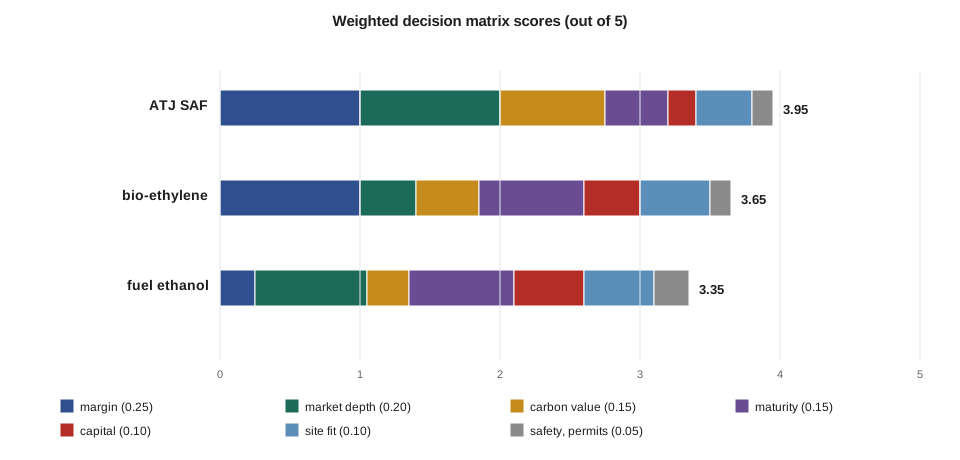
breakATJ SAF product value 1245 per t ethanol; economic potential 36.2 million per year bio-ethylene product value 1015 per t ethanol; economic potential 18.1 million per year fuel ethanol product value 786 per t ethanol; economic potential 0.0 million per year ATJ SAF weighted score 3.95 bio-ethylene weighted score 3.65 fuel ethanol weighted score 3.35 ranking reverses if the 'market depth' weight moves from 0.20 to 0.11 ranking reverses if the 'carbon value' weight moves from 0.15 to 0.00 ranking reverses if the 'maturity' weight moves from 0.15 to 0.27 ranking reverses if the 'capital' weight moves from 0.10 to 0.22 ranking reverses if the 'site fit' weight moves from 0.10 to 0.31
Both conversion options beat fuel ethanol by a wide margin at this level: about 36 million dollars a year for SAF against 18 million for bio-ethylene. The SAF number rests on two items, the Clean Fuel Regulations credits and an offtake premium of 0.60 dollars a litre that Kingfisher's commercial team believes airlines and corporate buyers would pay under a long-term contract. Together they are more than half the SAF product value. Bio-ethylene depends on its premium, about 700 dollars a tonne over fossil ethylene. Neither number is safe, and economic potential ignores capital, which is much larger for SAF.
The weighted decision matrix
Many factors that matter cannot be reduced to dollars at this stage: the depth of the market, the technical maturity of the process, the capital required, how well the plant fits the site, and the safety and permitting burden. The team uses a weighted decision matrix. Each criterion gets a weight, agreed with Ingrid before the options are scored so that the weights cannot be tuned to favour an answer. Each option is scored from 1 to 5 on each criterion, with the reasons written down. The weighted score is the sum of weight times score.
The team's reasons for the main scores are part of the report. SAF scores only 4 for margin, despite its higher economic potential, because more than half of that potential rests on credits and premiums. It scores 5 for market depth because demand is set by policy across many airlines and far exceeds any plant Kingfisher could build; bio-ethylene scores 2 because its premium market is thin. SAF scores 3 for maturity, because the full ethanol-to-jet sequence has run commercially only since 2024, while ethanol dehydration scores 5. SAF scores 2 for capital, because it adds oligomerization, hydrogenation and fractionation to the dehydration that bio-ethylene needs alone.
Is the answer robust?
A decision matrix is only as good as its weights, and weights are judgments. The honest test is a sensitivity analysis: how much would a weight have to change for the ranking to change? The code moves each weight in turn, rescaling the others so they still sum to one, and reports where the top two options swap.
At the Sarnia site the answer is fairly robust but not overwhelming. The ranking reverses if market depth is weighted at about 0.11 instead of 0.20, if maturity rises from 0.15 to about 0.27, if capital rises to about 0.22, or if site fit rises to about 0.31. Each of those would represent a different company strategy: one that values a quick, cheap, low-risk project over a large and growing market. The team presents the matrix and its sensitivity to Ingrid, who confirms that Kingfisher's board wants a growth product and is prepared to accept technology risk if it is managed. The team records that bio-ethylene remains a credible fallback, sharing the same first reactor, and that a future project could make both.
Professor Marchetti adds one challenge. A matrix can hide a fatal flaw behind good scores elsewhere. Before accepting it, the team checks each option for show-stoppers: a hazard that could not be made acceptable, a permit that could not be obtained, a feedstock that could not be supplied. None of the three options has one, but the check is recorded.
The alcohol-to-jet process
With SAF selected, the team describes the process in four steps, which the rest of the course designs.
- Dehydration. Ethanol is vaporized, mixed with steam and passed over an acid catalyst, typically an alumina or a modified zeolite, at about 350 to 450 °C and a few bar. The reaction is endothermic, so the reactor is either a fired multitubular reactor or a series of adiabatic beds with reheating between them. Small amounts of acetaldehyde, diethyl ether, higher olefins and coke form alongside the ethylene.
- Ethylene purification and oligomerization. The crude ethylene is quenched to remove water, compressed, and cleaned of oxygenates and carbon dioxide that would poison the next catalyst. It is then oligomerized: ethylene molecules are joined into longer olefins over a catalyst. The reaction is strongly exothermic. Practical schemes use one or two catalytic steps, for example a nickel-based catalyst that makes butenes and hexenes followed by an acid catalyst that builds them into the C8 to C16 range, with unconverted light olefins recycled.
- Hydrogenation. The olefins are saturated with hydrogen over a nickel or palladium catalyst to give paraffins, mostly branched, which are stable in storage and in aircraft fuel systems.
- Fractionation. Distillation splits the paraffins into a light naphtha cut, the jet cut that meets Annex A5, and a heavy diesel cut. Light ends can be recycled to oligomerization to raise the jet yield.
The real process differs between licensors in the catalysts, the number of oligomerization steps and the recycle scheme, and much of it is proprietary. The team's design is a generic version based on the published literature, and the report says so: a feasibility study of a licensed technology would normally use the licensor's process design package. Ingrid accepts this, and notes that Kingfisher would ask licensors for proposals at the next stage.
Worked problem
Theoretical yield of hydrocarbons from ethanol
What is the maximum mass of jet-range paraffin (taken as \((\text{CH}_2)_n\text{H}_2\) with \(n = 12\)) that can be made from 1 kg of ethanol, with hydrogen supplied from outside?
Show solution
- Each ethanol (46.07 g/mol) gives one \(\text{CH}_2\text{=CH}_2\) (28.05 g/mol): at most 0.609 kg ethylene per kg ethanol.
- Six ethylenes make one \(\text{C}_{12}\text{H}_{24}\) (168.3 g/mol), and one \(\text{H}_2\) saturates it to \(\text{C}_{12}\text{H}_{26}\) (170.3 g/mol).
- Paraffin \(= 0.609 \times 170.3 / 168.3 = 0.616\) kg per kg ethanol.
Answer: About 0.62 kg. Real plants make about 0.59 kg of liquid hydrocarbons, of which only part is in the jet range, because of selectivity losses and the spread of chain lengths.
Common mistakes
MistakeChoosing weights after scoring the options.
InsteadAgree the weights with the client first, then score.
MistakeTreating the weighted score as a precise number.
InsteadTest how far the weights must move to change the ranking.
MistakeIgnoring credits and premiums in the economic potential, or treating them as certain.
InsteadInclude them and identify them as the main risk.
MistakeDropping the runner-up once a choice is made.
InsteadRecord it as a fallback and note what would make it preferable.
MistakePresenting a generic process as if it were the licensed one.
InsteadState that the design is generic and that a licensor's package would replace it.
Summary and key terms
- Candidate products are screened on market, chemistry and site fit before detailed comparison.
- Level-1 economic potential, product value minus raw material cost, ranks options and discards poor ones early.
- A weighted decision matrix scores factors that cannot yet be priced; weights are set before scoring.
- Sensitivity of the ranking to the weights shows whether the choice is robust.
- Alcohol-to-jet makes SAF in four steps: dehydration, oligomerization, hydrogenation and fractionation.
- SAF demand is driven by policy, so its value depends on credits and premiums that are themselves risks.
- Economic potential
- Product value minus raw material cost, an upper bound on what a process can earn.
- Weighted decision matrix
- A table scoring options against weighted criteria.
- Bio-ethylene
- Ethylene made by dehydrating ethanol from biomass.
- Oligomerization
- Joining a few monomer molecules into a short chain, here olefins of C4 to C20.
- HEFA
- Hydroprocessed esters and fatty acids, the most common SAF pathway.
- Show-stopper
- A single factor that makes an option unacceptable regardless of other scores.
Practice problems
Work each problem on paper first, then reveal the answer to check.
What is the maximum mass of ethylene from 1 tonne of ethanol?
Show answer
0.609 t.
An option scores 4, 3 and 5 on criteria weighted 0.5, 0.3 and 0.2. What is its weighted score?
Show answer
3.9.
Why is the dehydration step common to both bio-ethylene and SAF?
Show answer
Both start by converting ethanol to ethylene.
Why is economic potential an upper bound on profit?
Show answer
It ignores capital, utilities, labour and other operating costs.
Why is oligomerization harder to control than dehydration?
Show answer
It is strongly exothermic; dehydration is endothermic.
What does the sensitivity analysis of the matrix tell the board?
Show answer
How far its priorities would have to differ for the recommendation to change.
Lesson quiz · 5 questions
Score 60% or more to complete this lesson.
Create a free account to save your progress, take quizzes and earn a certificate.