
CHE-499 · Lesson 1 of 12 · 25 min
The capstone, the team and the client brief
Every chemical engineering degree ends the same way: a team of students is handed a real problem with no answer at the back of the book, and has a school year to design a plant that solves it. This course follows one such team at St. Clair Polytechnic University in Sarnia, Ontario. Its client is Kingfisher Bioenergy, the company whose ethanol plant on the St. Clair River has run through this program's courses from mass balances to environmental engineering. The question Kingfisher has put to the team is the most open one in the series: what should the plant make from its ethanol next, and what would the plant that makes it look like?
This first lesson is about the project rather than the process: what a capstone is for, how the team is organized, how the client's brief is read, and how a year of work is planned. Engineers who skip this step tend to spend October calculating a column for a product nobody asked for.
What the capstone is for
Accreditation bodies require every engineering program to end with a substantial design experience. In Canada, the Canadian Engineering Accreditation Board (CEAB) expects graduates to have carried a design from an open-ended need through analysis, synthesis and evaluation to a recommendation, drawing on the whole curriculum and on standards, economics, safety, environmental and social factors. The capstone is where the separate courses meet. Reactor design from CHE-345, separations from CHE-350, process control from CHE-374, process safety from CHE-380, design economics from CHE-446 and environmental engineering from CHE-480 stop being separate exams and become chapters of one report that must agree with itself.
Three things make a capstone different from earlier design assignments. First, the problem is underdefined: the client knows what it wants in business terms, not in kilograms per hour, and the team must turn one into the other. Second, decisions interact. The reactor temperature sets the separation train, which sets the heat integration, which sets the utilities and the carbon intensity, which sets part of the revenue. Third, the result is judged as professional work: by the client, by a faculty advisor who is a licensed engineer, and by an industry panel at the final presentation.
The client and the brief
Kingfisher's ethanol plant makes about 240 million litres of fuel ethanol a year after the expansion that CHE-480 followed, together with distillers grains, corn oil and a stream of almost pure carbon dioxide from fermentation. Fuel ethanol is a commodity: its price follows gasoline blending demand, and the plant's margin has been squeezed for several years. Ingrid Solheim, the senior process engineer who has mentored Theo Laurent through his work terms, has been asked by the board to look at products that use ethanol as a feedstock rather than selling all of it as fuel. Kingfisher agreed to sponsor a capstone team to carry out the first study, with Ingrid as client representative and Theo, now an engineer in training, as day-to-day mentor.
Ingrid's brief to the team is two pages long. Its key sentences are these:
- Kingfisher wishes to evaluate converting up to 100 million litres a year of its ethanol into a higher-value, lower-carbon product at the Sarnia site.
- Candidate products include, but are not limited to, ethylene for bio-based polyethylene and jet-range hydrocarbons for sustainable aviation fuel (SAF).
- The study should recommend one product and process, develop a conceptual design to the level of a process flow diagram, heat and material balance, major equipment list and preliminary P&IDs for the reaction section, and estimate capital and operating costs to the accuracy normally expected of a feasibility study.
- The design must be safe, permittable at the Sarnia site, and should take advantage of the fermentation carbon dioxide capture project now in planning.
- Kingfisher will provide site data, utility costs and its price forecasts. The team is not to contact vendors or licensors in Kingfisher's name without approval.
Reading a brief carefully is an engineering skill. The team marked each sentence as a requirement (must), a preference (should) or context. The capacity is an upper limit, not a target. The product is open, but two candidates are named, and Lesson 3 must compare them fairly. The deliverables match what industry calls a feasibility study or front-end loading stage 1 (FEL-1), the stage CHE-446 described, extended to preliminary P&IDs and a hazard review for the reaction section. The last sentence protects Kingfisher commercially: a capstone team asking a licensor for a quotation on company letterhead could create expectations nobody intended.
The team
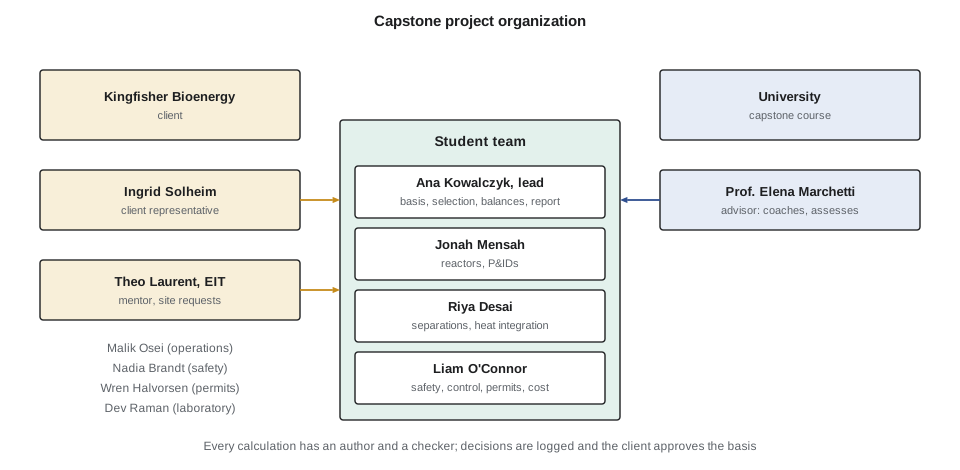
The capstone team has four students, each of whom leads some parts of the design while reviewing others:
| Member | Lead responsibilities | Checks |
|---|---|---|
| Ana Kowalczyk (team lead) | Design basis, process selection, flowsheet and balances, final report | Economics |
| Jonah Mensah | Reactor design, catalyst data, reaction section P&IDs | Separations |
| Riya Desai | Separation train, heat integration, utilities | Reactors |
| Liam O'Connor | Safety review, control strategy, environmental permits and carbon intensity, cost estimate | Flowsheet |
Their faculty advisor is Professor Elena Marchetti, a P.Eng., who spent fifteen years designing petrochemical plants before joining the university. Her role is to coach and to assess, not to design: she will ask the questions an industrial reviewer would ask, but the decisions are the team's. Ingrid represents the client and approves the design basis. Theo meets the team every two weeks, answers questions about the site, and passes requests for data to the right people at Kingfisher: Malik Osei, the plant manager, for operating data; Nadia Brandt for process safety; Wren Halvorsen for permits; Dev Raman in the laboratory for ethanol quality.
The author-and-checker rule in the table comes straight from industry practice. In a design office no calculation leaves the building without being checked by someone other than its author, and the checker signs it too. A student team that adopts the rule early finds that most of its errors are caught in the week they are made rather than at the final presentation.
The team charter
Before any engineering, the team wrote a one-page charter and all four members signed it. It records how decisions are made (by consensus where possible, by the lead for that area otherwise, with any disagreement and its reasons recorded in the decision log), how work is shared (each member keeps a weekly log of hours and tasks), how the team communicates (a shared folder with a fixed file structure, a weekly meeting with minutes and actions), and what happens if a member falls behind (raise it within a week, first within the team, then with the advisor). It also records expectations about academic integrity: generative tools and simulation software may be used, but every number in the report must be one a team member can explain and reproduce.
Charters feel bureaucratic to students. They exist because the most common reason capstone teams fail is not technical: it is a member who disappears in February, or two members who disagree about the process for a month without saying so. A charter turns those problems into a procedure.
Planning the year
The capstone runs over two terms, about 26 teaching weeks, with fixed deliverables: a proposal and design basis memorandum in week 4, an interim report and design review in week 13, a hazard review of the reaction section in week 20, and the final report and presentation in week 26. Between them, the work has a natural order. The basis comes before selection; selection before balances; balances before the reactors and separations, which can run in parallel; both before heat integration; heat integration before equipment sizing; sizing before the P&IDs, the hazard review and the cost estimate; and all of these before the economics and the report.
Ana turns that order into a network and finds its critical path: the chain of tasks with no float, where any delay delays the whole project. The forward pass gives each task its earliest start and finish; the backward pass, from the end date, gives its latest start and finish; float is the difference.
# Critical path for the capstone schedule (weeks), by forward and backward passes
tasks = {  # name: (duration in weeks, predecessors)
    'brief':        (1, []),
    'basis':        (3, ['brief']),
    'selection':    (3, ['basis']),
    'balances':     (4, ['selection']),
    'reactors':     (4, ['balances']),
    'separations':  (4, ['balances']),
    'heat':         (2, ['reactors', 'separations']),
    'equipment':    (4, ['heat']),
    'pids':         (3, ['equipment']),
    'hazop':        (2, ['pids']),
    'environment':  (3, ['balances']),
    'estimate':     (3, ['equipment']),
    'economics':    (2, ['estimate', 'environment']),
    'report':       (3, ['hazop', 'economics']),
}
def cpm(tasks, show=True):
    order = list(tasks)                      # listed so that predecessors come first
    ES, EF = {}, {}
    for t in order:
        d, pre = tasks[t]
        ES[t] = max((EF[p] for p in pre), default=0); EF[t] = ES[t] + d
    end = max(EF.values())
    LS, LF = {}, {}
    for t in reversed(order):
        succ = [s for s in order if t in tasks[s][1]]
        LF[t] = min((LS[s] for s in succ), default=end); LS[t] = LF[t] - tasks[t][0]
    if show: print(f"{'task':<12}{'ES':>4}{'EF':>4}{'LS':>4}{'LF':>4}{'float':>7}")
    for t in order:
        if show: print(f"{t:<12}{ES[t]:>4}{EF[t]:>4}{LS[t]:>4}{LF[t]:>4}{LF[t]-EF[t]:>7}")
    crit = [t for t in order if LF[t] == EF[t]]
    if show: print('project length', end, 'weeks; critical path:', ' > '.join(crit))
    return end
end = cpm(tasks)
# fast track: draft P&IDs from the PFD while equipment is sized, start the estimate from the
# preliminary equipment list, and draft the report alongside the HAZOP and economics
fast = dict(tasks)
fast['pids'] = (3, ['heat'])
fast['hazop'] = (2, ['pids', 'equipment'])
fast['estimate'] = (4, ['heat'])
fast['report'] = (2, ['hazop', 'economics'])
print('fast-track length', cpm(fast, show=False), 'weeks')
# team effort: four students at about 12 hours a week each over the critical-path length
hours = 4 * 12 * end
print(f"team effort available about {hours} hours, {hours/4:.0f} hours each")task ES EF LS LF float brief 0 1 0 1 0 basis 1 4 1 4 0 selection 4 7 4 7 0 balances 7 11 7 11 0 reactors 11 15 11 15 0 separations 11 15 11 15 0 heat 15 17 15 17 0 equipment 17 21 17 21 0 pids 21 24 21 24 0 hazop 24 26 24 26 0 environment 11 14 21 24 10 estimate 21 24 21 24 0 economics 24 26 24 26 0 report 26 29 26 29 0 project length 29 weeks; critical path: brief > basis > selection > balances > reactors > separations > heat > equipment > pids > hazop > estimate > economics > report fast-track length 25 weeks team effort available about 1392 hours, 348 hours each
The strict sequence takes 29 weeks, three more than the school year has. Almost every task is critical; only the environmental work, which needs the balances but nothing after them, has float, ten weeks of it. The team cannot work faster on each task without cutting quality, so it changes the logic instead. It drafts the P&IDs from the process flow diagram while the equipment is being sized, since the instruments and valves on a line do not depend on the exact exchanger area. It starts the cost estimate from the preliminary equipment list rather than the final data sheets, accepting a little more estimating uncertainty. It writes the report chapter by chapter as each part of the design is finished, instead of all at the end. That fast-track plan fits in 25 weeks and leaves one week of contingency.
Overlapping tasks is what industry calls fast-tracking, and it has a cost: work started on preliminary information may need rework when the final information arrives. The team accepts that risk on tasks where the rework is small and refuses it where it is large. The hazard review, for example, still waits for both the P&IDs and the equipment design, because a HAZOP of a drawing that later changes must be repeated.
Worked problem
Float on a non-critical task
In the strict schedule, the environmental work (3 weeks) can start when the balances finish at week 11 and must finish before the economics starts at week 24. What is its float, and what does that mean for the team?
Show solution
- Earliest finish \(= 11 + 3 = 14\) weeks.
- Latest finish \(= 24\) weeks, the latest start of the economics.
- Float \(= 24 - 14 = 10\) weeks.
Answer: Ten weeks. Liam can schedule the permit and carbon work around the critical tasks, but if it slips by more than ten weeks it delays the project. Float belongs to the project, not to the task's owner.
Hours and scope
Each student expects to spend about 12 hours a week on the capstone, so the team has roughly 1,400 hours, a little over 300 each after meetings and reports. A real FEL-1 study for a plant of this size might take a contractor several thousand hours. The team must therefore decide early what it will design in detail and what it will treat by shortcut, and say so in the report. Professor Marchetti's advice is blunt: design one section deeply and the rest adequately. The team chooses the reaction section, where the novel chemistry is, for the deep treatment; utilities, storage and offsites will be sized by rule of thumb and estimated by factors.
Professional conduct in a student project
The team members are not yet engineers, and nothing they produce will be sealed. Their work still carries professional obligations. The report will be read by Kingfisher's board; if it overstates confidence in a cost or understates a hazard, real decisions could be distorted. Professor Marchetti asks the team to follow the spirit of the Code of Ethics in section 77 of Regulation 941 under Ontario's Professional Engineers Act from the first week: work within your competence, be honest about uncertainty, credit your sources, and protect the client's confidential information. Kingfisher's site data are covered by a confidentiality agreement the students signed. The final report will have a public version with those data removed, which is what the university keeps in its library.
There is also a quieter obligation: to the people who will build and operate the plant if Kingfisher goes ahead. Theo reminds the team that the panel operators at the site are the ones who will live with the design. Several of them have agreed to be interviewed about how the existing distillation and dehydration units behave, and the team schedules those interviews before the basis is fixed.
Deliverables and how they are judged
| Week | Deliverable | Judged on |
|---|---|---|
| 4 | Proposal and design basis memorandum | Completeness of basis, clarity of scope, plan |
| 13 | Interim report and design review | Process selection, flowsheet, balances, reactor and separation concepts |
| 20 | Hazard review of the reaction section | HAZOP worksheet, relief and LOPA, actions |
| 26 | Final report and presentation | Technical quality, economics, safety and environment, recommendation, teamwork |
The final mark combines the advisor's assessment, the industry panel's assessment and a peer evaluation in which each member rates the contribution of the others. The peer evaluation is not a formality: a student whose teammates rate their contribution low can receive a lower individual mark than the team's.
Common mistakes
MistakeStarting calculations before the design basis is agreed.
InsteadFix and get approval for the basis first; every later number depends on it.
MistakeTreating the brief's capacity as a target to be met exactly.
InsteadRead 'up to' as an upper bound and justify the chosen capacity.
MistakeDividing the report into four sections and writing them separately.
InsteadDivide the work by lead and checker, and integrate continually so the design agrees with itself.
MistakeFast-tracking every task to save time.
InsteadOverlap only where the rework risk is small; keep the hazard review after the design it reviews.
MistakeContacting vendors as if on the client's behalf.
InsteadFollow the brief: approach licensors and vendors only with the client's approval.
Summary and key terms
- The capstone is the culminating design experience accreditation requires, where earlier courses combine into one consistent design.
- A brief is read sentence by sentence for requirements, preferences and context before any calculation.
- Every calculation has an author and a checker; a team charter sets how decisions, work and conflicts are handled.
- The critical path method finds the tasks with no float; fast-tracking overlaps tasks where rework risk is small.
- A student team must choose what to design deeply and what by shortcut, and say so.
- Professional obligations apply before licensure: competence, honesty about uncertainty, credit and confidentiality.
- Capstone
- The culminating design project of an engineering degree.
- Client brief
- The client's statement of the need, scope and constraints of a study.
- FEL-1
- Front-end loading stage 1: a feasibility study that selects a concept and estimates its cost.
- Critical path
- The longest chain of dependent tasks; any delay on it delays the project.
- Float
- The time a task can slip without delaying the project.
- Fast-tracking
- Overlapping dependent tasks to shorten a schedule, at the risk of rework.
- Team charter
- A signed agreement on how a team will work, decide and resolve problems.
Practice problems
Work each problem on paper first, then reveal the answer to check.
Which sentence of the brief limits the plant's capacity, and is it a target?
Show answer
Up to 100 million litres a year of ethanol; it is an upper limit, not a target.
Why does the team keep the HAZOP after the P&IDs and equipment design even when fast-tracking?
Show answer
A hazard review of a design that later changes must be repeated.
A task with 3 weeks' duration can start at week 8 and must finish by week 15. What is its float?
Show answer
4 weeks.
Why does the team design the reaction section in more depth than the utilities?
Show answer
Its chemistry is new and uncertain; utilities can be sized by established rules.
What is the purpose of the author-and-checker rule?
Show answer
To catch errors when they are made, by someone independent of the author.
Why will the university keep only a public version of the final report?
Show answer
Kingfisher's site data are confidential under the agreement the students signed.
Lesson quiz · 5 questions
Score 60% or more to complete this lesson.
Create a free account to save your progress, take quizzes and earn a certificate.