
CHE-499 · Lesson 2 of 12 · 25 min
Project basis and the design basis memorandum
By week 4 the team must hand Ingrid a design basis memorandum: the short document that fixes every assumption the design will rest on. It is the least glamorous document in the project and the one that most decides whether the rest is useful. A design built on the wrong ambient temperature, the wrong feed composition or the wrong on-stream factor can be internally perfect and still useless. This lesson walks through what a design basis contains, how the team filled it in, and how it is controlled once approved.
The process selection in Lesson 3 is not finished when the memorandum is due, so the team writes the basis in two layers. The site and economic basis, which do not depend on the product, are fixed now. The process basis is written for the leading candidate, alcohol-to-jet (ATJ), with the alternative noted where it would differ, and is confirmed after selection. Professor Marchetti approves of this: a basis that waits for every decision never gets written.
What a design basis contains
Design basis documents vary by company, but they cover the same ground. The team's table of contents follows the template Kingfisher uses for its own projects:
- Purpose and scope: what is being designed, to what stage, and what is excluded.
- Capacity and operating modes: throughput, on-stream factor, design margin, turndown, start-up and shutdown.
- Feed and product specifications, including the standards products must meet.
- Site data: location, climate, elevation, soil, existing facilities and battery limits.
- Utilities: what is available at the battery limit, at what conditions and cost.
- Codes, standards and regulations that apply.
- Safety and environmental basis: design philosophy, permit limits, carbon intensity targets.
- Economic basis: currency and cost year, prices, plant life, discount rate, tax.
- Open items: assumptions still to be confirmed, with an owner and date for each.
The last item matters as much as the others. A design basis is honest about what it does not know. Each open item carries a name, so that someone is responsible for closing it, and a date by which the design will otherwise proceed on the stated assumption.
Capacity and on-stream factor
The brief allows up to 100 million litres of ethanol a year. The team chooses the full amount for the base case. Larger plants have lower capital per unit of product, and Kingfisher can always build smaller if the study shows the market will not absorb the output. The basis records that the capacity will be revisited in the economics, where a smaller plant is one of the sensitivity cases.
A plant does not run every hour of the year. Catalyst changes, planned maintenance turnarounds and unplanned trips take some of the time. The team adopts 8,000 on-stream hours a year, an on-stream factor of 91.3 %, which is typical for a continuous plant of this kind and close to what the existing ethanol plant achieves. The hourly feed rate is the annual amount divided by the on-stream hours, not by 8,760.
Equipment is then designed for more than the normal rate. The basis sets a design margin of 10 % on hydraulic and thermal capacity, so pumps, exchangers and columns can handle 110 % of normal flow, and a turndown of 50 %, the lowest rate at which the plant must still operate stably. Turndown matters for the reaction section: a catalytic reactor sized for 100 % flow may run too cold, or with too long a residence time, at half rate.
Feed specification
The most interesting decision in the basis is what to feed. The existing plant makes fuel ethanol in three steps after fermentation: a beer column and rectifier take the ethanol to about 92 to 95 % by mass, close to the azeotrope; molecular sieves remove most of the remaining water; and a few percent of gasoline is added as denaturant before the ethanol leaves the site. The ATJ process begins by dehydrating ethanol to ethylene, which makes a mole of water for every mole of ethanol anyway. Feeding anhydrous ethanol, dried at a cost only to have water made again in the first reactor, makes little sense if the catalyst tolerates water.
The team therefore proposes to take hydrous ethanol directly from the rectifier at about 92.5 % by mass, before the molecular sieves and before any denaturant is added. Water in the feed acts as a diluent in the dehydration reactor, where some steam is wanted anyway to moderate the temperature drop and to slow coke formation on the catalyst. This choice unloads the site's molecular sieves and avoids putting gasoline into a process whose product must be certified as synthetic. It is recorded as an open item, owned by Jonah, because it depends on catalyst data the team has not yet seen.
# Design basis numbers for the ATJ plant: feed rates, on-stream factor, preliminary yields and storage
L_year = 100e6            # litres of ethanol (anhydrous basis) per year, the brief's upper limit
rho_e = 0.789             # kg/L at 20 C
hours = 8000              # on-stream hours per year (91.3 % of 8,760)
M_e = 46.07
w_e = 0.925               # mass fraction ethanol in the hydrous feed (about 190 proof)
m_e = L_year * rho_e / 1000 / hours            # t/h ethanol
n_e = m_e * 1000 / M_e                         # kmol/h
m_feed = m_e / w_e                              # t/h hydrous feed
print(f"on-stream factor {hours/8760:.3f}; ethanol {m_e:.2f} t/h = {n_e:.1f} kmol/h")
print(f"hydrous feed {m_feed:.2f} t/h, of which water {m_feed-m_e:.2f} t/h ({(m_feed-m_e)*1000/18.02:.0f} kmol/h)")
# design flow with a 10 % margin on the hydraulic and thermal capacity of equipment
print(f"design (110 %) feed {1.10*m_feed:.2f} t/h; turndown (50 %) {0.50*m_feed:.2f} t/h")
# preliminary yields from published ATJ descriptions (illustrative until Lesson 4)
yields = {'jet (SAF)': (0.462, 0.760), 'naphtha': (0.071, 0.700), 'renewable diesel': (0.059, 0.800)}
tot = 0.0
for name, (y, rho) in yields.items():
    t = y * m_e * hours / 1000                  # kt/yr
    tot += t
    print(f"{name:<17} {y:.3f} t per t ethanol -> {t:5.1f} kt/yr = {t/rho:5.1f} million L/yr")
print(f"hydrocarbon total {tot:.1f} kt/yr; mass yield {tot*1000/(m_e*hours):.3f}")
# storage: days of product at design rate, tank working volume 85 % of nominal
for name, days in (('ethanol feed', 3), ('jet (SAF)', 14), ('naphtha', 10), ('renewable diesel', 10)):
    if name == 'ethanol feed': vol = m_feed / 0.80 * 24 * days
    else: y, rho = yields[name]; vol = y * m_e / rho * 24 * days
print(f"{name:<17} {days:>2} days: {vol:6.0f} m3 working, {vol/0.85:6.0f} m3 nominal")on-stream factor 0.913; ethanol 9.86 t/h = 214.1 kmol/h hydrous feed 10.66 t/h, of which water 0.80 t/h (44 kmol/h) design (110 %) feed 11.73 t/h; turndown (50 %) 5.33 t/h jet (SAF) 0.462 t per t ethanol -> 36.5 kt/yr = 48.0 million L/yr naphtha 0.071 t per t ethanol -> 5.6 kt/yr = 8.0 million L/yr renewable diesel 0.059 t per t ethanol -> 4.7 kt/yr = 5.8 million L/yr hydrocarbon total 46.7 kt/yr; mass yield 0.592 ethanol feed 3 days: 960 m3 working, 1129 m3 nominal jet (SAF) 14 days: 2014 m3 working, 2370 m3 nominal naphtha 10 days: 240 m3 working, 282 m3 nominal renewable diesel 10 days: 175 m3 working, 205 m3 nominal
The hydrous feed is about 10.7 t/h, carrying about 0.8 t/h of water. The basis also lists the trace components Dev's laboratory measures in the rectifier product: methanol, acetaldehyde, ethyl acetate, higher alcohols (fusel oils), acetic acid and traces of sulfur and nitrogen compounds from the corn and the fermentation nutrients. These matter more than their concentrations suggest. Nitrogen compounds such as ammonia and amines poison acid catalysts, and the oligomerization catalyst of Lesson 5 is acidic. Sulfur poisons nickel and palladium hydrogenation catalysts. The basis sets provisional limits, to be confirmed with the catalyst supplier, and Dev agrees to run a month of daily analyses so the team can design for the real variability rather than a single sample.
Product specifications
The main product is synthetic paraffinic kerosene made by the alcohol-to-jet route, ATJ-SPK. Jet fuel is one of the most tightly specified products in the fuel industry, because a fuel problem in flight cannot be fixed by pulling over. Synthetic blending components are certified under ASTM D7566, whose annexes each approve one production pathway. ATJ-SPK made from ethanol or isobutanol is covered by Annex A5, to which ethanol was added as an approved feedstock in 2018. A synthetic component that meets its annex may be blended with conventional jet fuel up to the limit the annex sets, 50 % by volume for ATJ-SPK, and the blend is then treated as conventional jet fuel, meeting ASTM D1655 or, in Canada, the CAN/CGSB-3.23 standard for aviation turbine fuel.
The annex limits the properties that matter for engines and aircraft systems: distillation range, flash point (for safe handling), freezing point (for long flights at altitude), thermal stability, density, and the near absence of aromatics, sulfur and other contaminants. Because ATJ-SPK contains almost no aromatics, which are needed in the blend to swell the seals of older fuel systems, the blend must still meet a minimum aromatic content, which in practice comes from the fossil jet it is mixed with. The basis takes the product specification from the annex and adds a margin on flash and freezing point for the design of the fractionator, so that normal variation in column operation does not put product off specification.
The two by-products, a naphtha-range cut and a heavier diesel-range cut, have looser specifications. The naphtha can be sold as a renewable blendstock or to a steam cracker; the diesel cut as renewable diesel if it meets the diesel standard, or as a heating fuel otherwise. The basis records the alternative of recycling part of the light cut to the oligomerization reactors to make more jet, which Lesson 5 examines.
| Item | Basis | Source or owner |
|---|---|---|
| Ethanol to ATJ | 100 million L/yr (9.86 t/h), hydrous 92.5 wt % | Brief; Jonah to confirm catalyst tolerance |
| On-stream hours | 8,000 h/yr | Kingfisher operating data |
| Design margin, turndown | 110 %, 50 % | Team, approved by Ingrid |
| Main product | ATJ-SPK to ASTM D7566 Annex A5 | Standard |
| By-products | Naphtha cut, diesel cut | Team |
| Hydrogen | Purchased, 99.9 % by pipeline or tube trailer | Open item: Liam |
| Carbon dioxide | Fermentation CO2 capture assumed in service | Kingfisher's capture project |
| Plant life, cost year | 20 years of operation, 2026 costs | Kingfisher finance |
Site data
The ATJ plant will sit on a vacant parcel inside the existing site fence, next to the tank farm. The basis records the climate data the design needs: the summer design dry-bulb temperature for air coolers and the cooling tower, the winter design temperature for winterization of instruments and water-filled equipment, and the wet-bulb temperature that limits cooling water supply temperature. Sarnia has warm, humid summers and cold winters, so the basis specifies cooling water supplied at 29 °C in summer and returned at 40 °C, and heat tracing on water and dead-leg lines. Elevation, wind data for dispersion and flare design, and soil bearing data for foundations come from Kingfisher's earlier site studies.
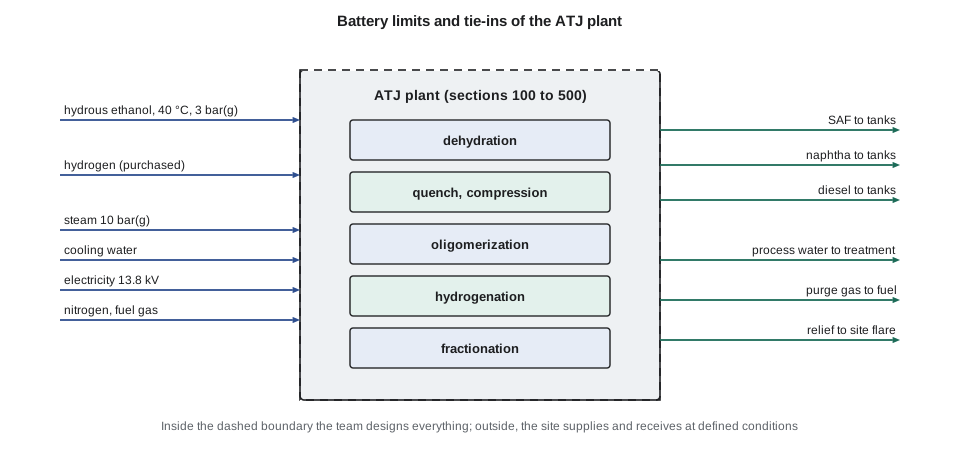
Battery limits define where the ATJ plant begins and ends. Inside the limits, the team designs everything. Outside them, the existing site provides feeds and utilities and accepts products and wastes at defined tie-in points. The basis lists each tie-in with its conditions: hydrous ethanol from the rectifier at 40 °C and 3 bar(g), plant steam at 10 bar(g), cooling water from a new cell on the existing tower, electricity at 13.8 kV, nitrogen for purging and blanketing, fuel gas, the flare header, wastewater to the site's treatment, and product lines to new tanks in the tank farm.
Utilities
Kingfisher's utility systems were sized for the ethanol plant and its expansion. The basis states what spare capacity exists and what the ATJ plant must provide for itself. Medium-pressure steam is available in modest amounts; the new boilers of the expansion have some margin. Cooling water needs a new cell on the existing tower. Electricity is available from the site substation, but a large electric heater, one of the options in Lesson 7, would need a new feeder. Hydrogen is not made on the site. Sarnia has industrial gas suppliers that can deliver it, and the basis assumes purchased hydrogen while recording on-site electrolysis as an alternative for the carbon intensity study.
Each utility in the basis carries a cost, taken from Kingfisher's forecasts, and a carbon intensity. The second column is unusual in older design bases but central here. The value of the product depends on its carbon intensity, so the team needs emission factors for steam, electricity, natural gas and hydrogen from the first week. The electricity factor in Ontario is about 40 g CO₂e per kWh on an annual average basis, and the basis records that value and its source.
Codes, standards and regulations
The basis lists the codes the design must follow, so that every later calculation can cite them. Pressure vessels are designed to CSA B51, registered with the TSSA. Process safety follows CSA Z767 Process Safety Management, applied under Ontario's Occupational Health and Safety Act, with the Technical Standards and Safety Authority (TSSA) for pressure equipment and fuel systems. Electrical equipment in areas where flammable gas may be present is classified under Section 18 of the Canadian Electrical Code (zones). Safety instrumented systems follow CAN/CSA-C22.2 No. 61511-1 (the Canadian adoption of IEC 61511). Relief systems follow API Standard 520 and API Standard 521, piping ASME B31.3, and storage tanks API 650. Air emissions need an amended Environmental Compliance Approval (ECA) for air and noise, supported by an updated ESDM report under O. Reg. 419/05. The basis does not repeat these documents; it says which edition the design uses, and which Kingfisher engineering standards add to them.
Economic basis
The economics of Lesson 12 can only be compared with other projects if they use the company's conventions. Kingfisher's finance group provides them: costs in Canadian dollars of 2026; an operating life of 20 years after two years of construction; a real discount rate of 8 % after tax for the base case, with 10 % and 6 % as sensitivities; a combined income tax rate of 26.5 %; and the immediate expensing of manufacturing and processing machinery enacted by Bill C-15 in March 2026. Prices for ethanol, fossil jet fuel, the by-products and credits come from Kingfisher's forecasts. The ethanol is valued at its market price, not its production cost. Every litre turned into jet fuel is a litre not sold as fuel ethanol, so the market price is the real cost to Kingfisher of using it, even though it comes from its own plant.
Worked problem
On-stream hours and hourly rate
If the plant achieved only 7,500 on-stream hours, what hourly ethanol rate would be needed to process 100 million litres a year, and would the 10 % design margin cover it?
Show solution
- Hourly rate \(= 100\times10^{6} \times 0.789 / 7\,500 / 1\,000 = 10.52\) t/h.
- Ratio to the normal rate \(= 10.52 / 9.86 = 1.067\), so 6.7 % above normal.
- The design margin is 10 %, so the equipment can handle it, with 3 % to spare.
Answer: About 10.5 t/h, within the 10 % margin. The margin is not free capacity: if the plant loses on-stream time it uses up the margin that was meant to cover uncertainty in the design.
Approval and change control
Ingrid approves the memorandum in week 5 after two rounds of comments. From then on it is a controlled document. Any change to an approved item, such as a different feed purity, a new product or a different discount rate, goes through a short change note: what changes, why, what parts of the design it affects, and who approves it. The team keeps a change log beside the decision log of Lesson 1. In week 9, for example, the catalyst data Jonah obtains from the literature show that the oligomerization catalyst needs ethylene with less than 1 ppm of oxygenates; the change note adds an ethylene purification step to the flowsheet and records the extra cost. Without change control, the separation train and the cost estimate would have drifted apart.
Common mistakes
MistakeDividing annual capacity by 8,760 hours to get the design rate.
InsteadDivide by the on-stream hours, then apply the design margin.
MistakeValuing the site's own ethanol at its production cost.
InsteadUse the market price: it is the opportunity cost of not selling the ethanol.
MistakeCopying the jet fuel specification without margin.
InsteadDesign the fractionator to meet the specification with margin for normal variation.
MistakeLeaving assumptions unstated because they are uncertain.
InsteadRecord them as open items with an owner and a date.
MistakeChanging a basis item quietly when new data arrive.
InsteadUse a change note so every affected part of the design is updated.
Summary and key terms
- The design basis memorandum fixes the assumptions every later calculation uses and lists open items with owners and dates.
- Hourly rates come from annual capacity divided by on-stream hours; equipment is designed with a margin and checked at turndown.
- Feeding hydrous ethanol before the molecular sieves and denaturant avoids drying water that the dehydration reaction makes again.
- ATJ-SPK is certified under ASTM D7566 Annex A5 and may be blended with conventional jet fuel up to 50 %.
- Battery limits and tie-ins define what the team designs and what the site supplies.
- The economic basis follows the company's conventions and values the ethanol at its opportunity cost.
- Design basis memorandum
- A controlled document fixing the assumptions of a design.
- On-stream factor
- The fraction of the year a plant operates.
- Turndown
- The lowest rate, as a fraction of design, at which a plant operates stably.
- Battery limits
- The boundary of the plant being designed, where it connects to existing facilities.
- ATJ-SPK
- Synthetic paraffinic kerosene made from alcohols, certified under ASTM D7566 Annex A5.
- Change note
- A record of a change to an approved basis item, its reasons and its effects.
- Opportunity cost
- The value of the best alternative use given up, here the sale of the ethanol.
Practice problems
Work each problem on paper first, then reveal the answer to check.
What hourly ethanol rate corresponds to 80 million litres a year at 8,000 h/yr?
Show answer
7.89 t/h.
Why does the team take ethanol before the molecular sieves?
Show answer
Dehydration makes water anyway; drying the feed wastes energy if the catalyst tolerates water.
Why must the ethanol be taken before the denaturant is added?
Show answer
Gasoline in the feed would contaminate a product certified as synthetic and add unwanted aromatics and sulfur.
What is the maximum blend of ATJ-SPK with conventional jet under its annex?
Show answer
50 % by volume.
Why does the basis record a carbon intensity for each utility?
Show answer
The product's value depends on its carbon intensity, which depends on the utilities used.
Name two trace feed components that matter for the catalysts.
Show answer
Nitrogen compounds (poison acid catalysts) and sulfur (poisons metal hydrogenation catalysts).
Lesson quiz · 5 questions
Score 60% or more to complete this lesson.
Create a free account to save your progress, take quizzes and earn a certificate.