
CHE-380 · Lesson 7 of 12 · 23 min
Preventing fires and explosions
Lessons 5 and 6 described what happens when a flammable mixture finds an ignition source. This lesson is about stopping it. The strategies attack the sides of the fire triangle: keep air out of equipment by inerting, keep fuel out of the air by containment and ventilation, and remove ignition sources by controlling static electricity, electrical equipment and hot work. At Kingfisher Bioenergy, Theo's tasks are to check the nitrogen blanketing design for the ethyl acetate tanks, to review the drum filling station, where static electricity is the main concern, and to confirm the electrical area classification for the tank farm. Each task combines simple calculations with codes and practices built from long experience.
Inerting
Inerting adds an inert gas, usually nitrogen, to a vessel to reduce the oxygen concentration below the limiting oxygen concentration of lesson 5. It is the most reliable way to prevent internal fires and explosions in tanks, reactors, dryers and centrifuges that handle flammable materials, because it does not depend on keeping ignition sources out of the vessel. Two operations are involved. Purging removes air from equipment before flammable material is introduced, or removes flammable vapour before air is let in for maintenance. Blanketing keeps a small positive pressure of nitrogen on a vessel during operation so that air cannot leak in as liquid is withdrawn or the vapour cools.
For the ethyl acetate tanks, with an estimated LOC of about 10 % oxygen, the company standard sets the operating limit at 6 % and an alarm at 8 %, each monitored by an oxygen analyser on the vapour space. The blanketing regulator admits nitrogen when the tank pressure falls during pump-out and a conservation vent relieves when it rises during filling. Nitrogen is not free and is itself a hazard, so the design balances reliability, consumption and the risk of asphyxiation near vents and inside tanks.
Purging calculations
In pressure purging, a vessel is pressurized with nitrogen from \(P_L\) to \(P_H\), allowed to mix, then vented back to \(P_L\). Each cycle multiplies the oxygen fraction by \(P_L/P_H\), so after \(j\) cycles
Vacuum purging works the same way with a vacuum as the low pressure. In sweep-through purging, nitrogen flows in at one opening and out at another; for a well-mixed vessel of volume \(V\) the time to dilute from \(C_1\) to \(C_2\) is
Real vessels are not perfectly mixed, so practice applies a factor, often doubling or tripling the calculated volume, and confirms the result with an oxygen measurement before the next step. Siphon purging, which fills a vessel with liquid and drains it while admitting nitrogen, uses the least nitrogen for vessels that can be filled.
# Preventing ignition: purging calculations and static electricity checks
import math
# Pressure purging a 30 m3 tank with nitrogen from 21 % O2 to below 8 % (target well under the LOC)
PL, PH, y0 = 101.3, 250.0, 21.0
j = 0; y = y0
while y >= 8.0: j += 1; y = y0 * (PL / PH) ** j
n_N2 = 30.0 * (PH - PL) * 1000 / (8.314 * 293) * j
print(f"pressure purge 1 atm to {PH:.0f} kPa abs: {j} cycles -> {y:.1f} % O2, nitrogen {n_N2 * 0.028:.0f} kg")
# Sweep-through purge: Qv t = V ln(C1/C2)
V, Qv = 30.0, 0.05       # m3, m3/s nitrogen
t = V / Qv * math.log(21.0 / 8.0)
print(f"sweep purge at {Qv * 3600:.0f} m3/h: {t / 60:.0f} min (assumes perfect mixing; use a safety factor)")
# Static: energy stored on an ungrounded steel drum and on a person
for name, C, V in (("55-gallon steel drum, ungrounded", 100e-12, 20_000.0), ("person on insulating floor", 200e-12, 10_000.0)):
    print(f"{name}: {0.5 * C * V * V * 1000:.1f} mJ  vs MIE of ethyl acetate ~0.46 mJ")
# Charge relaxation time of a liquid: tau = eps0 * epsr / sigma
eps0 = 8.854e-12
for name, er, s in (("ethyl acetate (semi-conductive)", 6.0, 4.6e-7), ("toluene (low conductivity)", 2.4, 1e-12)):
print(f"{name}: relaxation time {eps0 * er / s:.2e} s")pressure purge 1 atm to 250 kPa abs: 2 cycles -> 3.4 % O2, nitrogen 103 kg sweep purge at 180 m3/h: 10 min (assumes perfect mixing; use a safety factor) 55-gallon steel drum, ungrounded: 20.0 mJ vs MIE of ethyl acetate ~0.46 mJ person on insulating floor: 10.0 mJ vs MIE of ethyl acetate ~0.46 mJ ethyl acetate (semi-conductive): relaxation time 1.15e-04 s toluene (low conductivity): relaxation time 2.12e+01 s
For a 30 m³ vessel, two pressure cycles from atmospheric to 250 kPa absolute reduce the oxygen from 21 % to about 3.4 %, using about 100 kg of nitrogen. A sweep purge at 180 m³/h would take about 10 minutes in an ideal well-mixed vessel to reach 8 %; in practice the operators sweep for longer and confirm with an analyser. The choice between methods depends on whether the vessel can take pressure or vacuum, how much nitrogen is available and how long the operation can take.
Worked problem
Vacuum purging
A vessel is evacuated to 20 kPa absolute and then filled with nitrogen to 101 kPa, three times. Starting from 21 % oxygen, what is the final oxygen concentration?
Show solution
- Each cycle multiplies by \(20/101 = 0.198\).
- \(y_3 = 21 \times 0.198^3 = 0.16\) %.
Answer: About 0.16 % oxygen.
Static electricity
Static charge is generated whenever two materials contact and separate: liquid flowing through pipes and filters, liquid splashing into a container, powder moving through a chute, a person walking across a floor. Charge that cannot leak away accumulates, raising the voltage until it discharges as a spark. The energy stored on an object of capacitance \(C\) at voltage \(V\) is
An ungrounded steel drum of about 100 pF charged to 20 kV stores 20 mJ, and a person of about 200 pF at 10 kV stores 10 mJ. Both are far above the minimum ignition energy of ethyl acetate vapour, roughly 0.5 mJ. Static sparks are among the commonest ignition sources in solvent handling, and many drum and tote filling fires have been traced to them.
Whether a liquid holds its charge depends on its conductivity. The charge relaxes with a time constant \(\tau = \varepsilon_0\varepsilon_r/\sigma\). Ethyl acetate, a polar liquid, is moderately conductive and loses charge in a fraction of a millisecond once it is in a grounded container. Low-conductivity liquids such as toluene and many hydrocarbon fuels, with conductivities around 1 pS/m, take tens of seconds, long enough to build hazardous charges in a tank. For such liquids the rules include limiting flow velocity in pipes, especially at the start of filling, adding relaxation time downstream of filters, and sometimes adding antistatic additives. Guidance comes from NFPA 77 and from industry practices for loading fuels.
Bonding and grounding
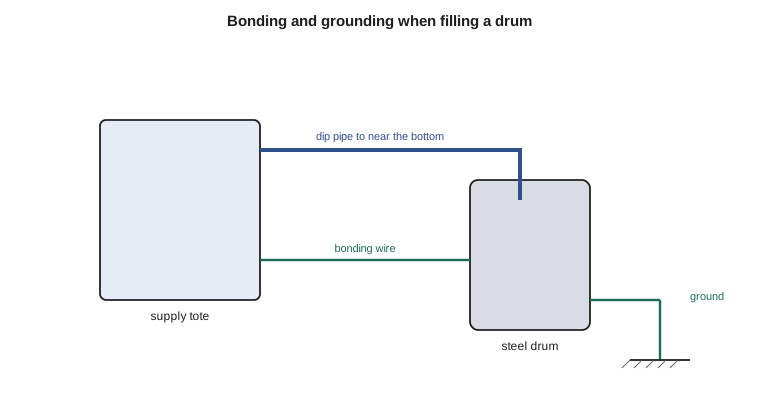
Bonding connects conductive objects electrically so that they stay at the same potential and cannot spark to each other. Grounding connects them to earth so that charge drains away. At the drum filling station, the supply tote, the filling lance and the drum are bonded together and grounded through a clamp with a monitoring system that prevents the filling pump from starting unless a good ground is detected. The lance reaches to near the bottom of the drum so that the liquid does not free-fall and splash, which would generate more charge and mist. Operators wear conductive footwear, and the floor is conductive. Plastic containers cannot be grounded in the usual way and are not used for low-flash-point solvents at Kingfisher Bioenergy.
Worked problem
Static energy
A worker of capacitance 150 pF walks across an insulating floor and reaches 15 kV. Could a discharge ignite ethyl acetate vapour?
Show solution
- \(E = 0.5 \times 150 \times 10^{-12} \times (15{,}000)^2 = 0.017\) J = 17 mJ.
- Compare with about 0.5 mJ.
Answer: Yes: the stored energy is about 30 times the minimum ignition energy.
Ventilation and containment
Ventilation keeps vapour concentrations from small, expected releases well below the LFL. Buildings that house flammable liquid pumps or filling stations are ventilated at rates that hold concentrations below a quarter of the LFL, often with gas detection that increases the ventilation or shuts down the operation if the level rises. Containment is the first defence: welded rather than flanged piping where practical, sealless or double-sealed pumps on volatile services, closed sampling systems, and vapour return lines when tank trucks are loaded. Each of these reduces the number and size of releases that the other safeguards must handle.
Electrical area classification
Electrical equipment can ignite flammable atmospheres through sparks and hot surfaces. Area classification identifies where flammable atmospheres could exist and how often, and requires equipment suitable for each area. In Ontario the rules are Section 18 of the Canadian Electrical Code, which uses the Zone 0, 1 and 2 system. In the zone system, Zone 0 is an area where a flammable atmosphere is present continuously or for long periods, such as inside a tank's vapour space; Zone 1 is where it is likely in normal operation, such as near a vent or a drum filling opening; and Zone 2 is where it is not likely in normal operation and would exist only briefly, such as around flanges and valves in a well-ventilated area. In the older North American division system, Division 1 roughly covers Zones 0 and 1, and Division 2 corresponds to Zone 2.
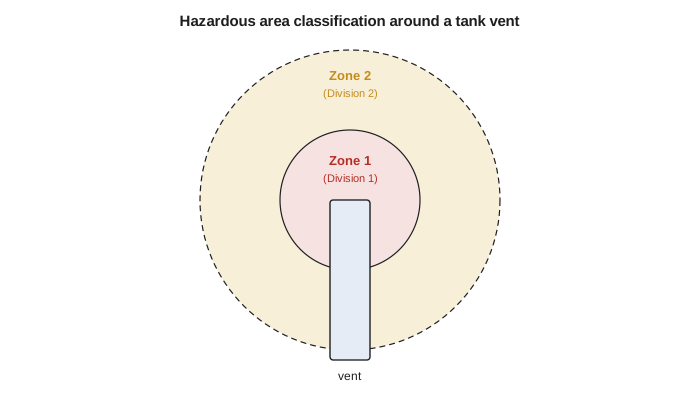
The extent of each zone around a source is taken from codes and recommended practices, such as API RP 505 and the NFPA 497 recommended practice, adjusted for the ventilation and the properties of the material. Equipment in classified areas must be protected by one of several methods: explosion-proof or flameproof enclosures that contain an internal explosion, intrinsically safe circuits that cannot release enough energy to ignite the atmosphere, purged and pressurized enclosures, or non-sparking designs for Zone 2. Each piece of equipment also carries a temperature class that must be below the autoignition temperature of the material. The dispersion results of lesson 4 helped Theo confirm that the drum filling station lies inside the Zone 2 area of the tank farm and that its motors, lights and the grounding monitor carry the right ratings for that area.
Checking the blanketing design
Theo checks the nitrogen supply for the tank blankets by asking what happens when a tank is pumped out at full rate. The transfer pump draws 120 m³/h of liquid, so the blanketing regulator must admit at least 120 m³/h of nitrogen at tank conditions to stop the pressure falling and air entering through the vacuum vent. On a summer afternoon a sudden rainstorm can cool the tank shell and contract the vapour space, adding to the demand; API Standard 2000 gives methods for estimating this thermal inbreathing. The nitrogen header and regulators are sized for the sum, with a margin, and a low-pressure alarm on the nitrogen supply warns the operators if it fails. If the nitrogen supply is lost for a long time, the procedure is to stop transfers from the tanks so that no air is drawn in.
Hot work and other ignition sources
Welding, cutting and grinding are among the most frequent causes of fires in operating plants. Hot work permits require the area to be tested for flammable gas, combustibles to be removed or covered, drains and openings to be sealed, a fire watch to be posted during and after the work, and the permit to be signed by a person who understands the hazards. Vehicles, smoking, open flames and portable electronics are controlled in classified areas. Theo notes that most of these controls depend on people following procedures every time, which is why the engineering controls of inerting, bonding and classified equipment are designed to work even when a procedure slips.
Common mistakes
MistakeDesigning a blanket at an oxygen level just below the LOC.
InsteadKeep a margin, monitor oxygen and alarm well below the LOC.
MistakeAssuming one purge calculation fits all vessels.
InsteadReal vessels mix imperfectly; apply a factor and verify with an analyser.
MistakeFilling drums by splash loading from the top.
InsteadUse a grounded dip pipe to near the bottom and bond all conductive parts.
MistakeTreating area classification as a one-time drawing.
InsteadReview it when equipment, ventilation or materials change.
Summary and key terms
- Inerting keeps oxygen below the LOC; the ethyl acetate tanks run at 6 % with an 8 % alarm.
- Pressure purging multiplies oxygen by \(P_L/P_H\) each cycle; two cycles to 250 kPa absolute give about 3.4 %.
- Static energy \(\tfrac{1}{2}CV^2\) from an ungrounded drum or a person can be tens of millijoules.
- Bonding, grounding and dip pipes control static at the drum station.
- Area classification by zones or divisions sets the protection required for electrical equipment.
- Inerting
- Adding inert gas to keep oxygen below the limiting oxygen concentration.
- Blanketing
- Maintaining a small positive pressure of inert gas on a vessel in service.
- Bonding
- Electrically connecting conductive objects so they stay at the same potential.
- Grounding
- Connecting conductive objects to earth to drain static charge.
- Relaxation time
- The time constant for charge to leak from a liquid.
- Intrinsic safety
- A protection method limiting circuit energy below what can ignite the atmosphere.
Practice problems
Work each problem on paper first, then reveal the answer to check.
How many pressure cycles from 100 to 400 kPa absolute reduce oxygen from 21 % to below 2 %?
Show answer
Two: \(21 \times 0.25^2 = 1.3\) %.
What is the energy on a 50 pF object at 8 kV?
Show answer
\(0.5 \times 50 \times 10^{-12} \times 64 \times 10^6 = 1.6\) mJ.
Why are low-conductivity liquids more of a static hazard?
Show answer
Their charge takes a long time to relax.
What is the difference between bonding and grounding?
Show answer
Bonding equalizes potential between objects; grounding connects them to earth.
Which zone describes the vapour space inside a fixed-roof solvent tank?
Show answer
Zone 0.
Name two protection methods for electrical equipment in Zone 1.
Show answer
Flameproof enclosures, intrinsic safety or purging and pressurization.
Lesson quiz · 5 questions
Score 60% or more to complete this lesson.
Create a free account to save your progress, take quizzes and earn a certificate.