
CHE-380 · Lesson 5 of 12 · 22 min
Fires and flammability
Ethanol and ethyl acetate are the two largest hazards at Kingfisher Bioenergy, and both are hazards because they burn. Most fires and explosions in the chemical industry come from flammable liquids and gases released into the air or allowed to form flammable mixtures inside equipment. This lesson covers the properties that describe how easily a material burns: flammability limits, flash point, autoignition temperature and minimum ignition energy. It also covers how to estimate the limits of mixtures and how to tell whether the vapour space in a tank is flammable. These properties are the basis for the prevention methods of lesson 7 and the hazard analyses later in the course.
The fire triangle
A fire needs three things: fuel, an oxidant (usually the oxygen in air) and an ignition source. Remove any one and there is no fire. The triangle is simple, but each side has quantitative detail. Fuel must be present as a vapour or fine mist in the right proportion with air; too little or too much will not burn. Oxygen must exceed a minimum concentration. Ignition sources must deliver enough energy or be hot enough. Most prevention strategies remove one side deliberately: keeping fuel concentrations below the flammable range by ventilation, removing oxygen by inerting, or eliminating ignition sources by electrical classification and bonding. Because ignition sources are hard to eliminate completely, good designs rarely rely on that side alone.
Flammability limits
A mixture of fuel vapour and air burns only between a lower flammable limit, LFL, and an upper flammable limit, UFL, usually given as volume percent of fuel in air at room temperature and atmospheric pressure. Below the LFL the mixture is too lean, and the heat released by burning a small volume is not enough to ignite the next; above the UFL it is too rich. For ethyl acetate the limits are about 2.0 and 11.5 %; for ethanol, about 3.3 and 19 %. The limits widen as temperature rises and, especially the UFL, as pressure rises. They narrow as inert gas is added. Published values differ a little between sources because of the test apparatus, so engineers use values from a recognized compilation and keep margins.
The LFL of many organic vapours is close to half the stoichiometric concentration, and the heat released at the LFL is nearly the same for many hydrocarbons. Such correlations are useful for estimating limits when data are missing. For mixtures of fuels, Le Chatelier's rule gives the limit from the mole fractions \(y_i\) of the fuels in the fuel part of the vapour:
with the same form for the UFL. The rule works well for similar fuels such as hydrocarbons and less well for mixtures with very different chemistry, but it is widely used for estimates. The vapour above the ester column's reflux drum, which contains ethyl acetate and some ethanol, illustrates it.
# Flammability: Le Chatelier mixture limits, LOC estimate, and the vapour-in-headspace check
lims = {"ethyl acetate": (2.0, 11.5), "ethanol": (3.3, 19.0)}   # % by volume, approximate published values
y = {"ethyl acetate": 0.7, "ethanol": 0.3}                        # mole fractions of the fuel part of the vapour
lfl = 1 / sum(y[f] / lims[f][0] for f in y); ufl = 1 / sum(y[f] / lims[f][1] for f in y)
print(f"mixture LFL {lfl:.2f} %   UFL {ufl:.1f} %")
# Limiting oxygen concentration estimate: LOC ~ z x LFL, z = moles O2 per mole fuel
z = {"ethyl acetate": 5.0, "ethanol": 3.0}   # C4H8O2 + 5 O2; C2H6O + 3 O2
for f in lims: print(f"LOC estimate for {f}: {z[f] * lims[f][0]:.1f} % O2 (measured values are usually used)")
# Headspace of a fixed-roof tank: vapour fraction ~ Psat/P from Antoine (ethyl acetate, approximate constants, mmHg, C)
import math
A, B, Cc = 7.10179, 1244.95, 217.88
for T in (-10, -4, 5, 15, 25, 35):
    p = 10 ** (A - B / (T + Cc)) * 133.322
    yv = 100 * p / 101_325
    state = "below LFL (too lean)" if yv < 2.0 else ("FLAMMABLE" if yv <= 11.5 else "above UFL (too rich)")
print(f"{T:4d} C: vapour {yv:5.1f} % -> {state}")mixture LFL 2.27 % UFL 13.0 % LOC estimate for ethyl acetate: 10.0 % O2 (measured values are usually used) LOC estimate for ethanol: 9.9 % O2 (measured values are usually used) -10 C: vapour 1.7 % -> below LFL (too lean) -4 C: vapour 2.5 % -> FLAMMABLE 5 C: vapour 4.3 % -> FLAMMABLE 15 C: vapour 7.5 % -> FLAMMABLE 25 C: vapour 12.5 % -> above UFL (too rich) 35 C: vapour 19.9 % -> above UFL (too rich)
For a vapour that is 70 % ethyl acetate and 30 % ethanol on a fuel basis, the mixture limits come out at about 2.3 % and 13 %. These limits apply to the total fuel concentration in air.
Worked problem
Mixture LFL
A vapour contains fuel that is 50 % methane (LFL 5.0 %) and 50 % propane (LFL 2.1 %) by mole. Estimate its LFL.
Show solution
- \(1/LFL = 0.5/5.0 + 0.5/2.1 = 0.100 + 0.238 = 0.338\).
- \(LFL = 2.96\) %.
Answer: About 3.0 % total fuel in air.
Flash point and the vapour space of a tank
The flash point of a liquid is the lowest temperature at which it gives off enough vapour to form an ignitable mixture with air near its surface, measured in a standard closed-cup or open-cup apparatus. It corresponds roughly to the temperature at which the vapour pressure gives a concentration equal to the LFL. Ethyl acetate's flash point is about −4 °C and ethanol's about 13 °C. Both are below normal handling temperatures, which is why both are classed as flammable liquids under the fire codes and dangerous goods rules, and why spills of either can be ignited easily.
The same idea answers an important design question: is the vapour space of a storage tank flammable? In a closed fixed-roof tank in equilibrium, the vapour above the liquid is saturated, and its fuel concentration is the vapour pressure divided by the total pressure. The code calculates that concentration for ethyl acetate from the Antoine equation. At −10 °C the headspace is about 1.7 % ethyl acetate, below the LFL. Between about −4 °C and 23 °C it lies inside the flammable range. Above about 24 °C it is too rich to burn. A tank of ethyl acetate in a Sarnia winter or on a spring morning may therefore contain a flammable atmosphere, and any ignition source inside it, such as a static spark during filling, could cause an internal explosion.
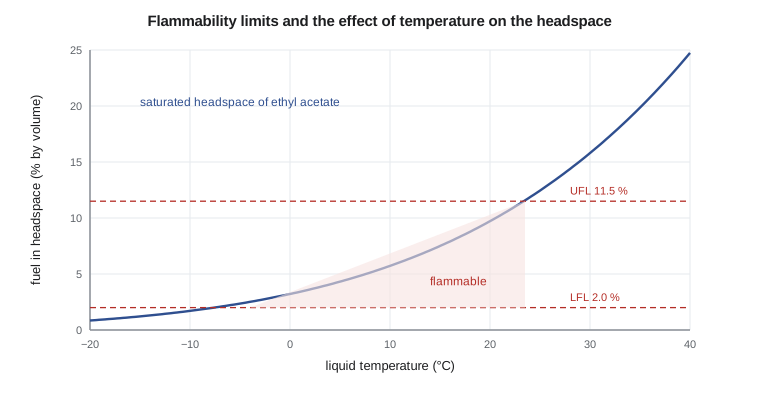
This analysis is why the new ethyl acetate tanks at Kingfisher Bioenergy are blanketed with nitrogen, which keeps the oxygen in the headspace too low for combustion whatever the temperature. Ethanol tanks behave similarly over a higher temperature band and are typically fitted with internal floating roofs, which remove most of the vapour space. Lesson 7 shows how the inerting is designed and checked.
Limiting oxygen concentration
Adding nitrogen or carbon dioxide to a flammable mixture narrows its limits until, at a certain oxygen concentration, no mixture of the fuel with that atmosphere can burn. That oxygen concentration is the limiting oxygen concentration, LOC, also called the minimum oxygen concentration. For many organic vapours it is between about 9 and 12 % oxygen with nitrogen as the diluent. Measured values should be used where available. When they are not, a rough estimate is \(LOC \approx z \times LFL\), where \(z\) is the number of moles of oxygen per mole of fuel for complete combustion. For ethyl acetate, \(z = 5\), so the estimate is about 10 % oxygen. Inerting systems are normally designed to keep the oxygen well below the LOC, often at least 2 percentage points lower or at 60 % of it, with continuous monitoring.
Worked problem
LOC estimate
Estimate the LOC for propane (LFL 2.1 %), which burns as C₃H₈ + 5O₂.
Show solution
- \(z = 5\).
- \(LOC \approx 5 \times 2.1 = 10.5\) % oxygen.
Answer: About 10.5 %, close to measured values of about 11 %.
Ignition: temperature and energy
The autoignition temperature is the lowest temperature at which a material ignites in air without an external flame or spark, for example on contact with a hot surface. It is about 427 °C for ethyl acetate and about 363 °C for ethanol, though values depend on the test. Hot surfaces such as steam lines, exhaust pipes and electrical equipment must stay below the autoignition temperature of any material that could reach them; electrical equipment for flammable areas carries a temperature code for this purpose.
The minimum ignition energy, MIE, is the smallest spark energy that can ignite the most easily ignited mixture of a vapour with air. For many hydrocarbon and solvent vapours it is a fraction of a millijoule; for ethyl acetate it is reported to be roughly 0.5 mJ. That is very small: a person walking across a floor can accumulate several millijoules of static charge, and a discharge from a human finger can ignite such vapours. Dusts typically need more energy, from about 1 mJ to hundreds of millijoules, though some fine dusts are as sensitive as vapours.
| Property | Ethyl acetate | Ethanol |
|---|---|---|
| Lower flammable limit | about 2.0 % | about 3.3 % |
| Upper flammable limit | about 11.5 % | about 19 % |
| Flash point | about −4 °C | about 13 °C |
| Autoignition temperature | about 427 °C | about 363 °C |
| Minimum ignition energy | roughly 0.5 mJ | roughly 0.6 mJ |
The minimum ignition energy depends strongly on composition. It is lowest near the stoichiometric mixture and rises steeply toward the flammable limits, where much more energy is needed. It also falls as oxygen concentration rises, so oxygen-enriched atmospheres are especially easy to ignite. Published values refer to the most easily ignited mixture, which makes them conservative for design.
Mists deserve a note. A liquid sprayed as fine droplets can burn even when its temperature is below its flash point, because the droplets present a large surface and vaporize quickly in a flame. Leaks of hot oils and lubricants from small holes produce such mists, and several fires in compressor and turbine enclosures have started this way. Flash point alone therefore does not settle whether a release can burn; the way it is released matters too.
Types of fire
A release of flammable material that ignites can burn in several ways. A pool fire burns above a liquid pool; its size depends on the pool area and the burning rate. A jet fire burns at a pressurized release of gas or flashing liquid; it is intense and can cut through steel in minutes if it impinges on equipment. A flash fire occurs when a dispersed vapour cloud ignites without significant overpressure; the flame front sweeps through the cloud quickly, and people inside it are severely burned. If the cloud is partly confined or congested, the flame can accelerate and produce a vapour cloud explosion, the subject of lesson 6. Lesson 6 also covers how thermal radiation from fires is estimated and how it affects people and equipment.
Fire codes classify flammable and combustible liquids by flash point and boiling point, and the class sets requirements for storage, spacing, diking, ventilation and fire protection. The ethyl acetate tank farm follows the Ontario Fire Code and the referenced NFPA 30 Flammable and Combustible Liquids Code for these requirements. Theo notices that most of the code requirements map directly onto the properties in this lesson: the low flash point puts ethyl acetate in the most restrictive class, which drives the spacing between tanks, the size of the dikes and the need for foam protection.
Common mistakes
MistakeAssuming a tank is safe because its liquid is cold.
InsteadCheck the headspace concentration against the limits; cold tanks can be flammable.
MistakeAssuming the space above the UFL is safe.
InsteadAir entering a rich space dilutes it through the flammable range.
MistakeDesigning inerting right at the LOC.
InsteadKeep a margin below the LOC and monitor oxygen continuously.
MistakeTreating flash point as the temperature at which a liquid ignites.
InsteadIt is the temperature at which the vapour can be ignited by a source.
Summary and key terms
- Fire needs fuel within its limits, oxygen above the LOC and an ignition source.
- Ethyl acetate burns between about 2.0 and 11.5 % in air; ethanol between about 3.3 and 19 %.
- Le Chatelier's rule gives mixture limits; the reflux drum vapour gives about 2.3 to 13 %.
- A saturated ethyl acetate headspace is flammable from about −4 to 23 °C, so the tanks are blanketed with nitrogen.
- Ethyl acetate's MIE is a fraction of a millijoule; static sparks can ignite it.
- Lower flammable limit
- The lowest fuel concentration in air that can propagate a flame.
- Flash point
- The lowest liquid temperature at which its vapour can be ignited near the surface.
- Autoignition temperature
- The temperature at which a mixture ignites without a spark or flame.
- Minimum ignition energy
- The smallest spark energy that can ignite the most sensitive mixture.
- Limiting oxygen concentration
- The oxygen level below which no fuel-air mixture can burn.
- Flash fire
- Rapid burning of a vapour cloud without significant overpressure.
Practice problems
Work each problem on paper first, then reveal the answer to check.
A fuel is 60 % A (LFL 2 %) and 40 % B (LFL 4 %). Estimate the mixture LFL.
Show answer
\(1/(0.3 + 0.1) = 2.5\) %.
At 30 °C, is an ethyl acetate tank headspace flammable?
Show answer
No, it is above the UFL, but air leaking in can make it flammable.
Estimate the LOC of ethanol from its LFL and combustion equation.
Show answer
\(3 \times 3.3 \approx 10\) % oxygen.
Why must hot surfaces in flammable areas be kept below the autoignition temperature?
Show answer
Vapour contacting them could ignite without a spark.
Name three types of fire that can follow a flammable release.
Show answer
Pool fire, jet fire and flash fire.
Why do fire codes require the most restrictive treatment for ethyl acetate?
Show answer
Its flash point is below ordinary temperatures.
Lesson quiz · 5 questions
Score 60% or more to complete this lesson.
Create a free account to save your progress, take quizzes and earn a certificate.