
CHE-380 · Lesson 3 of 12 · 23 min
Source models for releases
Every consequence study starts with a question that sounds simple: if something leaks, how much comes out and how fast? The answer is a source model. It describes the rate, duration and physical state of a release: liquid, gas, a flashing two-phase mixture, or vapour rising from a pool. The tank farm review at Kingfisher Bioenergy needs source models for the new ethyl acetate storage tanks T-401 to T-403, the transfer pumps and the nitrogen blanketing system. Theo works through them with the site process safety engineer, Nadia Brandt, who has done many such studies. This lesson presents the standard models for the most common release types, following the approach used in the process safety literature.
Choosing release scenarios
Source models are applied to scenarios, and scenarios are chosen from the hazard review. Typical scenarios are holes of standard sizes in pipes and vessels, such as 5, 25 and 100 mm, full-bore ruptures of small connections, failures of hoses during loading, overfilling of tanks and the escape of gas through a failed regulator. For each scenario the analyst needs the material, its temperature and pressure, the hole size and location, the inventory available and how long the release would continue before it is isolated. The last item is often the most important and the most uncertain. A release that an operator or an automatic valve stops in five minutes is very different from one that drains a whole tank.
Nadia's rule is to start with a credible worst case for screening and then refine the scenarios that matter. A full-bore rupture of the largest line is rarely likely, but if its consequences stay inside the plant there is no need to study it further. If a smaller and more likely release reaches the fence, it deserves careful work.
Liquid through a hole
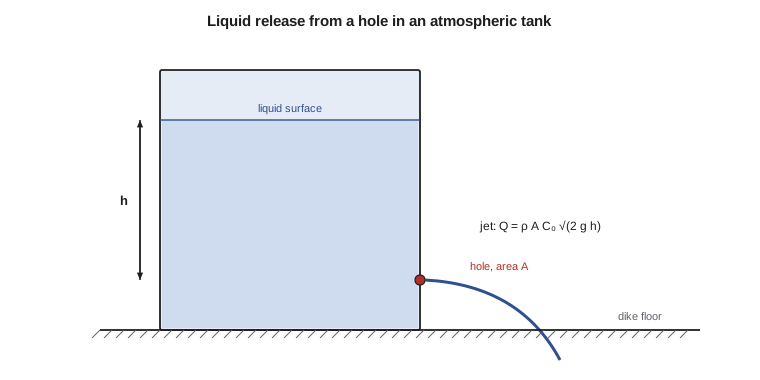
For an incompressible liquid flowing through a hole, the mechanical energy balance gives the discharge. Driving pressure may come from the liquid head above the hole, from gas pressure in the vessel, or both. The mass flow is
where \(\rho\) is the liquid density, \(A\) the hole area, \(C_0\) a discharge coefficient, \(P_g\) the gauge pressure above the liquid and \(h_L\) the liquid height above the hole. For a sharp-edged orifice \(C_0\) is about 0.61; when its value is uncertain, analysts sometimes use 1.0 to be conservative. For an atmospheric tank, \(P_g\) is zero and the equation becomes Torricelli's result. As the liquid level falls the rate decreases, and integrating the balance gives the time to drain the liquid above the hole.
# Source models: liquid through a hole, choked gas release, flashing fraction and pool evaporation
import math
g, R = 9.81, 8.314
# 1. Liquid ethyl acetate from a 25 mm hole 4.0 m below the liquid surface in an atmospheric tank
rho, C0, d, h = 900.0, 0.61, 0.025, 4.0
A = math.pi * d * d / 4
Qm = rho * A * C0 * math.sqrt(2 * g * h)
print(f"liquid release: {Qm:.2f} kg/s initially; tank 'drains' slower as the level falls")
# Time to drain the liquid above the hole from a 10.0 m diameter tank (Torricelli)
At = math.pi * 10.0 ** 2 / 4
t = At / (C0 * A) * math.sqrt(2 * h / g)
print(f"time to drain the 4.0 m above the hole: {t / 3600:.1f} h  (mass {rho * At * h / 1000:.0f} t)")
# 2. Nitrogen escaping from a 10 mm hole in a 600 kPa(g) blanketing line (choked flow)
k, M, T0, P0 = 1.40, 0.028, 293.0, 701_325.0
crit = (2 / (k + 1)) ** (k / (k - 1))
print(f"choked if Pamb/P0 < {crit:.3f}: here {101_325 / P0:.3f}")
A2 = math.pi * 0.010 ** 2 / 4
Qg = 1.0 * A2 * P0 * math.sqrt(k * M / (R * T0) * (2 / (k + 1)) ** ((k + 1) / (k - 1)))
print(f"nitrogen release {Qg * 1000:.0f} g/s ({Qg * 3600:.0f} kg/h)")
# 3. Flashing fraction of propane released from storage at 20 C (normal boiling point -42 C)
cp, Tb, Hv = 2.5, 231.0, 426.0     # kJ/kg K, K, kJ/kg (approximate)
fv = cp * (293.0 - Tb) / Hv
print(f"propane flash fraction ~ {fv:.2f}; with spray (rainout ignored) roughly twice that becomes airborne")
# 4. Evaporation from an ethyl acetate pool in a 10 m x 12 m dike at 25 C
Psat, Tl = 12_600.0, 298.0           # Pa (approximate), K
K0, M0 = 0.0083, 18.0                # m/s for water, Crowl's reference method
Km = K0 * (M0 / 88.1) ** (1 / 3)
Qe = 0.0881 * Km * 120.0 * Psat / (R * Tl)
print(f"pool evaporation: mass transfer coefficient {Km * 100:.2f} cm/s, rate {Qe:.2f} kg/s")liquid release: 2.39 kg/s initially; tank 'drains' slower as the level falls time to drain the 4.0 m above the hole: 65.8 h (mass 283 t) choked if Pamb/P0 < 0.528: here 0.144 nitrogen release 128 g/s (460 kg/h) propane flash fraction ~ 0.36; with spray (rainout ignored) roughly twice that becomes airborne pool evaporation: mass transfer coefficient 0.49 cm/s, rate 0.26 kg/s
For a 25 mm hole 4.0 m below the liquid surface in tank T-402, the initial release is 2.4 kg/s of ethyl acetate. Left alone, the 283 tonnes above the hole would take about 66 hours to drain from the 10 m diameter tank. The initial rate is what matters for the first minutes of a fire or vapour cloud; the duration and total mass matter for the size of the pool and for environmental damage. The model assumes the hole stays the same size, which may not hold for a crack that grows. The dike around the tanks is the main defence: it limits the pool area, and lesson 4 uses that area to estimate how much vapour rises from it.
Worked problem
Release from a pressurized tank
A tank holds water-like liquid (\(\rho = 1{,}000\) kg/m³) under a nitrogen pad of 100 kPa gauge, with 3 m of liquid above a 10 mm hole. Take \(C_0 = 0.61\). What is the release rate?
Show solution
- \(A = \pi(0.010)^2/4 = 7.85 \times 10^{-5}\) m².
- \(P_g/\rho + gh = 100{,}000/1{,}000 + 9.81 \times 3 = 129.4\) J/kg.
- \(Q_m = 1{,}000 \times 7.85 \times 10^{-5} \times 0.61 \times \sqrt{2 \times 129.4} = 0.77\) kg/s.
Answer: About 0.77 kg/s, most of it driven by the gas pressure.
Gas through a hole
Gas flowing from a vessel through a hole accelerates as its pressure falls. If the upstream pressure is high enough, the flow reaches sonic velocity in the hole and is choked: further reductions in downstream pressure do not increase it. Choking occurs when the downstream to upstream absolute pressure ratio is below the critical ratio
which is about 0.53 for diatomic gases such as nitrogen and air with \(k = 1.4\). In practice almost any gas release from a vessel above about 90 kPa gauge is choked. The choked mass flow is
where \(P_0\) and \(T_0\) are the upstream absolute pressure and temperature and \(M\) the molar mass. For a 10 mm hole in the 600 kPa gauge nitrogen supply, the release is about 128 g/s. Nitrogen is not toxic or flammable, but in an enclosed space it displaces oxygen. A release of that size into a small analyser shelter could reduce the oxygen to dangerous levels within minutes, which is why such shelters at Kingfisher Bioenergy have oxygen monitors and ventilation.
Worked problem
Choked flow check
Air at 300 kPa absolute escapes to the atmosphere. Is the flow choked?
Show solution
- Critical ratio for \(k = 1.4\): 0.528.
- Actual ratio: \(101.3/300 = 0.338\), which is below 0.528.
Answer: Yes, the flow is choked, and the rate depends only on upstream conditions.
Flashing liquids
A liquid stored above its normal boiling point, kept liquid by pressure, partly vaporizes when released. Propane, butane and ammonia are common examples; at Kingfisher Bioenergy, the propane used for the boiler pilot and the denaturant blending area are the nearest cases. The released liquid cools to its boiling point, and the energy given up vaporizes a fraction
of the mass. For propane at 20 °C, \(f_v\) is about 0.36. The rest leaves as droplets. Fine droplets evaporate in the air, while larger ones rain out onto the ground. Observations of real releases suggest that a common rule of thumb, taking roughly twice the flash fraction as airborne, gives sensible estimates when there is little rainout. Flashing flow through a hole or pipe also behaves differently from pure liquid or gas flow, and specialist two-phase models are needed for accurate release rates; they connect to the relief sizing of lesson 9.
Evaporation from pools
A liquid that spills at a temperature below its boiling point forms a pool that evaporates. The evaporation rate depends on the vapour pressure, the area of the pool and the mass transfer from the surface into the wind:
where \(K\) is a gas-phase mass transfer coefficient, \(A\) the pool area, \(P^{sat}\) the saturation pressure at the liquid temperature \(T_L\). One simple method takes \(K\) from the value for water, about 0.83 cm/s, scaled by the cube root of the ratio of molar masses. Correlations that include wind speed and pool size are also available. For ethyl acetate filling the 10 m by 12 m dike at 25 °C, the rate is about 0.26 kg/s. Boiling liquids, such as a cryogen spilled on warm ground, evaporate at a rate set by heat transfer from the ground and air rather than by mass transfer, and different models apply.
The dike is a powerful safeguard because evaporation scales with area. If the same spill spread unconfined over a paved area five times larger, it would evaporate five times faster and produce a larger cloud. Reducing pool area is therefore one of the simplest and most effective consequence reductions: sloped dike floors that drain to a small remote sump, smaller dikes around each tank, and foam blankets applied by the fire service all work by shrinking the evaporating surface.
| Release type | Driving force | Typical model |
|---|---|---|
| Liquid through a hole | Liquid head and gas pressure | Orifice equation, \(C_0 \approx 0.61\) |
| Gas through a hole | Upstream pressure | Choked flow above about 1.9 times atmospheric |
| Flashing liquid | Superheat above boiling point | Flash fraction plus aerosol estimate |
| Evaporating pool | Vapour pressure and wind | Mass transfer coefficient times area |
| Boiling pool | Heat from ground and air | Heat transfer model |
Releases inside buildings
Not every release happens in the open. A leak inside a pump house or an analyser shelter accumulates rather than dispersing, and the concentration rises until the ventilation removes vapour as fast as it arrives. The steady concentration is the release rate divided by the ventilation rate, the same balance used for dilution ventilation in lesson 2, but with a release rate many times larger. A 1 mm leak from a pump seal on the ethyl acetate transfer line releases only grams per second, yet in a small, poorly ventilated pump house it can raise the concentration toward the lower flammable limit within an hour. For this reason the transfer pumps at Kingfisher Bioenergy are outdoors under a roof rather than in an enclosed building, and the analyser shelter has gas detection interlocked with its ventilation fan.
Uncertainty and what to do with it
Each model has parameters that are uncertain: discharge coefficients, hole sizes, isolation times, liquid temperatures, rainout fractions. Nadia's practice is to run a range of values and record which ones dominate. In the tank farm study, isolation time dominates the mass released, and pool area dominates the evaporation rate. The temperature of the liquid matters strongly too, because vapour pressure rises roughly exponentially with temperature: the evaporation rate on a hot summer day may be twice that on a cool spring day. Analysts usually choose conservative values for screening, then refine only where the result is close to a decision threshold.
Source terms also depend on how the plant is operated. If an operator is in the field and can close a manual valve in two minutes, the release mass is modest; if the plant is unattended at night, the release may run until it is noticed. The review team therefore records the assumptions about detection and isolation along with each source term, so that a later change, such as reducing night staffing, triggers a review of the analysis.
Common mistakes
MistakeUsing gauge pressure in the choked flow equation.
InsteadUse absolute pressure \(P_0\).
MistakeAssuming a release continues only as long as it takes to notice it.
InsteadAdd realistic times for detection, decision and isolation.
MistakeTreating all of a flashing release as vapour.
InsteadEstimate the flash fraction and the aerosol; the rest may rain out.
MistakeIgnoring pool area when estimating evaporation.
InsteadEvaporation scales with area; dikes and drainage reduce it.
Summary and key terms
- Source models give release rate, duration and physical state.
- A 25 mm hole 4 m below the surface of T-402 releases 2.4 kg/s of ethyl acetate.
- Gas releases from vessels above about 90 kPa gauge are choked; the nitrogen leak was 128 g/s.
- Propane at 20 °C flashes about 36 % on release.
- The dike pool evaporates about 0.26 kg/s at 25 °C; smaller pools evaporate less.
- Source model
- A description of the rate, duration and state of a release.
- Discharge coefficient
- A factor accounting for losses in flow through a hole.
- Choked flow
- Flow at sonic velocity, independent of downstream pressure.
- Flash fraction
- The fraction of a superheated liquid that vaporizes on release.
- Rainout
- Liquid droplets from a release that fall to the ground.
- Isolation time
- The time from the start of a release until it is stopped.
Practice problems
Work each problem on paper first, then reveal the answer to check.
Double the hole diameter for a liquid release. What happens to the rate?
Show answer
It increases fourfold.
A gas at 150 kPa absolute escapes to the atmosphere. Choked?
Show answer
No: \(101.3/150 = 0.68 > 0.53\).
What is the critical pressure ratio for \(k = 1.3\)?
Show answer
\((2/2.3)^{1.3/0.3} = 0.546\).
Why does a smaller dike reduce the evaporation rate?
Show answer
Evaporation is proportional to pool area.
A liquid has \(c_p = 2\) kJ/kg K, is 30 K above its boiling point and has \(\Delta H_v = 400\) kJ/kg. Flash fraction?
Show answer
\(2 \times 30/400 = 0.15\).
Name two quantities that dominate the uncertainty in the tank farm source terms.
Show answer
Isolation time and pool area.
Lesson quiz · 5 questions
Score 60% or more to complete this lesson.
Create a free account to save your progress, take quizzes and earn a certificate.