
CHE-380 · Lesson 6 of 12 · 20 min
Explosions, BLEVEs and dust
An explosion is a rapid release of energy that produces a pressure wave. In process plants, explosions come from several sources: the ignition of a flammable vapour cloud among equipment, a deflagration inside a vessel or duct, the bursting of a vessel under pressure, a boiling liquid expanding vapour explosion when a pressurized tank of liquefied gas fails in a fire, and the ignition of combustible dust. This lesson explains the physics of each at the level needed for facility siting and protection. Its purpose is defensive: to estimate what a blast could do to occupied buildings and equipment so that they can be placed and built to protect the people inside. At Kingfisher Bioenergy, the question that drives the lesson is whether the new control room and the existing laboratory are far enough from the ethyl acetate tank farm and process area.
Deflagration and detonation
When a flammable mixture ignites, a flame front moves through it. In a deflagration the front moves slower than the speed of sound in the unburned gas, pushed by heat transfer and diffusion. In open air a deflagration in a vapour cloud travels a few metres per second and produces little overpressure; this is a flash fire. If the flame is accelerated by turbulence, for example as it passes through congested pipe racks and equipment, the speed can rise to hundreds of metres per second and generate damaging overpressures. In a detonation the front moves faster than sound, driven by a shock wave; overpressures are much higher. Most accidental vapour cloud explosions in process plants are fast deflagrations caused by congestion and confinement, not detonations.
This explains a central lesson from incidents such as Flixborough and Texas City: the severity of a vapour cloud explosion depends less on the total amount of fuel than on how much of the cloud lies in congested or confined regions. Open areas contribute little. Reducing congestion, keeping clouds away from crowded equipment and spacing plant to allow venting all reduce explosion severity.
Estimating overpressure
Several methods estimate the overpressure from a vapour cloud explosion. The oldest and simplest is the TNT-equivalent method. It converts the energy of the fuel in the cloud into an equivalent mass of TNT using an explosion efficiency:
where \(\eta\) is an efficiency, typically 1 to 10 % and often taken as about 3 %, \(m\) the mass of fuel in the cloud, \(\Delta H_c\) its heat of combustion, and \(E_{TNT}\) about 4.68 MJ/kg. The overpressure at distance \(R\) is then read from published curves of side-on overpressure against scaled distance \(Z = R/m_{TNT}^{1/3}\). The method is easy to use but crude, because it ignores the role of congestion. More modern methods, such as the TNO multi-energy method and the Baker-Strehlow-Tang method, assign a blast strength to each congested region and are preferred for siting studies. Recommended practices API RP 752 for permanent buildings and API RP 753 for portable buildings, written after Texas City, describe how such studies are used to site occupied buildings.
# Explosion and fire consequence estimates used for building siting (illustrative inputs)
import math
# TNT-equivalent method for a vapour cloud, scaled distance and approximate side-on overpressure
m, dHc, eta, E_TNT = 2000.0, 23_600.0, 0.03, 4680.0   # kg in cloud, kJ/kg heat of combustion (ethyl acetate ~23.6 MJ/kg), yield, kJ/kg
W = eta * m * dHc / E_TNT
table = ((3, 200.0), (5, 70.0), (8, 28.0), (10, 18.0), (15, 9.5), (20, 6.5), (30, 3.8), (50, 2.0))   # Z m/kg^(1/3) vs kPa, approximate curve values
def ps(R):
    Z = R / W ** (1 / 3)
    if Z <= table[0][0]: return table[0][1]
    for (z1, p1), (z2, p2) in zip(table, table[1:]):
        if Z <= z2: return math.exp(math.log(p1) + (math.log(p2) - math.log(p1)) * (math.log(Z) - math.log(z1)) / (math.log(z2) - math.log(z1)))
    return table[-1][1]
print(f"TNT equivalent {W:.0f} kg")
for R in (50, 75, 100, 150, 250):
    print(f"control room at {R:3d} m: about {ps(R):5.1f} kPa side-on overpressure")
# Thermal radiation from a pool fire, point-source model
burn, D = 0.065, 10.0     # kg/m2 s burning rate (approximate for esters), equivalent pool diameter m
Apool = math.pi * D * D / 4; frac, tau = 0.25, 0.8
Qr = frac * burn * Apool * dHc   # kW radiated
for x in (15, 25, 40, 60):
    print(f"pool fire, {x:2d} m from centre: {tau * Qr / (4 * math.pi * x * x):5.1f} kW/m2")
# Dust: deflagration index class
for kst in (60, 150, 250, 320):
print(f"Kst {kst} bar m/s -> class St{1 if kst <= 200 else (2 if kst <= 300 else 3)}")TNT equivalent 303 kg control room at 50 m: about 32.2 kPa side-on overpressure control room at 75 m: about 15.1 kPa side-on overpressure control room at 100 m: about 9.6 kPa side-on overpressure control room at 150 m: about 5.6 kPa side-on overpressure control room at 250 m: about 2.9 kPa side-on overpressure pool fire, 15 m from centre: 8.5 kW/m2 pool fire, 25 m from centre: 3.1 kW/m2 pool fire, 40 m from centre: 1.2 kW/m2 pool fire, 60 m from centre: 0.5 kW/m2 Kst 60 bar m/s -> class St1 Kst 150 bar m/s -> class St1 Kst 250 bar m/s -> class St2 Kst 320 bar m/s -> class St3
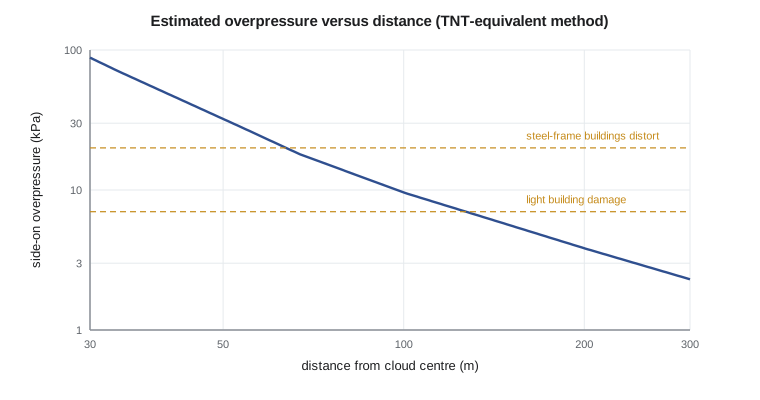
For a cloud containing 2,000 kg of ethyl acetate with a 3 % efficiency, the TNT equivalent is about 300 kg. The estimated side-on overpressure is about 32 kPa at 50 m, 15 kPa at 75 m, about 10 kPa at 100 m and below 3 kPa at 250 m. These numbers are approximate, because they rest on a chosen efficiency and on curve values read to perhaps 20 %. They are enough, however, to show the trend and the order of magnitude, and to compare candidate locations for the new control room.
| Side-on overpressure | Typical effect |
|---|---|
| about 1 kPa | Window glass may break |
| about 3 to 7 kPa | Minor to moderate damage to light buildings |
| about 15 to 20 kPa | Steel-frame buildings distort; serious damage to light buildings |
| about 35 kPa | Wood-frame buildings may collapse; threshold of eardrum injury |
| above about 70 kPa | Probable total destruction of conventional buildings |
At 100 m, the 10 kPa estimate puts a conventional building into the moderate damage range. Most injuries to people inside buildings in explosions come from building collapse and flying glass, not the blast itself. The siting study therefore leads to two decisions: the new control room is placed about 150 m from the tank farm, outside the 7 kPa contour of this screening estimate, and it is designed as a blast-resistant building with laminated glass and a structure checked for the estimated load. The existing laboratory, closer than that, is reviewed in more detail with the multi-energy method, and its occupancy during tank filling operations is reduced.
Worked problem
TNT equivalent and scaled distance
A cloud contains 500 kg of propane (\(\Delta H_c = 46\) MJ/kg). With \(\eta = 0.03\), find the TNT equivalent and the scaled distance at 60 m.
Show solution
- \(m_{TNT} = 0.03 \times 500 \times 46{,}000/4{,}680 = 147\) kg.
- \(Z = 60/147^{1/3} = 60/5.28 = 11.4\) m/kg\(^{1/3}\).
Answer: About 147 kg of TNT equivalent; at \(Z = 11.4\) the curves give roughly 15 kPa.
Thermal radiation from fires
Fires injure people and damage equipment mainly by thermal radiation. A simple point-source model treats the fire as a point emitting a fraction \(\chi_r\) of its heat release, and the radiation received at distance \(x\) is
where \(\dot m\) is the burning rate and \(\tau\) the atmospheric transmissivity. For a 10 m diameter pool of ethyl acetate, the model gives about 8.5 kW/m² at 15 m, 3 kW/m² at 25 m and about 1 kW/m² at 40 m. Commonly cited reference values are about 1.6 kW/m² for continuous exposure of people, about 5 kW/m² for brief exposure of emergency workers in protective clothing, about 12.5 kW/m² for ignition of wood and damage to plastic equipment, and about 37.5 kW/m² for severe damage to process equipment. Point-source models are reasonable at distances of more than a few pool diameters; closer in, solid flame models are used. The results guide the spacing of tanks, the location of fire water monitors and the routes firefighters can use.
Thermal radiation also affects equipment. Steel exposed to high radiation for long enough loses strength, and tanks near a fire are cooled with water spray or fixed monitors. The spacing between the ethyl acetate tanks follows the fire code, but the siting study checks that the radiation from a dike fire on the nearest neighbouring tank stays below the level at which its contents would boil vigorously. Where it would not, cooling water is provided. Radiation estimates also set the location of fire water monitors, which must be close enough to reach the fire but far enough away for firefighters to work.
Vessel bursts and BLEVEs
A vessel containing compressed gas stores energy that is released if it bursts. The energy can be estimated from the expansion of the gas, and blast curves give the overpressure. Vessel bursts are prevented by relief devices and by mechanical integrity programs, the subjects of lessons 8, 9 and 12.
A boiling liquid expanding vapour explosion, BLEVE, occurs when a vessel containing a liquid above its atmospheric boiling point, such as liquefied propane, fails suddenly. The typical sequence is a fire impinging on the vessel above the liquid level, where the steel is not cooled by liquid and weakens. The relief valve opens and releases vapour, but the vessel wall fails before the pressure falls. The liquid flashes violently, producing a blast, fragments that can travel hundreds of metres, and, if the contents are flammable, a fireball. Defences include water spray or fireproofing on pressurized storage, sloped ground that drains spills away from tanks, relief valves sized for fire exposure, and emergency response plans that keep responders back from a vessel engulfed in fire. At Kingfisher Bioenergy the small propane tank for the boiler pilot is located away from the ethanol tanks and drained ground is provided.
Dust explosions
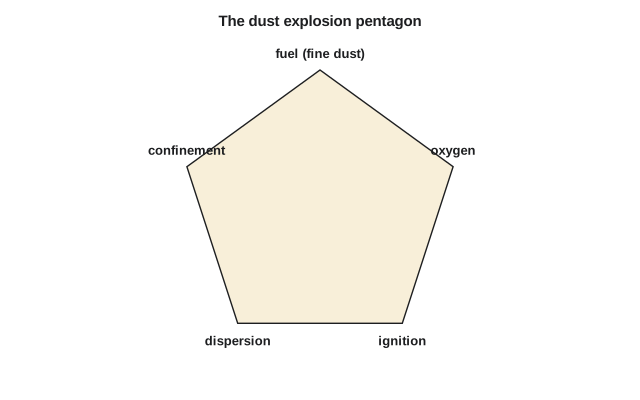
Fine particles of many combustible solids can explode when dispersed in air: grain, flour, sugar, wood, coal, plastics, metals and many chemicals. An ethanol plant handles grain at the receiving end and dried distillers grains at the product end, and both produce dust. A dust explosion needs five elements, often drawn as a pentagon: fuel in fine particle form, oxygen, an ignition source, dispersion of the dust in air and confinement. A small primary explosion inside equipment, such as a bucket elevator or dust collector, often shakes dust from beams and ledges into the air and ignites it, producing a larger secondary explosion. The 2008 sugar refinery explosion at Port Wentworth, Georgia, in which 14 people died, was a tragic example of accumulated dust feeding secondary explosions.
The severity of a dust deflagration in a closed vessel is described by the maximum pressure and the maximum rate of pressure rise, normalized for vessel volume as the deflagration index \(K_{St} = (dP/dt)_{max}V^{1/3}\), in bar·m/s. Dusts are grouped into classes St 1 for \(K_{St}\) up to 200, St 2 from 200 to 300 and St 3 above 300. Most grain and agricultural dusts fall in St 1. The classes are used to size explosion vents and suppression systems. In both countries the NFPA dust standards are the main references: NFPA 652 for the fundamentals and dust hazard analysis, NFPA 61 for agricultural and food processing facilities and NFPA 68 for venting. In the US, OSHA's grain handling standard, 29 CFR 1910.272, also applies to grain elevators, and in Canada fire codes and provincial rules call on the NFPA standards. Housekeeping is a primary control: accumulations of dust on surfaces must be kept below thin layers that could feed a secondary explosion.
Common mistakes
MistakeUsing the total mass of a released fuel to estimate blast without considering congestion.
InsteadSeverity depends on the congested and confined parts of the cloud.
MistakeTreating the TNT-equivalent result as precise.
InsteadIt is a screening estimate; use multi-energy methods for siting decisions.
MistakeAssuming a relief valve prevents a BLEVE.
InsteadFire can weaken the wall before pressure is relieved; cool or protect the vessel.
MistakeCleaning dust with compressed air.
InsteadUse vacuum systems rated for combustible dust to avoid dust clouds.
Summary and key terms
- Most vapour cloud explosions are fast deflagrations driven by congestion.
- A 2,000 kg ethyl acetate cloud gives about 300 kg TNT equivalent: about 10 kPa at 100 m.
- The new control room was sited about 150 m away and built blast resistant.
- Pool fire radiation falls with the square of distance; 10 m pool: about 3 kW/m² at 25 m.
- Dust explosions need fuel, oxygen, ignition, dispersion and confinement; secondary explosions are often worse.
- Deflagration
- Combustion with a flame front slower than the speed of sound.
- Detonation
- Combustion driven by a shock wave faster than the speed of sound.
- TNT equivalency
- A method expressing explosion energy as an equivalent mass of TNT.
- Side-on overpressure
- The pressure rise in a blast wave measured parallel to its travel.
- BLEVE
- A boiling liquid expanding vapour explosion from sudden failure of a pressurized liquid vessel.
- KSt
- The deflagration index of a dust, its normalized maximum rate of pressure rise.
Practice problems
Work each problem on paper first, then reveal the answer to check.
Why does a vapour cloud in an open field usually produce little overpressure?
Show answer
Without congestion the flame does not accelerate.
Double the TNT equivalent mass. By what factor does the distance to a given overpressure change?
Show answer
By \(2^{1/3} = 1.26\).
Radiation is 8 kW/m² at 15 m from a pool fire. Estimate it at 30 m.
Show answer
About 2 kW/m², a quarter.
What typically causes the vessel wall to fail in a BLEVE?
Show answer
Flame impingement on the vapour space where the steel is not cooled.
A dust has \(K_{St} = 250\) bar m/s. Which class?
Show answer
St 2.
Why do secondary dust explosions cause so much damage?
Show answer
The first blast lifts settled dust into a large cloud.
Lesson quiz · 5 questions
Score 60% or more to complete this lesson.
Create a free account to save your progress, take quizzes and earn a certificate.