
CHE-280 · Lesson 9 of 12 · 21 min
Environmentally assisted cracking
Of all the forms of corrosion, cracking is the one that worries Rafael most. A thinning wall gives years of warning to anyone who measures it. A pit usually leaks before it does anything worse. But a crack can grow through a highly stressed component with almost no loss of metal and no visible change at the surface, and if the component holds pressure, the result can be a sudden rupture rather than a leak. Environmentally assisted cracking is the general name for cracking caused by the combined action of a tensile stress and a corrosive environment, at stresses well below those that would break the metal in air. It covers stress corrosion cracking, hydrogen damage and corrosion fatigue. This lesson explains each, using cases from the Kingfisher Bioenergy plant and from industry, and shows how plants prevent them.
Stress corrosion cracking
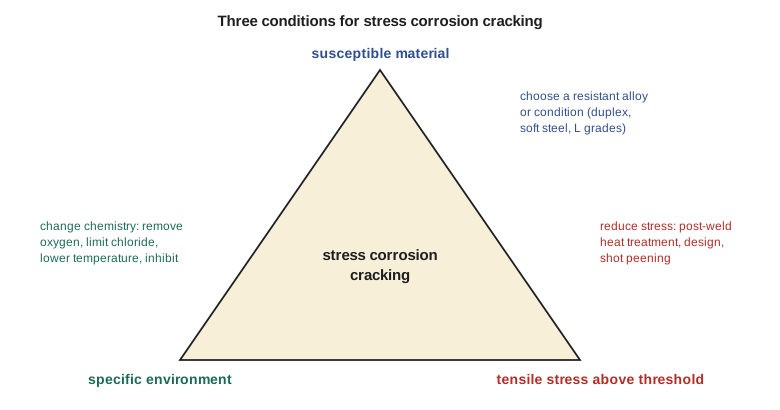
Stress corrosion cracking (SCC) requires three things at once: a susceptible material, a specific environment and a tensile stress above a threshold. Remove any one and cracking stops. The stress can be applied (pressure, weight, thermal expansion) or residual, left in the metal by welding, forming, bending or cold work; residual stresses near welds often approach the yield strength, so welds are the most common place for SCC to start. The environment is often surprisingly specific. Each alloy family has its own list of cracking environments, and a material that cracks rapidly in one environment may be immune in another that seems more aggressive.
Cracks may run through the grains (transgranular) or along the grain boundaries (intergranular), and they are often branched like the roots of a tree. The mechanisms involve repeated rupture of a protective film at the crack tip by strain, followed by localized dissolution, or hydrogen produced by corrosion entering the metal ahead of the crack. Either way, the crack grows slowly for a long time, sometimes years, and then faster as the stress at its tip rises.
| Material | Cracking environments | Notes |
|---|---|---|
| Austenitic stainless steels (304L, 316L) | Hot chloride solutions above about 60 °C; hot caustic; polythionic acids from sulfide scale | Transgranular, branched; duplex and nickel-rich alloys resist chloride SCC better |
| Carbon steel | Hot caustic (caustic embrittlement); fuel-grade ethanol; carbonate-bicarbonate; nitrates; amines; anhydrous ammonia with air | Often intergranular; stress relief of welds is a key defence |
| Copper alloys (brass) | Ammonia and ammonium compounds; mercury | Historically called season cracking |
| Aluminium alloys | Chloride solutions (high-strength grades) | Depends strongly on temper |
| Titanium | Methanol with chloride; some hot chloride salts | Rare in normal service |
| High-strength steels | Hydrogen from many sources | See hydrogen embrittlement |
Chloride stress corrosion cracking of stainless steel
Chloride SCC of austenitic stainless steel is the most common form in chemical plants. It needs chloride, a temperature above about 60 °C, oxygen or another oxidizer, and tensile stress. The chloride does not have to be in the process: water dripping from a leaking flange, rain soaking through damaged insulation, or a washdown that wets a hot surface can deposit chloride on the outside of a hot stainless line, where evaporation concentrates it. That is why insulation for stainless steel equipment must be low in leachable chloride and why hot stainless lines are often coated before insulating. Inside the evaporator, chloride concentrating at hot tube surfaces could crack 304L tubes as well as pit them; this is a second reason Rafael prefers duplex 2205, whose ferrite phase makes it far more resistant to chloride SCC.
Stress corrosion cracking of carbon steel in fuel ethanol
The plant's denatured ethanol storage tanks and loading lines are carbon steel, and fuel-grade ethanol is one of the less obvious environments that can crack it. In the 2000s, as ethanol use grew, cracks were found at welds in carbon steel tanks, piping and loading equipment at terminals and blending facilities, mostly downstream of ethanol plants. Research coordinated through the American Petroleum Institute and summarized in a recommended practice on ethanol SCC found that cracking needed dissolved oxygen in the ethanol, tensile stress (usually residual stress at welds that had not been stress relieved) and the right conditions of water, chloride and pH. Removing dissolved oxygen essentially stopped cracking in tests. Galvanic coupling and other factors played a part.
Industry practice that grew out of this work includes stress relieving new welds in ethanol service, minimizing dissolved oxygen (for example by deaeration or by blanketing tanks with nitrogen), controlling water and chloride content, adding corrosion inhibitors, and inspecting welds in tank bottoms and shells with magnetic particle or other crack-detection methods. Rafael checks that the plant's tanks were built with post-weld heat treatment at nozzle and shell-to-bottom welds where the recommended practice suggests it, and the inspection plan in Lesson 12 includes periodic wet fluorescent magnetic particle testing of selected tank welds.
Caustic and ammonia cracking
Hot concentrated sodium hydroxide cracks carbon steel, especially near welds; this was once called caustic embrittlement and caused many boiler explosions in the early twentieth century, when boiler water leaked through riveted joints and concentrated caustic in the crevices. Today, carbon steel equipment in caustic service above about 50 to 80 °C, depending on concentration, is stress relieved, and hotter duties use nickel alloys. Ammonia cracks brass, as the plant's old fermenter cooler showed in Lesson 4. Anhydrous ammonia can also crack carbon steel storage vessels when a little air is present; adding a small amount of water (about 0.2 percent) inhibits it, which is why ammonia storage specifications include a minimum water content.
Hydrogen damage
Atomic hydrogen produced at a metal surface by corrosion, cathodic protection, electroplating or welding can enter steel. Most of it combines to form hydrogen gas and bubbles away, but some atoms diffuse into the metal lattice, and they cause several kinds of damage. Hydrogen embrittlement reduces the ductility of high-strength steels and can cause delayed cracking under sustained stress; bolts above a hardness of about 35 to 39 on the Rockwell C scale are particularly at risk. Hydrogen blistering occurs when hydrogen collects at inclusions or laminations in lower-strength steel plate and forms molecular hydrogen at high pressure, bulging the steel. Hydrogen-induced cracking links blisters in a stepwise pattern through the wall. These forms are classic problems in wet hydrogen sulfide (sour) service in refineries and oil and gas production, because sulfide poisons the recombination of hydrogen atoms and drives more of them into the steel.
Sulfide stress cracking is a form of hydrogen embrittlement in hard steels and welds exposed to wet hydrogen sulfide. The international standard for materials in sour oil and gas production, published jointly by AMPP and ISO, sets limits on hardness and composition to prevent it; a common rule is to keep carbon steel welds and heat-affected zones below about 22 on the Rockwell C scale (roughly 250 on the Vickers scale). An ethanol plant has little hydrogen sulfide, but the plant does run anaerobic digestion of some waste streams, whose biogas contains hydrogen sulfide, so the same principles apply to the biogas piping and its compressor.
Corrosion fatigue
Fatigue is cracking under cyclic stress at levels well below the static strength, covered in MEC-250. In air, steels have a fatigue limit, a stress range below which they can survive indefinitely. In a corrosive environment, there is no true fatigue limit: corrosion roughens the surface, starts cracks at pits and accelerates crack growth, so failure eventually occurs at any stress range. This combination is corrosion fatigue. It causes failures in pump shafts, agitator shafts, vibrating piping, boiler tubes subject to thermal cycling, and equipment near reciprocating compressors and positive-displacement pumps. Cracks are usually transgranular and less branched than SCC cracks, often with several parallel cracks starting from pits.
Crack growth under cyclic loading follows the Paris law, \(da/dN = C(\Delta K)^m\), where \(a\) is the crack depth, \(N\) the number of cycles, \(\Delta K\) the range of the stress intensity factor and \(C\) and \(m\) material constants. For a shallow surface crack, \(\Delta K = Y \Delta\sigma \sqrt{\pi a}\), with a geometry factor \(Y\) near 1.12. A corrosive environment increases \(C\), sometimes by a factor of several or more. The program below integrates the Paris law for a small crack in a carbon steel pipe near a positive-displacement pump that pulses 25 times a minute, with an illustrative value of \(C\) raised to represent wet service. The crack grows from 0.5 mm to the limiting depth in under two months of continuous operation, which shows why vibration in wet piping must be fixed, not just watched.
# Corrosion fatigue: crack growth by the Paris law, da/dN = C (dK)^m
import math
C, m = 1.0e-11, 3.0        # m/cycle with dK in MPa*sqrt(m); C is about 3x the dry-air value (illustrative)
Y = 1.12                   # geometry factor for a shallow surface crack
d_sigma = 80.0             # stress range from pump pulsation, MPa
a0, K_IC = 0.5e-3, 60.0    # initial crack depth (m) and fracture toughness (MPa*sqrt(m))
a_c = (K_IC / (Y * (d_sigma) * 1.0)) ** 2 / math.pi    # critical depth if peak stress ~ range
a_c = min(a_c, 0.008)      # cannot exceed 80 % of a 10 mm wall
N, a, step = 0, a0, 1000
while a < a_c:
    dK = Y * d_sigma * math.sqrt(math.pi * a)
    a += C * dK ** m * step
    N += step
print(f"critical depth = {a_c * 1000:.1f} mm")
print(f"cycles to grow from {a0 * 1000:.1f} mm = {N:,.0f}")
f = 25 / 60                # 25 cycles per minute
print(f"at {f * 60:.0f} cycles per minute that is {N / f / 3600 / 24:.0f} days of operation")critical depth = 8.0 mm cycles to grow from 0.5 mm = 1,677,000 at 25 cycles per minute that is 47 days of operation
Worked problem
Stress intensity at a crack
A surface crack 2 mm deep sits in a vessel wall under a stress range of 60 MPa. Take \(Y = 1.12\). What is \(\Delta K\)?
Show solution
- \(\Delta K = Y \Delta\sigma \sqrt{\pi a} = 1.12 \times 60 \times \sqrt{\pi \times 0.002}\).
- \(\sqrt{0.006283} = 0.0793\).
- \(\Delta K = 1.12 \times 60 \times 0.0793 = 5.3\) MPa·m\(^{1/2}\).
Answer: About 5.3 MPa·m\(^{1/2}\). As the crack deepens, \(\Delta K\) rises with the square root of depth, and the growth rate rises with its cube for \(m = 3\).
Preventing environmentally assisted cracking
The triangle in the figure above gives the strategy. Change the material: choose an alloy or condition that does not crack in the environment, such as duplex instead of 304L in hot chloride, or soft rather than hardened steel in sour service. Change the environment: remove oxygen from ethanol and boiler water, limit chloride, control temperature, add inhibitors, or keep the metal dry. Reduce stress: stress relieve welds by post-weld heat treatment, design to lower operating and residual stresses, avoid sharp notches, and apply compressive surface stresses by shot peening. For corrosion fatigue, eliminate vibration and pulsation with better supports, pulsation dampeners and design, and protect surfaces with coatings or cathodic protection. And inspect: cracks need crack-detection methods such as magnetic particle, dye penetrant, eddy current and advanced ultrasonic techniques, described in Lesson 12, because thickness readings will not find them.
Common mistakes
MistakeAssuming a material that resists general corrosion will not crack.
InsteadCheck the specific cracking environments for the alloy; stainless steel cracks in hot chloride while resisting general attack.
MistakeLooking only at the process side for chloride stress corrosion cracking.
InsteadWet insulation, leaks and washdown can deposit chloride on the outside of hot stainless lines.
MistakeIgnoring residual stress from welding.
InsteadWeld residual stress often approaches yield; stress relieve where the environment can crack the material.
MistakeWatching a vibrating wet line instead of fixing the vibration.
InsteadCorrosion fatigue has no true endurance limit; remove the cyclic stress.
Summary and key terms
- Environmentally assisted cracking includes stress corrosion cracking, hydrogen damage and corrosion fatigue, at stresses well below the strength in air.
- Stress corrosion cracking needs a susceptible material, a specific environment and tensile stress, often residual stress from welding.
- Austenitic stainless steels crack in hot chloride; carbon steel cracks in hot caustic, fuel ethanol with oxygen, and other specific environments; brass cracks in ammonia.
- Hydrogen entering steel causes embrittlement of high-strength steels, blistering, hydrogen-induced cracking and sulfide stress cracking in sour service.
- Corrosion fatigue has no true endurance limit; crack growth follows the Paris law with a larger constant in corrosive environments.
- Prevent cracking by changing the material, the environment or the stress, and inspect with crack-detection methods.
- Stress corrosion cracking
- Cracking caused by the combined action of tensile stress and a specific corrosive environment on a susceptible material.
- Residual stress
- Stress locked into a component by welding, forming or uneven cooling, present without external load.
- Post-weld heat treatment
- Heating a welded component to relieve residual stresses and temper hard zones.
- Hydrogen embrittlement
- Loss of ductility and delayed cracking of a metal caused by absorbed hydrogen.
- Sulfide stress cracking
- Hydrogen embrittlement of hard steels in wet hydrogen sulfide environments.
- Corrosion fatigue
- Cracking under cyclic stress accelerated by a corrosive environment, with no true endurance limit.
- Paris law
- A relation, da/dN = C(ΔK)^m, between fatigue crack growth rate and the stress intensity range.
Practice problems
Work each problem on paper first, then reveal the answer to check.
Name the three conditions needed for stress corrosion cracking.
Show answer
A susceptible material, a specific environment and a tensile stress above a threshold.
Why must insulation on hot stainless steel lines be low in leachable chloride?
Show answer
Water soaking the insulation can carry chloride to the hot surface, where it concentrates and causes stress corrosion cracking.
What single change most reduced ethanol stress corrosion cracking of carbon steel in tests?
Show answer
Removing dissolved oxygen from the ethanol.
Why is a small water content specified for anhydrous ammonia storage?
Show answer
About 0.2 percent water inhibits stress corrosion cracking of carbon steel by ammonia contaminated with air.
Why is there no true fatigue limit in corrosion fatigue?
Show answer
Corrosion starts cracks at pits and keeps accelerating growth, so failure eventually occurs at any stress range.
Calculate ΔK for a 1 mm crack under a 100 MPa stress range with Y = 1.12.
Show answer
\(1.12 \times 100 \times \sqrt{\pi \times 0.001} = 6.3\) MPa·m\(^{1/2}\).
Lesson quiz · 5 questions
Score 60% or more to complete this lesson.
Create a free account to save your progress, take quizzes and earn a certificate.