
CHE-280 · Lesson 1 of 12 · 25 min
Materials selection for process plants
The thin stillage evaporator at the Kingfisher Bioenergy plant in Sarnia has been leaking again. Thin stillage is the liquid left after the whole stillage from the distillation columns has been centrifuged: a warm, acidic, slightly salty soup of dissolved solids, organic acids, yeast fragments and chloride from the corn and the process water. The evaporator concentrates it into syrup by boiling off water under vacuum, and its tubes and shell were built from type 304 stainless steel when the plant opened. Twice in the last eighteen months, a tube has developed a pinhole leak that let syrup into the steam side. Each leak meant a shutdown, a plugged tube and a lost day of production worth more than the cost of the tube bundle itself.
Theo Laurent, the co-op student who followed the plant through thermodynamics, physical chemistry and the analytical lab, has been assigned to the plant's new materials and integrity engineer, Rafael Mendes, for this term. Rafael's first question to Theo is the question this course is about: when a piece of equipment fails by corrosion, was it the wrong material, the wrong design, the wrong operation or bad luck? Answering it needs a working knowledge of the materials used to build process plants, the electrochemistry that drives corrosion, the forms corrosion takes, the ways to prevent it and the inspection programs that find it before it causes harm. This course follows Theo and Rafael through all five, with Ingrid Solheim, the process engineer, supplying the process conditions.
Why materials selection matters
Corrosion is the deterioration of a material by reaction with its environment. In a chemical plant it is not a side issue. Studies of the cost of corrosion in industrial economies have repeatedly put it at roughly three to four percent of gross domestic product, and a large share of that cost falls on process industries, pipelines and utilities. The direct costs are replacement equipment, coatings, inhibitors and inspection. The indirect costs are usually larger: lost production, contaminated product, leaks of flammable or toxic material, environmental releases and, in the worst cases, fires, explosions and injuries. Many of the serious process safety incidents of the last fifty years involved equipment that had thinned or cracked over years without anyone noticing.
Materials selection is the first and cheapest line of defence. A material chosen well at the design stage may run for decades with little attention. A material chosen poorly may fail in months, and replacing it in an operating plant costs many times more than choosing correctly in the first place. Selection is never just about corrosion resistance, though. The engineer must balance mechanical properties, fabricability, availability, cost, product purity, code requirements and the consequences of failure, and must do so with incomplete information about how the process will actually run.
The questions behind every selection
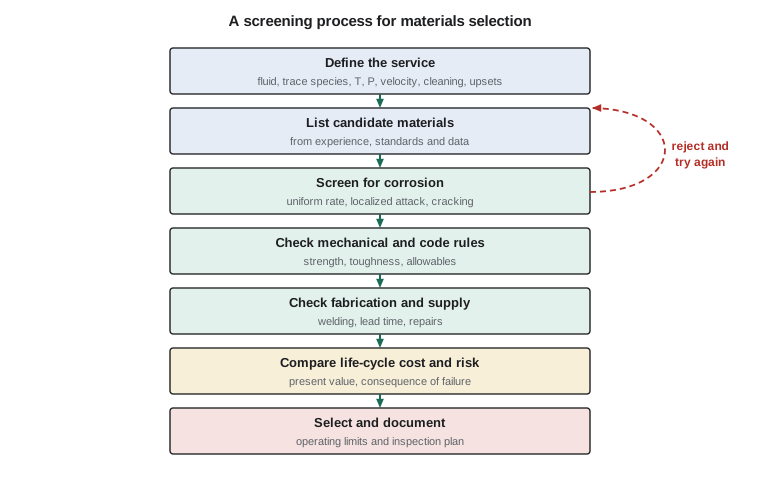
Rafael teaches Theo to start every selection with a short list of questions about the service. What is the fluid, and what is in it besides the main components? Trace contaminants often decide corrosion behaviour: a few hundred milligrams per litre of chloride can change a stainless steel from immune to pitting, and a trace of oxygen can turn a harmless condensate into an aggressive one. What are the temperature and pressure, including start-up, shutdown and upset conditions? What is the velocity, and are there solids that can erode? Is the equipment wetted continuously, intermittently or only during cleaning? What cleaning chemicals will it see? A tank that holds a mild fluid for eleven months and a hot caustic cleaning solution for one day each month must survive both.
The second set of questions concerns the consequences. What happens if this item leaks? A leak of cooling water from a heat exchanger is a nuisance; a leak of ethanol vapour near an ignition source is a fire; a leak of anhydrous ammonia is a toxic release. What is the required life? A pilot plant may need three years; a pressure vessel in a base-load plant may need thirty. Can the item be inspected and repaired in service, or does any failure mean a shutdown? Is the item regulated? In Ontario, pressure equipment falls under the Technical Standards and Safety Authority (TSSA), which administers Ontario's boilers and pressure vessels regulation and adopts CSA B51 and the ASME code, and the design must follow the referenced code, including its rules on allowable stresses and corrosion allowance.
Sources of corrosion data
Corrosion behaviour depends on so many variables that no table can predict it perfectly, but several sources give a good start. Corrosion data handbooks and supplier tables list corrosion rates or ratings for common alloys in hundreds of chemicals at various concentrations and temperatures, usually in pure solutions in the laboratory. Isocorrosion diagrams show, for one alloy in one chemical, the lines of constant corrosion rate (often 0.1 mm/y) on a plot of temperature against concentration. They are especially useful for acids such as sulfuric acid, where the behaviour of an alloy changes sharply with concentration. Standards and recommended practices from industry bodies, such as the American Petroleum Institute and AMPP (the Association for Materials Protection and Performance, formed in 2021 by the merger of NACE International and SSPC), summarize decades of field experience for particular services.
The most valuable data, however, come from the plant itself. Rafael's files contain inspection records for every vessel and line, corrosion coupon results from the cooling towers and condensate system, failure analysis reports, and the plant's own corrosion loop data. When the evaporator tubes failed, the tube samples went to a laboratory for metallography, which showed pits starting under deposits on the process side. That one report told Rafael more about the evaporator than any handbook could. Plant experience is especially important for mixed or unusual streams such as thin stillage, which no handbook lists.
Laboratory and field testing fill the gaps. Immersion coupon tests expose weighed specimens to the actual process fluid for weeks or months and measure the weight lost. Electrochemical tests, described in Lesson 6, give faster answers about pitting and passivity. Test racks installed inside operating equipment during a shutdown give the most realistic results of all, because they see the real temperature, flow, deposits and upsets. Whatever the source, the engineer should ask how closely the test matched the real service, especially in temperature, concentration of minor species and the presence of crevices and deposits.
Corrosion rate units and what they mean
Uniform corrosion rates are reported as a thickness loss per year. In Canada and most of the world, the unit is millimetres per year (mm/y); in the United States, mils per year (mpy) is common, where one mil is a thousandth of an inch, so 1 mm/y is about 39.4 mpy. A rough guide to what the numbers mean for carbon steel in a process plant: below 0.025 mm/y (1 mpy) is excellent; 0.025 to 0.1 mm/y is good and easily covered by a normal corrosion allowance; 0.1 to 0.5 mm/y is acceptable only with a generous allowance and regular inspection; and above 0.5 mm/y usually calls for a different material or a change in the environment. For stainless steels and nickel alloys, which are expected to be nearly immune, any measurable uniform rate is a warning that the passive film has broken down.
These guides apply only to uniform corrosion. A material that corrodes uniformly at 0.05 mm/y may be perfectly safe for twenty years, while a material that loses almost no weight but suffers pitting or cracking may fail in weeks. That is why the evaporator's 304 tubes, which showed negligible general corrosion, still leaked. Lessons 7 to 10 cover the forms of corrosion, and the most important lesson of the whole course is that the form often matters more than the rate.
The main families of materials
Process plants use a fairly small set of material families, each with its typical services. Carbon steel is the default for most vessels, tanks, piping and structural work because it is strong, tough, weldable, available and cheap; its weakness is corrosion, which designers handle with corrosion allowances, coatings, inhibitors and control of the environment. Low-alloy steels add chromium and molybdenum for strength at high temperature and resistance to hydrogen attack. Stainless steels resist a wide range of mild to moderately aggressive environments and keep products clean, which is why the fermenters, beer well, distillation columns and evaporators at an ethanol plant are usually stainless. Nickel alloys handle the most aggressive acids and chlorides at high cost. Copper alloys, aluminium alloys and titanium have important niches in heat exchangers and special services. Plastics, elastomers, fibre-reinforced plastics and linings handle many acids and salts that would destroy metals at modest temperatures. Lessons 2 to 5 examine each family.
| Equipment at the plant | Usual material | Main corrosion concern |
|---|---|---|
| Corn and grain handling | Carbon steel, galvanized steel | Atmospheric corrosion, abrasion |
| Fermenters, beer well, distillation | 304L or 316L stainless steel | Pitting and crevice corrosion under deposits |
| Thin stillage evaporator | 304L now, upgrade under study | Chloride pitting at boiling temperature |
| Ethanol storage tanks | Carbon steel | Stress corrosion cracking in fuel ethanol |
| Sulfuric acid storage (93 %) | Carbon steel | Hydrogen grooving, velocity effects |
| Cooling water system | Carbon steel, copper alloy and stainless tubes | Pitting, fouling, microbiological attack |
| Steam and condensate | Carbon steel | Carbonic acid and oxygen corrosion |
| Natural gas lateral (buried) | Coated carbon steel with cathodic protection | External corrosion in soil |
Life-cycle cost
The cheapest material to buy is rarely the cheapest to own. Life-cycle cost analysis adds the purchase and installation cost to the present value of maintenance, inspection, downtime and replacement over the study period, and subtracts any remaining value at the end. Because money spent in the future is worth less than money spent today, future costs are discounted. With a discount rate \(r\), a cost \(C\) incurred in year \(n\) has a present value of
For the thin stillage service, Rafael and Theo compare four options over thirty years: carbon steel with an epoxy lining, which needs relining every twelve years; 304L, which the plant's experience suggests will last about fifteen years before the pitting becomes intolerable; 316L, expected to last the full thirty years in this duty; and duplex 2205, which would comfortably outlast the study period. The program below does the arithmetic, including a salvage credit for any remaining life at the end. It also runs a simple weighted scoring of the non-cost factors, because a choice that looks best on cost may still lose on lead time, fabrication or cleanability.
# Weighted scoring and life-cycle cost for a new thin stillage tank
# Candidates: carbon steel with epoxy lining, 304L, 316L, duplex 2205
cands = {
    "CS + epoxy lining": {"capex": 180_000, "life": 12, "maint": 9_000},
    "304L":              {"capex": 260_000, "life": 15, "maint": 2_000},
    "316L":              {"capex": 300_000, "life": 30, "maint": 1_500},
    "duplex 2205":       {"capex": 340_000, "life": 40, "maint": 1_000},
}
rate = 0.07          # discount rate per year
horizon = 30         # study period, years

def pv(amount, year):
    return amount / (1 + rate) ** year

for name, c in cands.items():
    total = 0.0
    year = 0
    while year < horizon:              # buy, then replace at end of each life
        total += pv(c["capex"], year)
        year += c["life"]
    total += sum(pv(c["maint"], y) for y in range(1, horizon + 1))
    # salvage credit for remaining life at the end of the study period
    used = horizon % c["life"]
    if used:
        last = horizon - used
        total -= pv(c["capex"] * (c["life"] - used) / c["life"], horizon)
    c["lcc"] = total
    print(f"{name:18s} capex {c['capex']:>8,}  life {c['life']:>2} y  life-cycle cost {total:>10,.0f}")

best = min(cands, key=lambda n: cands[n]["lcc"])
print("lowest life-cycle cost:", best)

# Weighted scoring on non-cost criteria (scores 1-5)
weights = {"chloride resistance": 0.35, "cleanability": 0.15, "fabrication": 0.20, "lead time": 0.10, "cost": 0.20}
scores = {
    "CS + epoxy lining": [2, 3, 5, 5, 4],
    "304L":              [2, 5, 4, 4, 3],
    "316L":              [4, 5, 4, 4, 3],
    "duplex 2205":       [5, 5, 3, 2, 3],
}
for name, sc in scores.items():
    total = sum(w * s for w, s in zip(weights.values(), sc))
print(f"{name:18s} weighted score {total:.2f}")CS + epoxy lining capex 180,000 life 12 y life-cycle cost 395,267 304L capex 260,000 life 15 y life-cycle cost 379,054 316L capex 300,000 life 30 y life-cycle cost 318,614 duplex 2205 capex 340,000 life 40 y life-cycle cost 341,243 lowest life-cycle cost: 316L CS + epoxy lining weighted score 3.45 304L weighted score 3.25 316L weighted score 3.95 duplex 2205 weighted score 3.90
The lowest purchase price, the lined carbon steel tank, has the highest life-cycle cost once relining and downtime are counted, and 304L, the plant's original choice, is not much better. The 316L option wins on both cost and score here, though duplex is close behind and would be favoured if chloride levels rose. The answer is only as good as its inputs, of course, and the life estimates are the softest numbers in the analysis. Rafael's practice is to rerun the comparison with pessimistic lives for the better alloys and optimistic lives for the cheaper ones; if the ranking survives that test, the choice is robust.
Worked problem
Present value of a relining
A lined carbon steel tank needs relining in year 12 at a cost of 95,000 Canadian dollars. With a discount rate of 7 percent, what is the present value of that relining?
Show solution
- Use \(PV = C/(1 + r)^{n}\) with \(C = 95{,}000\), \(r = 0.07\) and \(n = 12\).
- \((1.07)^{12} = 2.252\).
- \(PV = 95{,}000/2.252 = 42{,}200\) Canadian dollars.
Answer: About 42,200 Canadian dollars. The discount shrinks future costs, but repeated relinings and the downtime they cause still add up.
Documenting the selection
A materials selection is not finished until it is written down. Rafael's plant keeps a materials selection report for each new item and a corrosion loop diagram for the whole plant. A corrosion loop groups equipment and piping that share the same process fluid and the same likely damage mechanisms, so that inspection and monitoring can be planned loop by loop. The report records the service conditions assumed, the damage mechanisms considered, the material chosen, the corrosion allowance, any limits on operating conditions (for example, a maximum chloride level or temperature) and the inspection plan. Those limits matter as much as the material. If the evaporator is upgraded to 316L on the assumption that chloride stays below a certain level, the plant must monitor chloride and act if it rises; otherwise the new tubes may fail as the old ones did.
Operating limits written into a selection report are often called integrity operating windows. Each window states a variable (chloride, pH, temperature, oxygen, velocity), its normal range, and what operators must do if it drifts outside the range: adjust the process, notify the integrity engineer, or shut down. Lesson 12 returns to integrity operating windows as part of the plant's corrosion management system.
Common mistakes
MistakeChoosing the material with the lowest purchase price.
InsteadCompare life-cycle cost, including maintenance, downtime and replacement, over the required life.
MistakeLooking up only the main components of the stream.
InsteadTrace species such as chloride, oxygen and sulfide often decide corrosion behaviour.
MistakeTreating a low uniform corrosion rate as proof that a material is suitable.
InsteadCheck for localized attack and cracking, which can cause failure with little weight loss.
MistakeDesigning only for normal operation.
InsteadInclude start-up, shutdown, upsets and cleaning chemicals in the service description.
Summary and key terms
- Corrosion is the deterioration of a material by reaction with its environment; its direct and indirect costs are large, and many process safety incidents involve corroded equipment.
- Selection starts with a full description of the service, including trace species, temperature range, velocity, cleaning and upsets, and with the consequences of failure.
- Corrosion data come from handbooks, isocorrosion diagrams, industry standards, plant experience and testing; plant experience is the most valuable.
- Uniform corrosion rates are given in mm/y or mpy (1 mm/y is about 39.4 mpy); the form of corrosion often matters more than the rate.
- Carbon steel is the default material; stainless steels, nickel alloys, non-ferrous metals and non-metallics serve more aggressive or special duties.
- Life-cycle cost, with future costs discounted to present value, usually favours more durable materials over the cheapest to buy.
- Document the selection, its assumptions and its operating limits, and monitor those limits in service.
- Corrosion
- Deterioration of a material, usually a metal, by chemical or electrochemical reaction with its environment.
- Corrosion allowance
- Extra wall thickness added to a design to be consumed by corrosion over the equipment's life.
- Isocorrosion diagram
- A chart showing lines of equal corrosion rate for one material in one chemical across a range of concentrations and temperatures.
- Life-cycle cost
- The total cost of owning an item over a study period, with future costs discounted to present value.
- Corrosion loop
- A group of equipment and piping with the same process fluid and the same likely damage mechanisms.
- Integrity operating window
- A defined range for a process variable, with required actions if the variable moves outside it, set to protect equipment from damage.
- Mils per year
- A corrosion rate unit used in the US; one mil is 0.001 inch, so 1 mm/y is about 39.4 mpy.
Practice problems
Work each problem on paper first, then reveal the answer to check.
Name four questions about the service that should be answered before choosing a material.
Show answer
For example: what is in the fluid including trace species, what are the temperature and pressure ranges, what is the velocity and are there solids, and what cleaning chemicals and upsets will it see.
Convert 0.30 mm/y to mils per year.
Show answer
\(0.30 \times 39.4 = 11.8\) mpy.
Why can a material with a negligible uniform corrosion rate still fail quickly?
Show answer
It may suffer localized corrosion such as pitting or crevice corrosion, or cracking, which removes little metal overall.
What is the present value of 50,000 spent in year 10 at a 6 percent discount rate?
Show answer
\(50{,}000/1.06^{10} = 27{,}900\).
What is an integrity operating window?
Show answer
A defined normal range for a process variable such as chloride or temperature, with required actions if it is exceeded.
Why is plant experience often more valuable than handbook data?
Show answer
Handbook data come from pure solutions in the laboratory; plant data reflect the real fluid, deposits, temperatures, velocities and upsets.
Lesson quiz · 5 questions
Score 60% or more to complete this lesson.
Create a free account to save your progress, take quizzes and earn a certificate.