
CHE-280 · Lesson 5 of 12 · 21 min
Polymers, elastomers, linings and fibre-reinforced plastics
Not every corrosion problem is solved with a better metal. At the Kingfisher Bioenergy plant, the cooling tower is built of fibre-reinforced plastic, the chemical feed lines for the water treatment program are plastic, the sulfuric acid dilution tank is lined with a fluoropolymer, the scrubber that strips ethanol from the fermentation carbon dioxide is fibre-reinforced plastic, and every pump, valve and flange relies on elastomer seals and gaskets. Non-metallic materials do not corrode electrochemically the way metals do. They resist many acids, salts and chlorides that would destroy steel, and they are often cheaper and lighter. But they degrade in their own ways: by absorbing liquids and swelling, by softening as temperature rises, by chemical attack on the polymer chains, by cracking under stress, and by sunlight. This lesson covers the non-metallic materials used in process plants and how to choose them. MEC-250 explains polymer structure; here the focus is on chemical resistance and use.
How polymers degrade
Polymers are long-chain molecules. Thermoplastics such as polyethylene, polypropylene, PVC and the fluoropolymers soften when heated and can be melted and reshaped. Thermosets such as epoxy, vinyl ester and polyester resins are cross-linked into a rigid network when they cure and do not melt. Rubbers and other elastomers are lightly cross-linked polymers that are flexible and recover their shape. In all three, the main mechanisms of degradation are similar.
Absorption and swelling come first. A polymer exposed to a liquid absorbs some of it, and if the liquid is chemically similar to the polymer (\"like dissolves like\"), absorption can be large. Swelling weakens the material, changes its dimensions and can cause seals to extrude or linings to blister. Polyethylene, for example, absorbs hydrocarbons and swells, while it barely notices water and most acids. Chemical attack breaks or alters the polymer chains: strong oxidizers such as concentrated nitric acid, chlorine and hot sulfuric acid attack most plastics; strong alkalis hydrolyse polyester resins. Environmental stress cracking happens when a liquid that does not dissolve the polymer still lets it crack at much lower stress than in air; detergents cause it in polyethylene. Ultraviolet light breaks chains near the surface of plastics exposed outdoors unless they contain stabilizers or carbon black. And all polymers lose strength and stiffness rapidly as temperature rises, so temperature limits are much lower than for metals.
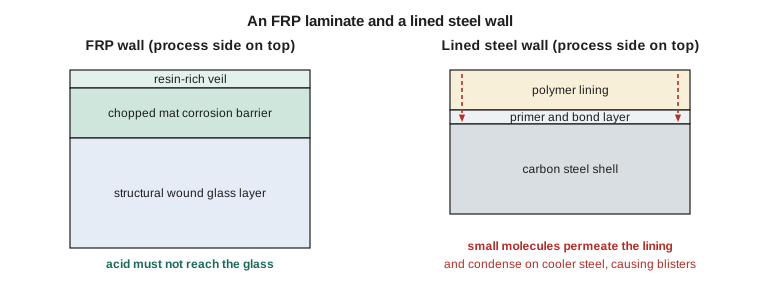
Permeation is a quieter problem. Small molecules such as water vapour, hydrogen chloride, chlorine and solvents can diffuse through a polymer lining and reach the steel behind it, where they condense and corrode the substrate, often blistering the lining from behind. Thicker linings, denser polymers and keeping the steel warmer than the process side reduce permeation problems.
Common thermoplastics
| Thermoplastic | Approximate maximum temperature | Strengths | Weaknesses |
|---|---|---|---|
| PVC | 60 °C | Cheap, resists most acids, salts and alkalis | Brittle in cold, attacked by many solvents, low temperature limit |
| CPVC | 90 °C | Higher temperature version of PVC | Solvents, cost |
| Polyethylene (HDPE) | 60 °C (pressure), higher unpressurized | Tough, flexible, resists acids and alkalis, buried water and gas lines | Swells in hydrocarbons, stress cracking with detergents, UV unless black |
| Polypropylene (PP) | 80 to 90 °C | Acids, alkalis, many solvents, tanks and scrubbers | Oxidizers, UV, brittle in cold |
| PVDF | 120 to 140 °C | Halogens, most acids, high purity | Strong alkalis at high temperature, amines, cost |
| PTFE, PFA, FEP | 200 to 260 °C | Nearly universal chemical resistance | Low strength, creep, permeation, cost |
These temperature limits are rough guides only. The safe temperature depends on the chemical, the stress and the required life. Pressure pipe in thermoplastics is rated at a reference temperature, often 23 °C, and derated at higher temperatures using factors from the manufacturer or the standard. Polyethylene water and gas pipe, for example, loses roughly a third of its pressure rating by 60 °C. Thermoplastics also creep under sustained load, so long-term strength, not short-term strength, governs design.
Thermal expansion and support
Plastics expand far more than steel when heated. Carbon steel grows about 12 millionths of its length per kelvin; PVC grows about four to five times as much and polyethylene more than ten times as much. A long plastic line that is heated by a warm process fluid or by the sun must have expansion loops, offsets or expansion joints, and it needs closer support spacing than steel because it is less stiff and softens when warm. Rigid plastic lines that are restrained at both ends can buckle or crack at fittings. The program below compares expansion of a 30 m run and the pressure rating of polyethylene pipe as temperature rises.
# Thermal expansion of a 30 m pipe run in three materials, heated from 10 C to 60 C
L = 30.0      # m
dT = 50.0     # K
alpha = {"carbon steel": 12e-6, "FRP (vinyl ester)": 20e-6, "PVC": 54e-6, "HDPE": 150e-6}
for m, a in alpha.items():
    print(f"{m:18s} growth = {a * L * dT * 1000:6.1f} mm")

# Pressure rating of HDPE pipe: P = 2 * HDS * t / (D - t)
HDS = 6.9            # hydrostatic design stress at 23 C, MPa (PE4710 class, approximate)
D, t = 0.2191, 0.0199   # outside diameter and wall, m (DR 11)
P = 2 * HDS * t / (D - t)
print(f"DR {D / t:.0f} pressure rating at 23 C = {P:.2f} MPa")
for T, f in [(23, 1.0), (38, 0.80), (49, 0.71), (60, 0.63)]:
print(f" at {T} C (factor {f:.2f}) = {P * f:.2f} MPa")carbon steel growth = 18.0 mm FRP (vinyl ester) growth = 30.0 mm PVC growth = 81.0 mm HDPE growth = 225.0 mm DR 11 pressure rating at 23 C = 1.38 MPa at 23 C (factor 1.00) = 1.38 MPa at 38 C (factor 0.80) = 1.10 MPa at 49 C (factor 0.71) = 0.98 MPa at 60 C (factor 0.63) = 0.87 MPa
Fibre-reinforced plastics
Fibre-reinforced plastic (FRP), also called glass-reinforced plastic, combines a thermoset resin with glass fibres. The resin provides the chemical resistance and the glass provides the strength. FRP tanks, scrubbers, ducts, pipes and cooling towers are common in chemical plants because they resist acids, salts and chlorides at a fraction of the cost of alloys. A typical laminate for chemical service has a resin-rich inner corrosion barrier, about 2.5 to 3 mm thick, made of a surfacing veil and chopped glass mat with a high resin content, backed by a structural layer of filament-wound or woven glass. The corrosion barrier must be intact; if acid reaches the structural glass fibres, it can attack the glass and wick along the fibres, weakening the laminate from inside.
The resin determines the chemical resistance. Isophthalic polyester resins are cheap and suit mild acids and water. Vinyl ester resins are tougher and resist stronger acids, chlorine compounds and mild alkalis, and they are the usual choice for chemical service. Epoxy resins are strong and resist alkalis well. Furan resins resist solvents and strong acids. FRP equipment is built to standards that specify laminate construction and testing, and good practice includes a qualified fabricator, resin chosen from the resin manufacturer's chemical resistance guide for the exact chemical and temperature, and inspection of the inner surface for cracks, voids and exposed fibres.
Linings
Lining a carbon steel vessel combines the strength and low cost of steel with the chemical resistance of a non-metallic material. The main types are thin-film coatings (epoxy, phenolic or novolac epoxy, usually 0.3 to 1 mm thick), thick sheet linings bonded or loose (rubber, PVC, polypropylene, PVDF, PTFE), spray-applied fluoropolymers, glass linings fused to steel, and brick and mortar linings for the most severe acid duties. Glass-lined steel reactors resist almost all acids at high temperature and are standard in pharmaceutical and fine chemical plants, but the glass is brittle and can be chipped by impact or cracked by thermal shock.
A lining is only as good as its weakest point. Every lining has edges, welds, nozzles and attachments where it can be breached, and a single pinhole lets the process fluid reach the steel, where corrosion can spread behind the lining unseen. Surface preparation, usually abrasive blasting to a specified cleanliness and roughness, is critical. Inspection uses holiday (spark) testing, in which a high-voltage probe passed over the lining shows any pinholes as sparks. Linings must also be compatible with the temperature and with the cleaning methods: steam out a thin-film epoxy lining, and it may blister. The plant's sulfuric acid dilution tank has a PTFE-family lining because dilution releases heat and the acid at intermediate concentrations attacks almost everything else.
Elastomers: seals and gaskets
Every pump, valve, flange and instrument depends on elastomeric seals, O-rings and gaskets. The choice of elastomer is a materials selection problem in its own right, and seal failures cause a large share of process leaks. Common elastomers include nitrile rubber (good with oils and fuels, poor with ozone and ketones), EPDM (excellent with water, steam, acids and alkalis, but swells badly in oils and fuels), neoprene (general purpose, weather resistant), fluoroelastomers (FKM, good with fuels, many acids and high temperatures, but attacked by ketones, amines and hot water and steam in some grades), and perfluoroelastomers (FFKM, nearly universal resistance at high cost).
Ethanol blends illustrate how subtle elastomer selection can be. Fuel-grade ethanol, and especially gasoline blends containing ethanol, swell some elastomers that are fine in pure gasoline, and they can also extract plasticizers, leaving seals hard and cracked. The plant's ethanol loading arms and pumps use seals specified for fuel ethanol, and Rafael insists that any replacement seal comes with documentation of its compound, not just its size. Gaskets for flanges follow similar logic: compressed fibre gaskets for utilities, spiral-wound metal gaskets with graphite or PTFE filler for most process duties, and PTFE envelope gaskets for highly corrosive services.
Inspecting non-metallic equipment
Non-metallic equipment needs inspection as much as steel does, but the methods differ. Ultrasonic thickness gauges designed for steel do not work well on FRP, and corrosion of a laminate rarely shows as uniform thinning. Inspectors instead look for changes at the inner surface: loss of gloss, softening (checked with a Barcol hardness tester, which presses a point into the resin), blisters, cracks, crazing and exposed glass fibres. On the outside, they look for weeping, white stress marks around nozzles and supports, and damage from impact or UV. Thermoplastic lines are checked for discoloration, cracking at fittings, sagging between supports and signs of overheating. Elastomer seals and hoses have defined replacement intervals, because they age even in storage and fail without much warning. Records of these inspections let the plant predict when equipment will need repair, just as thickness records do for steel.
Worked problem
Expansion of a polypropylene scrubber line
A 12 m polypropylene line carries scrubber water. It is installed at 15 °C and can reach 55 °C. Polypropylene's expansion coefficient is about \(1.5 \times 10^{-4}\) per kelvin. How much does the line grow?
Show solution
- \(\Delta L = \alpha L \Delta T = 1.5 \times 10^{-4} \times 12 \times 40\).
- \(\Delta L = 0.072\) m = 72 mm.
Answer: About 72 mm. The line needs an expansion loop or offset and guides that let it move; a rigid anchor at both ends could crack a fitting.
Common mistakes
MistakeUsing a plastic at its quoted maximum temperature regardless of pressure and chemical.
InsteadCheck the derated strength at the actual temperature, pressure, chemical and required life.
MistakeChoosing EPDM seals for a service containing oils or fuels.
InsteadEPDM swells badly in hydrocarbons; use an elastomer rated for the actual fluid.
MistakeAssuming a lining protects the steel even with a few pinholes.
InsteadHoliday test the lining, inspect edges and nozzles, and watch for permeation and blistering.
MistakeIgnoring the corrosion barrier of FRP equipment.
InsteadInspect for cracks and exposed fibres, which let the process attack the structural glass.
Summary and key terms
- Non-metals resist many acids, salts and chlorides but degrade by swelling, chemical attack, stress cracking, UV and loss of strength with temperature.
- Permeation of small molecules through linings can corrode and blister the steel behind them.
- Thermoplastics such as PVC, polyethylene, polypropylene, PVDF and PTFE have increasing temperature limits and chemical resistance, and must be derated with temperature.
- Plastics expand much more than steel and need expansion allowance and closer supports.
- FRP combines resin chemical resistance with glass strength; the resin-rich corrosion barrier must stay intact.
- Linings depend on surface preparation, holiday-free application and compatible temperatures and cleaning.
- Elastomer seals and gaskets must be chosen for the exact fluid, including ethanol blends.
- Thermoplastic
- A polymer that softens when heated and can be remelted, such as polyethylene or PVC.
- Thermoset
- A polymer that cures into a cross-linked network and does not melt, such as epoxy or vinyl ester.
- Environmental stress cracking
- Cracking of a polymer under stress in the presence of a liquid that does not dissolve it.
- Permeation
- Diffusion of gases or vapours through a polymer or lining.
- Corrosion barrier
- The resin-rich inner layer of an FRP laminate that provides chemical resistance.
- Holiday test
- An electrical test that finds pinholes or thin spots in a coating or lining.
- Elastomer
- A flexible, rubber-like polymer used for seals, O-rings, gaskets and hoses.
Practice problems
Work each problem on paper first, then reveal the answer to check.
Name three ways polymers degrade in chemical service.
Show answer
Absorption and swelling, chemical attack on the chains, environmental stress cracking, UV damage or softening with temperature.
Why must thermoplastic pressure pipe be derated at higher temperatures?
Show answer
Its strength and long-term creep resistance fall as temperature rises.
How much does a 20 m PVC line grow if heated by 30 K? Use \(5.4 \times 10^{-5}\) per kelvin.
Show answer
\(5.4 \times 10^{-5} \times 20 \times 30 = 0.032\) m, about 32 mm.
What is the purpose of the resin-rich layer on the inside of an FRP tank?
Show answer
It is the corrosion barrier that keeps the chemical away from the structural glass fibres.
Why is holiday testing done on linings?
Show answer
To find pinholes and thin spots through which the process could reach the steel.
Why might an EPDM gasket fail in a fuel ethanol blend line?
Show answer
EPDM swells in hydrocarbons such as gasoline; fuel service needs a compatible elastomer.
Lesson quiz · 5 questions
Score 60% or more to complete this lesson.
Create a free account to save your progress, take quizzes and earn a certificate.