
CHE-280 · Lesson 6 of 12 · 22 min
The electrochemistry of corrosion
Rafael keeps a small display on his desk: a steel bolt that spent ten years holding a copper fitting on a cooling water line. Where the bolt touched the copper, it is eaten away to half its diameter; a few centimetres along, it is almost untouched. Theo knows from CHE-250 (lesson 8, on electrochemistry) how galvanic cells work and how the Nernst equation sets electrode potentials. This lesson applies those ideas to corrosion: why metals corrode at all, why some corrode and others do not in the same water, how fast they corrode, and how engineers measure and predict corrosion rates. Everything in the rest of the course, from pitting to cathodic protection, builds on the ideas here.
Corrosion as an electrochemical cell
Aqueous corrosion of a metal is an electrochemical process with two halves happening at the same time on the same piece of metal. At anodic sites, metal atoms give up electrons and pass into solution as ions; for iron, \(\mathrm{Fe} \to \mathrm{Fe^{2+}} + 2e^-\). At cathodic sites, the electrons released by the anode are consumed by a reduction reaction in the environment. The metal conducts electrons from anode to cathode, and the solution (the electrolyte) conducts ions to complete the circuit. Anodes and cathodes may be microscopic and constantly shifting, giving fairly uniform corrosion, or large and fixed, giving localized attack. The rate of anodic metal loss must exactly equal the rate of cathodic electron consumption, because the metal cannot store charge. That simple balance is the key to understanding and controlling corrosion.
In process plant environments, two cathodic reactions dominate. In acids, hydrogen ions are reduced to hydrogen gas: \(2\mathrm{H^+} + 2e^- \to \mathrm{H_2}\). In neutral and alkaline water containing dissolved oxygen, oxygen is reduced: \(\mathrm{O_2} + 2\mathrm{H_2O} + 4e^- \to 4\mathrm{OH^-}\), or in acid \(\mathrm{O_2} + 4\mathrm{H^+} + 4e^- \to 2\mathrm{H_2O}\). Other oxidizers, such as ferric and cupric ions, chlorine and hypochlorite, can also act as cathodic reactants and greatly accelerate corrosion. In cooling water, the iron ions released at the anode react with the hydroxide made at the cathode and with more oxygen to form iron hydroxides and then rust.
This picture explains many practical rules at once. Removing oxygen from boiler feedwater removes the main cathodic reactant, so corrosion slows dramatically. Raising pH reduces the hydrogen ion concentration and makes hydrogen evolution harder. Oxidizing chemicals such as chlorine in cooling water add a cathodic reactant, so they increase corrosion of carbon steel even as they kill bacteria. And a large cathodic area connected to a small anodic area, like the copper fitting on Rafael's bolt, concentrates all the cathodic current onto a small region of metal.
Thermodynamics: will the metal corrode?
Whether a metal can corrode in an environment depends on thermodynamics. Each half-reaction has an equilibrium potential given by the Nernst equation from CHE-250. For a metal electrode in a solution of its ions,
Corrosion is possible when the equilibrium potential of the cathodic reaction is more positive (more noble) than that of the metal's dissolution. For iron in water, the iron equilibrium potential at a low dissolved iron activity of \(10^{-6}\) is about \(-0.62\) V against the standard hydrogen electrode (SHE), and the hydrogen potential at pH 7 is about \(-0.41\) V, so iron can corrode by hydrogen evolution even in neutral water, though slowly. The oxygen potential is far more positive, about \(+0.82\) V at pH 7, so oxygen is a much stronger driving force. Gold, whose equilibrium potential is above the oxygen potential, cannot corrode in water at all. Thermodynamics says what can happen; it says nothing about how fast.
Pourbaix diagrams
A Pourbaix diagram maps the thermodynamically stable form of a metal in water as a function of potential and pH. It divides the potential-pH plane into regions of immunity, where the metal itself is stable and cannot corrode; corrosion, where soluble ions are stable; and passivity, where a solid oxide or hydroxide is stable and may form a protective film. Two sloping dashed lines mark the stability limits of water: below the lower line, water is reduced to hydrogen, and above the upper line, it is oxidized to oxygen.
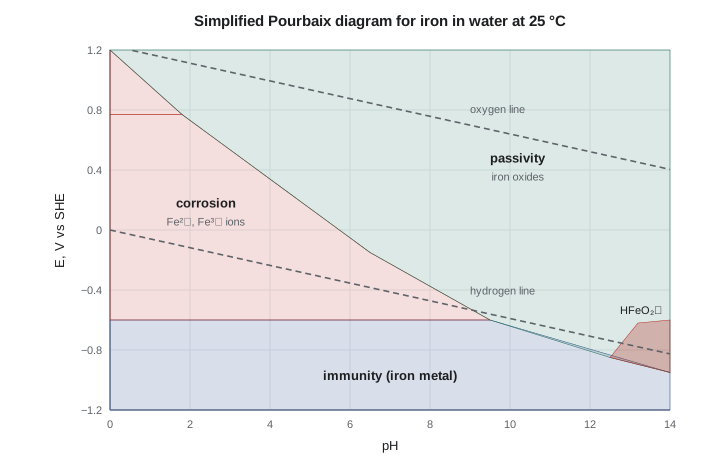
The iron diagram explains several practices at the plant. Boiler water is held at a pH of about 9.5 to 11 with very little oxygen, which places carbon steel in the passive region where a magnetite film protects it. Cathodic protection of the buried gas lateral, covered in Lesson 12, lowers the steel's potential into the immunity region. And acidic water, at low pH, lies in the corrosion region at almost every potential. Pourbaix diagrams have real limits, though: they are calculated for pure water and the metal's own ions, at 25 °C, and say nothing about rates or about the effect of chloride, which can break down a film the diagram calls passive. Engineers use them as maps of possibility, not as predictions.
Kinetics: polarization and Tafel behaviour
The rate of corrosion is set by kinetics. When a reaction proceeds at a net rate, its electrode potential shifts away from its equilibrium value. The shift is called polarization, and the size of the shift, the overpotential \(\eta\), tells how much driving force is being spent to make the reaction go at that rate. For reactions limited by the speed of charge transfer at the surface (activation polarization), the current density \(i\) and the overpotential follow the Tafel relationship:
where \(i_0\) is the exchange current density, a measure of how fast the reaction proceeds in both directions at equilibrium, and \(b\) is the Tafel slope, typically 0.03 to 0.15 V per decade of current. A metal on which hydrogen evolution has a high exchange current density, such as platinum, catalyses that reaction; one with a low exchange current density, such as lead or mercury, inhibits it. Concentration polarization adds a second limit: when the cathodic reaction is oxygen reduction in neutral water, oxygen must diffuse to the surface, and the current cannot exceed a limiting current density set by the oxygen concentration and the flow. That is why corrosion of carbon steel in cooling water rises with velocity and with oxygen content.
Mixed potential theory and Evans diagrams
A corroding metal carries both reactions at once on the same surface. Because the anodic and cathodic currents must be equal, the metal settles at a single potential, the corrosion potential \(E_{corr}\), where the anodic current of metal dissolution equals the cathodic current of the reduction reaction. The current at that point is the corrosion current \(i_{corr}\). This is mixed potential theory, and an Evans diagram shows it graphically: the anodic and cathodic polarization curves are plotted as potential against the logarithm of current density, and their intersection gives \(E_{corr}\) and \(i_{corr}\).
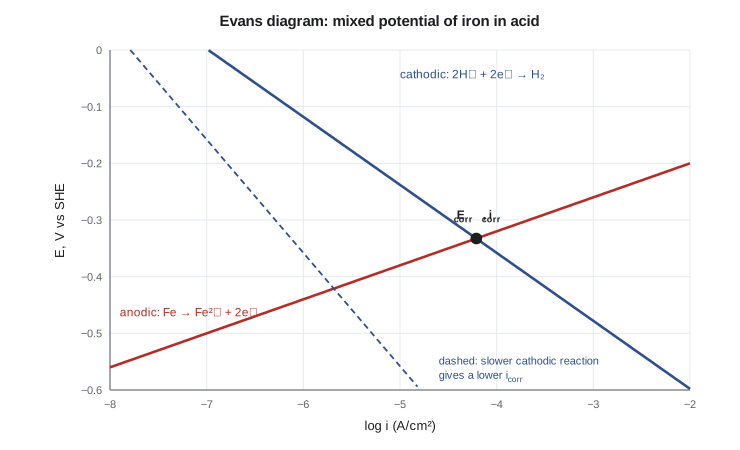
Evans diagrams make the methods of corrosion control easy to see. Removing oxygen or raising pH moves the cathodic line down and to the left, lowering \(i_{corr}\). An anodic inhibitor raises the anodic line, also lowering \(i_{corr}\). Coupling the metal to a more active metal supplies electrons from outside and drives the potential down toward immunity, as in cathodic protection. Passivating a metal, as chromium does in stainless steel, makes the anodic current fall dramatically above a certain potential, giving the characteristic active-passive curve described in Lesson 8.
From current to corrosion rate: Faraday's law
Faraday's law converts a corrosion current into a metal loss. A current \(I\) flowing for time \(t\) dissolves a mass \(m = ItM/(nF)\), where \(M\) is the molar mass, \(n\) the number of electrons per atom and \(F = 96{,}485\) C/mol. Dividing by density and area gives a penetration rate. A convenient engineering form is
where \(EW = M/n\) is the equivalent weight. For iron, with \(EW = 27.9\) and \(\rho = 7.87\) g/cm\(^3\), a corrosion current density of 1 µA/cm\(^2\) corresponds to about 0.0116 mm/y. The program below finds the corrosion potential and current of iron in deaerated acid at pH 2 by locating the intersection of the Tafel lines numerically, converts the current to a corrosion rate and checks the Nernst potential of iron at a low ion activity. The kinetic parameters are illustrative, chosen to give rates of the right order for carbon steel in dilute acid.
# Mixed-potential (Evans diagram) estimate of a corrosion rate
# Iron in deaerated acid: anodic Fe -> Fe2+ + 2e-, cathodic 2H+ + 2e- -> H2
import math
E_a, i0_a, b_a = -0.44, 1e-6, 0.060     # V vs SHE, A/cm2, V/decade (anodic, illustrative)
E_c, i0_c, b_c = 0.00 - 0.059 * 2, 1e-6, 0.120   # hydrogen at pH 2, A/cm2, V/decade

def i_anodic(E):  return i0_a * 10 ** ((E - E_a) / b_a)
def i_cathodic(E): return i0_c * 10 ** ((E_c - E) / b_c)

lo, hi = E_a, E_c
for _ in range(100):                     # bisection: find E where anodic = cathodic current
    mid = (lo + hi) / 2
    if i_anodic(mid) > i_cathodic(mid): hi = mid
    else: lo = mid
E_corr = (lo + hi) / 2
i_corr = i_anodic(E_corr)
print(f"E_corr = {E_corr:.3f} V vs SHE, i_corr = {i_corr:.2e} A/cm2")

# Faraday's law: corrosion rate (mm/y) = 3.27e-3 * i (uA/cm2) * EW / density
EW, rho = 55.85 / 2, 7.87               # equivalent weight g/eq, density g/cm3
CR = 3.27e-3 * i_corr * 1e6 * EW / rho
print(f"corrosion rate = {CR:.2f} mm/y")

# Nernst: equilibrium potential of Fe/Fe2+ at 1e-6 mol/L dissolved iron
E_eq = -0.44 + 0.059 / 2 * math.log10(1e-6)
print(f"Fe/Fe2+ equilibrium potential at 1e-6 mol/L = {E_eq:.3f} V vs SHE")E_corr = -0.333 V vs SHE, i_corr = 6.15e-05 A/cm2 corrosion rate = 0.71 mm/y Fe/Fe2+ equilibrium potential at 1e-6 mol/L = -0.617 V vs SHE
Worked problem
Faraday conversion for a stainless steel
Linear polarization measurements on a 316L probe in thin stillage give a corrosion current density of 0.08 µA/cm\(^2\). Take \(EW = 25.5\) and \(\rho = 7.98\) g/cm\(^3\) for 316L. What is the uniform corrosion rate?
Show solution
- \(\mathrm{CR} = 3.27 \times 10^{-3} \times 0.08 \times 25.5/7.98\).
- \(\mathrm{CR} = 8.4 \times 10^{-4}\) mm/y, under 0.001 mm/y.
Answer: Less than a micrometre per year: 316L is passive in this stream. Its risk is localized pitting, which a uniform rate does not capture.
Measuring corrosion electrochemically
Several electrochemical techniques measure corrosion in the laboratory and in operating plants. Linear polarization resistance (LPR) probes apply a small potential shift, typically 10 to 20 mV, around \(E_{corr}\) and measure the resulting current. The ratio, the polarization resistance \(R_p\), is inversely proportional to the corrosion current through the Stern-Geary relation, \(i_{corr} = B/R_p\), where \(B\) depends on the Tafel slopes and is often around 0.02 to 0.03 V. LPR probes give near real-time corrosion rates in conductive liquids, and the plant has them in its cooling water and condensate systems. Potentiodynamic polarization scans the potential over a wide range to map the whole anodic curve, revealing passivity, pitting potentials and active-passive transitions. Electrical resistance probes measure the increasing resistance of a thin metal element as it corrodes, and they work in any environment, including low-conductivity liquids and gases. Electrochemical impedance spectroscopy and electrochemical noise give more detailed information and are mainly research tools.
Reference electrodes make potential measurements meaningful. The standard hydrogen electrode is the theoretical zero, but in practice engineers use the saturated calomel electrode, the silver-silver chloride electrode and, for buried structures, the copper-copper sulfate electrode. Their potentials differ, so every potential must be reported with its reference. The copper-copper sulfate electrode is about 0.32 V more positive than the standard hydrogen electrode, which is why cathodic protection criteria for buried steel, quoted against copper-copper sulfate, use numbers such as \(-850\) mV.
Common mistakes
MistakeThinking a metal corrodes because it is exposed to water alone.
InsteadCorrosion needs a cathodic reaction; oxygen, hydrogen ions or other oxidizers supply it.
MistakeReading a Pourbaix diagram as a prediction of corrosion rate.
InsteadIt shows thermodynamic possibilities only; kinetics, temperature and chloride decide what actually happens.
MistakeReporting a potential without its reference electrode.
InsteadAlways state the reference: SHE, calomel, silver-silver chloride or copper-copper sulfate.
MistakeUsing a uniform rate from LPR to judge a passive alloy.
InsteadPassive alloys fail by localized attack; use pitting tests and inspection as well.
Summary and key terms
- Aqueous corrosion couples anodic metal dissolution with a cathodic reduction such as hydrogen evolution or oxygen reduction; their rates must be equal.
- Thermodynamics, through the Nernst equation and Pourbaix diagrams, shows whether corrosion is possible and whether immunity, corrosion or passivity is expected.
- Kinetics sets the rate: activation polarization follows Tafel behaviour, and oxygen diffusion can limit the cathodic current.
- Mixed potential theory locates \(E_{corr}\) and \(i_{corr}\) where anodic and cathodic curves cross on an Evans diagram.
- Faraday's law converts corrosion current to penetration rate; 1 µA/cm² is about 0.0116 mm/y for iron.
- LPR, electrical resistance probes and polarization scans measure corrosion; every potential must quote its reference electrode.
- Anode
- The site where oxidation, such as metal dissolution, occurs.
- Cathode
- The site where reduction, such as oxygen reduction or hydrogen evolution, occurs.
- Pourbaix diagram
- A potential-pH map showing the thermodynamically stable forms of a metal in water.
- Polarization
- The shift of an electrode potential away from equilibrium when a net current flows.
- Tafel slope
- The change in overpotential per tenfold change in current density for an activation-controlled reaction.
- Corrosion potential
- The mixed potential at which anodic and cathodic currents on a corroding metal are equal.
- Linear polarization resistance
- A technique that measures the current response to a small potential shift to estimate the corrosion rate.
Practice problems
Work each problem on paper first, then reveal the answer to check.
Write the anodic reaction for iron and the cathodic reaction for oxygen in neutral water.
Show answer
\(\mathrm{Fe} \to \mathrm{Fe^{2+}} + 2e^-\); \(\mathrm{O_2} + 2\mathrm{H_2O} + 4e^- \to 4\mathrm{OH^-}\).
Why does deaerating boiler feedwater reduce corrosion?
Show answer
It removes oxygen, the main cathodic reactant, so the cathodic and therefore the anodic rate fall.
What are the three kinds of region on a Pourbaix diagram?
Show answer
Immunity, corrosion and passivity.
Convert 25 µA/cm² for iron to mm/y.
Show answer
\(3.27 \times 10^{-3} \times 25 \times 27.9/7.87 = 0.29\) mm/y.
What does an LPR probe measure, and what relation converts it to a corrosion current?
Show answer
Polarization resistance; the Stern-Geary relation \(i_{corr} = B/R_p\).
Why can chlorine added to cooling water increase carbon steel corrosion?
Show answer
It is an oxidizer that acts as an extra cathodic reactant.
Lesson quiz · 5 questions
Score 60% or more to complete this lesson.
Create a free account to save your progress, take quizzes and earn a certificate.