
CHE-243 · Lesson 8 of 12 · 21 min
Carbonyl compounds: aldehydes, ketones, acids and their derivatives
The carbonyl group, a carbon doubly bonded to oxygen, C=O, is the most important functional group in organic chemistry. It appears in aldehydes, ketones, carboxylic acids, esters, amides and acid anhydrides, and in the sugars, fats and proteins of every living thing. At Kingfisher Bioenergy carbonyl compounds are everywhere: glucose is an aldehyde in its open-chain form; acetaldehyde, acetic acid and ethyl acetate are among the impurities in the ethanol; the corn oil is a mixture of esters; and the proteins in the distillers grains are polyamides. Ingrid's question to Theo for this lesson is practical: could the plant profitably turn some of its ethanol into ethyl acetate, a widely used solvent, and what chemistry and equilibrium limits would it face?
Structure of the carbonyl group
The carbonyl carbon is sp² hybridized and flat, with 120° bond angles, and the C=O consists of a sigma bond and a pi bond. Oxygen is much more electronegative than carbon, so the bond is strongly polarized: the oxygen carries a partial negative charge and the carbon a partial positive charge. A resonance structure with a full positive charge on carbon and a negative charge on oxygen expresses the same idea. The partly positive carbon is electrophilic and attracts nucleophiles; the oxygen, with two lone pairs, is weakly basic and can be protonated by acids, which makes the carbon even more electrophilic. Nearly all carbonyl chemistry follows from these two facts.
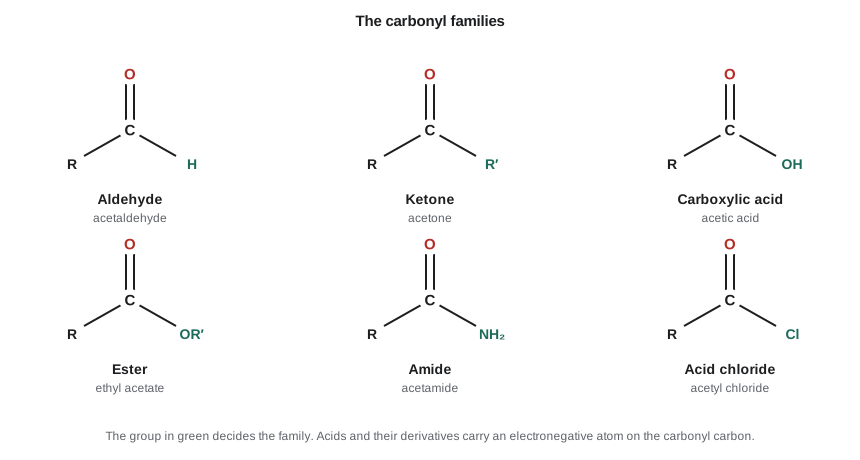
Aldehydes and ketones
In an aldehyde the carbonyl carbon carries at least one hydrogen, R–CHO; in a ketone it carries two carbon groups, R–CO–R′. Formaldehyde, HCHO, is made in huge volumes from methanol and used in resins for plywood and particleboard. Acetaldehyde, CH₃CHO, is an intermediate in many syntheses and the first oxidation product of ethanol. Acetone, CH₃COCH₃, and 2-butanone are major solvents. Aldehydes and ketones are polar and boil higher than alkanes of similar size, but they cannot hydrogen bond with themselves, so they boil lower than the corresponding alcohols. Small ones dissolve in water because water can hydrogen bond to the carbonyl oxygen.
The characteristic reaction of aldehydes and ketones is nucleophilic addition. A nucleophile attacks the carbonyl carbon, the pi electrons move onto the oxygen, and the result is a tetrahedral intermediate that usually picks up a proton to give an alcohol. Hydride reducing agents such as sodium borohydride add H⁻ and reduce aldehydes to primary alcohols and ketones to secondary alcohols. Catalytic hydrogenation does the same on an industrial scale. Water adds reversibly to form hydrates, and alcohols add to form hemiacetals and acetals. That last reaction is exactly how glucose forms its ring: the OH on carbon 5 adds to the aldehyde carbon within the same molecule, forming a cyclic hemiacetal.
Aldehydes are more reactive than ketones, for two reasons. A hydrogen is smaller than a carbon group, so nucleophiles reach the carbonyl carbon more easily, and alkyl groups donate electron density that slightly reduces the carbon's positive charge. Aldehydes are also easily oxidized to carboxylic acids, even by air, which is why acetaldehyde in stored ethanol can slowly turn into acetic acid. Many aldehydes have strong odours at very low concentrations, and acetaldehyde, with a sharp green-apple smell, is one of the compounds that distillers remove in the heads cut.
Carboxylic acids
A carboxylic acid has a carboxyl group, –COOH, which combines a carbonyl and a hydroxyl on the same carbon. Carboxylic acids are much stronger acids than alcohols, with pKa values typically between 4 and 5, because the carboxylate anion is stabilized by resonance between its two oxygens (lesson 1). Acetic acid has a pKa of 4.76, so in a fermenter at pH 4.5 to 5 a substantial fraction of it is in the undissociated form, which crosses yeast cell membranes and stresses the yeast. Lactic and acetic acids produced by contaminating bacteria are a common cause of sluggish fermentations, and the plant tracks both.
Carboxylic acids form strong hydrogen-bonded dimers, giving them high boiling points: acetic acid boils at 118 °C. Small acids mix with water; long-chain acids, the fatty acids, are insoluble in water but form soaps when neutralized with a base. Free fatty acids in corn oil are measured as the acid value, and they matter for biodiesel production because they react with the base catalyst to form soap instead of fuel.
| Acid | Formula | pKa (approximate) | Where it appears |
|---|---|---|---|
| Formic acid | HCOOH | 3.75 | Methanol oxidation; preservatives |
| Acetic acid | CH₃COOH | 4.76 | Vinegar; bacterial by-product in fermenters |
| Lactic acid | CH₃CH(OH)COOH | 3.86 | Bacterial contaminant; feedstock for polylactic acid |
| Succinic acid | HOOC(CH₂)₂COOH | 4.2 (first) | Minor yeast by-product; bio-based chemical |
| Oleic acid | C₁₇H₃₃COOH | about 5 | Corn oil fatty acid |
Carboxylic acid derivatives
Replacing the OH of a carboxylic acid with another electronegative group gives the acid derivatives: acid chlorides (–COCl), anhydrides (–CO–O–CO–), esters (–COOR) and amides (–CONH₂, –CONHR, –CONR₂). All of them react by nucleophilic acyl substitution: a nucleophile adds to the carbonyl carbon to form a tetrahedral intermediate, which then collapses, pushing out the leaving group and restoring the C=O. The derivatives differ greatly in reactivity, in the order acid chloride > anhydride > ester > amide, which follows the ability of each leaving group to depart. Acid chlorides react violently with water, while amides survive boiling water for hours, which is why proteins, held together by amide bonds, are stable enough to build living things.
The reactivity order has a practical use: a more reactive derivative can be converted into a less reactive one, but not easily the other way. Acid chlorides and anhydrides are used to make esters and amides quickly and completely, while making an ester directly from an acid and an alcohol is slower and reversible, as the next section shows. Acetic anhydride is a major industrial chemical used to make cellulose acetate and aspirin, and it reacts exothermically with water, so it is stored dry and handled with care.
Fischer esterification and its equilibrium
Heating a carboxylic acid with an alcohol and an acid catalyst gives an ester and water. The reaction, named after Emil Fischer, is an equilibrium with a modest equilibrium constant, close to 4 for ethanol and acetic acid. Starting from equal moles of acid and alcohol, the equilibrium mixture contains only about two-thirds ester. To drive the reaction further, industry uses one reactant in excess or removes a product as it forms, usually water. In reactive distillation, now common for ethyl acetate, the reaction and the separation happen in the same column, so the ester and water are drawn off continuously and conversion approaches completion.
# Equilibrium conversion for ethyl acetate esterification: ethanol + acetic acid <=> ethyl acetate + water
# K is close to 4 for this reaction near room temperature (approximate textbook value).
K = 4.0

def conversion(ratio, water0=0.0):
    """ratio = moles ethanol per mole acetic acid fed; water0 = moles water fed per mole acid.
    Solve K = x (water0 + x) / ((1 - x)(ratio - x)) for x by bisection."""
    lo, hi = 0.0, min(1.0, ratio) - 1e-12
    for _ in range(200):
        x = (lo + hi) / 2
        f = x * (water0 + x) - K * (1 - x) * (ratio - x)
        lo, hi = (x, hi) if f < 0 else (lo, x)
    return x

for r in (1, 2, 3, 5, 10):
    print(f"ethanol:acid = {r:2d}:1  equilibrium conversion of acid = {100 * conversion(r):.1f}%")
print(f"1:1 feed using 95% ethanol (0.15 mol water per mol acid): {100 * conversion(1.0, 0.15):.1f}%")ethanol:acid = 1:1 equilibrium conversion of acid = 66.7% ethanol:acid = 2:1 equilibrium conversion of acid = 84.5% ethanol:acid = 3:1 equilibrium conversion of acid = 90.3% ethanol:acid = 5:1 equilibrium conversion of acid = 94.5% ethanol:acid = 10:1 equilibrium conversion of acid = 97.4% 1:1 feed using 95% ethanol (0.15 mol water per mol acid): 64.3%
The program shows Le Chatelier's principle in numbers. A 1:1 feed reaches about 67 percent conversion of the acid; a 3:1 excess of ethanol reaches about 90 percent; and using 95 percent ethanol, which brings water in with the feed, lowers the 1:1 conversion to about 64 percent. For Kingfisher Bioenergy, the fact that the plant produces ethanol cheaply makes an ethanol excess attractive, and the unreacted ethanol can be recovered and recycled. Ethyl acetate can also be made from ethanol alone by catalytic dehydrogenation, which avoids buying acetic acid and produces hydrogen as a by-product, a route compared in lesson 12.
Hydrolysis and transesterification
The reverse of esterification is ester hydrolysis. With acid, hydrolysis is reversible. With a base such as sodium hydroxide it goes to completion, because the carboxylic acid formed is immediately deprotonated to its salt, which cannot react back. Base hydrolysis of fats is called saponification and is how soap has been made for millennia: a triglyceride plus three hydroxide ions gives glycerol and three fatty acid salts.
Transesterification swaps the alcohol part of an ester for a different alcohol. It is the basis of biodiesel production: triglycerides in vegetable oil react with methanol, using sodium methoxide or potassium hydroxide as the catalyst, to give fatty acid methyl esters, the biodiesel, and glycerol as a by-product. The reaction is an equilibrium, so excess methanol is used, and the glycerol separates as a dense lower layer. Free fatty acids and water must be kept low, because free acids neutralize the base to form soap and water hydrolyzes the esters, both of which reduce yield and make separation difficult. Corn oil from ethanol plants often has a high free fatty acid content, so it is usually first treated with acid-catalyzed esterification to convert the free acids to esters before the base-catalyzed step.
Worked problem
Methanol demand for biodiesel from distillers corn oil
A biodiesel producer converts 1000 kg of corn oil, treated as triolein (molar mass about 885 g/mol), using methanol at a 6:1 molar ratio to oil. How much methanol is fed, and how much is consumed if conversion is complete?
Show solution
- Moles of oil: \(1{,}000{,}000\ \text{g} / 885\ \text{g/mol} = 1130\ \text{mol}\).
- Methanol fed at 6:1: \(6 \times 1130 = 6780\ \text{mol}\), or \(6780 \times 32.04 = 217\ \text{kg}\).
- Stoichiometry needs 3 mol methanol per mol triglyceride: \(3 \times 1130 = 3390\ \text{mol}\), or 109 kg.
- The remaining 108 kg is excess, recovered by distillation and recycled.
Answer: About 217 kg of methanol is fed per tonne of oil, of which about 109 kg reacts. The excess pushes the equilibrium toward the esters, and recovering it is a major part of a biodiesel plant's energy use.
Amides
Amides form when carboxylic acids or their derivatives react with ammonia or amines. They are the least reactive derivatives because nitrogen's lone pair is shared with the carbonyl by resonance, which gives the C–N bond partial double-bond character and makes it flat and rigid. That rigidity shapes protein structure, since the peptide bond linking amino acids is an amide. Nylons are synthetic polyamides, and the amide's strength and hydrogen bonding give nylon fibres their toughness. Lesson 9 returns to nitrogen compounds and lesson 11 to polyamides.
Common mistakes
MistakeExpecting ketones to oxidize easily like aldehydes.
InsteadKetones have no hydrogen on the carbonyl carbon and resist mild oxidation.
MistakeTreating esterification as a reaction that goes to completion.
InsteadWith K near 4, a 1:1 feed reaches about two-thirds conversion; use an excess or remove water.
MistakeIgnoring free fatty acids in a base-catalyzed biodiesel feed.
InsteadThey consume the catalyst as soap; pretreat high-acid oils with acid-catalyzed esterification.
MistakeAssuming all acid derivatives react with water at similar rates.
InsteadReactivity falls from acid chlorides to anhydrides to esters to amides.
Summary and key terms
- The C=O group is polar: the carbon is electrophilic and the oxygen weakly basic.
- Aldehydes and ketones undergo nucleophilic addition; aldehydes are more reactive and easily oxidized.
- Carboxylic acids have pKa values near 4 to 5 because their anions are resonance-stabilized.
- Acid derivatives react by nucleophilic acyl substitution; reactivity is acid chloride > anhydride > ester > amide.
- Fischer esterification is an equilibrium (K ≈ 4 for ethyl acetate); excess reactant or water removal raises conversion.
- Base hydrolysis of fats gives soap; transesterification with methanol gives biodiesel and glycerol.
- Carbonyl group
- A carbon doubly bonded to oxygen, C=O.
- Nucleophilic addition
- A reaction in which a nucleophile adds to a carbonyl carbon, giving a tetrahedral product.
- Nucleophilic acyl substitution
- Addition to the carbonyl of an acid derivative followed by loss of a leaving group.
- Esterification
- Formation of an ester from a carboxylic acid and an alcohol.
- Saponification
- Base hydrolysis of an ester, especially of fats to give soap and glycerol.
- Transesterification
- Exchange of the alcohol part of an ester for another alcohol.
- Hemiacetal
- The product of adding one alcohol molecule to an aldehyde or ketone carbonyl.
Practice problems
Work each problem on paper first, then reveal the answer to check.
What is the product of reducing 2-butanone with sodium borohydride?
Show answer
2-Butanol, a secondary alcohol.
Rank acetyl chloride, ethyl acetate and acetamide by reactivity toward water.
Show answer
Acetyl chloride > ethyl acetate > acetamide.
Why does base hydrolysis of an ester go to completion?
Show answer
The acid product is deprotonated to a carboxylate, which cannot react back with the alcohol.
Using the program, what conversion does a 5:1 ethanol-to-acid feed give?
Show answer
About 94.5 percent.
What two products form when a triglyceride reacts with methanol?
Show answer
Fatty acid methyl esters (biodiesel) and glycerol.
Why are acetic and lactic acids harmful to yeast at fermenter pH?
Show answer
Near their pKa, much of each acid is undissociated, crosses cell membranes and acidifies the cell interior.
Lesson quiz · 5 questions
Score 60% or more to complete this lesson.
Create a free account to save your progress, take quizzes and earn a certificate.