
CHE-243 · Lesson 3 of 12 · 21 min
Alkanes, cycloalkanes and conformations
Alkanes are the simplest organic compounds, made only of carbon and hydrogen joined by single bonds. They are also the most abundant: natural gas is mostly methane with some ethane and propane, and crude oil is a mixture dominated by alkanes and cycloalkanes from a few carbons up to more than forty. At Kingfisher Bioenergy, alkanes arrive in two places. The plant burns natural gas in its boilers and dryers, and it blends a hydrocarbon denaturant, typically natural gasoline, a light mixture of pentanes and hexanes from gas processing, into fuel ethanol so that it cannot be sold as beverage alcohol. This lesson covers the structure, properties and few reactions of alkanes, and the three-dimensional shapes they adopt, which matter far beyond alkanes themselves.
The alkane series
Open-chain alkanes have the general formula CₙH₂ₙ₊₂. Each member of the series differs from the next by a CH₂ unit, so they form a homologous series whose properties change smoothly with chain length. The first four members, methane, ethane, propane and butane, are gases at room temperature. Pentane through about heptadecane are liquids, and the larger alkanes are waxy solids. The smooth rise in boiling point comes from London dispersion forces, which grow with molecular surface area.
| Alkane | Formula | Boiling point (°C) | Typical use |
|---|---|---|---|
| Methane | CH₄ | −162 | Natural gas, fuel, hydrogen production |
| Ethane | C₂H₆ | −89 | Feedstock for ethylene crackers |
| Propane | C₃H₈ | −42 | Fuel (LPG), feedstock |
| Butane | C₄H₁₀ | −0.5 | Fuel, gasoline blending |
| Pentane | C₅H₁₂ | 36 | Natural gasoline, blowing agent |
| Hexane | C₆H₁₄ | 69 | Solvent for oilseed extraction |
| Octane | C₈H₁₈ | 126 | Gasoline component |
| Hexadecane | C₁₆H₃₄ | 287 | Diesel range; reference fuel for cetane number |
Branching lowers the boiling point at a given molar mass, because branched molecules are more compact and have less surface contact with their neighbours. Pentane boils at 36 °C, 2-methylbutane at 28 °C and the nearly spherical 2,2-dimethylpropane at 10 °C. Branching also changes how a fuel burns in an engine: highly branched alkanes resist knocking, which is why 2,2,4-trimethylpentane, commonly called isooctane, defines 100 on the octane scale and heptane defines zero. Ethanol itself has a high octane rating, which is one reason refiners blend it into gasoline.
Physical properties and safety
Alkanes are nonpolar, so they are insoluble in water and less dense than it, and they dissolve readily in other nonpolar liquids such as oils. Their low polarity and volatility make the lighter alkanes a serious fire hazard. Pentane has a flash point far below zero and a lower flammability limit near 1.4 percent by volume in air, so a small leak can form an ignitable cloud. Alkane vapours are heavier than air from propane upward and flow into low points such as sumps and trenches. Static electricity is a particular hazard when pumping nonpolar liquids, because they conduct charge poorly and can accumulate enough to cause a spark, which is why denaturant and gasoline transfers require bonding and grounding.
In Ontario, the storage and handling of fuels such as the denaturant falls under the Technical Standards and Safety Authority's liquid fuels requirements and the Ontario Fire Code, which set rules for tank design, spill containment and separation distances.
Conformations of ethane and butane
Rotation about a carbon-carbon single bond is fast at room temperature, so a molecule such as ethane constantly passes through different arrangements called conformations. Conformations are not different compounds: they interconvert millions of times per second. Chemists picture them using Newman projections, which look straight down the C–C bond. The front carbon is drawn as a point with three bonds radiating from it, and the back carbon as a circle with three bonds emerging from its edge.
In the staggered conformation of ethane, the hydrogens on the back carbon sit exactly between those on the front carbon, as far apart as possible. In the eclipsed conformation, each back hydrogen lines up behind a front hydrogen. Eclipsed ethane is about 12 kJ/mol higher in energy than staggered, a difference called torsional strain that arises from repulsion between the bonding electron pairs. The barrier is small compared with the thermal energy available at room temperature, so rotation is free but the molecule spends most of its time near the staggered arrangement.
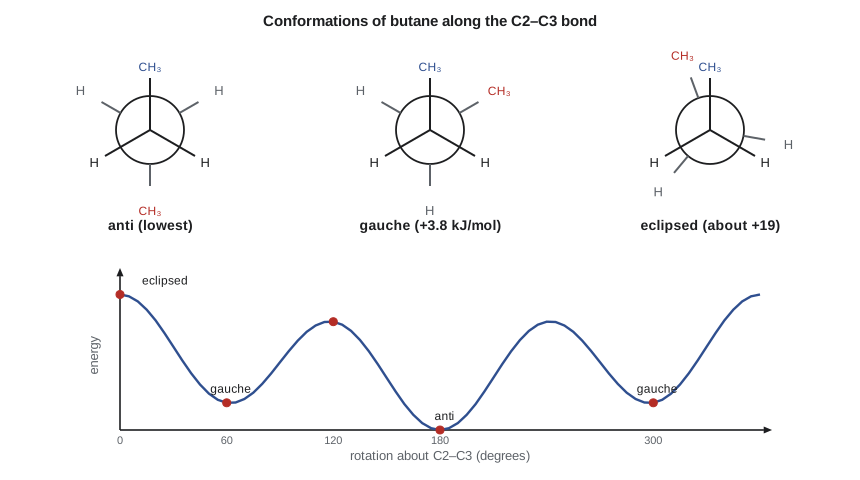
Butane adds a new effect. Looking along the C2–C3 bond, the two methyl groups can be 180° apart (the anti conformation), 60° apart (gauche), or lined up (fully eclipsed). The gauche conformation is about 3.8 kJ/mol less stable than anti because the methyl groups crowd each other, an effect called steric strain. The fully eclipsed form, with both torsional and steric strain, is roughly 19 kJ/mol above anti. At room temperature most butane molecules are anti, and long alkane chains prefer the extended zigzag shape that skeletal structures show.
Cycloalkanes and ring strain
Cycloalkanes contain a ring of carbon atoms and have the general formula CₙH₂ₙ. Cyclopentane and cyclohexane are common in crude oil and naphtha, and cyclohexane is a major industrial chemical, made by hydrogenating benzene and used to make nylon intermediates. Rings cannot rotate freely about their bonds, so substituents on a ring are fixed on one face or the other, which leads to cis and trans isomers: in cis-1,2-dimethylcyclohexane both methyl groups are on the same face of the ring, and in the trans isomer they are on opposite faces.
Small rings are strained. A tetrahedral carbon prefers bond angles of 109.5°, but the internal angle of a flat three-membered ring is 60° and of a four-membered ring 90°. Compressing the angles weakens the bonds, an effect called angle strain, and small rings also suffer torsional strain because their C–H bonds are eclipsed. The strain can be measured from heats of combustion: burning a strained ring releases more energy per CH₂ group than burning a long, strain-free chain. The program below uses approximate heats of combustion to calculate the strain energy of rings from three to eight carbons.
# Ring strain from heats of combustion per CH2 group (approximate textbook values, kJ/mol)
per_ch2 = {3: 697.1, 4: 686.2, 5: 664.0, 6: 658.6, 7: 662.3, 8: 663.6}
ref = 658.6          # strain-free value taken from long-chain alkanes

print("ring  dHc per CH2  strain per CH2  total strain (kJ/mol)")
for n, q in per_ch2.items():
    s = q - ref
    print(f" C{n}     {q:6.1f}         {s:5.1f}          {s * n:6.1f}")

# Heat released by burning 1 kg of each ring: q per CH2 x moles of CH2 in 1 kg (CH2 = 14.027 g/mol)
for n in (3, 6):
print(f"C{n} ring: about {per_ch2[n] * 1000 / 14.027 / 1000:.1f} MJ released per kg burned")ring dHc per CH2 strain per CH2 total strain (kJ/mol) C3 697.1 38.5 115.5 C4 686.2 27.6 110.4 C5 664.0 5.4 27.0 C6 658.6 0.0 0.0 C7 662.3 3.7 25.9 C8 663.6 5.0 40.0 C3 ring: about 49.7 MJ released per kg burned C6 ring: about 47.0 MJ released per kg burned
Cyclopropane and cyclobutane carry more than 100 kJ/mol of strain, and cyclopropane's weakened bonds make it more reactive than other alkanes. Cyclohexane has essentially no strain, which is why six-membered rings are so common in nature, from glucose to steroids. Cyclopentane has a little, and rings of seven to about eleven carbons have small strains from crowding across the ring.
The chair conformation of cyclohexane
Cyclohexane avoids strain by folding into a chair shape. In the chair, every bond angle is close to 109.5° and every C–H bond on adjacent carbons is staggered, so there is neither angle nor torsional strain. Each carbon in a chair has two kinds of hydrogen positions. Axial positions point straight up or down, parallel to the ring's axis, alternating up and down around the ring. Equatorial positions point outward, roughly around the ring's equator.
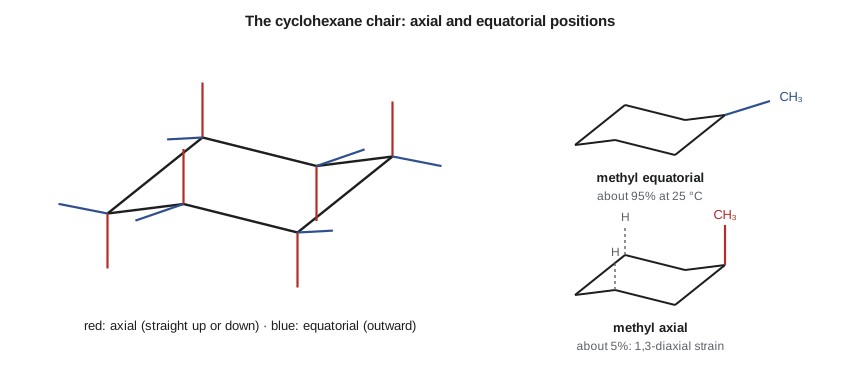
At room temperature the ring flips rapidly between two chair forms, and each flip converts all axial positions to equatorial and all equatorial positions to axial. For cyclohexane itself the two chairs are identical. For a substituted ring they are not. A methyl group in an axial position bumps into the two axial hydrogens on the same face of the ring, three carbons away, an interaction called 1,3-diaxial strain. As a result, about 95 percent of methylcyclohexane molecules have the methyl group equatorial at room temperature. A large group such as tert-butyl is almost entirely equatorial and effectively locks the ring.
Worked problem
Population of conformers from an energy difference
The equatorial conformer of methylcyclohexane is about 7.3 kJ/mol more stable than the axial conformer. Estimate the fraction of molecules in the equatorial form at 25 °C.
Show solution
- The two conformers are in equilibrium: axial ⇌ equatorial, with \(K = e^{-\Delta G^\circ/RT}\).
- \(\Delta G^\circ = -7.3\ \text{kJ/mol}\) for axial \(\to\) equatorial, so \(K = e^{7300/(8.314 \times 298.15)} = e^{2.945} = 19.0\).
- Fraction equatorial \(= K/(1 + K) = 19.0/20.0 = 0.95\).
Answer: About 95 percent of the molecules are equatorial. The same relationship between an energy difference and a population ratio governs chemical equilibria, which you met in CHE-220.
Reactions of alkanes
Alkanes are sometimes called paraffins, from a Latin phrase meaning little affinity, because they react with very few reagents. Strong C–C and C–H bonds and the absence of polar groups or lone pairs leave nothing for acids, bases or most oxidizing agents to attack. That inertness is what makes alkanes good fuels, solvents and lubricants. Alkanes do, however, undergo three important industrial reactions.
The first is combustion. Complete combustion gives carbon dioxide and water and releases a large amount of heat; methane releases about 890 kJ/mol (higher heating value), the basis of the plant's boiler and dryer fuel. Incomplete combustion, with too little air, produces carbon monoxide and soot, which is why burners are tuned for a modest excess of air, as you calculated in CHE-200.
The second is free-radical halogenation. Under ultraviolet light or heat, chlorine reacts with methane to give chloromethane and hydrogen chloride, and further substitution gives dichloromethane, chloroform and carbon tetrachloride. The reaction proceeds by a chain mechanism with initiation (light splits Cl₂ into two chlorine atoms), propagation (a chlorine atom removes a hydrogen from methane to form a methyl radical, which then takes a chlorine atom from Cl₂, regenerating the chlorine atom) and termination (two radicals combine). Chain reactions can accelerate rapidly, and radical chlorinations are carried out under careful control for that reason. Lesson 10 returns to chain mechanisms.
The third is cracking and reforming, the high-temperature processes that refineries and petrochemical plants use to break large alkanes into smaller, more valuable molecules. Steam cracking of ethane at around 800 °C produces ethylene and hydrogen; catalytic cracking breaks heavy oils into gasoline-range molecules; and catalytic reforming converts straight-chain alkanes and cycloalkanes into branched alkanes and aromatics with higher octane ratings. Lesson 12 places these processes in the wider petrochemical industry.
Alkanes in the ethanol plant
Ingrid asks Theo to check why the plant's denaturant specification limits benzene and other aromatics and sets a maximum final boiling point. The answer draws on this lesson and the next two. Natural gasoline is mostly C₅ and C₆ alkanes with some cycloalkanes, which blend into ethanol without separating and evaporate cleanly in an engine. Heavier hydrocarbons would raise the final boiling point and leave deposits, and aromatics such as benzene are limited because of their toxicity, a point lesson 5 develops. Understanding the structure of a mixture lets an engineer read a specification and see what each limit is protecting.
Common mistakes
MistakeTreating staggered and eclipsed ethane as different compounds.
InsteadThey are conformations of one compound that interconvert rapidly at room temperature.
MistakeDrawing cyclohexane as a flat hexagon and reasoning about its angles from that.
InsteadThe real ring is a puckered chair with tetrahedral angles; the flat hexagon is shorthand.
MistakePutting a large substituent axial in the preferred conformer.
InsteadLarge groups prefer equatorial positions to avoid 1,3-diaxial strain.
MistakeAssuming alkanes are harmless because they are unreactive.
InsteadTheir chemistry is mild, but their flammability, volatility and static hazards are serious.
Summary and key terms
- Alkanes are CₙH₂ₙ₊₂ and cycloalkanes CₙH₂ₙ; boiling points rise with chain length and fall with branching.
- Rotation about single bonds produces conformations; staggered arrangements are favoured over eclipsed ones.
- In butane, anti is most stable, gauche about 3.8 kJ/mol higher, fully eclipsed about 19 kJ/mol higher.
- Small rings carry angle and torsional strain; cyclohexane's chair is essentially strain-free.
- Substituents on a cyclohexane chair prefer equatorial positions to avoid 1,3-diaxial strain.
- Alkanes combust, undergo free-radical halogenation, and are cracked and reformed in refineries.
- Homologous series
- A family of compounds whose successive members differ by a CH₂ unit.
- Conformation
- A three-dimensional arrangement of a molecule produced by rotation about single bonds.
- Newman projection
- A drawing that views a molecule straight down a carbon-carbon bond.
- Torsional strain
- Extra energy caused by eclipsed bonds on adjacent atoms.
- Angle strain
- Extra energy caused by bond angles that differ from the ideal value.
- Axial and equatorial
- The two kinds of positions on a cyclohexane chair: vertical and outward-pointing.
- Octane number
- A measure of a fuel’s resistance to knocking, on a scale set by isooctane (100) and heptane (0).
Practice problems
Work each problem on paper first, then reveal the answer to check.
Which has the higher boiling point, hexane or 2,2-dimethylbutane?
Show answer
Hexane; the branched isomer is more compact, with weaker dispersion forces.
Why is cyclopropane more reactive than propane?
Show answer
Its 60° bond angles create large angle strain, weakening its C–C bonds.
In the chair conformation of cyclohexane, how many hydrogens are axial?
Show answer
Six, three pointing up and three pointing down, alternating around the ring.
Using the program's data, what is the total ring strain of cyclobutane?
Show answer
About 110 kJ/mol (27.6 kJ/mol per CH₂ × 4).
Write the balanced equation for the complete combustion of propane.
Show answer
C₃H₈ + 5 O₂ → 3 CO₂ + 4 H₂O.
Why do denaturant transfers require bonding and grounding?
Show answer
Nonpolar hydrocarbons conduct charge poorly, so static can build up and ignite the vapour.
Lesson quiz · 5 questions
Score 60% or more to complete this lesson.
Create a free account to save your progress, take quizzes and earn a certificate.