
CHE-243 · Lesson 11 of 12 · 22 min
Polymers and polymerization
Polymers are very large molecules built from many small repeating units called monomers. They make up most of the materials around us: the plastics of packaging and pipes, the fibres of clothing and carpets, rubber, paints, adhesives, and, in nature, cellulose, starch, proteins and DNA. More than 400 million tonnes of plastics are produced each year worldwide, and most of the organic chemicals industry ultimately feeds polymer production. The Kingfisher Bioenergy plant is surrounded by polymers: its feedstock is starch, its by-product fibre is cellulose and protein, its pipes and tank linings include polyethylene, PVC and fibreglass-reinforced resins, and the bio-based ethylene and lactic acid discussed in earlier lessons are routes into renewable plastics. This lesson covers how polymers form, how their structure controls their properties, and how engineers describe them.
Monomers, repeat units and polymer types
A monomer must be able to join at least two other molecules to build a chain. Alkenes do this by opening their double bond; molecules with two reactive functional groups, such as a diacid and a diol, do it by reacting at both ends. The structure that repeats along the chain is the repeat unit, written in square brackets with a subscript n: polyethylene is –[CH₂–CH₂]ₙ–. The number of repeat units in a chain, the degree of polymerization, is typically thousands to hundreds of thousands, giving molar masses from tens of thousands to millions of grams per mole.
Polymers are classified in several overlapping ways. By origin, they are natural (cellulose, starch, proteins, natural rubber), modified natural (cellulose acetate) or synthetic. By response to heat, they are thermoplastics, which soften when heated and can be remelted and reshaped, such as polyethylene and PET, or thermosets, which form permanent cross-linked networks when cured and char rather than melt, such as epoxies and phenol-formaldehyde resins. By chain structure, they are linear, branched or cross-linked. And by how they are made, they are chain-growth or step-growth polymers.
Chain-growth (addition) polymerization
In chain-growth polymerization, an active centre adds monomer molecules one at a time to the end of a growing chain. The active centre is usually a radical, but it can also be a cation, an anion, or a metal complex. Radical polymerization follows the chain mechanism described in lesson 10. An initiator, such as a peroxide or an azo compound, decomposes on heating into radicals. A radical adds to the double bond of a monomer, producing a new radical at the chain end, which adds another monomer, and so on, thousands of times per second. The chain stops growing when two radicals meet and combine or exchange a hydrogen.
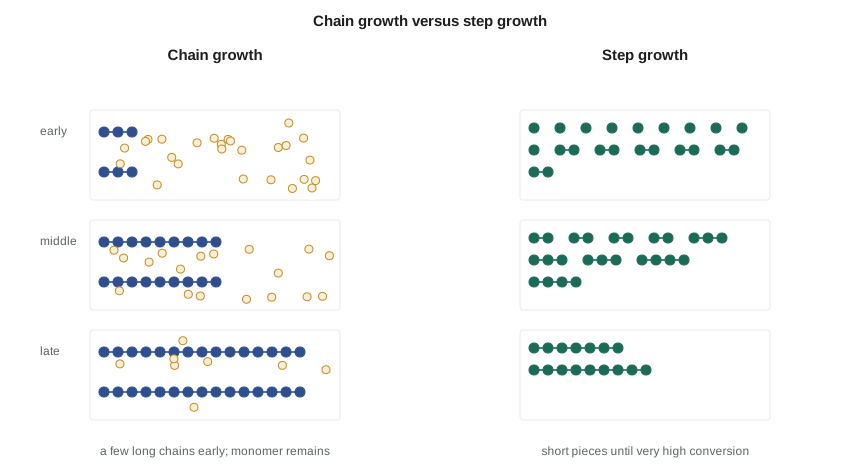
Many everyday plastics are made this way from substituted ethylenes: polypropylene from propylene, polystyrene from styrene, polyvinyl chloride from vinyl chloride, and poly(methyl methacrylate), the clear acrylic sheet, from methyl methacrylate. Polyethylene itself comes in several forms. Low-density polyethylene, made by radical polymerization at very high pressure, has many branches that keep the chains from packing closely, so it is soft and flexible. High-density polyethylene, made at low pressure with Ziegler-Natta or metallocene catalysts, has nearly linear chains that pack into crystalline regions, making it stiffer and stronger. Linear low-density polyethylene, made by copolymerizing ethylene with a little 1-butene, 1-hexene or 1-octene, combines toughness with flexibility for films.
Chain-growth polymerizations release a great deal of heat, around 70 to 100 kJ per mole of monomer for common vinyl monomers, and their rate rises with temperature, so they are prone to runaway. In a bulk polymerization the viscosity also rises sharply as chains grow, which slows termination and accelerates the reaction further, an effect called autoacceleration. Industrial reactors control heat by running in solution, in suspension of droplets in water, or in emulsion, and by using cooling jackets, internal coils and reflux condensers. Monomer storage tanks carry inhibitors, as lesson 10 described.
| Polymer | Monomer | Main uses |
|---|---|---|
| High-density polyethylene (HDPE) | Ethylene | Bottles, pipe, tanks, geomembranes |
| Low-density polyethylene (LDPE) | Ethylene | Films, bags, coatings |
| Polypropylene (PP) | Propylene | Packaging, automotive parts, fibres |
| Polyvinyl chloride (PVC) | Vinyl chloride | Pipe, window frames, wire insulation |
| Polystyrene (PS) | Styrene | Packaging, insulation foam |
| Polyethylene terephthalate (PET) | Terephthalic acid and ethylene glycol | Bottles, polyester fibre |
| Nylon 6,6 | Adipic acid and hexamethylenediamine | Fibres, engineering parts |
| Polylactic acid (PLA) | Lactic acid (via lactide) | Compostable packaging, 3D printing |
Step-growth (condensation) polymerization
In step-growth polymerization, any two molecules with complementary functional groups can react, whether monomers, short oligomers or long chains. Many step-growth reactions release a small molecule such as water, so they are also called condensation polymerizations. Polyesters form from diacids and diols by the esterification of lesson 8; polyamides form from diacids and diamines; polyurethanes form from diisocyanates and diols, without releasing a by-product.
Because every molecule can react with every other, the chains stay short until the reaction is almost complete. Wallace Carothers, who invented nylon at DuPont in the 1930s, showed that for a perfectly balanced feed of two monomers, the number-average degree of polymerization depends only on the extent of reaction p, the fraction of functional groups that have reacted.
The equation has a striking consequence: reaching 90 percent conversion gives chains only ten units long on average, and a useful fibre-forming polymer, with a hundred or more repeat units, requires 99 percent conversion or better. Any imbalance in the feed ratio, or any monofunctional impurity that caps chain ends, sharply limits the chain length. That is why polyester and nylon producers use highly purified monomers in exactly balanced amounts, and why equilibrium-limited polyesterification is driven by removing water or ethylene glycol under vacuum at high temperature. The program below applies the Carothers equation and calculates molar mass averages for a sample.
Molar mass distributions
Unlike small molecules, a polymer sample contains chains of many lengths, so its molar mass is described by averages. The number-average molar mass, \(M_n\), is the total mass divided by the total number of chains, and it governs properties that depend on counting chain ends. The weight-average molar mass, \(M_w\), weights each chain by its mass, so long chains count more; it relates more closely to melt viscosity and toughness. The ratio \(M_w/M_n\), called the dispersity (formerly the polydispersity index), measures how broad the distribution is. It equals 1 for chains all of one length, is about 2 for typical step-growth polymers, and can range from below 1.1 for carefully controlled living polymerizations to above 10 for some branched polyethylenes.
# Number- and weight-average molar mass, dispersity, and the Carothers equation for step growth
chains = [(50000, 120), (100000, 300), (150000, 260), (200000, 150), (300000, 60)]   # (M in g/mol, number of chains)
N = sum(n for M, n in chains)
Mn = sum(n * M for M, n in chains) / N
Mw = sum(n * M * M for M, n in chains) / sum(n * M for M, n in chains)
print(f"Mn = {Mn:,.0f} g/mol   Mw = {Mw:,.0f} g/mol   dispersity = {Mw / Mn:.2f}")

# Step growth: degree of polymerization Xn = 1/(1 - p) for a 1:1 feed of two monomers
for p in (0.90, 0.95, 0.99, 0.995, 0.999):
print(f"extent of reaction p = {p:.3f} -> Xn = {1 / (1 - p):6.0f}")Mn = 138,202 g/mol Mw = 167,073 g/mol dispersity = 1.21 extent of reaction p = 0.900 -> Xn = 10 extent of reaction p = 0.950 -> Xn = 20 extent of reaction p = 0.990 -> Xn = 100 extent of reaction p = 0.995 -> Xn = 200 extent of reaction p = 0.999 -> Xn = 1000
Structure and properties
Polymer properties depend on chain length, chain shape, the forces between chains and how the chains are arranged. Longer chains entangle more, raising strength and melt viscosity. Branching interferes with packing and lowers crystallinity and density. Polar groups and hydrogen bonds between chains, as in nylon's amide groups, raise melting points and strength. Cross-links tie chains into networks: a few cross-links turn natural rubber into elastic vulcanized rubber, and many cross-links make rigid thermosets.
Two temperatures characterize most polymers. Below the glass transition temperature, \(T_g\), the chains in the amorphous regions are frozen and the material is glassy and rigid; above it, segments of the chains can move and the material becomes rubbery or leathery. Crystalline regions melt at a higher melting temperature, \(T_m\). Polystyrene, with \(T_g\) near 100 °C, is a rigid glass at room temperature; polyethylene, with \(T_g\) far below zero, is flexible. Tacticity, the regularity of side groups along the chain, also matters: polypropylene made with stereospecific catalysts has its methyl groups all on one side (isotactic), letting the chains crystallize into a useful plastic, whereas random (atactic) polypropylene is a soft, sticky material.
Worked problem
Chain length needed for a polyester fibre
A PET producer needs a number-average degree of polymerization of at least 100 repeat units for fibre. What extent of reaction is required, assuming a perfectly balanced feed?
Show solution
- From Carothers, \(X_n = 1/(1 - p)\), so \(p = 1 - 1/X_n\).
- Here \(X_n\) counts monomer residues; 100 repeat units of PET contain 200 monomer residues (one acid and one glycol each), so \(X_n = 200\).
- \(p = 1 - 1/200 = 0.995\).
Answer: The reaction must reach 99.5 percent conversion of functional groups. Driving an equilibrium esterification that far requires continuously removing the condensation by-product under vacuum, which is why the final stage of PET production runs at around 280 °C under high vacuum.
Recycling and the chemistry of breaking polymers down
The same chemistry that builds polymers can take some of them apart. Mechanical recycling melts and reshapes thermoplastics, but each cycle shortens chains and mixes in contaminants, so properties gradually fall. Chemical recycling breaks polymers back into monomers or useful intermediates. Step-growth polymers are the easiest candidates, because their ester and amide links can be reversed: PET can be split by glycolysis with ethylene glycol, by methanolysis, or by hydrolysis back to terephthalic acid and glycol, all of them reverse esterifications in the sense of lesson 8, and enzymes that cut PET's ester bonds are being developed for the same purpose. Chain-growth polymers such as polyethylene have only strong C–C bonds, so they must be broken down by pyrolysis at high temperature into a mixture of hydrocarbons, which takes far more energy and gives a less uniform product.
Thermosets are hardest of all to recycle, because their cross-linked networks cannot be remelted. Engineers designing a product therefore make choices about end of life at the start: choosing a single polymer rather than a laminate of several, avoiding unnecessary additives, and favouring polymers whose links can be reversed.
Bio-based polymers and the ethanol plant
Several bio-based polymers connect directly to plants like Kingfisher Bioenergy. Bio-ethylene from dehydrated ethanol (lesson 4) can be polymerized into polyethylene identical to the petroleum-based product, so it fits existing equipment and recycling streams. Polylactic acid is made from lactic acid produced by fermenting sugars, the same feedstock the plant uses; the lactic acid is converted to a cyclic dimer, lactide, which is then polymerized by ring opening. PLA is compostable under industrial conditions, but its properties depend strongly on the enantiomeric purity of the lactic acid (lesson 6). Starch itself can be blended or modified into bioplastics, and the protein and fibre in distillers grains are being studied as fillers for composites.
Ingrid notes for Theo that bio-based does not automatically mean biodegradable or lower impact. Bio-polyethylene is as persistent as ordinary polyethylene, and life-cycle assessments of bio-based plastics depend heavily on how the crops were grown and what energy powered the processing. Engineers evaluating such products need both the chemistry in this course and the mass and energy balances of CHE-200.
Plastics policy is changing quickly. Canada listed plastic manufactured items as toxic under the Canadian Environmental Protection Act and restricted several single-use plastics, a measure that has been challenged in the courts, and federal and provincial programs are increasing producer responsibility for packaging. Engineers working with polymers should check the current federal and Ontario requirements before designing a product.
Common mistakes
MistakeExpecting long chains early in a step-growth polymerization.
InsteadChain length stays low until conversion exceeds about 99 percent, as Carothers' equation shows.
MistakeTreating a polymer's molar mass as a single number.
InsteadReport averages such as \(M_n\) and \(M_w\) and the dispersity, which describe the distribution.
MistakeAssuming every plastic melts and can be remelted.
InsteadThermosets are cross-linked networks that char rather than melt.
MistakeEquating bio-based with biodegradable.
InsteadBio-polyethylene is chemically identical to petroleum polyethylene and just as persistent.
Summary and key terms
- Polymers are long chains of repeat units; thermoplastics remelt, thermosets are permanent cross-linked networks.
- Chain growth adds monomers to active chain ends (often radicals); it is strongly exothermic and prone to runaway.
- Step growth joins any two complementary groups; \(X_n = 1/(1 - p)\) demands very high conversion and pure, balanced monomers.
- \(M_n\), \(M_w\) and the dispersity \(M_w/M_n\) describe the molar mass distribution.
- Branching, polarity, cross-linking, tacticity and the glass transition control properties.
- Bio-ethylene, PLA and starch-based materials link fermentation plants to renewable polymers.
- Monomer
- A small molecule that can link with others to form a polymer.
- Degree of polymerization
- The number of monomer units in a polymer chain.
- Chain-growth polymerization
- Polymerization by successive addition of monomers to an active chain end.
- Step-growth polymerization
- Polymerization in which any two molecules with complementary groups can react.
- Dispersity
- The ratio \(M_w/M_n\), measuring the breadth of a molar mass distribution.
- Glass transition temperature
- The temperature above which amorphous polymer chains gain segmental mobility.
- Thermoset
- A polymer that forms an irreversibly cross-linked network on curing.
Practice problems
Work each problem on paper first, then reveal the answer to check.
Write the repeat unit of polyvinyl chloride.
Show answer
–[CH₂–CHCl]ₙ–.
Is nylon 6,6 a chain-growth or a step-growth polymer?
Show answer
Step-growth: it forms from a diacid and a diamine with loss of water.
Using Carothers' equation, what \(X_n\) results from p = 0.98?
Show answer
1/(1 − 0.98) = 50.
Using the program, what is the dispersity of the sample?
Show answer
About 1.21.
Why is HDPE stiffer than LDPE?
Show answer
Its nearly linear chains pack into more crystalline regions.
Why does a monofunctional impurity limit chain length in step growth?
Show answer
It caps a chain end so that end can no longer react to extend the chain.
Lesson quiz · 5 questions
Score 60% or more to complete this lesson.
Create a free account to save your progress, take quizzes and earn a certificate.