
CHE-243 · Lesson 7 of 12 · 22 min
Alcohols, ethers and alkyl halides: substitution and elimination
Ethanol is the product that pays the bills at Kingfisher Bioenergy, and it belongs to a family of compounds, the alcohols, whose chemistry is closely tied to two others: ethers and alkyl halides. All three have a carbon bonded to an electronegative atom by a single bond, C–O or C–X, and that polar bond makes the carbon slightly positive and open to attack. This lesson looks at the properties of the three families and at the two reaction types that dominate their chemistry: substitution, in which one group replaces another on a carbon, and elimination, in which a small molecule is removed to form a double bond. Knowing which of the two will happen, and how fast, is one of the central skills of organic chemistry and of process development.
Alcohols: structure and properties
An alcohol has a hydroxyl group, –OH, bonded to an sp³ carbon. Alcohols are classified by the carbon that carries the OH. In a primary alcohol that carbon is bonded to one other carbon (ethanol, 1-propanol, isoamyl alcohol); in a secondary alcohol to two (2-propanol, 2-butanol); and in a tertiary alcohol to three (tert-butyl alcohol). The classification matters because it strongly affects how the alcohol reacts. Methanol, with no carbons on the OH carbon, behaves much like a primary alcohol.
The O–H group makes alcohols polar and able to hydrogen bond, both with themselves and with water. Methanol, ethanol and the propanols mix with water in all proportions; solubility falls as the hydrocarbon part grows, so 1-butanol dissolves only to about 7 percent and 1-octanol hardly at all. Hydrogen bonding also explains why alcohols boil much higher than alkanes or ethers of similar size, and why ethanol and water form an azeotrope near 95.6 percent ethanol by mass that ordinary distillation cannot cross. The plant uses molecular sieves, which adsorb water selectively, to dry its ethanol past the azeotrope to the 99-plus percent needed for fuel.
Alcohols are very weak acids, with pKa values near 16 for ethanol, about the same as water. Strong bases such as sodium metal or sodium hydride remove the proton to form alkoxide ions, such as ethoxide, CH₃CH₂O⁻, which are strong bases and good nucleophiles. Sodium methoxide dissolved in methanol is the catalyst used to make biodiesel from vegetable oils, a reaction covered in lesson 8. Alcohols are also weak bases: in strong acid, the oxygen accepts a proton, and that protonation is the first step in many alcohol reactions.
Ethers
An ether has an oxygen bonded to two carbons, R–O–R′. Ethers cannot hydrogen bond with themselves, because they lack an O–H, so they boil far lower than isomeric alcohols, but they can accept hydrogen bonds from water and dissolve moderately in it. Diethyl ether, the classic laboratory solvent and early anesthetic, boils at 35 °C. Industrially important ethers include tetrahydrofuran (THF), a cyclic solvent, and methyl tert-butyl ether (MTBE), once a major gasoline oxygenate. MTBE was phased out of US gasoline in the mid-2000s after leaking storage tanks contaminated groundwater, and ethanol largely replaced it as the oxygenate in gasoline, which helped drive the growth of the fuel ethanol industry.
Ethers are chemically unreactive, which makes them good solvents, but they carry two serious hazards. They are extremely flammable, with low flash points and wide flammability ranges, and their vapours are heavier than air. More insidiously, many ethers react slowly with oxygen in air and light to form organic peroxides, which can accumulate in old containers or concentrate when the ether is distilled and can then detonate on heating, friction or shock. Peroxide-forming solvents are dated on opening, tested regularly and discarded on schedule, and they are never distilled to dryness.
Alkyl halides
Alkyl halides, R–X, have a halogen bonded to an sp³ carbon. The C–X bond is polar, with the carbon δ+, and the halide ion is a stable leaving group, so alkyl halides are reactive building blocks in synthesis. They are classified as primary, secondary or tertiary like alcohols. Small chlorinated hydrocarbons such as dichloromethane, trichloroethylene and tetrachloroethylene were once widely used as solvents and degreasers; concerns about toxicity, groundwater contamination and ozone depletion have led to tight restrictions on many of them, and both countries have recently moved to ban or sharply restrict several chlorinated solvents.
Chlorofluorocarbons (CFCs), once used as refrigerants and propellants, illustrate why halide chemistry matters beyond the laboratory. They are stable enough to reach the stratosphere, where ultraviolet light breaks off chlorine atoms that catalyze ozone destruction. The Montreal Protocol of 1987 phased out CFCs; their replacements, the HFCs, do not harm ozone but are strong greenhouse gases and are now being phased down under the Kigali Amendment. Refrigeration engineers, including those designing the plant's chillers, must track which refrigerants are allowed.
Nucleophilic substitution: the SN2 mechanism
In a nucleophilic substitution, a nucleophile, an electron-pair donor such as hydroxide, cyanide, an alkoxide or an amine, replaces a leaving group on a carbon. There are two limiting mechanisms. In the SN2 mechanism (substitution, nucleophilic, bimolecular), the nucleophile attacks the carbon from the side opposite the leaving group at the same moment that the leaving group departs. The reaction passes through a single transition state in which the carbon is partly bonded to both groups, with the other three substituents flattened into a plane. The carbon's configuration is inverted, like an umbrella turning inside out in the wind.
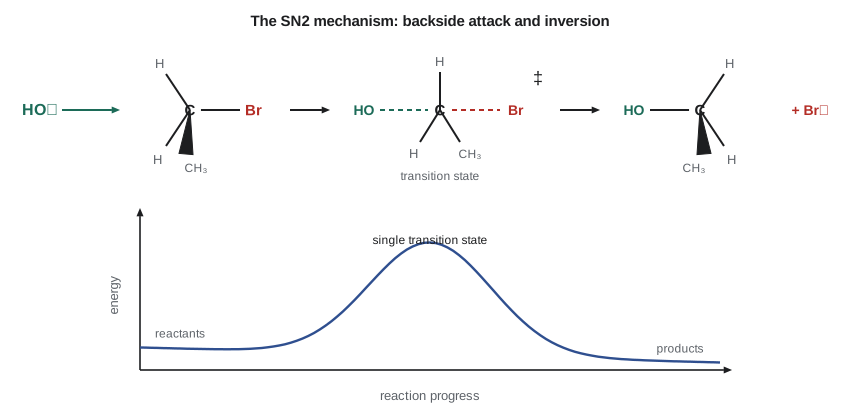
Because both the nucleophile and the substrate take part in the slow step, the SN2 rate depends on both concentrations: rate = k[RX][Nu]. Steric hindrance controls SN2 reactivity. The nucleophile must reach the back of the carbon, so methyl and primary substrates react fastest, secondary substrates slowly, and tertiary substrates essentially not at all. SN2 reactions are fastest in polar aprotic solvents, such as acetone, dimethyl sulfoxide or acetonitrile, which dissolve ionic nucleophiles without surrounding them with hydrogen bonds.
The SN1 mechanism
In the SN1 mechanism (unimolecular), the leaving group departs first, forming a carbocation, and the nucleophile then attacks the flat cation from either face. The slow step involves only the substrate, so rate = k[RX], independent of the nucleophile concentration. SN1 is favoured by substrates that form stable carbocations, tertiary and resonance-stabilized ones, and by polar protic solvents such as water and alcohols, which stabilize the ions as they form. Because the nucleophile can attack either face of the flat carbocation, a stereocentre usually ends up partly racemized, and because a carbocation is involved, rearrangements like those in lesson 4 can occur.
Elimination: E2 and E1
Strong bases can do something other than substitute. Instead of attacking the carbon, a base can remove a hydrogen from the neighbouring carbon, while the leaving group departs and a double bond forms. This is elimination. The E2 mechanism happens in one step and needs a strong base; it works best when the hydrogen and the leaving group are anti to each other. The E1 mechanism goes through the same carbocation as SN1, followed by loss of a proton, and competes with SN1 under the same conditions. When elimination can form more than one alkene, the more substituted and more stable alkene usually predominates, a pattern called Zaitsev's rule, although bulky bases such as tert-butoxide favour the less substituted alkene.
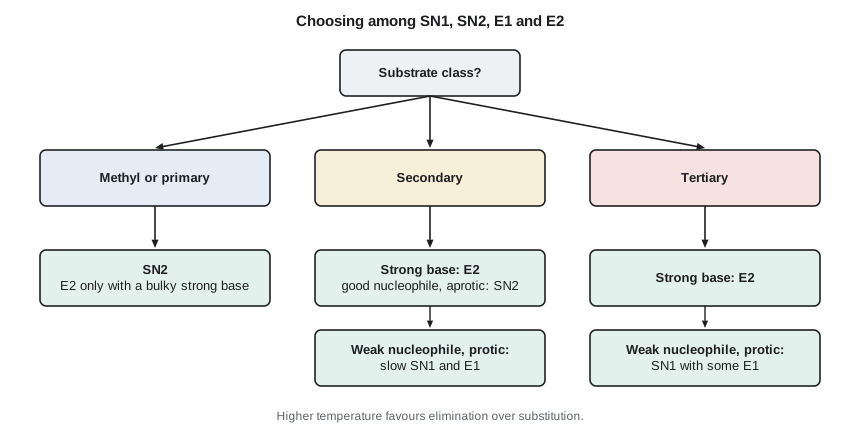
Choosing among the four mechanisms comes down to three questions. What is the substrate: methyl, primary, secondary or tertiary? Is the reagent a good nucleophile, a strong base, or both? And is the solvent polar protic or polar aprotic? Higher temperature also favours elimination over substitution, because elimination produces more molecules and so has a larger entropy change. The program below encodes simplified rules of thumb and shows how the SN1 and SN2 rate laws respond differently when the nucleophile concentration doubles.
# A rule-of-thumb guide to substitution and elimination, and SN1 versus SN2 rate laws
def predict(substrate, nucleophile, solvent):
    """substrate: methyl, primary, secondary, tertiary; nucleophile: strong_weak_base, strong_strong_base,
    weak; solvent: polar_aprotic or polar_protic"""
    if substrate in ('methyl', 'primary'):
        return 'E2 (bulky strong base)' if nucleophile == 'bulky_base' else 'SN2'
    if substrate == 'tertiary':
        if nucleophile in ('strong_strong_base', 'bulky_base'):
            return 'E2'
        return 'SN1 with some E1'
    # secondary
    if nucleophile in ('strong_strong_base', 'bulky_base'):
        return 'E2'
    if nucleophile == 'strong_weak_base':
        return 'SN2' if solvent == 'polar_aprotic' else 'SN2, slower'
    return 'SN1/E1 mixture (slow)'

cases = [('primary', 'strong_weak_base', 'polar_aprotic'), ('primary', 'bulky_base', 'polar_protic'),
         ('secondary', 'strong_strong_base', 'polar_protic'), ('secondary', 'strong_weak_base', 'polar_aprotic'),
         ('tertiary', 'weak', 'polar_protic'), ('tertiary', 'strong_strong_base', 'polar_protic')]
for c in cases:
    print(f"{c[0]:9s} {c[1]:19s} {c[2]:13s} -> {predict(*c)}")

# Doubling the nucleophile concentration: SN2 rate doubles, SN1 rate does not change
k2, k1 = 0.010, 0.0020          # L/(mol s) and 1/s, illustrative
RX = 0.10
for Nu in (0.10, 0.20):
print(f"[Nu] = {Nu:.2f} M SN2 rate = {k2 * RX * Nu:.1e} M/s SN1 rate = {k1 * RX:.1e} M/s")primary strong_weak_base polar_aprotic -> SN2 primary bulky_base polar_protic -> E2 (bulky strong base) secondary strong_strong_base polar_protic -> E2 secondary strong_weak_base polar_aprotic -> SN2 tertiary weak polar_protic -> SN1 with some E1 tertiary strong_strong_base polar_protic -> E2 [Nu] = 0.10 M SN2 rate = 1.0e-04 M/s SN1 rate = 2.0e-04 M/s [Nu] = 0.20 M SN2 rate = 2.0e-04 M/s SN1 rate = 2.0e-04 M/s
Worked problem
Predicting the products of 2-bromo-2-methylpropane under two conditions
2-Bromo-2-methylpropane, (CH₃)₃CBr, is (a) warmed in water and (b) treated with concentrated sodium ethoxide in ethanol. Predict the main mechanism and product in each case.
Show solution
- The substrate is tertiary: SN2 is blocked by steric hindrance, so the choices are SN1/E1 or E2.
- (a) Water is a weak nucleophile and weak base, and a polar protic solvent. The C–Br bond ionizes to the tertiary carbocation, and water attacks it: SN1, giving tert-butyl alcohol, with some 2-methylpropene from E1.
- (b) Ethoxide is a strong base. With a tertiary substrate it removes a neighbouring hydrogen in one step: E2, giving 2-methylpropene as the main product.
Answer: Warm water gives mainly tert-butyl alcohol by SN1; concentrated ethoxide gives mainly 2-methylpropene by E2. The same substrate gives different products depending on the reagent.
Reactions of alcohols
The OH group itself is a poor leaving group, because hydroxide is a strong base. Alcohols are therefore activated before substitution or elimination. In strong acid, the OH is protonated to –OH₂⁺, and water, a weak base, leaves easily. That is how hydrogen bromide converts alcohols into alkyl bromides, and how acid dehydrates alcohols to alkenes (lesson 4) or, at lower temperature, joins two alcohol molecules into an ether. Industrially, diethyl ether is made as a by-product of ethanol dehydration, and dimethyl ether, a candidate clean fuel, is made by dehydrating methanol.
Alcohols can also be oxidized, and their classification decides the result. Primary alcohols oxidize first to aldehydes and then to carboxylic acids. Secondary alcohols oxidize to ketones and stop there. Tertiary alcohols have no hydrogen on the OH carbon and resist oxidation. The same chemistry happens in living things: liver enzymes oxidize ethanol to acetaldehyde and then to acetic acid, and acetic acid bacteria do the same in vinegar making. In the fermenter, small amounts of acetaldehyde and acetic acid appear because yeast and contaminating bacteria carry out the same oxidation steps, which is one reason the plant watches dissolved oxygen and sanitation.
Toxic alcohols and solvent selection
The members of the alcohol family differ sharply in toxicity. Ethanol is the least harmful of the simple alcohols in small amounts, but methanol is highly toxic: the body oxidizes it to formaldehyde and formic acid, which can cause blindness and death. Fermentation produces a little methanol from pectin in plant material, and fuel ethanol specifications limit it, typically to about half a percent by volume. Ethylene glycol, used in antifreeze, is also toxic by a similar oxidation pathway. When engineers choose a solvent or extraction agent they compare toxicity, flammability, environmental fate and cost, and many companies use published solvent selection guides that rank common solvents on these criteria.
Common mistakes
MistakeExpecting tertiary alkyl halides to undergo SN2.
InsteadBackside attack is blocked; tertiary substrates react by SN1, E1 or E2.
MistakeWriting OH⁻ as the leaving group from an alcohol without activation.
InsteadProtonate the OH or convert it to a better leaving group first; water leaves, hydroxide does not.
MistakeAssuming the SN1 rate depends on the nucleophile concentration.
InsteadOnly the substrate takes part in the slow step, so rate = k[RX].
MistakeStoring opened ethers indefinitely.
InsteadMany ethers form explosive peroxides; date, test and dispose of them on schedule.
Summary and key terms
- Alcohols are primary, secondary or tertiary; hydrogen bonding gives them high boiling points and water solubility.
- Ethers are unreactive solvents but highly flammable and prone to forming explosive peroxides.
- SN2: one step, backside attack, inversion, rate = k[RX][Nu], fastest for methyl and primary substrates.
- SN1: carbocation intermediate, racemization, rate = k[RX], favoured by tertiary substrates and protic solvents.
- Strong bases favour elimination (E2); Zaitsev's rule predicts the more substituted alkene.
- Primary alcohols oxidize to aldehydes and acids, secondary to ketones; tertiary alcohols resist oxidation.
- Nucleophile
- An electron-pair donor that attacks an electron-poor atom.
- Leaving group
- An atom or group that departs with the bonding electron pair in a substitution or elimination.
- SN2
- A one-step bimolecular substitution with backside attack and inversion of configuration.
- SN1
- A two-step unimolecular substitution through a carbocation intermediate.
- E2
- A one-step elimination in which a base removes a proton as the leaving group departs.
- Zaitsev’s rule
- Elimination usually gives the more substituted, more stable alkene.
- Azeotrope
- A mixture that boils at constant composition, so distillation cannot separate it further.
Practice problems
Work each problem on paper first, then reveal the answer to check.
Classify isoamyl alcohol, (CH₃)₂CHCH₂CH₂OH, as primary, secondary or tertiary.
Show answer
Primary: the OH carbon is bonded to one other carbon.
What happens to the rate of an SN2 reaction if the nucleophile concentration is tripled?
Show answer
It triples, since rate = k[RX][Nu].
What is the oxidation product of 2-propanol?
Show answer
Acetone (propanone), a ketone.
Why is dimethyl sulfoxide a good solvent for SN2 reactions?
Show answer
It is polar aprotic: it dissolves ionic nucleophiles without hydrogen-bonding to them.
Predict the main product when 2-bromobutane reacts with potassium tert-butoxide.
Show answer
1-Butene; the bulky base favours the less substituted alkene by E2.
Why can't ordinary distillation give pure ethanol from fermentation beer?
Show answer
Ethanol and water form an azeotrope near 95.6 mass percent ethanol.
Lesson quiz · 5 questions
Score 60% or more to complete this lesson.
Create a free account to save your progress, take quizzes and earn a certificate.