
CHE-243 · Lesson 6 of 12 · 21 min
Stereochemistry
Hold your hands up, palm to palm. They are mirror images of each other, yet you cannot place your left hand exactly on top of your right: the thumbs end up on opposite sides. Objects that are not superimposable on their mirror images are called chiral, from the Greek word for hand. Many molecules are chiral in exactly this way, and the two mirror-image forms can behave very differently wherever they meet another chiral object, such as an enzyme, a receptor in the nose, or a chiral catalyst. Biology is built from chiral molecules: the amino acids in proteins are almost all of one handedness and the sugars of another. Because fermentation is biology, the Kingfisher Bioenergy plant handles chiral molecules every day, from the glucose in its mash to the lactic acid made by contaminating bacteria.
This lesson covers how chirality arises, how to describe it with the R/S system, how chiral molecules interact with polarized light, and why stereochemistry matters to engineers who make pharmaceuticals, flavours, agricultural chemicals and bio-based products.
Stereoisomers
Lesson 2 introduced constitutional isomers, which differ in how atoms are connected. Stereoisomers have the same connections but differ in the arrangement of atoms in space. You have already met two kinds: cis/trans isomers of alkenes in lesson 4 and of rings in lesson 3. This lesson adds stereoisomers that arise from tetrahedral carbon atoms. Stereoisomers come in two classes. Enantiomers are non-superimposable mirror images of each other. Diastereomers are stereoisomers that are not mirror images; cis and trans isomers are diastereomers, and so are many compounds with two or more stereocentres.
Chirality and stereocentres
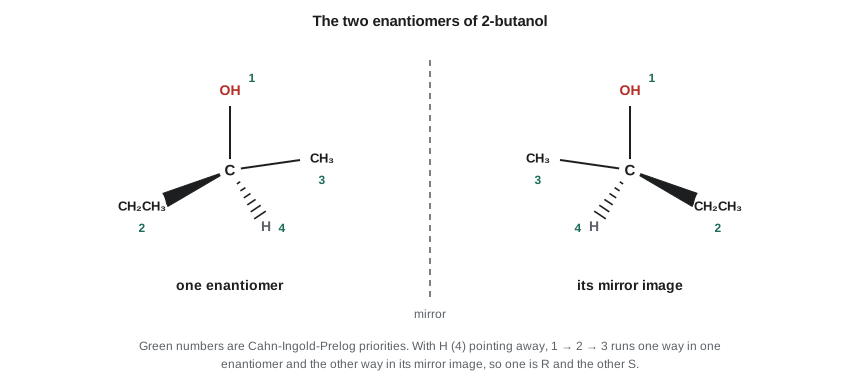
The most common source of chirality is a carbon atom bonded to four different groups, called a stereocentre or chiral centre. 2-Butanol, CH₃CH(OH)CH₂CH₃, has one: the second carbon carries a hydrogen, a hydroxyl group, a methyl group and an ethyl group. Swapping any two of the four groups produces the mirror-image molecule, and no rotation can make the two forms coincide. By contrast, 2-propanol, CH₃CH(OH)CH₃, has two identical methyl groups on its central carbon and is achiral: it is superimposable on its mirror image.
A quick test for chirality is to look for a plane of symmetry. A molecule with an internal mirror plane is achiral, even if it contains stereocentres. A molecule with one stereocentre and no other source of asymmetry is always chiral. Drawing stereocentres requires a convention for the third dimension: a solid wedge represents a bond pointing toward the viewer, a hashed wedge a bond pointing away, and plain lines bonds in the plane of the page.
Naming configurations: the R/S system
Each stereocentre is labelled R or S by the Cahn-Ingold-Prelog rules, the same priority rules used for E/Z alkenes. The procedure has three steps. First, rank the four groups on the stereocentre by atomic number of the atom directly attached: higher atomic number means higher priority. If two attached atoms are the same, compare the sets of atoms attached to them, working outward until a difference appears; double bonds count as two single bonds to the same atom. Second, orient the molecule so that the lowest-priority group, often hydrogen, points away from you. Third, trace a path from priority 1 to 2 to 3. If the path runs clockwise, the stereocentre is R (rectus, right); if counterclockwise, it is S (sinister, left).
Worked problem
Assigning R or S to 2-butanol
One enantiomer of 2-butanol is viewed with its C–H bond pointing directly away from you. The other three groups then look like the spokes of a steering wheel: OH at the top, CH₂CH₃ at the lower right and CH₃ at the lower left. Assign R or S.
Show solution
- Priorities by attached atom: O (atomic number 8) is highest, so OH = 1. H is lowest = 4.
- CH₃ and CH₂CH₃ both attach through carbon. Compare the next atoms out: CH₃ has (H, H, H); CH₂CH₃ has (C, H, H). Carbon beats hydrogen, so CH₂CH₃ = 2 and CH₃ = 3.
- Hydrogen already points away from the viewer, as the rule requires.
- Trace 1 (top) to 2 (lower right) to 3 (lower left). That path turns clockwise.
- The stereocentre is R.
Answer: This enantiomer is (R)-2-butanol. Its mirror image, with the methyl and ethyl positions swapped, is (S)-2-butanol. If the lowest-priority group points toward you instead, determine the direction and reverse the answer.
The R/S label describes the geometry only. It does not predict which way a compound rotates polarized light, and it can change when a substituent changes priority even though the shape stays the same. It is a naming system, and like all naming systems it needs careful, rule-based application.
Optical activity
Enantiomers have identical physical properties in a non-chiral environment: the same boiling point, density, solubility and spectra. They differ in one physical property: when plane-polarized light passes through a solution of one enantiomer, the plane of polarization rotates. One enantiomer rotates it clockwise (dextrorotatory, labelled + or d) and the other rotates it by exactly the same amount counterclockwise (levorotatory, − or l). The instrument used to measure the rotation is a polarimeter, and the rotation is standardized as the specific rotation, the observed rotation divided by the path length in decimetres and the concentration in grams per millilitre.
Polarimetry has a long industrial history in sugar processing. Sucrose solutions are dextrorotatory, and the sugar content of syrups is routinely measured with a polarimeter calibrated in degrees of sugar. When sucrose is hydrolyzed into glucose and fructose, the mixture becomes levorotatory because fructose rotates light strongly to the left; that change gave invert sugar its name.
Racemic mixtures and enantiomeric excess
A 50:50 mixture of two enantiomers is called a racemic mixture, or racemate. Its optical rotation is zero, because the rotations of the two enantiomers cancel. Ordinary chemical reactions that create a stereocentre from achiral starting materials, without any chiral catalyst or reagent, always give racemic products, because the two mirror-image pathways are equally likely. Enzymes, by contrast, are chiral and usually produce a single enantiomer. Fermentation by lactic acid bacteria, for example, produces lactic acid that is mainly one enantiomer, while chemical synthesis from petrochemical feedstocks produces the racemate.
The purity of a chiral sample is expressed as its enantiomeric excess (ee), the percentage of the major enantiomer minus the percentage of the minor one. A sample that is 75 percent R and 25 percent S has an ee of 50 percent. Enantiomeric excess can be measured from optical rotation, since the observed specific rotation is proportional to the ee, or more accurately by chromatography on a chiral column. The program below calculates ee and the expected rotation for several mixtures and works backward from a measured rotation.
# Stereoisomer counts, enantiomeric excess and optical rotation
def max_stereoisomers(n_centres):
    return 2 ** n_centres

for name, n in [('2-butanol', 1), ('2,3-dibromopentane', 2), ('glucose (open chain)', 4)]:
    print(f"{name:22s} {n} stereocentre(s) -> at most {max_stereoisomers(n)} stereoisomers")

def ee(major, minor):
    return 100 * (major - minor) / (major + minor)

alpha_pure = 13.5          # specific rotation of one pure enantiomer, degrees (illustrative)
for major, minor in [(50, 50), (75, 25), (95, 5), (100, 0)]:
    e = ee(major, minor)
    print(f"{major}:{minor} mixture  ee = {e:5.1f}%  expected rotation = {alpha_pure * e / 100:+.2f} degrees")

# Working back from a measured rotation
measured = 10.8
e = 100 * measured / alpha_pure
print(f"Measured {measured} degrees -> ee {e:.0f}% -> {50 + e / 2:.0f}% major enantiomer")2-butanol 1 stereocentre(s) -> at most 2 stereoisomers 2,3-dibromopentane 2 stereocentre(s) -> at most 4 stereoisomers glucose (open chain) 4 stereocentre(s) -> at most 16 stereoisomers 50:50 mixture ee = 0.0% expected rotation = +0.00 degrees 75:25 mixture ee = 50.0% expected rotation = +6.75 degrees 95:5 mixture ee = 90.0% expected rotation = +12.15 degrees 100:0 mixture ee = 100.0% expected rotation = +13.50 degrees Measured 10.8 degrees -> ee 80% -> 90% major enantiomer
Molecules with more than one stereocentre
A molecule with n stereocentres can have up to 2ⁿ stereoisomers. With two stereocentres there are up to four: (R,R), (S,S), (R,S) and (S,R). (R,R) and (S,S) are a pair of enantiomers, as are (R,S) and (S,R); any other pairing, such as (R,R) with (R,S), gives diastereomers. Unlike enantiomers, diastereomers have different physical properties, including boiling points and solubilities, so they can be separated by ordinary distillation, crystallization or chromatography.
Sometimes the number of stereoisomers is less than 2ⁿ. When a molecule has two stereocentres with identical sets of substituents, one of the forms may contain an internal plane of symmetry and be achiral despite its stereocentres. Such a compound is called a meso compound. Tartaric acid, a by-product of wine making, has (R,R) and (S,S) enantiomers and an achiral meso form, so it has only three stereoisomers instead of four. Louis Pasteur's famous 1848 separation of the crystals of a tartaric acid salt into left- and right-handed forms was the first demonstration that molecules themselves can be chiral.
| Pair | Relationship | Physical properties | Separable by distillation? |
|---|---|---|---|
| (R)- and (S)-2-butanol | Enantiomers | Identical except optical rotation | No |
| (R,R)- and (S,S)-tartaric acid | Enantiomers | Identical except optical rotation | No |
| (R,R)- and meso-tartaric acid | Diastereomers | Different | In principle, yes |
| cis- and trans-2-butene | Diastereomers | Different | Yes |
Sugars: chirality in the fermenter
Glucose has four stereocentres in its open-chain form, so there are sixteen possible stereoisomers of the same constitution, and nature uses mainly one of them, D-glucose. The D and L labels, older than the R/S system, relate a sugar's configuration to that of glyceraldehyde and are still standard for sugars and amino acids. In water, glucose exists mostly as a six-membered ring formed when the hydroxyl group on carbon 5 adds to the aldehyde carbon. Ring formation creates a new stereocentre at carbon 1, giving two forms called alpha and beta anomers.
The difference between alpha and beta linkages has enormous practical consequences. Starch, the energy store of corn, is a polymer of glucose joined by alpha linkages, which the plant's amylase enzymes break easily to release glucose for fermentation. Cellulose, the main component of the corn stover and fibre, is a polymer of the same glucose joined by beta linkages, which form straight, hydrogen-bonded chains that pack into tough fibres and resist enzymes. Making ethanol from cellulose, so-called cellulosic ethanol, requires different enzymes, pretreatment and much more effort. The only difference between the two polymers is the orientation of one bond at one carbon.
Why stereochemistry matters industrially
Because biological receptors and enzymes are chiral, the enantiomers of a drug, flavour or pesticide often have different effects. The enantiomers of carvone smell of spearmint and of caraway. One enantiomer of a pharmaceutical may be the active drug while the other is inactive or harmful; the tragedy of thalidomide in the late 1950s and early 1960s, in which birth defects were linked to the drug, made regulators insist that companies characterize each enantiomer. Today many drugs are sold as single enantiomers, and producing them economically is a major challenge in chemical engineering.
Three strategies are used to obtain single enantiomers. Resolution separates a racemate, usually by converting it into a pair of diastereomers with a chiral reagent, separating those by crystallization, and then reversing the reaction. Asymmetric catalysis uses a chiral catalyst to make one enantiomer preferentially; the 2001 Nobel Prize in Chemistry recognized work on chiral hydrogenation and oxidation catalysts. Biocatalysis uses enzymes or whole microorganisms, which is where fermentation expertise, like that at Kingfisher Bioenergy, connects to fine chemicals. Bio-based lactic acid, made by fermentation as essentially a single enantiomer, is the raw material for polylactic acid plastic, and the enantiomeric purity of the lactic acid controls the crystallinity and heat resistance of the final polymer.
Common mistakes
MistakeCalling any carbon with a substituent a stereocentre.
InsteadA stereocentre needs four different groups; two identical groups make the carbon achiral.
MistakeUsing R and S to predict the sign of optical rotation.
InsteadR/S describes geometry; the + or − sign must be measured.
MistakeAssigning R/S with the lowest-priority group pointing toward you without reversing the result.
InsteadEither rotate the molecule so it points away, or reverse your answer.
MistakeAssuming every molecule with two stereocentres has four stereoisomers.
InsteadCheck for a meso form with an internal mirror plane.
Summary and key terms
- Chiral molecules are not superimposable on their mirror images; a carbon with four different groups is a stereocentre.
- Enantiomers are mirror-image stereoisomers; diastereomers are stereoisomers that are not mirror images.
- Cahn-Ingold-Prelog priorities and the direction 1 → 2 → 3 with group 4 at the back assign R or S.
- Enantiomers rotate plane-polarized light equally in opposite directions; racemic mixtures show zero rotation.
- n stereocentres give up to 2ⁿ stereoisomers, fewer when meso forms exist; diastereomers have different properties.
- Alpha versus beta glucose linkages separate digestible starch from tough cellulose; single enantiomers matter in drugs and biopolymers.
- Chiral
- Not superimposable on its mirror image.
- Stereocentre
- An atom, usually carbon, bonded to four different groups.
- Enantiomers
- Stereoisomers that are non-superimposable mirror images.
- Diastereomers
- Stereoisomers that are not mirror images of each other.
- Racemic mixture
- An equal mixture of two enantiomers, with zero optical rotation.
- Enantiomeric excess
- The percentage of the major enantiomer minus the percentage of the minor one.
- Meso compound
- An achiral compound that contains stereocentres and an internal plane of symmetry.
Practice problems
Work each problem on paper first, then reveal the answer to check.
Does 3-methylhexane have a stereocentre?
Show answer
Yes: carbon 3 carries H, CH₃, CH₂CH₃ and CH₂CH₂CH₃, four different groups.
Rank the groups –OH, –CH₃, –H and –COOH on the stereocentre of lactic acid.
Show answer
–OH (1), –COOH (2), –CH₃ (3), –H (4).
A sample is 90 percent S and 10 percent R. What is its ee?
Show answer
80 percent.
How many stereoisomers does a compound with three stereocentres and no symmetry have?
Show answer
2³ = 8.
Why can diastereomers be separated by distillation while enantiomers cannot?
Show answer
Diastereomers have different physical properties; enantiomers have identical ones apart from optical rotation.
Using the program's specific rotation, what rotation would a 60 percent ee sample show?
Show answer
13.5 × 0.60 = +8.1 degrees.
Lesson quiz · 5 questions
Score 60% or more to complete this lesson.
Create a free account to save your progress, take quizzes and earn a certificate.