
CHE-243 · Lesson 2 of 12 · 27 min
Drawing and naming organic compounds
Theo's first task in the quality lab at Kingfisher Bioenergy was to match the compound names on a gas chromatography report to the structures in the plant's safety data sheets. The report listed methanol, acetaldehyde, ethyl acetate, 1-propanol, 2-methyl-1-propanol, 3-methyl-1-butanol and 2-methyl-1-butanol, each with a concentration in milligrams per litre. Some names were systematic, some were common names such as isobutanol and isoamyl alcohol, and the safety data sheets used yet another mix. Before Theo could compare them he had to learn the two skills this lesson covers: reading and drawing organic structures quickly, and translating between structures and names.
These skills are not academic. Two compounds with nearly the same name can have very different hazards and properties, and mistakes in names have caused real incidents when the wrong chemical was ordered, delivered or added to a process. Engineers write names into material specifications, permits, management-of-change records and purchase orders, and they need to be exact.
Ways of drawing a structure
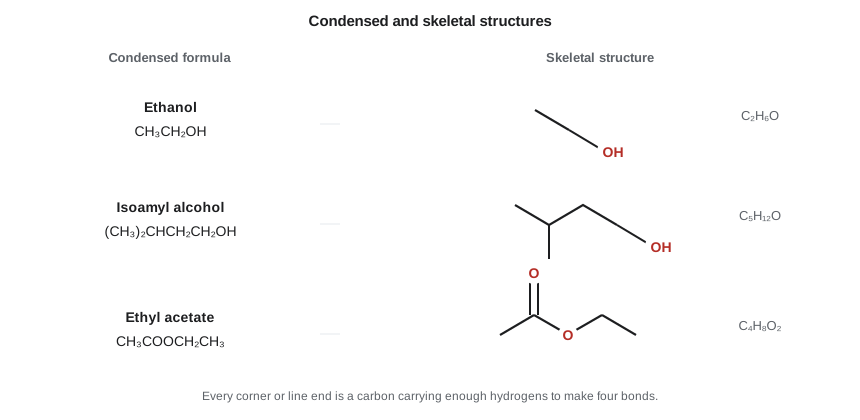
Organic structures are drawn at several levels of detail. A molecular formula, such as C₂H₆O, gives only the atoms present and cannot distinguish ethanol from dimethyl ether. A full Lewis structure shows every atom, bond and lone pair, which is clear but slow to draw for large molecules. A condensed structural formula writes each carbon with its hydrogens, such as CH₃CH₂OH for ethanol or CH₃OCH₃ for dimethyl ether, and is convenient in text and spreadsheets. Parentheses show repeated units or branches: CH₃(CH₂)₄CH₃ is hexane and (CH₃)₂CHOH is 2-propanol.
The skeletal (or bond-line) structure is what chemists use most. Each line is a bond, each corner or line end is a carbon atom, and hydrogens on carbon are not drawn: you assume each carbon has enough hydrogens to make four bonds. Atoms other than carbon and hydrogen, and hydrogens attached to them, are written explicitly. Hexane becomes a zigzag line of six vertices; ethanol becomes a two-segment line ending in OH. Skeletal structures are fast to draw and make the carbon framework and the functional groups easy to see at a glance.
Worked problem
Counting atoms in a skeletal structure
A skeletal structure shows a zigzag chain of four segments with a branch line from the second vertex, and OH on the right-hand end. Write its molecular formula.
Show solution
- Count the carbons: a chain of four segments has five carbons (three vertices plus two line ends), and the branch line from the second vertex adds a sixth.
- Assign hydrogens: a carbon with one carbon neighbour has three, one with two carbon neighbours has two, and one with three carbon neighbours has one. A chain-end carbon that also carries OH has two.
- Here the chain is C1 (end, CH₃), C2 (branch point, CH), C3 (CH₂), C4 (CH₂), C5 (CH₂OH), with the branch carbon a CH₃: hydrogens = 3 + 1 + 2 + 2 + 2 + 3 + 1 (on O) = 14.
- Formula: C₆H₁₄O.
Answer: The compound is C₆H₁₄O, a hexanol isomer. Counting carbons by vertices and supplying hydrogens to make four bonds is a habit worth practising until it is automatic.
Isomers
Compounds with the same molecular formula but different structures are isomers. Constitutional (or structural) isomers differ in which atoms are bonded to which: ethanol and dimethyl ether are constitutional isomers, as are 1-propanol and 2-propanol. Stereoisomers have the same connections but differ in the arrangement of atoms in space; they are the subject of lesson 6. The number of possible constitutional isomers grows rapidly with size. Butane, C₄H₁₀, has two; pentane has three; decane has 75; and C₂₀H₄₂ has more than 366,000. This growth is why naming rules are essential.
The fusel alcohols in fuel ethanol are a good example. Isomers of C₅H₁₂O include 1-pentanol, 3-methyl-1-butanol (isoamyl alcohol) and 2-methyl-1-butanol (active amyl alcohol), all of which yeast produce in different amounts from amino acids. They have similar but not identical boiling points, odours and solubilities, so the lab must identify each one separately.
Degree of unsaturation
A useful first step with any molecular formula is to calculate its degree of unsaturation, the total number of rings plus pi bonds. A saturated, acyclic hydrocarbon has the formula CₙH₂ₙ₊₂. Each ring or pi bond removes two hydrogens. Halogens count like hydrogens, oxygen and sulfur do not change the count, and each nitrogen adds one hydrogen to the saturated formula.
A formula with a degree of unsaturation of zero must be an acyclic, fully saturated compound. A value of one means one ring or one double bond (C=C or C=O). Four or more often signals a benzene ring, which has one ring and three pi bonds. The program below applies the formula to several compounds.
# Degree of unsaturation (rings + pi bonds) from a molecular formula
import re

def counts(formula):
    c = {}
    for el, n in re.findall(r'([A-Z][a-z]?)(\d*)', formula):
        c[el] = c.get(el, 0) + (int(n) if n else 1)
    return c

def dou(formula):
    c = counts(formula)
    C, H, N = c.get('C', 0), c.get('H', 0), c.get('N', 0)
    X = sum(c.get(x, 0) for x in ('F', 'Cl', 'Br', 'I'))
    return (2 * C + 2 + N - H - X) / 2      # O and S do not change the count

for name, f in [('hexane', 'C6H14'), ('cyclohexane', 'C6H12'), ('1-hexene', 'C6H12'), ('benzene', 'C6H6'),
                ('ethyl acetate', 'C4H8O2'), ('pyridine', 'C5H5N'), ('linoleic acid', 'C18H32O2')]:
print(f"{name:14s} {f:9s} degree of unsaturation = {dou(f):.0f}")hexane C6H14 degree of unsaturation = 0 cyclohexane C6H12 degree of unsaturation = 1 1-hexene C6H12 degree of unsaturation = 1 benzene C6H6 degree of unsaturation = 4 ethyl acetate C4H8O2 degree of unsaturation = 1 pyridine C5H5N degree of unsaturation = 4 linoleic acid C18H32O2 degree of unsaturation = 3
Cyclohexane and 1-hexene share the formula C₆H₁₂ and both show one degree of unsaturation, one from a ring and the other from a double bond. Ethyl acetate's one degree comes from its C=O. Linoleic acid, the main fatty acid in corn oil, shows three: one C=O and two C=C bonds, which is why corn oil is called polyunsaturated.
Functional groups to recognize
Organic compounds are grouped into families by their functional groups. Recognizing these groups on sight is the most important skill in organic chemistry, because each family has characteristic properties and reactions. The table lists the families you will meet most often in this course and in the plant.
| Family | Functional group | Example | Name ending |
|---|---|---|---|
| Alkane | C–C and C–H only | Hexane, CH₃(CH₂)₄CH₃ | -ane |
| Alkene | C=C | Ethylene, CH₂=CH₂ | -ene |
| Alkyne | C≡C | Acetylene, HC≡CH | -yne |
| Arene | Benzene ring | Toluene, C₆H₅CH₃ | -benzene |
| Alkyl halide | C–X (X = F, Cl, Br, I) | Chloroethane, CH₃CH₂Cl | halo- prefix |
| Alcohol | C–OH | Ethanol, CH₃CH₂OH | -ol |
| Ether | C–O–C | Diethyl ether, CH₃CH₂OCH₂CH₃ | alkoxy- or ether |
| Amine | C–N | Methylamine, CH₃NH₂ | -amine |
| Aldehyde | C(=O)H | Acetaldehyde, CH₃CHO | -al |
| Ketone | C–C(=O)–C | Acetone, CH₃COCH₃ | -one |
| Carboxylic acid | C(=O)OH | Acetic acid, CH₃COOH | -oic acid |
| Ester | C(=O)O–C | Ethyl acetate, CH₃COOCH₂CH₃ | -oate |
| Amide | C(=O)N | Acetamide, CH₃CONH₂ | -amide |
| Nitrile | C≡N | Acetonitrile, CH₃CN | -nitrile |
IUPAC names for alkanes
The International Union of Pure and Applied Chemistry (IUPAC) maintains the systematic naming rules used worldwide. A systematic name has three parts: prefixes that name and locate substituents, a parent name that gives the number of carbons in the main chain, and a suffix that identifies the main functional group. The parent names for chains of one to ten carbons are meth-, eth-, prop-, but-, pent-, hex-, hept-, oct-, non- and dec-. The first four are historical; from five onward they come from Greek numbers.
Naming a branched alkane follows four steps. First, find the longest continuous carbon chain; that is the parent. If two chains tie for length, choose the one with more substituents. Second, number the chain from the end that gives the first substituent the lowest number. Third, name each substituent as an alkyl group (methyl, ethyl, propyl and so on) with its locant, the number of the carbon it is attached to. Fourth, list substituents in alphabetical order, use di-, tri- and tetra- for repeats (these prefixes are ignored when alphabetizing), separate numbers with commas and numbers from words with hyphens.
Worked problem
Naming a branched alkane
Name the alkane (CH₃)₂CHCH₂CH(CH₃)CH₂CH₃.
Show solution
- Write out the chain: CH₃–CH(CH₃)–CH₂–CH(CH₃)–CH₂–CH₃. The longest chain runs from one of the first CH₃ groups to the last CH₃: six carbons, so the parent is hexane.
- Number from the end nearer a substituent. From the left, methyl groups sit on C2 and C4; from the right they would sit on C3 and C5. Left is lower.
- Two methyl groups: dimethyl, with locants 2 and 4.
- Name: 2,4-dimethylhexane.
Answer: The compound is 2,4-dimethylhexane, C₈H₁₈, one of the many octane isomers found in gasoline and in hydrocarbon denaturants.
Some branched alkyl groups have common names that IUPAC still accepts and that appear constantly in industry. The isopropyl group is (CH₃)₂CH–, the isobutyl group is (CH₃)₂CHCH₂–, the sec-butyl group is CH₃CH₂CH(CH₃)–, and the tert-butyl group is (CH₃)₃C–. The prefix iso usually means a branch of two methyl groups at the end of the chain, which is why 3-methyl-1-butanol is commonly called isoamyl alcohol.
Naming compounds with functional groups
When a molecule contains a functional group named by a suffix, the parent chain must include the carbon bearing that group, and the chain is numbered to give the group the lowest possible locant. For alcohols, drop the final e of the alkane name and add -ol: propane becomes propanol, and the position of the OH group is shown by a number, as in 1-propanol and 2-propanol. Current IUPAC recommendations place the locant just before the suffix (propan-2-ol), and both forms are widely used; this course uses the older style that appears on most safety data sheets.
For alkenes the suffix is -ene and the locant is the lower-numbered carbon of the double bond: CH₂=CHCH₂CH₃ is 1-butene and CH₃CH=CHCH₃ is 2-butene. For aldehydes the suffix is -al and the carbonyl carbon is always carbon 1, so no locant is needed: CH₃CHO is ethanal, better known as acetaldehyde. Ketones use -one with a locant: CH₃COCH₂CH₃ is 2-butanone, the solvent known industrially as methyl ethyl ketone. Carboxylic acids use -oic acid, with the acid carbon as carbon 1: CH₃COOH is ethanoic acid, or acetic acid.
Esters are named like salts, in two words: the alkyl group from the alcohol comes first, then the acid part with -ate replacing -ic acid. The ester from ethanol and acetic acid is ethyl ethanoate, almost always called ethyl acetate. The ester from isoamyl alcohol and acetic acid, isoamyl acetate, gives bananas their smell and is one of the fruity compounds that give fermented beverages their aroma.
When a molecule has more than one functional group, one is chosen as the principal group for the suffix according to a priority order, and the others become prefixes. In decreasing priority, the main families rank roughly as carboxylic acids, esters, amides, nitriles, aldehydes, ketones, alcohols, amines, alkenes and alkynes, with halogens and alkyl groups always named as prefixes. Lactic acid, CH₃CH(OH)COOH, a product of bacterial contamination in ethanol fermentations, is therefore named 2-hydroxypropanoic acid: the acid takes the suffix and the alcohol becomes the prefix hydroxy-.
Worked problem
Names from the quality report
Give the structures of 2-methyl-1-propanol and 3-methyl-1-butanol, and give the common name of each.
Show solution
- 2-Methyl-1-propanol: parent propanol, OH on C1, methyl on C2. Structure HOCH₂–CH(CH₃)–CH₃, or (CH₃)₂CHCH₂OH. Formula C₄H₁₀O.
- It is the isobutyl group plus OH, so its common name is isobutyl alcohol or isobutanol.
- 3-Methyl-1-butanol: parent butanol, OH on C1, methyl on C3. Structure HOCH₂CH₂CH(CH₃)CH₃, or (CH₃)₂CHCH₂CH₂OH. Formula C₅H₁₂O.
- This branched five-carbon alcohol is isoamyl alcohol (also called isopentyl alcohol).
Answer: Isobutanol is (CH₃)₂CHCH₂OH and isoamyl alcohol is (CH₃)₂CHCH₂CH₂OH. They are the two most abundant fusel alcohols in a typical corn ethanol fermentation.
Common names, trade names and CAS numbers
Industry uses many common names: wood alcohol for methanol, grain alcohol for ethanol, acetone for propanone, MEK for 2-butanone, toluene for methylbenzene and glycol for 1,2-ethanediol. Trade names add another layer. Because names are ambiguous, regulators and suppliers rely on the Chemical Abstracts Service registry number, a unique identifier assigned to each substance. Ethanol is CAS 64-17-5, for example, and methanol is 67-56-1.
In Canada, WHMIS labels and safety data sheets list the product identifier and, for ingredients, the chemical name and CAS number, so the CAS number is the most reliable way to confirm that a delivered chemical matches the one specified. Engineers writing specifications should give both a systematic name and a CAS number.
Common mistakes
MistakeChoosing the longest chain as drawn left to right.
InsteadTrace every path; the longest chain often bends through a branch.
MistakeNumbering to give the substituents the lowest numbers when a functional group is present.
InsteadThe principal functional group gets the lowest locant first; substituents come second.
MistakeAlphabetizing by multiplying prefixes, such as putting dimethyl under d.
InsteadIgnore di-, tri- and tetra- when alphabetizing; dimethyl is listed under m.
MistakeAssuming a molecular formula identifies a compound.
InsteadMost formulas have many isomers; give a structure, systematic name or CAS number.
Summary and key terms
- Condensed formulas suit text; skeletal structures show carbon frameworks quickly, with hydrogens on carbon implied.
- Constitutional isomers share a formula but differ in connectivity; their number grows rapidly with size.
- Degree of unsaturation (rings + pi bonds) = (2C + 2 + N − H − X)/2.
- IUPAC names combine substituent prefixes, a parent chain name and a functional group suffix.
- The principal functional group decides the suffix and gets the lowest locant.
- Common names and CAS numbers are widely used; specifications should give an exact name and CAS number.
- Skeletal structure
- A drawing in which lines are bonds and corners or ends are carbons with implied hydrogens.
- Constitutional isomers
- Compounds with the same molecular formula but different bonding connections.
- Degree of unsaturation
- The number of rings plus pi bonds implied by a molecular formula.
- Parent chain
- The main carbon chain on which an IUPAC name is based.
- Locant
- A number that gives the position of a substituent or functional group on the parent chain.
- CAS registry number
- A unique numerical identifier assigned to a chemical substance by the Chemical Abstracts Service.
Practice problems
Work each problem on paper first, then reveal the answer to check.
Write the condensed formula for 2-propanol.
Show answer
(CH₃)₂CHOH, or CH₃CH(OH)CH₃.
How many degrees of unsaturation does C₇H₈ have, and what structure fits?
Show answer
(14 + 2 − 8)/2 = 4; toluene, a benzene ring with a methyl group.
Name CH₃CH₂CH(CH₃)CH₂CH₃.
Show answer
3-Methylpentane.
Name CH₃CH₂COOCH₃.
Show answer
Methyl propanoate: the methyl group comes from methanol and propanoate from propanoic acid.
Give a systematic name for methyl ethyl ketone.
Show answer
2-Butanone (butan-2-one).
Why are 1-propanol and 2-propanol isomers?
Show answer
Both are C₃H₈O, but the OH is on an end carbon in one and the middle carbon in the other.
Lesson quiz · 5 questions
Score 60% or more to complete this lesson.
Create a free account to save your progress, take quizzes and earn a certificate.