
CHE-243 · Lesson 10 of 12 · 21 min
Reaction mechanisms, energy and rates
The earlier lessons introduced reactions family by family. This lesson steps back to look at what they have in common: how chemists describe the step-by-step path of a reaction, why some reactions are fast and others slow, how temperature and catalysts change rates, and how a chemical engineer uses that knowledge to choose operating conditions. Mechanisms are not just a chemist's curiosity. Knowing the mechanism of a reaction tells an engineer which variables control the rate and the selectivity, what side products to expect, and which conditions could let a reaction run away. At Kingfisher Bioenergy, Theo meets these ideas in the fermenters, where temperature trades yeast growth against contamination and by-product formation, and in Ingrid's ethyl acetate study, where catalyst choice and temperature decide yield.
Bond breaking: heterolytic and homolytic
Every reaction breaks some bonds and forms others. A covalent bond can break in two ways. In heterolysis, both electrons of the bond go to one atom, producing a cation and an anion; this is how C–Br bonds break in SN1 reactions, and it is favoured in polar solvents that stabilize ions. In homolysis, the bond splits evenly, each atom taking one electron, producing two radicals, species with an unpaired electron. Homolysis needs energy from heat or light and is typical of nonpolar conditions and gas-phase reactions such as combustion, cracking and the chlorination of methane.
Chemists track electron movement with curved arrows. A full-headed curved arrow shows the movement of an electron pair, from a lone pair or bond toward the atom or bond where the pair ends up. A half-headed, fishhook arrow shows a single electron moving, as in radical reactions. Every mechanism in this course can be written as a sequence of a few elementary moves drawn with curved arrows: a nucleophile attacking an electrophile, a leaving group departing, a proton transferring, or electrons rearranging within a molecule.
Nucleophiles and electrophiles
Most polar organic reactions combine an electron-rich species with an electron-poor one. A nucleophile, literally nucleus-loving, donates an electron pair: lone pairs on oxygen, nitrogen, sulfur and halide ions, negatively charged carbon species, and the pi electrons of alkenes and aromatic rings. An electrophile, electron-loving, accepts an electron pair: protons, carbocations, carbonyl carbons, the carbon of a C–X bond, and Lewis acids such as aluminium chloride. Recognizing the nucleophile and electrophile in a pair of reactants is the first step in predicting what they will do. Nucleophilicity is related to basicity, since both involve donating an electron pair, but it also depends on size, solvent and steric hindrance.
Energy diagrams
A reaction energy diagram plots the energy of the system against the reaction coordinate, a measure of progress from reactants to products. Reactants and products sit in energy valleys. Between them lies at least one peak, the transition state, an unstable arrangement in which bonds are partly broken and partly formed; it exists for only about one molecular vibration and cannot be isolated. The height of the peak above the reactants is the activation energy, Eₐ. The difference between reactants and products is the enthalpy (or free energy) change of the reaction.
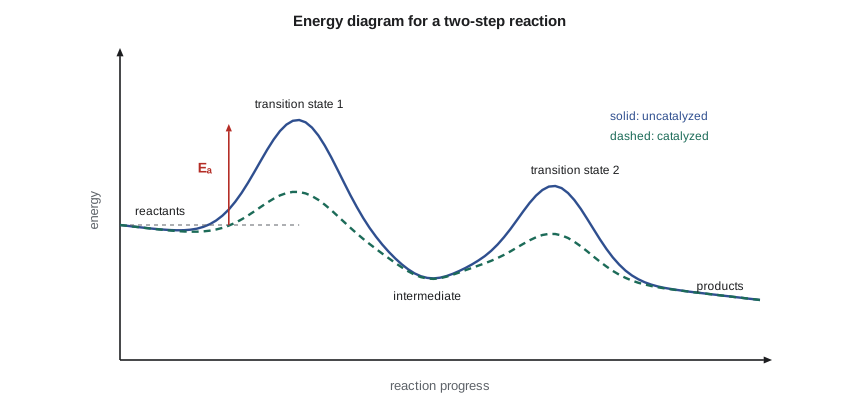
Two quantities on the diagram answer different questions. The overall energy change, ΔH or ΔG, tells you whether the reaction is favourable and how far it can go at equilibrium: that is thermodynamics, as in CHE-220. The activation energy tells you how fast the reaction proceeds: that is kinetics. A reaction can be strongly favourable yet immeasurably slow, as wood is in air at room temperature, until a spark supplies enough energy to cross the barrier. Many reactions have more than one step and pass through intermediates, species such as carbocations or tetrahedral adducts that sit in shallow valleys between transition states. The step with the highest transition state is the rate-determining step.
Rate laws and reaction order
The rate law of a reaction expresses how its rate depends on concentrations, and it must be measured, because it reflects the mechanism, not the overall equation. For an elementary step, the order follows from how many molecules collide: a unimolecular step is first order and a bimolecular step second order. The SN1 and SN2 rate laws in lesson 7 are examples. For a multistep reaction, the rate law usually reflects the rate-determining step and any fast equilibria before it.
First-order reactions are especially common and simple. Their concentration falls exponentially with time, and their half-life, the time to fall to half the starting concentration, does not depend on concentration: t½ = ln 2 / k. Radioactive decay, many thermal decompositions and the death of microorganisms during sterilization all follow first-order kinetics. Second-order reactions have half-lives that grow as the concentration falls, which is why the last few percent of a bimolecular reaction often take as long as the first ninety.
Temperature and the Arrhenius equation
Rates rise steeply with temperature. Svante Arrhenius described the dependence in 1889, and his equation remains the workhorse of reaction engineering. The pre-exponential factor A reflects how often molecules collide in a suitable orientation, and the exponential term gives the fraction of collisions with enough energy to cross the barrier. Plotting ln k against 1/T gives a straight line with slope −Eₐ/R, which is how activation energies are measured.
The old rule of thumb that reaction rates double for every 10 °C rise holds only for activation energies around 50 kJ/mol near room temperature. Reactions with larger activation energies are far more sensitive. The program below calculates rate constants and half-lives for an illustrative first-order decomposition with Eₐ = 100 kJ/mol, and then compares two competing reactions with different activation energies.
# Arrhenius temperature dependence and first-order half-lives
import math
R = 8.314

def k(T, A, Ea):
    return A * math.exp(-Ea / (R * T))

A, Ea = 1.0e12, 100e3          # illustrative first-order decomposition, 1/s and J/mol
for Tc in (25, 50, 75, 100):
    kk = k(Tc + 273.15, A, Ea)
    print(f"{Tc:3d} C  k = {kk:.2e} 1/s  half-life = {math.log(2) / kk / 3600:10.2f} h")

# Rule of thumb check: how much faster per 10 C near room temperature?
r = k(308.15, A, Ea) / k(298.15, A, Ea)
print(f"25 -> 35 C speeds this reaction up by a factor of {r:.1f}")

# Two competing reactions with different activation energies: selectivity changes with temperature
A1, E1 = 1.0e8, 60e3      # desired
A2, E2 = 1.0e12, 90e3     # side reaction
for Tc in (40, 80, 120):
    T = Tc + 273.15
print(f"{Tc:3d} C desired:side rate ratio = {k(T, A1, E1) / k(T, A2, E2):6.1f}")25 C k = 3.02e-06 1/s half-life = 63.79 h 50 C k = 6.84e-05 1/s half-life = 2.81 h 75 C k = 9.91e-04 1/s half-life = 0.19 h 100 C k = 1.00e-02 1/s half-life = 0.02 h 25 -> 35 C speeds this reaction up by a factor of 3.7 40 C desired:side rate ratio = 10.1 80 C desired:side rate ratio = 2.7 120 C desired:side rate ratio = 1.0
Two engineering lessons stand out. First, a 25 °C rise cuts this reaction's half-life from about 64 hours to under 3 hours, and another 25 °C cuts it to about 11 minutes: a compound that is stable in storage can decompose quickly if it overheats. Second, when a desired reaction has a lower activation energy than a side reaction, raising the temperature hurts selectivity, because the side reaction speeds up more. The ratio falls from about 10 at 40 °C to 1 at 120 °C. That is why many processes run at the lowest temperature that gives an acceptable rate, and why fermenters are cooled: above the yeast's optimum, contaminating bacteria and stress responses gain ground and by-products rise.
Worked problem
Finding an activation energy from two measurements
Theo measures the rate constant of the acid-catalyzed esterification in Ingrid's laboratory tests as 1.8 × 10⁻⁴ L/(mol·s) at 60 °C and 5.4 × 10⁻⁴ L/(mol·s) at 80 °C. Estimate the activation energy.
Show solution
- Convert temperatures: \(T_1 = 333.15\ \text{K}\), \(T_2 = 353.15\ \text{K}\).
- \(\ln(k_2/k_1) = \ln 3.0 = 1.099\).
- \(1/T_2 - 1/T_1 = 0.0028317 - 0.0030017 = -1.700\times10^{-4}\ \text{K}^{-1}\).
- \(E_a = -R \ln(k_2/k_1)/(1/T_2 - 1/T_1) = -8.314 \times 1.099/(-1.700\times10^{-4}) = 53{,}700\ \text{J/mol}\).
Answer: The activation energy is about 54 kJ/mol, so the rate roughly doubles for each 10 °C in this range, matching the rule of thumb. The data are illustrative of the size measured for acid-catalyzed esterifications.
Catalysis
A catalyst speeds up a reaction without being consumed, by providing a different mechanism with a lower activation energy. It does not change the equilibrium position: a catalyst speeds up the forward and reverse reactions equally, so it helps a reaction reach equilibrium sooner but does not make more product at equilibrium. That distinction matters in Ingrid's study. A better catalyst will make esterification reach equilibrium faster, but only removing water or using excess ethanol will raise the equilibrium conversion.
Catalysts come in three broad types. Homogeneous catalysts dissolve in the reaction mixture, such as sulfuric acid in esterification or sodium methoxide in biodiesel production; they are active and selective but must be separated from the product afterward. Heterogeneous catalysts are solids, such as acidic ion-exchange resins, zeolites and supported metals, with the reaction taking place on their surface; they are easy to separate and reuse, which is why most large-scale processes prefer them. Enzymes are biological catalysts, extraordinarily active and selective, working near room temperature in water. The amylases that liquefy and saccharify starch at the plant, and the enzymes inside the yeast that convert glucose to ethanol in a dozen steps, are all catalysts in this sense.
| Catalyst type | Example at or near the plant | Advantages | Drawbacks |
|---|---|---|---|
| Homogeneous acid | Sulfuric acid for esterification | Cheap, active | Corrosive; must be neutralized and removed |
| Solid acid | Ion-exchange resin in a reactive distillation column | No separation step; reusable | Temperature limits; can foul |
| Supported metal | Copper catalyst for ethanol dehydrogenation | Selective, reusable | Deactivates by sintering or coking |
| Enzyme | Glucoamylase in saccharification | Very selective, mild conditions | Sensitive to temperature, pH and inhibitors |
Radical chain reactions
Some reactions proceed by chains of radical steps, and their kinetics behave differently from ordinary reactions. The chlorination of methane in lesson 3 is a classic example: initiation creates a few radicals, propagation steps consume reactants and regenerate radicals, so each initiation can lead to thousands of product molecules, and termination steps remove radicals by combining them. Combustion, the oxidation of oils, the polymerization of ethylene and the formation of peroxides in ethers are all radical chain processes.
Chain reactions explain several safety phenomena. Small amounts of inhibitors, compounds that trap radicals, can stop a chain: monomers such as styrene are shipped with an inhibitor and kept cool so they do not polymerize in the tank, and antioxidants protect oils and fuels in storage. Conversely, traces of initiators such as peroxides or metal ions can start a chain unexpectedly. A chain reaction that also releases heat can accelerate itself, because heat raises the rate, which releases more heat. That feedback is the essence of a thermal runaway, the subject of lesson 12.
Kinetic and thermodynamic control
When a reaction can give two products, the one that forms faster is not always the more stable one. At low temperature and short times, the product with the lower activation energy dominates: the reaction is under kinetic control. At higher temperature, with longer times and reversible steps, the system has time to reach equilibrium, and the more stable product dominates: the reaction is under thermodynamic control. Process chemists exploit this choice deliberately, for example in sulfonation and alkylation reactions, where temperature and residence time select between isomers.
Common mistakes
MistakeConfusing a transition state with an intermediate.
InsteadAn intermediate sits in an energy valley and can sometimes be detected; a transition state is an energy maximum that cannot be isolated.
MistakeAssuming a catalyst increases the equilibrium yield.
InsteadCatalysts lower the barrier for both directions; only changing conditions or removing products shifts the equilibrium.
MistakeWriting the rate law from the balanced equation.
InsteadRate laws must be measured; they reflect the mechanism and the rate-determining step.
MistakeApplying the doubling-per-10 °C rule to every reaction.
InsteadIt holds only near Eₐ ≈ 50 kJ/mol; reactions with higher activation energies are far more sensitive.
Summary and key terms
- Bonds break heterolytically (to ions) or homolytically (to radicals); curved arrows track the electrons.
- Nucleophiles donate electron pairs; electrophiles accept them; most polar reactions pair the two.
- Energy diagrams show transition states, intermediates and activation energies; the highest barrier controls the rate.
- Rate laws are measured; first-order reactions have constant half-lives, t½ = ln 2 / k.
- The Arrhenius equation links rate to temperature; higher activation energies mean steeper temperature dependence.
- Catalysts lower activation energies without changing equilibrium; chain reactions can accelerate and run away.
- Mechanism
- The step-by-step sequence of bond-breaking and bond-forming events in a reaction.
- Transition state
- The highest-energy arrangement along a reaction step, with bonds partly broken and formed.
- Intermediate
- A short-lived species formed in one step of a reaction and consumed in a later one.
- Activation energy
- The energy barrier between reactants and the transition state.
- Rate-determining step
- The slowest step of a multistep mechanism, which controls the overall rate.
- Catalyst
- A substance that speeds up a reaction by providing a lower-energy pathway and is not consumed.
- Radical
- A species with an unpaired electron.
Practice problems
Work each problem on paper first, then reveal the answer to check.
Is a carbocation a transition state or an intermediate?
Show answer
An intermediate: it sits in an energy valley between two transition states.
A first-order reaction has k = 0.010 min⁻¹. What is its half-life?
Show answer
ln 2 / 0.010 = 69 minutes.
Does adding a catalyst change ΔH for a reaction?
Show answer
No; it changes the path and the activation energy, not the energies of reactants and products.
Using the program, by what factor does the rate rise from 25 to 35 °C?
Show answer
About 3.7, because Eₐ = 100 kJ/mol is well above 50 kJ/mol.
Why are styrene monomer tanks inhibited and kept cool?
Show answer
To stop a self-accelerating radical polymerization that releases heat.
Name the three kinds of step in a radical chain reaction.
Show answer
Initiation, propagation and termination.
Lesson quiz · 5 questions
Score 60% or more to complete this lesson.
Create a free account to save your progress, take quizzes and earn a certificate.