
CHE-243 · Lesson 1 of 12 · 25 min
Structure and bonding in organic molecules
Almost every stream at the Kingfisher Bioenergy plant in Sarnia is organic. Corn starch is a polymer of glucose. Fermentation turns the glucose into ethanol and carbon dioxide, along with small amounts of methanol, acetaldehyde, acetic acid, ethyl acetate and a family of heavier alcohols that distillers call fusel oil. The corn oil skimmed from the thin stillage is a mixture of triglycerides. The denaturant blended into the fuel ethanol is a hydrocarbon. Even the cleaning chemicals, antifoams and enzymes are organic compounds. In CHE-200 and CHE-220 you treated these substances as names with molar masses and property values. This course looks inside them: how their atoms are bonded, why they behave as they do, and how they react.
Process engineer Ingrid Solheim has a practical reason for wanting co-op student Theo Laurent to understand organic chemistry. The plant's quality lab reports impurities by name, the fuel ethanol specification limits several of them, and every proposal to make a new product from ethanol or corn oil starts with a reaction. An engineer who can read a structure, predict roughly how a molecule will behave, and spot a hazardous combination of chemicals is far more useful than one who can only look up numbers. Throughout the course Theo works on three questions from the plant: where the impurities in the ethanol come from and how they can be removed, whether the plant could convert some ethanol or corn oil into higher-value chemicals, and how to handle the chemicals on site safely.
Why carbon is special
Organic chemistry is the chemistry of carbon compounds, usually with hydrogen and often with oxygen, nitrogen, sulfur and the halogens. Millions of organic compounds are known, far more than for all other elements combined. Three features of carbon explain this. First, carbon has four valence electrons and forms four covalent bonds, so it can branch in several directions at once. Second, carbon-carbon bonds are strong, about 350 kJ/mol for a single bond, so carbon can form long chains and rings that are stable at ordinary temperatures. Third, carbon forms single, double and triple bonds with itself and with oxygen and nitrogen, which multiplies the possible structures.
Carbon's electronegativity, about 2.5 on the Pauling scale, sits in the middle of the range. Bonds between carbon and hydrogen are almost nonpolar, while bonds from carbon to oxygen, nitrogen and the halogens are polar. That difference is the root of most reactivity: the nonpolar hydrocarbon skeleton is fairly inert, and chemical change usually happens at the polar groups attached to it. Chemists call those reactive groups functional groups, and much of this course is organized around them.
Covalent bonds and Lewis structures
A covalent bond is a pair of electrons shared between two atoms. Lewis structures show valence electrons as lines (bonding pairs) and dots (lone pairs). Writing a correct Lewis structure is the first step in understanding any molecule, and it follows a simple procedure: count the valence electrons, connect the atoms with single bonds, complete the octets of the outer atoms with lone pairs, and then form multiple bonds if the central atoms still lack an octet. Hydrogen needs only two electrons.
Each neutral atom in an organic molecule has a typical bonding pattern, and recognizing these patterns lets you check a structure at a glance. Neutral carbon makes four bonds and has no lone pairs. Neutral nitrogen makes three bonds and has one lone pair. Neutral oxygen makes two bonds and has two lone pairs. A halogen makes one bond and has three lone pairs. When an atom departs from its usual pattern it carries a formal charge, calculated as the number of valence electrons in the free atom minus the number of nonbonding electrons minus half the number of bonding electrons.
| Atom (neutral) | Bonds | Lone pairs | Example |
|---|---|---|---|
| Carbon | 4 | 0 | C in ethanol, CH₃CH₂OH |
| Nitrogen | 3 | 1 | N in ammonia or an amine |
| Oxygen | 2 | 2 | O in water, ethanol or an ether |
| Halogen (F, Cl, Br, I) | 1 | 3 | Cl in chloromethane |
| Hydrogen | 1 | 0 | Every C–H bond |
Worked problem
Formal charges in the ammonium ion and in carbon monoxide
Find the formal charge on nitrogen in the ammonium ion, NH₄⁺, and on carbon and oxygen in carbon monoxide, which has a triple bond and one lone pair on each atom.
Show solution
- Ammonium: nitrogen has 5 valence electrons, no nonbonding electrons and four bonds (8 bonding electrons). Formal charge \(= 5 - 0 - 4 = +1\). The charge of the ion sits on nitrogen.
- Carbon monoxide, carbon: 4 valence electrons, 2 nonbonding electrons, 6 bonding electrons. Formal charge \(= 4 - 2 - 3 = -1\).
- Carbon monoxide, oxygen: 6 valence electrons, 2 nonbonding, 6 bonding. Formal charge \(= 6 - 2 - 3 = +1\).
- The charges sum to zero, as they must for a neutral molecule.
Answer: Nitrogen carries +1 in ammonium. In carbon monoxide carbon carries −1 and oxygen +1, which is why carbon monoxide binds to metals, including the iron in hemoglobin, through its carbon atom.
Atomic orbitals and hybridization
Lewis structures tell you which atoms are bonded but not the shape of the molecule. Shape matters because it controls how molecules pack, how polar they are and how they meet in a reaction. The valence bond model explains shape by mixing, or hybridizing, the atomic orbitals of the central atom. Carbon's valence orbitals are one 2s orbital and three 2p orbitals. Mixing them in different proportions gives three kinds of hybrid orbitals.
When carbon forms four single bonds, as in methane or the CH₃ group of ethanol, all four orbitals mix to give four equivalent sp³ hybrids pointing to the corners of a tetrahedron, with bond angles of about 109.5°. When carbon forms a double bond, as in ethylene, it mixes the 2s and two 2p orbitals into three sp² hybrids in a plane at 120°, and the remaining unhybridized p orbital, perpendicular to that plane, overlaps side by side with a p orbital on the neighbouring carbon to form a pi bond. When carbon forms a triple bond, as in acetylene, it uses two sp hybrids at 180° and two p orbitals that form two pi bonds.
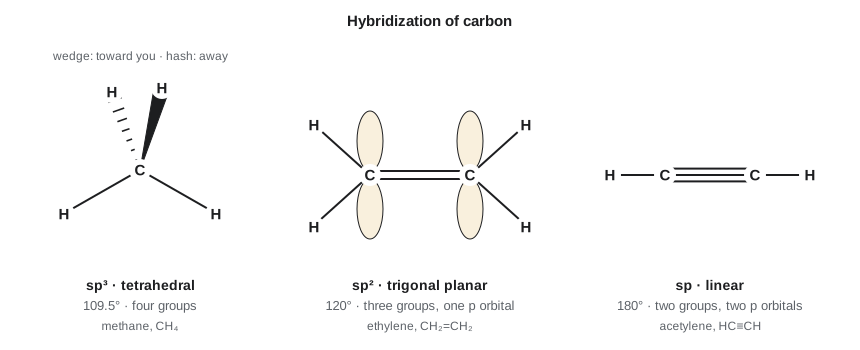
A quick rule gives the hybridization of any carbon, nitrogen or oxygen: count the groups around the atom, where a group is either a bonded atom or a lone pair. Four groups means sp³ and a tetrahedral arrangement; three groups means sp² and trigonal planar; two groups means sp and linear. The oxygen of ethanol has two bonded atoms and two lone pairs, so it is sp³ with a C–O–H angle of about 105°, a little smaller than tetrahedral because lone pairs repel more strongly than bonding pairs. The carbon of a carbonyl group, C=O, has three groups and is sp² and flat.
Sigma bonds, pi bonds and bond strength
Every single bond is a sigma bond, formed by end-on overlap of orbitals along the line between the nuclei. A double bond is one sigma bond plus one pi bond, and a triple bond is one sigma plus two pi bonds. Pi bonds are weaker than sigma bonds because side-by-side overlap is less effective, and their electrons sit above and below the bond axis, exposed to attack. That is why alkenes react readily with acids, halogens and oxidizing agents while alkanes do not. Pi bonds also prevent rotation: twisting one end of a double bond would break the side-by-side overlap, so a C=C bond is rigid, which gives rise to cis and trans isomers.
| Bond | Typical length (pm) | Typical energy (kJ/mol) |
|---|---|---|
| C–C | 154 | 350 |
| C=C | 134 | 610 |
| C≡C | 120 | 835 |
| C–H | 109 | 410 |
| C–O | 143 | 360 |
| C=O | 120 | 740 |
| O–H | 96 | 460 |
The table shows that a C=C double bond is not twice as strong as a single bond: the pi component adds only about 260 kJ/mol. Breaking that weaker pi bond while forming two new sigma bonds releases energy, which is why addition reactions to alkenes are usually exothermic. The same reasoning explains why hydrogenating an unsaturated vegetable oil releases heat that must be removed from the reactor.
Polar bonds, dipoles and molecular polarity
When two bonded atoms differ in electronegativity, the shared electrons are pulled toward the more electronegative atom, which gains a partial negative charge, δ−, while the other gains δ+. Bond polarity is measured by the bond dipole. The C–H bond is nearly nonpolar (electronegativity difference about 0.4). The C–O bond (difference about 1.0) and the O–H bond (about 1.4) are strongly polar. A molecule's overall polarity is the vector sum of its bond dipoles, so shape matters: carbon dioxide has two very polar C=O bonds but is linear, so the dipoles cancel and the molecule is nonpolar. Water is bent, so its O–H dipoles add and it is strongly polar.
Polarity governs solubility and separation, which is why it matters so much in a plant. Ethanol is fully miscible with water because its O–H group forms hydrogen bonds with water, while the denaturant hydrocarbons are almost insoluble in water. The fusel alcohols are intermediate: as the hydrocarbon part grows from two carbons in ethanol to five in isoamyl alcohol, solubility in water falls and the alcohols concentrate in a separate layer, which is how distillers draw them off from the side of the rectifier.
Intermolecular forces and physical properties
The forces between molecules, rather than within them, determine boiling points, viscosities and solubilities. In order of increasing strength for molecules of similar size, they are London dispersion forces, present in every molecule and growing with molecular size and surface area; dipole-dipole attractions between polar molecules; and hydrogen bonds, a strong dipole attraction between a hydrogen on O, N or F and a lone pair on another O, N or F. A simple comparison shows how large the effect is: ethanol (CH₃CH₂OH, 46 g/mol) boils at 78 °C, dimethyl ether (CH₃OCH₃, the same formula) boils at −24 °C, and propane (44 g/mol) boils at −42 °C. The only important difference is that ethanol can hydrogen bond with itself.
| Compound | Formula | M (g/mol) | Boiling point (°C) | Strongest force |
|---|---|---|---|---|
| Propane | C₃H₈ | 44 | −42 | Dispersion |
| Dimethyl ether | C₂H₆O | 46 | −24 | Dipole-dipole |
| Acetaldehyde | C₂H₄O | 44 | 20 | Dipole-dipole |
| Ethanol | C₂H₆O | 46 | 78 | Hydrogen bonding |
| Acetic acid | C₂H₄O₂ | 60 | 118 | Hydrogen bonding (forms dimers) |
The table also explains a familiar plant problem. Acetaldehyde boils at about 20 °C, far below ethanol, so it concentrates at the top of the distillation train and is drawn off in a small heads stream. Ethyl acetate (77 °C) boils almost exactly where ethanol does, so it is harder to remove by simple distillation and is controlled mainly by keeping fermentation clean.
Resonance
Some molecules cannot be described by a single Lewis structure. In the acetate ion, CH₃COO⁻, both C–O bonds are identical in length, intermediate between a single and a double bond. Chemists draw two resonance structures, each with the negative charge on a different oxygen, and the real ion is a hybrid of the two. Resonance structures differ only in the placement of electrons, never of atoms, and they are connected by a double-headed arrow. Spreading charge over more atoms stabilizes a species, which is why acetic acid is far more acidic than ethanol: the acetate ion shares its charge between two oxygens, while the ethoxide ion keeps it on one.
When you draw resonance structures, move only pi electrons and lone pairs, keep every atom within its octet (hydrogen within two), and keep the total charge the same. The most important contributors have full octets, the fewest formal charges, and any negative charge on the most electronegative atom.
Acids and bases in organic chemistry
Two definitions are useful. A Brønsted-Lowry acid donates a proton and a base accepts one. A Lewis acid accepts an electron pair and a Lewis base donates one; this broader view covers reactions with no proton transfer at all, such as boron trifluoride accepting the lone pair of an ether. Acid strength is reported as pKa, the negative logarithm of the acid dissociation constant; a lower pKa means a stronger acid. Typical values span a huge range: hydrochloric acid about −7, acetic acid 4.8, phenol 10, water 15.7, ethanol about 16, and an alkane C–H about 50.
Four factors explain most differences in acidity: the electronegativity of the atom holding the negative charge after the proton leaves; resonance that spreads that charge; inductive effects from nearby electronegative atoms; and the hybridization of the atom, since an sp orbital holds electrons closer to the nucleus than sp³. Acetylene, with an sp carbon, has a pKa near 25, much more acidic than ethane at about 50. These ideas return in every later lesson, because most organic reactions start with an acid-base step.
Calculating molar mass and composition
Every material balance on an organic stream starts with molar masses. The program below parses a molecular formula and returns the molar mass and the mass percentage of each element for several compounds found in the plant's ethanol. Note that acetaldehyde (C₂H₄O) and ethyl acetate (C₄H₈O₂) have the same percentage composition, because one formula is exactly twice the other: elemental analysis alone cannot tell them apart, which is why the lab uses gas chromatography.
# Molar mass from a molecular formula, with element-by-element mass fractions
import re

MASS = {'C': 12.011, 'H': 1.008, 'O': 15.999, 'N': 14.007, 'S': 32.06, 'Cl': 35.45, 'Br': 79.904, 'F': 18.998}

def parse(formula):
    counts = {}
    for el, n in re.findall(r'([A-Z][a-z]?)(\d*)', formula):
        counts[el] = counts.get(el, 0) + (int(n) if n else 1)
    return counts

def molar_mass(formula):
    c = parse(formula)
    return sum(MASS[el] * n for el, n in c.items()), c

for name, f in [('ethanol', 'C2H6O'), ('acetaldehyde', 'C2H4O'), ('ethyl acetate', 'C4H8O2'),
                ('isoamyl alcohol', 'C5H12O'), ('glucose', 'C6H12O6')]:
    M, c = molar_mass(f)
    fracs = ', '.join(f"{el} {100 * MASS[el] * n / M:.1f}%" for el, n in c.items())
print(f"{name:16s} {f:8s} M = {M:7.2f} g/mol {fracs}")ethanol C2H6O M = 46.07 g/mol C 52.1%, H 13.1%, O 34.7% acetaldehyde C2H4O M = 44.05 g/mol C 54.5%, H 9.2%, O 36.3% ethyl acetate C4H8O2 M = 88.11 g/mol C 54.5%, H 9.2%, O 36.3% isoamyl alcohol C5H12O M = 88.15 g/mol C 68.1%, H 13.7%, O 18.1% glucose C6H12O6 M = 180.16 g/mol C 40.0%, H 6.7%, O 53.3%
Isoamyl alcohol and ethyl acetate also have almost the same molar mass, 88 g/mol, yet one is an alcohol and the other an ester, with different boiling points, solubilities and odours. Structure, not formula, determines behaviour.
Common mistakes
MistakeDrawing carbon with five bonds, or nitrogen with four bonds and no charge.
InsteadCheck every atom against its usual pattern; a fourth bond on nitrogen means a +1 formal charge.
MistakeAssuming a molecule with polar bonds must be polar.
InsteadAdd the bond dipoles as vectors; symmetric shapes such as linear CO₂ or tetrahedral CCl₄ cancel them.
MistakeTreating resonance structures as different molecules that flip back and forth.
InsteadThe real molecule is one hybrid; the drawings are a bookkeeping device.
MistakeComparing boiling points by molar mass alone.
InsteadCheck for hydrogen bonding first, then polarity, then size and shape.
Summary and key terms
- Carbon forms four strong covalent bonds, including chains, rings and multiple bonds, which allows millions of compounds.
- Neutral C, N, O and halogens make 4, 3, 2 and 1 bonds; departures from the pattern mean a formal charge.
- Four groups around an atom give sp³ and 109.5°, three give sp² and 120°, two give sp and 180°.
- A double bond is a sigma plus a pi bond; pi bonds are weaker, reactive and prevent rotation.
- Polarity depends on bond dipoles and shape; hydrogen bonding dominates boiling points and water solubility.
- Resonance spreads electrons and charge, stabilizing ions and explaining why carboxylic acids are acidic.
- Functional group
- An atom or group of atoms in a molecule that gives it characteristic reactions.
- Formal charge
- The charge assigned to an atom in a Lewis structure, V − N − B/2.
- Hybridization
- Mixing of atomic orbitals to form new orbitals suited to the geometry of bonding.
- Pi bond
- A bond formed by side-by-side overlap of p orbitals, with electron density above and below the bond axis.
- Hydrogen bond
- A strong attraction between H bonded to O, N or F and a lone pair on another electronegative atom.
- Resonance
- Description of a molecule by two or more Lewis structures that differ only in electron placement.
- pKa
- The negative logarithm of an acid dissociation constant; lower values mean stronger acids.
Practice problems
Work each problem on paper first, then reveal the answer to check.
What is the hybridization of each carbon in acetaldehyde, CH₃CHO?
Show answer
The CH₃ carbon has four groups and is sp³; the carbonyl carbon has three groups and is sp².
Calculate the formal charge on oxygen in the hydronium ion, H₃O⁺.
Show answer
6 − 2 − 3 = +1.
Why is dimethyl ether much more volatile than ethanol, though both are C₂H₆O?
Show answer
Ethanol has an O–H group and hydrogen bonds with itself; dimethyl ether has no O–H and cannot.
Is carbon tetrachloride polar?
Show answer
No. Its four C–Cl dipoles point to the corners of a tetrahedron and cancel.
Which is the stronger acid, acetic acid or ethanol, and why?
Show answer
Acetic acid (pKa 4.8 against about 16), because resonance spreads the negative charge of acetate over two oxygens.
Using the program's method, what is the molar mass of acetic acid, C₂H₄O₂?
Show answer
2(12.011) + 4(1.008) + 2(15.999) = 60.05 g/mol.
Lesson quiz · 5 questions
Score 60% or more to complete this lesson.
Create a free account to save your progress, take quizzes and earn a certificate.