
BUS-110 · Lesson 7 of 12 · 38 min
Compound interest: future and present value
Under simple interest, only the original principal earns interest. Under compound interest, interest is added to the balance at the end of each compounding period, and from then on the interest itself earns interest. Over a few months the difference is small, but over years it becomes enormous. Compound interest drives savings and investment growth, the cost of long-term loans and mortgages, the valuation of businesses and bonds, and the long-run effect of inflation. This lesson develops the core formulas for moving a single amount forward and backward in time, and for comparing rates that compound at different frequencies.
Nominal rates and periodic rates
Compound rates are quoted as a nominal annual rate together with a compounding frequency, such as 6 % compounded monthly. The nominal rate (written j) is divided by the number of compounding periods per year (m) to give the periodic rate (i) actually applied each period. The total number of periods is the number of years times m.
| Compounding | Periods per year (m) | Periodic rate for 6 % | Periods in 10 years |
|---|---|---|---|
| Annually | 1 | 6 % | 10 |
| Semi-annually | 2 | 3 % | 20 |
| Quarterly | 4 | 1.5 % | 40 |
| Monthly | 12 | 0.5 % | 120 |
| Daily | 365 | 0.016438 % | 3,650 |
Future value
If a principal PV is invested at a periodic rate i, after one period it grows to PV(1 + i), after two periods to PV(1 + i)(1 + i), and after n periods to the future value FV.
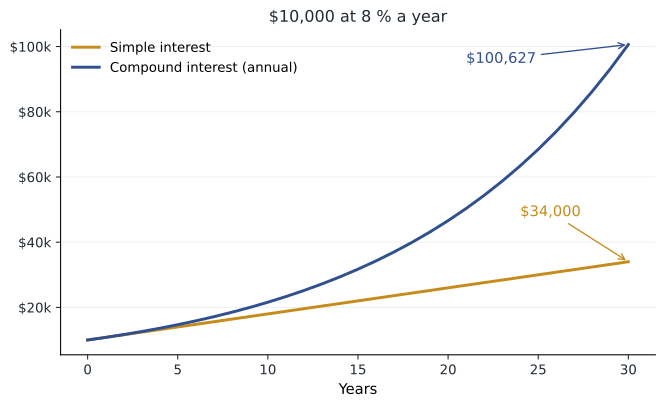
The factor \( (1 + i)^n \) is the compounding factor. Because n is an exponent, the growth accelerates: each period's interest is larger than the last.
Worked problem
Future value with monthly compounding
A business invests $10,000 at 6 % compounded monthly for 10 years. What is the future value, and how much of it is interest?
Show solution
- i = 0.06 ÷ 12 = 0.005; n = 12 × 10 = 120.
- FV = $10,000 × 1.005^120 = $10,000 × 1.819397 = $18,193.97.
- Interest = $18,193.97 − $10,000 = $8,193.97.
- Simple interest at 6 % for 10 years would earn only $6,000.
Answer: The investment grows to $18,193.97, earning $8,193.97 of interest, over a third more than simple interest would.
The more often interest compounds, the faster the balance grows, but the effect shrinks as the frequency rises. Daily compounding beats monthly by only a few dollars on $10,000 over 10 years. The limit, continuous compounding, gives \( FV = PV e^{jt} \).
| Compounding | Future value of $10,000 at 6 % for 10 years |
|---|---|
| Annually | $17,908.48 |
| Semi-annually | $18,061.11 |
| Quarterly | $18,140.18 |
| Monthly | $18,193.97 |
| Daily | $18,220.29 |
| Continuously | $18,221.19 |
Present value
Rearranging the future value formula gives the present value: the amount that must be invested today to reach a given future amount. Finding a present value is called discounting, and the factor \( (1 + i)^{-n} \) is the discount factor.
Worked problem
Saving for a future purchase
A company will need $50,000 in 7 years to replace a delivery truck. How much must it set aside today in an account paying 4.5 % compounded quarterly?
Show solution
- i = 0.045 ÷ 4 = 0.01125; n = 4 × 7 = 28.
- PV = $50,000 ÷ 1.01125^28 = $50,000 ÷ 1.367857 = $36,553.67.
Answer: Setting aside $36,553.67 today will grow to $50,000 in 7 years.
Present value is one of the most important ideas in finance. It lets amounts at different dates be compared on equal terms, and it underlies the valuation of loans, bonds, leases, pensions and whole businesses. Lesson 10 uses it to evaluate investment decisions.
Worked problem
Choosing between payment dates
A business selling a piece of equipment is offered $40,000 now or $48,000 in 3 years. It can earn 5.5 % compounded monthly on its cash. Which offer is worth more? Would the answer change if the business could earn 8 % compounded monthly?
Show solution
- At 5.5 %: i = 0.055 ÷ 12 = 0.0045833 and n = 36. PV of $48,000 = $48,000 ÷ 1.0045833^36 = $40,714.24.
- The later offer is worth $40,714.24 today, more than $40,000, so it is better by $714.24 in present value terms.
- Equivalently, $40,000 invested now would grow to only $47,157.94 in 3 years, less than $48,000.
- At 8 %: PV of $48,000 = $48,000 ÷ (1 + 0.08 ÷ 12)^36 = $37,788.22, less than $40,000.
Answer: At 5.5 % the $48,000 in 3 years is worth more; at 8 % the $40,000 now is better. The right choice depends on the rate the business can earn, which is why the discount rate is the most important assumption in any present value comparison.
Effective and equivalent rates
Because compounding frequencies differ, nominal rates cannot be compared directly. A rate of 6 % compounded monthly earns more than 6 % compounded annually. The effective annual rate (f) is the annually compounded rate that gives the same growth in one year. It is the fairest single number for comparing loans and investments.
Worked problem
Comparing two offers
Bank A offers a savings account at 6 % compounded monthly. Bank B offers 6.05 % compounded semi-annually. Which pays more?
Show solution
- Bank A: f = 1.005^12 − 1 = 0.061678, or 6.168 %.
- Bank B: f = (1 + 0.0605 ÷ 2)^2 − 1 = 1.03025^2 − 1 = 0.061415, or 6.142 %.
Answer: Bank A pays more, 6.168 % against 6.142 %, even though its nominal rate is lower.
Sometimes a rate stated with one frequency must be converted to an equivalent rate with another, for example when payments are monthly but the rate compounds semi-annually. Two rates are equivalent when they give the same effective annual rate. To convert, find the periodic rate for the new frequency that produces the same growth over a year.
Worked problem
An equivalent monthly rate for a Canadian mortgage
Under the federal Interest Act, fixed-rate mortgage rates in Canada are quoted compounded semi-annually, but payments are monthly. Find the monthly periodic rate equivalent to 5.5 % compounded semi-annually, and the effective annual rate.
Show solution
- Semi-annual periodic rate = 0.055 ÷ 2 = 0.0275.
- Equivalent monthly rate = 1.0275^(2/12) − 1 = 1.0275^(1/6) − 1 = 0.0045317, or 0.45317 % a month.
- Nominal equivalent = 12 × 0.0045317 = 5.438 % compounded monthly.
- Effective annual rate = 1.0275^2 − 1 = 5.576 %.
Answer: The equivalent monthly rate is 0.45317 %, or 5.438 % compounded monthly; both give an effective annual rate of 5.576 %. Using 5.5 % ÷ 12 instead would overstate the interest.
Solving for the rate and the time
When the present value, future value and number of periods are known, the periodic rate is found by taking the n-th root. When the rate is known, the number of periods is found with logarithms.
Worked problem
Finding the rate earned
An investment of $25,000 grew to $40,000 in 6 years. What nominal rate compounded quarterly did it earn? What was the effective annual rate?
Show solution
- n = 4 × 6 = 24; FV ÷ PV = 1.6.
- i = 1.6^(1/24) − 1 = 0.019776, or 1.9776 % a quarter.
- Nominal rate j = 4 × 0.019776 = 7.911 % compounded quarterly.
- Effective rate = 1.6^(1/6) − 1 = 8.148 %.
Answer: The investment earned 7.91 % compounded quarterly, an effective 8.15 % a year.
Worked problem
How long to double?
How long does it take money to double at 7 % compounded annually? Compare with the rule of 72.
Show solution
- n = ln 2 ÷ ln 1.07 = 0.693147 ÷ 0.067659 = 10.24 years.
- Rule of 72: 72 ÷ 7 = 10.3 years.
Answer: Money doubles in about 10.24 years at 7 %. The rule of 72, which divides 72 by the percentage rate, is a quick and surprisingly accurate estimate for rates between about 4 % and 12 %.
Changing rates
When the rate changes during the term, compound the amount in stages: grow it at the first rate for the first stretch, then use the result as the starting value for the next stretch at the new rate.
Worked problem
A two-stage GIC strategy
An investor places $20,000 in a 3-year guaranteed investment certificate (GIC) at 3.8 % compounded annually, then reinvests the proceeds in a 2-year GIC at 3.2 % compounded annually. What does she have after 5 years, and what was her average annual return?
Show solution
- After 3 years: $20,000 × 1.038^3 = $22,367.74.
- After 2 more years: $22,367.74 × 1.032^2 = $23,822.18.
- Average annual return = (23,822.18 ÷ 20,000)^(1/5) − 1 = 3.56 %.
Answer: She ends with $23,822.18, an average return of about 3.56 % a year.
Inflation and real returns
Inflation erodes what money can buy. If prices rise 2.4 % a year, $1,000 a year from now buys what $976.56 buys today. The nominal return on an investment is the stated rate; the real return is the growth in purchasing power after inflation. Over long periods inflation compounds exactly like interest: at 2.5 % a year, prices roughly double every 28 years.
Worked problem
Real return
A savings account pays 5 % and inflation runs at 2.4 %. What is the real rate of return? What if inflation rises to 5.5 %?
Show solution
- Real rate = 1.05 ÷ 1.024 − 1 = 0.0254, or 2.54 %.
- With 5.5 % inflation: 1.05 ÷ 1.055 − 1 = −0.0047, a real loss of 0.47 %.
- The shortcut nominal minus inflation (5 − 2.4 = 2.6 %) is close but slightly overstates the real rate.
Answer: The real return is 2.54 %. If inflation exceeded 5 %, the saver would lose purchasing power even while earning interest.
Taxes reduce returns further. Interest earned in an ordinary account is fully taxable each year, but interest earned inside a tax-free savings account (TFSA) is never taxed, and growth inside a registered retirement savings plan (RRSP) is taxed only when withdrawn. The compounding formulas are the same; what changes is the rate that is left after tax.
# Future value, effective rates, equivalent rates and solving for n
import math
PV, j = 10000, 0.06
for m, name in [(1, "annual"), (2, "semi-annual"), (4, "quarterly"), (12, "monthly"), (365, "daily")]:
    fv = PV * (1 + j / m) ** (m * 10)
    eff = (1 + j / m) ** m - 1
    print(f"{name:12s} FV {fv:10,.2f}  effective {eff:.4%}")
print(f"PV of 50,000 in 7 years at 4.5% quarterly: {50000 / 1.01125 ** 28:,.2f}")
print(f"Monthly rate equivalent to 5.5% semi-annual: {1.0275 ** (1 / 6) - 1:.5%}")
print(f"Years to double at 7%: {math.log(2) / math.log(1.07):.2f}")annual FV 17,908.48 effective 6.0000% semi-annual FV 18,061.11 effective 6.0900% quarterly FV 18,140.18 effective 6.1364% monthly FV 18,193.97 effective 6.1678% daily FV 18,220.29 effective 6.1831% PV of 50,000 in 7 years at 4.5% quarterly: 36,553.67 Monthly rate equivalent to 5.5% semi-annual: 0.45317% Years to double at 7%: 10.24
Common mistakes
MistakeUsing the nominal rate as the periodic rate.
InsteadDivide the nominal rate by the number of compounding periods per year.
MistakeUsing years as n when compounding is more frequent.
Insteadn = years × periods per year.
MistakeComparing nominal rates with different compounding frequencies.
InsteadConvert each to an effective annual rate first.
MistakeDividing a semi-annually compounded rate by 12 to get a monthly rate.
InsteadUse the equivalent rate (1 + i)^(2/12) − 1.
MistakeSubtracting inflation from a nominal rate and calling it exact.
InsteadUse (1 + nominal) ÷ (1 + inflation) − 1 for the real rate.
Summary and key terms
- Periodic rate i = j ÷ m; number of periods n = m × t.
- FV = PV(1 + i)^n and PV = FV(1 + i)^(−n).
- More frequent compounding gives more growth, with diminishing gains.
- The effective annual rate f = (1 + i)^m − 1 allows fair comparisons.
- Equivalent rates give the same effective annual rate.
- Solve for i with roots and for n with logarithms; the rule of 72 estimates doubling time.
- Real return = (1 + nominal) ÷ (1 + inflation) − 1.
- Compound interest
- Interest earned on both principal and previously earned interest.
- Nominal rate
- The stated annual rate, together with its compounding frequency.
- Periodic rate
- The rate applied each compounding period.
- Compounding frequency
- The number of times interest is added per year.
- Future value
- The value of an amount at a later date, including interest.
- Present value
- The value today of an amount due in the future.
- Discounting
- Finding a present value.
- Effective annual rate
- The annually compounded rate equivalent to a given rate.
- Equivalent rates
- Rates with different frequencies that give the same growth.
- Real rate of return
- The return after allowing for inflation.
Practice problems
Work each problem on paper first, then reveal the answer to check.
$4,000 is invested at 5 % compounded annually for 8 years. What is the future value?
Show answer
$5,909.82.
$7,500 is invested at 4 % compounded quarterly for 5 years. What is the future value?
Show answer
$9,151.43.
What is the present value of $20,000 due in 6 years at 6 % compounded monthly?
Show answer
$13,966.05.
What is the effective rate of 8 % compounded quarterly?
Show answer
8.243 %.
What monthly rate is equivalent to 4.8 % compounded semi-annually?
Show answer
About 0.39606 % a month.
$1,000 grows to $1,500 in 5 years. What annually compounded rate is that?
Show answer
About 8.45 %.
How many years does it take money to triple at 6 % compounded annually?
Show answer
About 18.85 years.
Estimate the doubling time at 9 % using the rule of 72.
Show answer
8 years.
A return of 6 % with inflation of 3 %. What is the real return?
Show answer
About 2.91 %.
$10,000 earns 3 % for 2 years and then 4 % for 3 years, compounded annually. What is the final amount?
Show answer
$11,933.68.
Lesson quiz · 5 questions
Score 60% or more to complete this lesson.
Create a free account to save your progress, take quizzes and earn a certificate.