
BUS-110 · Lesson 1 of 12 · 38 min
Arithmetic, fractions, ratios and proportions for business
Business mathematics is not advanced mathematics. Almost everything a manager, bookkeeper, buyer or small-business owner needs can be done with the four basic operations, fractions, percentages and a handful of formulas. What makes it hard is not the arithmetic itself but knowing which calculation answers the business question, setting it up correctly and checking that the answer makes sense. This course is built around that skill. Each lesson takes one family of business calculations, shows where it comes from, works through realistic examples and points out the mistakes people actually make.
This first lesson lays the foundation: the order of operations, rounding and precision, fractions and decimals, ratios, rates and proportions. These ideas reappear in every later lesson, from sharing profit among partners to converting currencies and allocating overhead costs.
Examples in this course use Canadian dollars, Canadian tax rules and Canadian conventions unless a comparison is useful. Figures that change, such as tax rates and payroll limits, are stamped with the year they apply to.
Order of operations
A business formula is only useful if everyone evaluates it the same way. The standard order is: brackets first, then exponents (powers), then multiplication and division from left to right, then addition and subtraction from left to right. Spreadsheets and calculators follow the same rule, which is why a misplaced bracket is one of the most common sources of spreadsheet errors.
Worked problem
Order of operations in a pricing formula
A buyer writes the selling price of a product as cost + cost × markup rate − discount. Cost is $40, the markup rate is 0.5 and the discount is $5. Evaluate the formula, then evaluate (cost + cost) × markup rate − discount and explain why the answers differ.
Show solution
- Multiplication comes before addition: cost × markup rate = $40 × 0.5 = $20.
- Then add and subtract from left to right: $40 + $20 − $5 = $55.
- In the second version the brackets come first: $40 + $40 = $80.
- Then multiply: $80 × 0.5 = $40, and subtract: $40 − $5 = $35.
- The brackets changed the meaning of the formula: the second version halves twice the cost instead of adding half the cost.
Answer: The intended formula gives $55. Moving the brackets gives $35, a completely different price. Always check that brackets match the business logic.
Rounding and precision
Money is usually rounded to the nearest cent, but rounding too early causes errors that grow through a calculation. The safest habit is to keep full precision in intermediate steps and round only the final answer. When a value lands exactly halfway, the usual rule taught in business courses is to round up (so $2.345 becomes $2.35), although some software uses banker's rounding, which rounds halves to the nearest even digit. Interest rates and exchange rates are normally kept to at least four decimal places during a calculation.
Precision also means reporting sensible digits. A forecast that says sales will be $1,284,617.23 next year suggests a precision nobody has. It is usually better to say about $1.28 million. On the other hand, an invoice must be exact to the cent, because a customer is entitled to check it.
Worked problem
The cost of rounding too early
A distributor buys 2,400 units at $3.4567 each and then adds 6 % for freight. Calculate the total cost by rounding the unit price to the nearest cent first, and again by rounding only at the end.
Show solution
- Rounding first: $3.4567 rounds to $3.46. Cost = 2,400 × $3.46 = $8,304.00; with freight, $8,304.00 × 1.06 = $8,802.24.
- Rounding last: 2,400 × $3.4567 = $8,296.08; with freight, $8,296.08 × 1.06 = $8,793.8448, which rounds to $8,793.84.
- Difference = $8,802.24 − $8,793.84 = $8.40.
Answer: Rounding the unit price too early overstates the cost by $8.40. Small per-unit differences become large when multiplied by big quantities.
Fractions, decimals and percentages
A fraction, a decimal and a percentage are three ways of writing the same number. One quarter can be written as \( \frac{1}{4} \), as 0.25 or as 25 %. To convert a fraction to a decimal, divide the top number (numerator) by the bottom number (denominator). To convert a decimal to a percentage, multiply by 100. To go back, divide by 100.
| Fraction | Decimal | Percentage | Common business use |
|---|---|---|---|
| 1/2 | 0.5 | 50 % | Half-price sale; a 50/50 partnership |
| 1/3 | 0.3333… | 33.33 % | Splitting profit among three partners |
| 1/4 | 0.25 | 25 % | Quarterly instalments |
| 1/8 | 0.125 | 12.5 % | Older share prices quoted in eighths |
| 1/12 | 0.08333… | 8.33 % | One month of an annual amount |
| 13/100 | 0.13 | 13 % | Harmonized sales tax in Ontario |
Repeating decimals such as one third (0.3333…) are a trap. If three partners each receive 33.33 % of a $10,000 profit, the shares add up to $9,999, not $10,000. The usual fix is to calculate two shares and give the remainder to the third, so the total always balances.
Mixed numbers appear in trades and purchasing: a board may be 2\( \frac{3}{8} \) inches thick, or an order may be for 4\( \frac{1}{2} \) cases. To multiply or divide mixed numbers, convert them to improper fractions or decimals first. To add fractions, put them over a common denominator.
Worked problem
Adding fractions in a work schedule
A part-time employee works 3½ hours on Monday, 4¾ hours on Tuesday and 2⅔ hours on Wednesday. How many hours did they work in total, and what is their pay at $18.60 an hour?
Show solution
- Convert to a common denominator of 12: 3½ = 3 6/12, 4¾ = 4 9/12, 2⅔ = 2 8/12.
- Add whole numbers: 3 + 4 + 2 = 9. Add twelfths: 6 + 9 + 8 = 23/12 = 1 11/12.
- Total = 10 11/12 hours, or about 10.9167 hours.
- Pay = 10.9167 × $18.60 = $203.05 (keeping full precision, 10 11/12 × 18.60 = 203.05 exactly to the cent).
Answer: The employee worked 10 11/12 hours and earns $203.05 before deductions.
Ratios
A ratio compares two or more quantities of the same kind. Ratios are written with a colon, such as 3 : 2, or as a fraction. Businesses use ratios to divide profit among partners, to allocate costs among departments, to mix ingredients and to compare financial results. A ratio can be scaled up or down by multiplying or dividing every term by the same number, so 6 : 4 and 3 : 2 are equivalent. A ratio is in lowest terms when the terms share no common factor.
To allocate an amount in a given ratio, add the terms of the ratio to find the total number of parts, divide the amount by the total parts to find the value of one part, then multiply by each term.
Worked problem
Dividing partnership profit
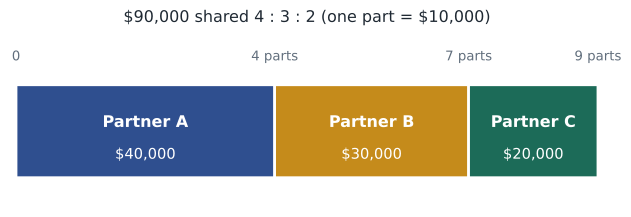
Three partners agree to share profit in the ratio of their capital contributions: $120,000, $90,000 and $60,000. This year's profit is $90,000. How much does each partner receive?
Show solution
- Ratio of capital: 120,000 : 90,000 : 60,000. Divide each term by 30,000 to get 4 : 3 : 2.
- Total parts = 4 + 3 + 2 = 9. One part = $90,000 ÷ 9 = $10,000.
- Partner A = 4 × $10,000 = $40,000; Partner B = 3 × $10,000 = $30,000; Partner C = 2 × $10,000 = $20,000.
- Check: $40,000 + $30,000 + $20,000 = $90,000.
Answer: Partner A receives $40,000, Partner B $30,000 and Partner C $20,000.
Ratios are also used to allocate shared costs. A company that rents one building for three departments might split the rent by floor area. A factory might allocate the cost of its maintenance crew by machine hours. The choice of basis matters: a basis that does not reflect what really drives the cost will make some products look more profitable than they are. Managerial accounting courses return to this idea under the name activity-based costing.
Worked problem
Allocating rent by floor area
A firm pays $14,400 a month for a building. Sales uses 1,800 square feet, production 4,200 square feet and administration 1,200 square feet. Allocate the rent in proportion to floor area.
Show solution
- Total area = 1,800 + 4,200 + 1,200 = 7,200 square feet.
- Rent per square foot = $14,400 ÷ 7,200 = $2.00.
- Sales = 1,800 × $2.00 = $3,600; production = 4,200 × $2.00 = $8,400; administration = 1,200 × $2.00 = $2,400.
- Check: $3,600 + $8,400 + $2,400 = $14,400.
Answer: Sales is charged $3,600, production $8,400 and administration $2,400 a month.
Rates and unit rates
A rate compares quantities of different kinds, such as dollars per hour, kilometres per litre or units per shift. A unit rate expresses the comparison per one unit of the second quantity, which makes options easy to compare. Unit pricing on store shelves, wage rates, productivity measures and exchange rates are all unit rates.
Worked problem
Comparing supplier prices with unit rates
A café can buy coffee beans in a 2.5 kg bag for $68.75 or a 12 kg bulk sack for $312.00. Which is cheaper per kilogram, and how much does the café save a month if it uses 30 kg?
Show solution
- 2.5 kg bag: $68.75 ÷ 2.5 = $27.50 per kg.
- 12 kg sack: $312.00 ÷ 12 = $26.00 per kg.
- Saving per kg = $27.50 − $26.00 = $1.50; for 30 kg, 30 × $1.50 = $45.00 a month.
Answer: The bulk sack is cheaper at $26.00 per kg and saves $45.00 a month, provided the café can store and use the beans before they go stale.
Proportions
A proportion is a statement that two ratios are equal, such as \( \frac{a}{b} = \frac{c}{d} \). If three of the four values are known, the fourth can be found by cross-multiplying: \( a \times d = b \times c \). Proportions solve many everyday business problems: scaling a recipe, estimating materials for a larger job, converting currencies or projecting costs from a sample.
Worked problem
Currency conversion with a proportion
A Canadian importer must pay a supplier 18,500 US dollars. The bank quotes 1 US dollar = 1.3850 Canadian dollars. How many Canadian dollars are needed? If the bank charges a 2.5 % spread instead, what is the effective cost?
Show solution
- Set up the proportion: 1 USD / 1.3850 CAD = 18,500 USD / x CAD.
- Cross-multiply: x = 18,500 × 1.3850 = 25,622.50 CAD.
- With a 2.5 % spread: 25,622.50 × 1.025 = 26,263.06 CAD.
- The spread costs 26,263.06 − 25,622.50 = 640.56 CAD.
Answer: The importer needs 25,622.50 Canadian dollars at the quoted rate, or 26,263.06 with the bank's spread. Comparing the spreads of different banks or payment services can save hundreds of dollars on a single payment.
Exchange rates are quoted both ways, so always check which currency is the base. If 1 US dollar buys 1.3850 Canadian dollars, then 1 Canadian dollar buys 1 ÷ 1.3850 = 0.7220 US dollars. The rates in this lesson are illustrative; real rates change every second the markets are open.
Worked problem
Scaling materials with a proportion
A painting contractor used 14 litres of paint for a 210 square metre warehouse wall. How much paint will a similar 495 square metre wall need, and how many 3.78 litre cans should be ordered?
Show solution
- Set up: 14 litres / 210 m² = x litres / 495 m².
- x = 14 × 495 ÷ 210 = 33 litres.
- Cans = 33 ÷ 3.78 = 8.73, so order 9 cans because part cans cannot be bought.
Answer: The larger wall needs about 33 litres, so the contractor should order 9 cans.
Checking your answers
Good business mathematicians check every answer in three ways. First, estimate before calculating: if 2,400 units cost about $3.50 each, the total should be about $8,400, so an answer of $84,000 or $840 is clearly wrong. Second, check that allocations add back to the total. Third, ask whether the answer makes business sense: a profit margin of 140 % or a negative wage is a sign that something was set up incorrectly.
# Allocate an amount in a ratio, giving any rounding remainder to the last share
def allocate(amount, ratio):
    total = sum(ratio)
    shares = [round(amount * r / total, 2) for r in ratio[:-1]]
    shares.append(round(amount - sum(shares), 2))
    return shares

print(allocate(90000, [4, 3, 2]))
print(allocate(10000, [1, 1, 1]))[40000.0, 30000.0, 20000.0] [3333.33, 3333.33, 3333.34]
The short program above allocates an amount in any ratio and makes sure the shares add exactly to the total. Spreadsheet users can do the same by calculating all but the last share with a formula and setting the last share equal to the total minus the others.
Common mistakes
MistakeRounding intermediate results to the cent.
InsteadKeep full precision until the final answer, then round once.
MistakeDividing an amount by each term of a ratio instead of by the sum of the terms.
InsteadAdd the terms first to find the total number of parts, then find the value of one part.
MistakeUsing an exchange rate in the wrong direction.
InsteadWrite the proportion with units on both sides and check which currency is the base.
MistakeLetting allocated shares fail to add up to the total because of repeating decimals.
InsteadCalculate all but one share and give the remainder to the last.
MistakeIgnoring brackets in a spreadsheet formula.
InsteadCheck each formula against the business logic and test it with simple numbers.
Summary and key terms
- Follow the order of operations: brackets, exponents, multiplication and division, addition and subtraction.
- Keep full precision in intermediate steps and round only the final answer.
- Fractions, decimals and percentages are interchangeable forms of the same number.
- To allocate in a ratio, divide the amount by the sum of the terms and multiply by each term.
- Unit rates make options with different quantities easy to compare.
- A proportion sets two ratios equal; cross-multiply to find an unknown.
- Check answers by estimating, confirming that allocations add up and asking whether results make business sense.
- Order of operations
- The agreed sequence for evaluating a formula.
- Numerator
- The top number of a fraction.
- Denominator
- The bottom number of a fraction.
- Ratio
- A comparison of quantities of the same kind.
- Lowest terms
- A ratio whose terms share no common factor.
- Rate
- A comparison of quantities of different kinds.
- Unit rate
- A rate expressed per one unit of the second quantity.
- Proportion
- A statement that two ratios are equal.
- Allocation basis
- The measure used to share a cost, such as floor area or machine hours.
- Exchange rate
- The price of one currency in terms of another.
Practice problems
Work each problem on paper first, then reveal the answer to check.
Evaluate 12 + 8 × 3 − 4.
Show answer
32.
Round $14.4651 to the nearest cent.
Show answer
$14.47.
Write 3/8 as a decimal and a percentage.
Show answer
0.375 and 37.5 %.
Reduce the ratio 45 : 30 : 15 to lowest terms.
Show answer
3 : 2 : 1.
Share $24,000 in the ratio 5 : 3.
Show answer
$15,000 and $9,000.
A 750 mL bottle costs $9.00 and a 2 L bottle costs $22.00. Which is cheaper per litre?
Show answer
The 2 L bottle: $11.00 per litre against $12.00 per litre for the 750 mL bottle.
If 6 workers pack 480 boxes in a shift, how many boxes do 9 workers pack at the same rate?
Show answer
720 boxes.
Convert 4,000 euros to dollars at 1 euro = 1.52 dollars.
Show answer
6,080 dollars.
A rent of $9,000 is shared by area 600 : 900 : 1,500. What does the largest department pay?
Show answer
$4,500.
Add 2¼ + 1⅝.
Show answer
3⅞.
Lesson quiz · 5 questions
Score 60% or more to complete this lesson.
Create a free account to save your progress, take quizzes and earn a certificate.