
BLR-330 · Lesson 12 of 12 · 20 min
Capstone: running a crew through the Northgate turnaround
This capstone brings the course together by following Kiera's crew through the whole Northgate turnaround, from the first shift to the last punch list item. It shows how the planning, scheduling, isolation, maintenance, inspection and safety practices of the earlier lessons fit together in one job, and it shows how a lead hand measures progress, recovers from problems and closes the work out. Kiera's package has three parts: the E-2201A and E-2201B exchangers, the retray of C-410 and the support of the V-2204 inspection and demister replacement. Its budget is 6,800 crew hours over the 36 days.
The first days
The first two days are the hardest to plan and the easiest to lose. Kiera's crew spends the first shift in the blinding team with Colleen, then waits for the handover of E-2201A on day two. The waiting is planned: Heather's schedule has the crew finishing their site orientation, checking their crates, building the extractor platform and setting up the C-410 hoist while the unit is being freed of gas. On day two, the E-2201A handover is signed at ten in the morning, the permit is issued at eleven and the channel cover is off by three.
Even with good planning, the first days produce surprises. On day one the crew finds that two of the channel cover studs on E-2201A have seized and must be cut. On day two the extractor arrives without its long hoses, which are on a truck at the gate. Each surprise costs an hour or two. Kiera reports each one in her shift report, with what she did about it and what it cost. She learns the first rule of turnaround progress: the schedule assumes the first days will go to plan, and they never quite do.
Measuring progress: earned value
On a turnaround, progress is measured every shift, and the method most owners and contractors use is earned value. Each activity in the package carries its budgeted hours. The planned value, PV, is the budgeted hours of the work that should have been done by a given time according to the schedule. The earned value, EV, is the budgeted hours of the work actually completed, however long it actually took. The actual cost, AC, is the hours actually spent. From these come two indexes.
The schedule performance index, SPI, is the earned value divided by the planned value. An SPI below 1 means the crew is behind schedule, above 1 ahead. The cost performance index, CPI, is the earned value divided by the actual hours. A CPI below 1 means the work is taking more hours than budgeted. Together they tell the lead hand and the turnaround team whether the crew is keeping up and whether it is using its hours efficiently. A forecast of the final hours, the estimate at completion, is the budget divided by the CPI, assuming the crew continues to work at the same efficiency.
Earned value depends on honest measurement of what is complete. Many turnarounds use rules of credit to avoid optimism: an activity earns nothing until it starts, a set share when it starts, and the rest only when it is complete and signed off, or earns by measured steps such as trays installed. Kiera reports by those rules. When a tray is in but not yet signed by the vendor's representative, it earns only part of its value.
Worked problem
Earned value for Crew 7
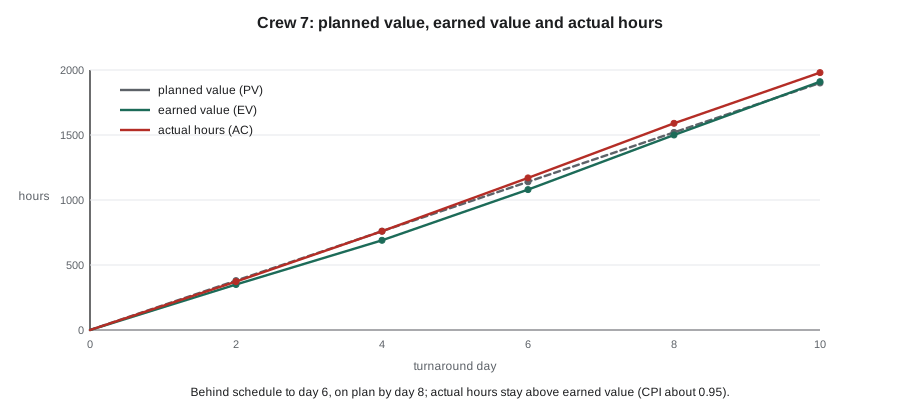
Heather's reports give the planned value, earned value and actual hours to date at the end of every second day for the first ten days. Work out the SPI and CPI for each report, describe the trend, forecast the final hours, and check the punch list at the end of the turnaround.
Show solution
- SPI is EV divided by PV; CPI is EV divided by AC.
- Below 0.95 counts as behind; above 1.05 as ahead.
- The estimate at completion is the budget divided by the latest CPI.
- Punch list items are counted by category; A items must be closed before start-up.
Answer: The crew was behind for the first six days and caught up by day 8. Its CPI stayed near 0.95, so the forecast is about 7,050 hours, some 250 hours over budget. All A items are closed.
# Earned value for the crew's package, and punch list close-out at the end of the turnaround
days = [(2, 380, 350, 372), (4, 760, 690, 760), (6, 1140, 1080, 1170), (8, 1520, 1500, 1590), (10, 1900, 1910, 1980)]   # (day, planned hours to date, earned hours to date, actual hours to date)
for d, pv, ev, ac in days:
    spi, cpi = ev / pv, ev / ac
    flag = "behind" if spi < 0.95 else "ahead" if spi > 1.05 else "on plan"
    print(f"day {d:2}: PV {pv:5}  EV {ev:5}  AC {ac:5}  SPI {spi:.2f}  CPI {cpi:.2f}  {flag}")
BUDGET = 6800
d, pv, ev, ac = days[-1]
eac = BUDGET / (ev / ac)
print(f"Forecast at completion: {eac:,.0f} hours against a budget of {BUDGET:,} ({eac - BUDGET:+,.0f})")
punch = [("A (before start-up)", 46, 46), ("B (before handover)", 88, 81), ("C (after start-up)", 37, 12)]   # (category, raised, closed)
for cat, raised, closed in punch:
    print(f"{cat:28} raised {raised:3}  closed {closed:3}  open {raised - closed:3}")
tot_r = sum(p[1] for p in punch); tot_c = sum(p[2] for p in punch)
print(f"Punch list {tot_c}/{tot_r} closed ({tot_c / tot_r:.0%}); A items must all be closed before start-up")day 2: PV 380 EV 350 AC 372 SPI 0.92 CPI 0.94 behind day 4: PV 760 EV 690 AC 760 SPI 0.91 CPI 0.91 behind day 6: PV 1140 EV 1080 AC 1170 SPI 0.95 CPI 0.92 behind day 8: PV 1520 EV 1500 AC 1590 SPI 0.99 CPI 0.94 on plan day 10: PV 1900 EV 1910 AC 1980 SPI 1.01 CPI 0.96 on plan Forecast at completion: 7,049 hours against a budget of 6,800 (+249) A (before start-up) raised 46 closed 46 open 0 B (before handover) raised 88 closed 81 open 7 C (after start-up) raised 37 closed 12 open 25 Punch list 139/171 closed (81%); A items must all be closed before start-up
Recovering from the early slip
By the fourth day Crew 7's SPI is 0.91. The seized studs, the missing hoses and a slow first day in C-410 have put it about 70 hours behind. The nozzle repair on E-2201A is on the critical path and has lost the four hours waiting for the repair procedure, described in lesson 10. Rosa and Heather sit down with Kiera to plan the recovery.
They use three tools. First, float: the bundle cleaning on E-2201A has two shifts of float, so it is moved later, and the people freed go to the critical nozzle repair and the C-410 trays. Second, sequence: the C-410 tray removal is reorganized so that two teams work from two manways at once, which the vendor agrees to. Third, early notice: Kiera starts giving the inspection coordinator her hold points a day ahead. No extra people are added. By day eight the SPI is back to 0.99 and by day ten it is slightly above plan.
The CPI tells a different story. The crew has caught up by working efficiently in the second week, but the early problems cost hours that are not recovered, and the CPI stays around 0.94 to 0.96. The forecast shows the package finishing about 250 hours over its budget. Kiera reports that honestly, with the reasons, and Heather carries it into Ironbridge's cost report. The owner's cost controller is not surprised; the seized studs and the ring 30 crack are both documented as emergent work and covered by the contingency.
| Day | Problem | Effect | Response |
|---|---|---|---|
| 1 | Two seized studs on the E-2201A channel | About 3 hours lost | Cut under a hot work permit; new studs from stock |
| 2 | Extractor hoses missing at the gate | About 2 hours lost | Hoses brought in; crew set up the C-410 hoist meanwhile |
| 3 | Nozzle repair procedure not yet accepted | 4 hours on the critical path | Procedure accepted; hold points now given a day ahead |
| 5 | Crack in the tray 30 support ring | Emergent repair, about 40 hours | Repair procedure, weld and MT before the tray went in |
| 9 | Permit conflict on C-410 deck 3 | Line break moved to nights | No loss to the day crew |
The middle weeks
The middle of the turnaround settles into a rhythm. Each morning Kiera attends the area meeting, reviews her crew's critical activities and hold points, briefs her crew at the toolbox meeting and takes out the permits. During the shift she moves between the exchanger bay and the column, checks the work, chases materials and deals with the inspectors. At the end of each shift she writes her report: activities complete, percentage of others, hours used, problems and what the next shift needs to know. At handover she meets Dale's night lead hand for the area and walks the jobs with him.
The work itself goes as the earlier lessons describe. E-2201A's bundle is cleaned, seven tubes are plugged and mapped, and the shell nozzle is repaired, examined and accepted. The bundle goes back in, the joints are made up with new gaskets in the cross pattern, and the shell side is tested with the test ring, then the tube side and the shell side with the covers on. E-2201B has only light fouling and a shell cover gasket face that needs dressing. In C-410, the 32 trays go in from the bottom up, each signed before the next, and the ring 30 repair passes. In V-2204 the demister section is replaced and the drum is closed after a closing inspection that finds the forgotten tape and gloves.
Box-up and handback
The last week brings the work back together. Each piece of equipment is boxed up, tested and handed back to operations in the order of the start-up plan. Kiera's crew works with the blinding team again to remove blinds, now in reverse, each one verified by Colleen. The blind list shows three items still open on the day before start-up, as in lesson 4; they are closed by the end of that shift. The joint records for every flange the crew made up are checked by Harjit's inspector and filed with the work package.
The punch list is the list of small items still to be done: a missing insulation patch, a ladder cage bolt, a nameplate to refit, a tag to remove. Items are classed by when they must be done. A items must be closed before start-up, because they affect safety or the ability to start; B items before handover of the area; and C items can be done after start-up. At the end of the turnaround, every A item on Kiera's package is closed, seven B items are being worked on and twenty-five C items, mostly insulation and paint, are scheduled for the weeks after.
When the unit restarts, the crew watches its equipment as it heats up. On the second day after start-up the E-2203 channel, which was not in Crew 7's package because it was deferred, shows the small weep it had before the turnaround, exactly as the work list predicted when it ranked the item medium and left it for a later outage. Kiera's flanges are dry.
Close-out and lessons learned
Close-out turns the turnaround into records and lessons. The work packages are completed and returned with every record: ITPs signed, weld maps, traceability, bolting records, test records and nonconformance reports. Inspection reports are filed in each vessel's history, including V-2204's new corrosion rate and inspection date. Surplus materials are returned, and the contingency used for emergent work is documented. Ironbridge's final cost report shows the package at about 4 % over its hours, with the reasons.
Every turnaround ends with lessons learned sessions, in which owners and contractors list what went well and what should change. Kiera's list is short and practical: give hold points a day ahead from the first day, add consumables to every vessel tool list, carry spare extractor hoses, and put the gas test retest times on the entry board. Rosa adds one more to Ironbridge's list: give lead hands the March walkdown every time, because it caught the extractor platform problem before it cost a day.
Kiera's last task is to write the handover note for the next turnaround: what was done to her equipment, what was found and what is expected next time. V-2204 will need its next internal inspection by about April 2034 and an on-stream check every year; E-2201A has seven plugged tubes and a repaired nozzle to watch; and C-410's tray 30 support ring repair should be inspected at the next opening. The note goes into the turnaround file, where the planner of the next Northgate turnaround will find it. That, Rosa tells her, is how a turnaround is supposed to end: with the next one already easier.
Common mistakes
MistakeClaiming full credit for a tray that is in but not signed.
InsteadEarn by the rules of credit; unsigned work earns only part of its value.
MistakeHiding an hours overrun until the end.
InsteadReport the CPI and the reasons every shift so the owner can plan.
MistakeRecovering a slip by rushing the critical work.
InsteadUse float, sequence and early notice; rushing invites rework and injury.
MistakeLeaving the handover note for someone else.
InsteadThe people who did the work know what the next turnaround needs to know.
Summary and key terms
- A lead hand plans the first days around handovers and expects surprises.
- Earned value compares planned value, earned value and actual hours; SPI = EV/PV and CPI = EV/AC.
- Honest rules of credit keep earned value accurate.
- Slips are recovered with float, better sequence and early notice of hold points, not by rushing.
- Box-up, testing, blind removal and punch lists bring the work back to operations; A items close before start-up.
- Close-out files every record, captures lessons learned and leaves a note for the next turnaround.
- Planned value
- The budgeted hours of the work scheduled to be done by a given time.
- Earned value
- The budgeted hours of the work actually completed.
- SPI
- Schedule performance index: earned value divided by planned value.
- CPI
- Cost performance index: earned value divided by actual hours.
- Estimate at completion
- The forecast of final hours, here the budget divided by the CPI.
- Punch list
- The list of small items still to be done, classed by when they must be finished.
Practice problems
Work each problem on paper first, then reveal the answer to check.
On day 4 Crew 7's PV is 760 and EV is 690. What is the SPI, and what does it mean?
Show answer
0.91: the crew has completed about 91 % of the work it should have by then, so it is behind.
The CPI is 0.96 and the budget is 6,800 hours. What is the estimate at completion?
Show answer
About 7,080 hours (6,800 / 0.96), roughly 280 hours over budget.
Name the three tools Rosa and Heather used to recover the schedule.
Show answer
Using float on non-critical work, a better sequence with two teams in C-410, and earlier notice of hold points.
What makes a punch list item an A item?
Show answer
It affects safety or the ability to start up, so it must be closed before start-up.
Lesson quiz · 5 questions
Score 60% or more to complete this lesson.
Create a free account to save your progress, take quizzes and earn a certificate.