
BLR-330 · Lesson 1 of 12 · 21 min
Turnarounds and outages in industry
In late August, a week before the Northgate turnaround starts, Rosa Delgado calls Kiera into the trailer at the Ironbridge laydown yard. Kiera is in the final period of her apprenticeship, with her certificate exam booked for the winter, and Rosa has a job for her. "You'll run Crew 7 on days," she says. "Exchangers in Unit 22 and the trays in C-410. Eight people, thirty-six days, and the plant wants every day of it back." Dale Whitford, who has run crews on more turnarounds than he can count, is moving to nights as a lead hand on the coker. "You know how to do the work," he tells her. "Now you have to know how the work fits into the whole job. That's what this is." This course follows Kiera through the turnaround, from the planning meetings in the spring to the punch list at the end. It starts here with what a turnaround is, why plants do them and how the time and money behind one are counted.
What a turnaround is
Process plants such as refineries, upgraders, chemical plants, pulp mills and power stations run continuously. A refinery unit may operate for four, five or six years without stopping, because every day it runs it earns money and every start-up and shutdown is a risk. Some work, however, can only be done with the unit shut down, emptied and opened: inspecting the inside of pressure vessels, cleaning and repairing heat exchanger bundles, replacing column trays, repairing furnace tubes, replacing relief valves that cannot be isolated, and making the connections for new equipment. A turnaround is a planned shutdown of a unit or a whole plant to do that work, after which the plant is restarted and runs until the next one.
The words differ by industry. Refineries and chemical plants say turnaround, often shortened to TA. Power stations say outage, and distinguish a planned outage from a forced outage when equipment fails without warning. Pulp mills often say shutdown or maintenance shut. Upgraders and oil sands plants use turnaround. The principle is the same everywhere: the plant gives up production for a fixed number of days, and in return gets a list of work done that makes the next run safe and reliable.
A turnaround is also one of the largest events in the life of a plant. At Northgate the fall turnaround will bring about 1,300 contractor workers to site at the peak, roughly three times the plant's normal workforce. There will be cranes, scaffolding, temporary offices, buses, a lunch tent and a turnaround organization with its own managers, planners, schedulers, safety staff and inspectors. Boilermakers are a large part of that workforce, because so much of the work is on vessels, exchangers, columns, boilers and furnaces.
Why plants shut down
Turnarounds are driven by several needs that come due together. The main ones are inspection, cleaning, repair, replacement and change. Pressure equipment must be inspected at intervals set by the codes and the owner's inspection program, and many inspections need the inside of the equipment. Process fouling builds up on exchanger tubes, tray decks and furnace tubes, and as it does the unit's capacity and energy efficiency fall until cleaning pays for itself. Corrosion, erosion and cracking found in earlier inspections must be repaired before they reach the limit. Catalyst in reactors wears out and must be replaced. And projects to add capacity or meet new rules often need tie-ins that can only be made when the unit is empty.
| Driver | Example at Northgate | Why it needs a shutdown |
|---|---|---|
| Inspection due | Internal inspection of reflux drum V-2204 | The inspector must see and measure the inside surfaces |
| Fouling | E-2201A bundle fouled, heat transfer down about 30 % | The bundle must be pulled to be cleaned |
| Damage | Damaged trays in fractionator C-410 | Trays are inside the column |
| Wear-out | Relief valve on V-2210 that cannot be isolated | The valve cannot be removed with the vessel in service |
| Projects | Tie-ins for a new heat recovery exchanger | New nozzles are cut into lines that are normally full |
The run length between turnarounds is a balance. A longer run spreads the cost of each turnaround over more years of production, but equipment deteriorates as it runs, and the risk of an unplanned shutdown, a leak or a fire grows. Owners set run lengths from experience, inspection data and risk studies, and the industry has steadily pushed them longer as inspection methods and materials have improved. Many refinery units now run four to six years between major turnarounds, with shorter, smaller outages in between for specific equipment.
The cost of a turnaround
A turnaround costs money in two ways. The first is the direct cost of the work: contractor labour, equipment rental, scaffolding, cranes, materials, cleaning services, inspection services and the owner's own staff. The second is usually larger: the production that is lost while the unit is down. A refinery unit that earns a margin of a couple of million dollars a day loses that margin for every day it is shut down, and the loss continues until the unit is back on specification product. That is why a turnaround is measured in days and hours, and why every day of overrun is expensive.
Worked problem
Turnaround economics for three run lengths
Northgate's work package is estimated at 120 million Canadian dollars, the unit loses about 2.4 million Canadian dollars of margin for each day it is down, and the turnaround is planned for 36 days. Studies of the equipment give an expected cost of unplanned shutdowns for each year of a run that rises as the run gets longer. Which run length gives the lowest cost per year?
Show solution
- Add the work cost and the lost margin to get the cost of one turnaround.
- Divide by the run length and add the expected breakdown cost for each year.
- Compare the three run lengths, then look at what an overrun costs.
Answer: The program below works it through. With these figures the 6-year run is cheapest per year, and each day of overrun adds 2.4 million dollars of lost margin.
# Turnaround economics: cost per year of run for three run lengths (illustrative figures)
# A turnaround costs money twice: the work itself and the margin lost while the unit is down.
WORK_COST = 120          # million CAD for the work package
LOST_PER_DAY = 2.4       # million CAD of margin lost per day the unit is down
DAYS = 36               # planned outage days
RISK = {4: 0.4, 5: 0.9, 6: 2.2}   # expected cost of unplanned shutdowns per year of run (million CAD)

outage = WORK_COST + LOST_PER_DAY * DAYS
print(f"One turnaround: work {WORK_COST:.0f} + lost margin {LOST_PER_DAY * DAYS:.0f} = {outage:.0f} million CAD")
best = None
for years, risk in RISK.items():
    per_year = outage / years + risk
    print(f"Run of {years} years: {outage / years:5.1f} turnaround + {risk:3.1f} breakdown risk = {per_year:5.1f} million CAD per year")
    if best is None or per_year < best[1]:
        best = (years, per_year)
print(f"Lowest cost per year: a {best[0]}-year run")
for extra in (1, 3, 5):
print(f"Each {extra} day(s) of overrun adds {LOST_PER_DAY * extra:.1f} million CAD of lost margin")One turnaround: work 120 + lost margin 86 = 206 million CAD Run of 4 years: 51.6 turnaround + 0.4 breakdown risk = 52.0 million CAD per year Run of 5 years: 41.3 turnaround + 0.9 breakdown risk = 42.2 million CAD per year Run of 6 years: 34.4 turnaround + 2.2 breakdown risk = 36.6 million CAD per year Lowest cost per year: a 6-year run Each 1 day(s) of overrun adds 2.4 million CAD of lost margin Each 3 day(s) of overrun adds 7.2 million CAD of lost margin Each 5 day(s) of overrun adds 12.0 million CAD of lost margin
The numbers in the example are illustrative, but the shape is real. Lost margin is often as large as the work itself, so the most valuable thing a turnaround crew can do is finish its work on time and right the first time. A rework that costs a day costs the owner far more than the labour to redo it. When Kiera sees the overrun figures she understands why the turnaround manager's first slide says "Every hour counts".
The phases of a turnaround
A turnaround runs through phases that start long before the shutdown and end well after the start-up. The planning phase begins one to two years ahead with the owner's long-range plan, a list of equipment that will need work and a target date. Scope is gathered and challenged, work is planned in detail, materials with long delivery times are ordered, contractors are chosen and the schedule is built. The preparation phase, in the months before the shutdown, sets up the site: laydown areas, scaffolding that can be built before the shutdown, prefabricated spools, temporary facilities and training.
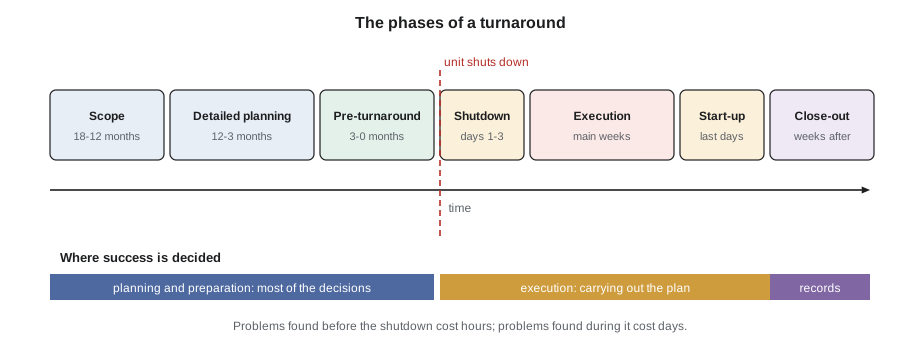
The shutdown phase takes the unit from operation to a state where maintenance can begin. Operations bring the unit down, drain and purge it of hydrocarbons, steam and wash it, cool it and then isolate it with blinds and locks. The plant hands the equipment over to maintenance in stages, each with a permit. The execution phase is the work itself, around the clock, with the critical path watched hour by hour. The start-up phase reverses the shutdown: boxing up, pressure testing, removing blinds, handing the equipment back to operations and bringing the unit up to temperature and pressure. The close-out phase, after start-up, finishes the paperwork, closes punch list items, returns materials and records lessons for the next turnaround.
| Phase | Typical timing | What boilermakers see |
|---|---|---|
| Scope development | 18 to 12 months before | Inspection findings turned into work requests |
| Detailed planning | 12 to 3 months before | Work packages, drawings, material lists, rigging plans |
| Pre-turnaround work | 3 months to the shutdown | Prefabrication, scaffolding, laydown, training |
| Shutdown | First 2 to 4 days | Waiting for handover; blinding crews start |
| Execution | Main weeks | Opening, inspection, repairs, boxing up |
| Start-up | Last days | Testing, deblinding, handover to operations |
| Close-out | Weeks after | Records, punch list, lessons learned |
Who is who on a turnaround
A turnaround organization is large and temporary. The owner appoints a turnaround manager, at Northgate Malcolm Ferris, who answers to the plant manager for safety, schedule, cost and scope. Under him are area coordinators who look after groups of units, planners who write work packages, schedulers who build and update the schedule, cost controllers, a safety team and the owner's inspectors. Operations keep their own organization and remain responsible for the plant; they issue permits, isolate equipment and take it back at the end.
Contractors such as Ironbridge bring their own organization. Ironbridge's site manager answers to the owner for the contract. A general foreman, Rosa, runs the boilermaker work, with foremen under her and lead hands under them. Ironbridge also brings its own planner, Heather Quan, who turns the owner's work packages into crew assignments and reports progress every shift, and its own safety advisor, Imran Qureshi. The lead hand is the first level of supervision: a working tradesperson who directs a small crew, keeps it supplied, knows the permits and the plan for each job, and reports what the crew did at the end of every shift.
Kiera's crew is small: Tessa Moreland and Cody Ferland, both journeypersons with twenty years each; Anders Holm, a welder; Jun Park, a fitter from the shop; and three apprentices, one of them in his first turnaround. Rosa tells Kiera what the job of a lead hand really is. "You won't do much boilermaking," she says. "You'll read packages, check permits, chase materials, keep your people safe and tell Heather the truth about where you are. If you do that, the boilermaking takes care of itself."
Turnaround discipline
Turnarounds have a culture of their own. Because there are so many people on site at once, and because the plant is in an unusual state, the rules are stricter than in normal maintenance. Work happens only on the equipment named on a permit, only after the isolation for it is in place and only within the scope of the work package. New work found during the turnaround, called emergent work or discovery work, goes through a formal process before anyone starts it. Every shift begins with a toolbox meeting and ends with a progress report. The schedule is updated every shift, and the critical path is reviewed every day by the turnaround manager.
The discipline exists because the consequences of mistakes are large. A crew that opens the wrong flange, starts work on equipment that is not isolated, or welds near a line that has not been freed of gas can cause a fire or a release that kills people. A crew that does work outside its package can delay others who need the same space or crane. And a crew that reports progress it has not made can hide a delay until it is too late to recover. Kiera's first lesson as a lead hand is that honesty in the shift report is as important as skill on the tools.
The industry has learned these lessons the hard way. Investigations of refinery fires and explosions have found again and again that they happened during shutdowns and start-ups, when equipment was in an unusual state, when temporary connections and blinds were in place, and when many people were working close together. The safety system of a turnaround, which later lessons cover in detail, is built from those investigations.
Common mistakes
MistakeThinking a turnaround is just a big maintenance job.
InsteadIt is a planned event with its own organization, rules and schedule, and every day of it is expensive production lost.
MistakeReporting progress you hope to make instead of progress you have made.
InsteadReport actual progress every shift; hidden delays cannot be recovered.
MistakeStarting new work because it is obviously needed.
InsteadEmergent work goes through the owner's process first; it may need a permit, materials, inspection or engineering.
MistakeTreating the lead hand as just another tradesperson.
InsteadThe lead hand plans, supplies and supervises the crew and is the link between the plan and the work.
Summary and key terms
- A turnaround is a planned shutdown to do work that can only be done with the unit down: inspection, cleaning, repair, replacement and tie-ins.
- Refineries say turnaround; power stations say outage; pulp mills often say shutdown.
- Run length balances the cost of turnarounds against the growing risk of failure; many units now run four to six years.
- Lost production is often as large as the cost of the work, so every day of overrun is expensive.
- A turnaround runs through planning, preparation, shutdown, execution, start-up and close-out.
- The lead hand directs a small crew and links the plan to the work.
- Turnaround
- A planned shutdown of a unit or plant to do maintenance, inspection and project work that needs it shut down.
- Outage
- The power industry's word for a shutdown; planned or forced.
- Run length
- The time a unit operates between turnarounds.
- Lost margin
- The profit a unit would have earned while it is shut down.
- Emergent work
- Work found during the turnaround that was not in the original scope.
- Lead hand
- A working tradesperson who directs a small crew.
Practice problems
Work each problem on paper first, then reveal the answer to check.
Why do refineries not simply inspect their vessels every year?
Show answer
Each turnaround costs both the work and the production lost while the unit is down; inspection intervals are set so that the equipment stays safe without shutting down more often than needed.
Using the example's figures, what is the total cost of one Northgate turnaround?
Show answer
206 million Canadian dollars: 120 for the work and 86 of lost margin.
What is the difference between a planned outage and a forced outage?
Show answer
A planned outage is scheduled in advance; a forced outage happens when equipment fails and the unit must shut down without warning.
Name three things a lead hand does that a crew member usually does not.
Show answer
Reads and explains the work package, checks permits and isolations, chases materials and tools, and reports progress each shift.
Lesson quiz · 5 questions
Score 60% or more to complete this lesson.
Create a free account to save your progress, take quizzes and earn a certificate.