
BLR-230 · Lesson 3 of 12 · 17 min
Foundations, bottoms and annular plates
Tank 15 starts as a circle of concrete. In April, the civil contractor hands over the foundation: a reinforced concrete ringwall 48.3 m (161 ft) across, filled inside with compacted granular fill and topped with a layer of clean sand, the whole pad sloping gently up toward the centre. Before Ironbridge lays a single plate, Hamid Rostami, the surveyor, checks the ringwall top all the way round, and Bernie walks the pad with Kiera. "A tank is only as good as what it sits on," Bernie says. "Most tank trouble in the first ten years starts right here, under the bottom, where nobody can see it once the plates are down."
What a tank foundation does
A full tank presses on the ground with the weight of its contents. Tank 15 full of water during its hydrotest weighs about 26,000 t (30,000 tons), spread over its floor area, which is a pressure on the ground of about 140 kPa (3,000 psf). The shell adds a concentrated load around the edge. The ground under a tank always settles under that load; the foundation's job is to make the settlement small, uniform and predictable, so that the shell stays round and plumb and the bottom does not bulge or crease.
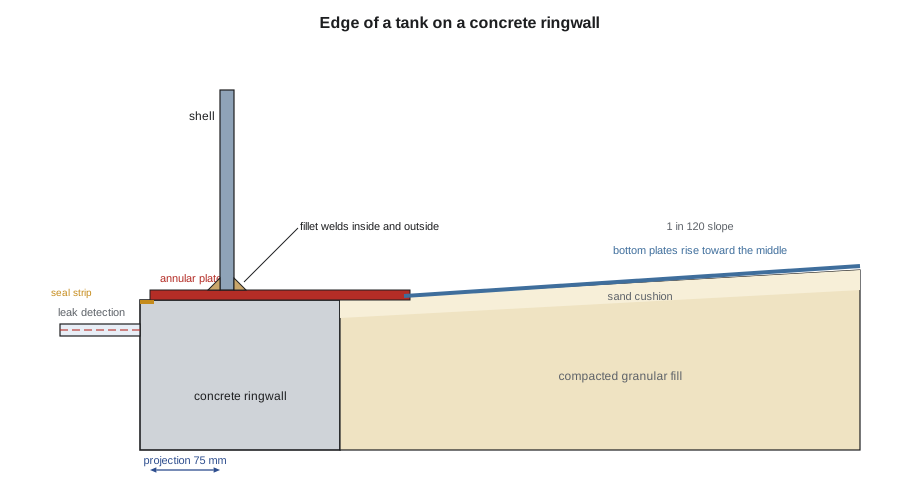
The owner's geotechnical engineer studies the soil and chooses the foundation. On firm ground, a compacted earth pad with a crushed stone or gravel ring under the shell may be enough. More often, and always for a large tank, a concrete ringwall is cast under the shell to carry its weight and to hold the fill inside in place. On soft ground, the foundation may be a concrete slab on piles, or the ground may be preloaded with a mound of soil for months before construction so that much of the settlement happens before the tank is built. At Prairie Junction, Tank 15 has a ringwall on improved ground, the same design as Tank 14, whose settlement records over twenty years gave the engineer good evidence of how the site behaves.
Checking the foundation before the steel goes down
The foundation must be level where the shell sits, because a shell set on an uneven ring will be out of plumb from the first course. API 650 sets levelness tolerances for the top of the foundation under the shell. For a concrete ringwall, the top must be level within about 3 mm in any 9 m (1/8 in in any 30 ft) of circumference and within about 6 mm (1/4 in) around the whole circumference, measured from the average elevation. Without a ringwall, the tolerances are looser. Hamid takes a level reading every 2 m (6 ft) around the ringwall and marks the high and low spots for Bernie.
Bernie also checks the slope of the pad inside the ring, the condition of the sand cushion, the location of the leak detection pipes and the anchor bolts, if the design has them, and the centre point and orientation marks that the civil contractor left. Every nozzle, manway and stairway on the tank is located by its angle from a reference, usually north, so the reference mark must be on the foundation before the first annular segment is set. Any problem found now is the civil contractor's to fix; once the steel is on the foundation, it becomes everyone's problem.
| Check | Why it matters |
|---|---|
| Ringwall top elevation all round | A shell set on an uneven ring starts out of plumb |
| Ringwall inside and outside diameter | The annular ring must bear fully on the concrete |
| Pad slope and surface | The bottom must drain to its sump and bear evenly |
| Sand cushion free of stones and debris | Hard spots cause bottom plate distortion and corrosion |
| Leak detection pipes and liner | Damage now cannot be repaired after the bottom is laid |
| Centre point and orientation marks | Every opening and attachment is located from them |
Bottom plates and the cone-up slope
Most tank bottoms are made of rectangular plates about 6 mm (1/4 in) thick, the minimum the standard allows, laid in strips across the tank and lap-welded: each plate overlaps its neighbour and a single fillet weld is run along the top edge of the lap. The standard requires a minimum lap, usually a few times the plate thickness, and limits where three plates may overlap, because a three-plate lap is hard to weld tight. Around the edge, where the rectangular plates meet the curve of the shell or the annular ring, the crew fits irregular sketch plates cut to the curve.
Bottoms are usually built with a slope so that water and sludge drain to a sump. A cone-up bottom rises toward the centre, so water drains to the shell, where a sump or drain nozzle collects it. A cone-down bottom slopes toward a sump at the centre. A typical slope is 1 in 120. Tank 15 is cone-up, with its water draw-off sump near the shell on the south side.
The annular ring
The shell of a large tank does not sit on ordinary bottom plates. It sits on the annular ring, a ring of thicker plate segments under the shell, butt-welded to each other so that the ring is continuous. The annular ring carries the heavy, concentrated load of the shell and the bending at the shell-to-bottom corner, which is the most highly stressed part of a tank's bottom. API 650 requires an annular ring when the bottom shell course is thick or highly stressed, and sets its thickness and its radial width: it must extend a minimum distance inside the shell and project a short distance outside it. The inner edge of the annular ring is lapped by the rectangular bottom plates.
Annular segments are cut from plate in the shape of a curved band, with the outer edge on the tank's outer radius. They are butt-welded with backing strips underneath, because the crew can only weld them from the top. These butt welds must be sound, because they lie directly under the shell, and the standard requires radiography of the annular plate radial joints in many cases. The welds under the shell are ground flush on top so that the shell plate sits evenly.
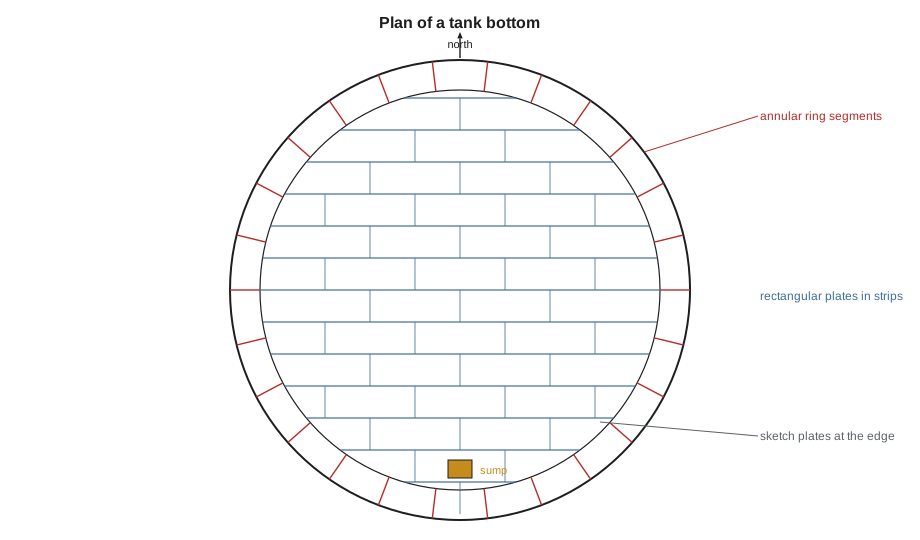
Bernie gives Kiera the bottom layout to check. The rectangular plates are 2.4 by 9.0 m (8 by 30 ft), the laps are 60 mm (2 in), and the annular ring is 750 mm (30 in) wide with segments no longer than 6.0 m (20 ft) on the outer edge.
# Tank 15 bottom: plate count, annular ring and the cone-up rise (metric)
import math

d = 48.0                  # tank diameter, m
pw, pl = 2.4, 9.0      # bottom plate size, width x length, m
lap = 0.06              # lap at each bottom plate joint, m
ring = 0.75            # annular ring radial width, m
seg = 6.0              # maximum annular segment length (outer edge), m
slope = 120              # cone-up slope, 1 in 120

r_in = d / 2 - ring + 0.075
area = math.pi * r_in ** 2                       # area covered by lapped plates
eff = (pw - lap) * (pl - lap)                    # coverage of one plate after laps
n = math.ceil(area / eff * 1.08)                 # 8 % extra for the sketch plates at the edge
print(f"Area inside the annular ring: {area:,.0f} m2")
print(f"Bottom plates needed (with 8 % for sketch plates): about {n}")

circ = math.pi * (d + 2 * 0.075)
segs = math.ceil(circ / seg)
print(f"Annular ring: {segs} segments of {circ / segs:.2f} m on the outer edge")

rise = (d / 2) / slope
print(f"Centre rise for a 1:{slope} cone-up bottom: {rise * 1000:.0f} mm")Area inside the annular ring: 1,709 m2 Bottom plates needed (with 8 % for sketch plates): about 89 Annular ring: 26 segments of 5.82 m on the outer edge Centre rise for a 1:120 cone-up bottom: 200 mm
About ninety plates for the bottom and twenty-six annular segments: the numbers match the material list, with a few spare plates. The centre of the bottom will stand about 200 mm (8 in) higher than the edge. Kiera notes that the sketch plates take more cutting time than the rectangular plates, even though there are fewer of them, because each one is a different shape.
Laying and welding the bottom
The bottom is laid in a set order. The annular segments are set first, on the ringwall, aligned to the centre point and the outer radius, and their butt joints are welded. Then the rectangular plates are laid in strips from the centre outward, tacked in place with the laps tight, and the sketch plates are fitted last. Tight laps matter: a lap with a gap under the top plate will not weld tight and can trap moisture.
Welding a large, thin bottom causes distortion. Each fillet weld shrinks as it cools and pulls the plates toward it, and a bottom welded in the wrong order buckles into ridges and hollows that will trap water and cause the bottom to flex every time the tank is filled. The usual sequence welds the short seams between plates in each strip first, then the long seams between strips, working from the centre outward, with welders spread out so that the heat is balanced. The outer seams, where the bottom plates lap onto the annular ring, are left unwelded until the bottom shell course has been welded to the annular ring, so that the shrinkage of the shell-to-bottom weld can be taken up by the loose plates. This seam is sometimes called the closure seam.
Every bottom weld is tested for leaks. The usual test is the vacuum box: a box with a clear top and a soft rubber gasket is placed over a length of weld wetted with soap solution, and a vacuum pump draws a partial vacuum, at least about 21 kPa (3 psi) below atmospheric, inside the box. Any leak in the weld draws air through and makes bubbles that the tester can see through the window. Each length of weld is tested with an overlap onto the length before. The annular butt joints and the lap welds are all boxed before the shell goes up over them.
Leak detection and corrosion under the bottom
The underside of a tank bottom is the one surface nobody can inspect while the tank is in service, and it is where many tanks fail. Water held in the pad, salts in the fill and stray electrical currents all corrode the underside, and a leak through the bottom can go unnoticed until product appears in the ground or the groundwater. Modern foundations defend against this in several ways. A liner of plastic sheet under the sand cushion catches any leak and carries it to leak detection pipes at the ringwall, where the operators can see it. Cathodic protection, a system of buried anodes or an impressed current grid under the bottom, makes the steel the cathode of a deliberate electrical circuit so that it does not corrode. Some owners specify a double bottom, a second steel bottom with a leak detection space between the two. The sand cushion itself is chosen to be clean and low in chlorides.
For the erector, these systems mean care. The cathodic protection grid and its reference cells are laid in the sand before the bottom plates go down, and a dropped plate or a careless excavator bucket can cut a cable that cannot be reached again. Kiera's crew lays plywood runways over the sand for the plate trolleys, and nobody drives on the pad. The leak detection pipes are capped while the work goes on so that grit and weld slag do not fill them.
Common mistakes
MistakeSetting the first shell course on an unchecked ringwall.
InsteadLevel the ringwall top to the standard's tolerance first; an uneven ring makes the shell out of plumb from the start.
MistakeWelding the bottom seams in any convenient order.
InsteadFollow the sequence: short seams first, then long seams, from the centre out, with heat balanced around the tank.
MistakeWelding the outer bottom-to-annular seam early.
InsteadLeave the closure seam until the shell-to-bottom weld is done so that its shrinkage can be absorbed.
MistakeSkipping the vacuum box on short bottom welds.
InsteadEvery bottom weld is boxed; a leak under the tank cannot be reached later.
Summary and key terms
- The foundation keeps settlement small and uniform; on poor ground it may be a pile slab or preloaded ground.
- The ringwall top must be level within tight tolerances before the shell goes on it.
- Bottom plates are lap-welded strips with sketch plates at the edge; the bottom usually slopes 1 in 120.
- The annular ring is a butt-welded ring of thicker plate that carries the shell and the corner bending.
- Bottom welding follows a sequence to limit distortion, leaving the closure seam until the shell is welded to the ring.
- Every bottom weld is leak tested with a vacuum box before the shell covers it.
- Ringwall
- A concrete ring cast under the shell of a tank to carry its weight and hold the pad fill.
- Sketch plate
- An irregular bottom plate cut to fill the curved gap at the edge of the bottom.
- Cone-up bottom
- A tank bottom that rises toward the centre so that water drains to the shell.
- Closure seam
- The bottom-to-annular seam left open until the shell-to-bottom weld is complete.
- Vacuum box
- A clear-topped box used with soap solution to find leaks in welds by drawing a partial vacuum.
- Lap weld
- A fillet weld along the edge of one plate overlapping another.
Practice problems
Work each problem on paper first, then reveal the answer to check.
Why is the closure seam welded last?
Show answer
So that the shrinkage of the shell-to-bottom weld can be taken up by loose bottom plates instead of buckling the bottom.
What does a cone-up bottom do with water?
Show answer
It drains toward the shell, where a sump or draw-off nozzle collects it.
A tank is 36 m (120 ft) in diameter with a 1 in 120 cone-up bottom. How much higher is the centre than the edge?
Show answer
18 m ÷ 120 = 0.150 m, or 150 mm.
Why must annular plate butt welds be ground flush on top?
Show answer
Because the shell plate sits on them and must bear evenly.
Lesson quiz · 5 questions
Score 60% or more to complete this lesson.
Create a free account to save your progress, take quizzes and earn a certificate.