
BLR-230 · Lesson 1 of 12 · 20 min
Field-erected tanks and structures
By March, Kiera Lafontaine has been with Ironbridge Industrial for two years. She has worked boiler outages at Riverbend, a refinery turnaround at Northgate, the fabrication shop and the exchanger shop. Rosa Delgado, the general foreman, has one more kind of work she wants Kiera to learn before her third period: field erection. This season Ironbridge has three field jobs. At Prairie Junction Terminal, the crew will build Tank 15, a new crude oil tank with an external floating roof, on a pad beside Tank 14, the big tank Kiera has already worked on. At Northgate, a smaller fixed-roof tank called T-31 will be built for diesel by the jacking method. At Riverbend, a new steel stack will be set and connected to Unit 2 with new breeching. In between, Kiera will spend time on bolting, both the structural bolts that hold platforms and stairways together and the flange bolts that hold pressure in, because a field crew does a great deal of both.
"Shop work comes to you on a table," Rosa tells her. "Field work is the other way round. The job is a pad of gravel and a pile of plate, and you build the thing where it will stand for fifty years, in the wind and the weather, with cranes and jacks and scaffolds instead of a shop floor." Rosa puts Kiera with Bernadette Thibault, Ironbridge's tank superintendent, who has built tanks on three continents and who everyone calls Bernie. Dale Whitford, Kiera's mentor since her first week, will run the stack job, and Desmond Pryce will teach the flange work.
What field erection means
Some equipment is too big to ship. A pressure vessel up to about 5 m (16 ft) in diameter can be built in a shop and moved by road or rail, but a storage tank 48 m (160 ft) across cannot. A tall stack can sometimes be shipped in sections and bolted or welded together on site, but its foundation, its anchor bolts and its connections to the boiler are site work. Field erection is the work of assembling large equipment and structures where they will stand: storage tanks, stacks and chimneys, ductwork and breeching, bins and silos, large water tanks and towers, and the steel that supports them.
Field erection has its own trade knowledge. The work is done at height, in the open, with heavy lifts and long welds that are made in every position. The tolerances are set by codes and by the owner's specification, and they are checked by survey rather than by a tape on a table. The sequence matters more than in the shop, because a tank shell or a stack section that is erected out of plumb or out of round cannot simply be cut apart and refitted. A good erection crew plans each step so that the structure is stable at every stage, so that the welds can be made in the best position the job allows, and so that each piece is checked before the next one hides it.
| Structure | Typical standard | Who is involved |
|---|---|---|
| Petroleum storage tank | API 650 for new welded tanks; API 653 for inspection, repair and reconstruction | Owner's engineer, tank erector, NDE contractor, owner's inspector |
| Bolted production tank | API 12B | Production company, tank supplier, field crew |
| Water storage tank or tower | AWWA D100 (welded) or D103 (bolted) | Municipality or utility, erector, inspector |
| Steel stack | ASME STS-1 and the building code | Plant owner, stack designer, erector |
| Breeching and ductwork | Owner's specification and the plant's design basis | Plant owner, boilermaker or sheet metal crew |
| Platforms, stairways and supports | CSA S16 and the building code | Steel erector or boilermaker crew |
Why tanks are built the way they are
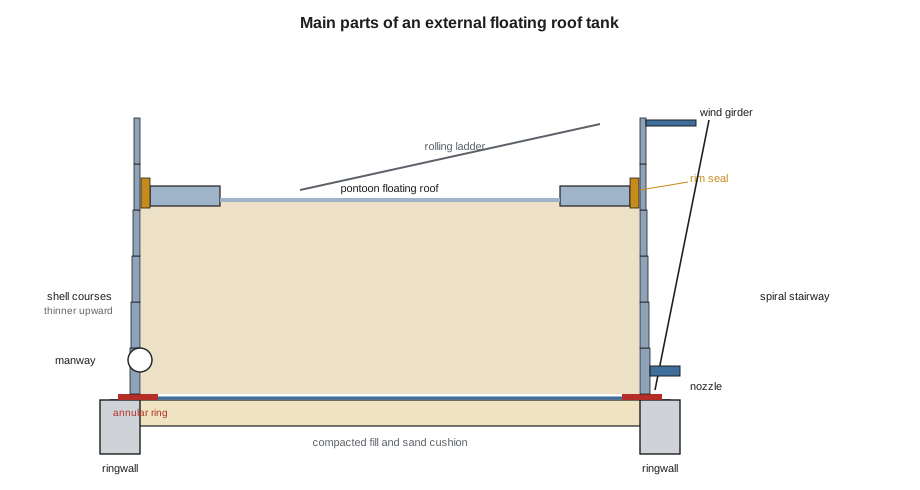
A storage tank for crude oil or products is the simplest-looking thing a boilermaker builds and one of the largest. It is a flat bottom resting on a prepared foundation, a cylindrical shell made of rings of curved plate called courses, and a roof. The tank is at or near atmospheric pressure, so the shell does not have to resist much internal pressure; it has to hold the weight of the liquid. The pressure of the liquid on the shell is greatest at the bottom and falls to zero at the top, so the bottom course is the thickest and each course above it is thinner. That is why a big tank's bottom course may be 17 mm (3/4 in) thick and its top course only 8 mm (5/16 in).
The bottom is thin, because it only carries the liquid down to the foundation, and the foundation does most of the work. The joint between the shell and the bottom is the most important weld in the tank, because it carries the bending and the hoop loads where the stiff bottom meets the shell. Under a large or heavily loaded tank, a ring of thicker plates called the annular ring is butt-welded under the shell to make this corner stronger. The roof may be fixed, a cone or a dome supported by rafters and columns or by the shell itself, or it may float on the liquid so that there is almost no vapour space above the product. The next lesson describes the roof types in detail.
The people on a tank job
A tank job brings together several organizations, and an apprentice needs to know who decides what. The owner, here the terminal company, decides what it needs: capacity, product, roof type, and the standard and edition the tank must meet. The owner's engineer writes the data sheet and the specification and approves the design. The tank contractor, here Ironbridge, designs the tank or works from a design provided, buys the plate, erects the tank and is responsible for the quality of the work. An NDE contractor examines the welds. The owner usually has its own inspector on site, who witnesses tests and accepts the tank. At Prairie Junction, the owner's engineer is Owen Kask, who has looked after the terminal's tank farm for twenty years.
On the Ironbridge side, Bernie runs the job. Under her are the foremen for each crew: the bottom crew, the shell crew, the roof crew and the welding crew. A surveyor, Hamid Rostami, sets out the foundation and checks the shell as it rises. Harjit Gill, Ironbridge's quality control manager, keeps the records that will show, at the end of the job, that every weld and every test was done as required. Imran Qureshi, the safety advisor, writes the site plan for work at heights, lifting, hot work and confined space entry, because a tank under construction becomes a confined space the moment the roof goes on or the last door sheet is welded in.
Capacity: nominal and working
Before any steel is ordered, the owner decides how much product the tank must hold. Capacity is described in two ways. Nominal capacity is the volume of the full shell, the floor area times the shell height. Working capacity is the volume the operator can actually use: the space between the lowest level the tank can be pumped down to and the highest level it is allowed to be filled to. At the bottom, a floating roof must stay above its legs while the tank is in service, and the outlet nozzle needs some liquid above it so that pumps do not draw vapour. At the top, the roof and its seal need room below the top of the shell, and the operators need a margin above their high-level alarm before the overfill protection acts.
Owen gives Bernie the numbers for Tank 15: a diameter of 48.0 m (160 ft), a shell height of 14.4 m (48 ft) in six courses, a low pump-out level of 1.8 m (6 ft) and a high liquid level of 13.2 m (44 ft). The code below works out the capacities.
# Tank 15: nominal capacity, working capacity and what a course holds (metric)
import math

d = 48.0              # tank diameter, m
h = 14.4              # shell height, m
courses = 6       # number of shell courses
area = math.pi * d ** 2 / 4
nominal = area * h
print(f"Floor area: {area:,.0f} m2")
print(f"Nominal capacity (full shell height): {nominal:,.0f} m3 = {nominal * 6.2898:,.0f} barrels")

# Working capacity: between the low pump-out level and the high liquid level
low = 1.8          # low level: floating roof still clear of its legs, m
high = 13.2        # high level: room left for the roof and the seal at the top, m
work = area * (high - low)
print(f"Working capacity ({low} to {high} m): {work:,.0f} m3 = {work * 6.2898:,.0f} barrels")
print(f"Working capacity is {work / nominal:.0%} of nominal")

per = area * h / courses
print(f"Each {h / courses:g} m course holds about {per:,.0f} m3 = {per * 6.2898:,.0f} barrels")
print(f"One cm of level = {area * 0.01:,.0f} m3")Floor area: 1,810 m2 Nominal capacity (full shell height): 26,058 m3 = 163,897 barrels Working capacity (1.8 to 13.2 m): 20,629 m3 = 129,752 barrels Working capacity is 79% of nominal Each 2.4 m course holds about 4,343 m3 = 27,316 barrels One cm of level = 18 m3
About four-fifths of the nominal volume is working capacity, which is typical for a floating roof crude tank. The last line is the one the operators use every day: one centimetre of level in Tank 15 is about 18 m3, so a small error in the level gauge is a large error in the inventory. That is one reason the shell must be round and plumb: the tank's strapping table, the chart that converts level to volume, assumes the tank is the shape it was designed to be.
Worked problem
Capacity of T-31
T-31 at Northgate is 24.0 m (80 ft) in diameter and 12.0 m (40 ft) high. What is its nominal capacity?
Show solution
- Floor area: π × 24.0² ÷ 4 = 452 m2.
- Nominal capacity: 452 × 12.0 = 5,429 m3.
- In barrels: 5,429 × 6.29 = about 34,100 barrels.
Answer: About 5,430 m3 (34,100 barrels).
Stacks, breeching and other field structures
Tanks are not the only field-erected work. A stack carries flue gas high enough that it disperses before it reaches the ground. A steel stack is a tall cylinder, often lined on the inside to protect it from hot, corrosive gas, with an access ladder, platforms and test ports for the gas sampling that environmental permits require. Breeching is the large duct that carries flue gas from the boiler or the air heater to the stack. Ductwork in a plant carries combustion air and flue gas between fans, heaters and boilers. All of these are big, light structures that must resist wind, heat and the pull of their own thermal growth, and they are built by the same crews that build tanks, with the same rigging and the same welding.
Riverbend's new stack is 60 m (200 ft) tall and 3.0 m (10 ft) in diameter, and it replaces an old brick-lined stack that the plant has decided not to reline. It will be set in three sections by crane, and the breeching between it and Unit 2's air heater outlet will be built on site. Lesson 8 follows that job.
A season's plan
Bernie lays out the season for Kiera on the site trailer wall. In spring the Tank 15 foundation is finished by the civil contractor and handed over; Ironbridge lays the annular ring and the bottom, then erects the shell course by course through the early summer while the floating roof is built on legs on the bottom inside. T-31's roof and top course are built at grade at Northgate in May and the tank is jacked up, course by course, through June. Riverbend's stack goes up in the July outage. In the fall, Tank 15 is hydrotested, settlement is measured, the seals are fitted and the tank is handed over. Through it all, there are platforms to bolt, stairways to set and flange joints to make up.
| Job | Work | When |
|---|---|---|
| Tank 15 | Annular ring, bottom, six shell courses, external floating roof, appurtenances, hydrotest | April to October |
| T-31 | Cone roof and top course at grade, jacking erection, bottom, nozzles, test | May to July |
| Riverbend stack | Anchor bolts check, three-section stack set, breeching, platforms | July outage |
| Bolting | Tank stairway and platforms, stack platforms, Northgate flange joints | Throughout |
Common mistakes
MistakeThinking a tank shell is the same thickness all the way up.
InsteadLiquid pressure rises with depth, so each course is thicker than the one above it; the bottom course is the thickest.
MistakeTreating nominal capacity as the volume the owner can use.
InsteadWorking capacity is set by the low pump-out and high liquid levels and is usually well below nominal.
MistakeAssuming a tank under construction is open air.
InsteadOnce the roof or the last door sheet is on, the inside is a confined space and needs a permit, testing and an attendant.
MistakeLeaving the plumbness and roundness checks until the shell is finished.
InsteadEach course is checked as it is set; errors carried up the shell cannot be fixed later.
Summary and key terms
- Field erection builds large equipment where it will stand: storage tanks, stacks, breeching, ductwork and their steel.
- Storage tanks are built to API 650 for petroleum and to AWWA D100 or D103 for water; API 653 covers inspection and repair.
- Shell courses get thinner toward the top because the liquid pressure falls with height.
- Nominal capacity is the full shell volume; working capacity lies between the low pump-out and high liquid levels.
- The owner, the owner's engineer, the contractor, the NDE contractor and the owner's inspector each have a part in the job.
- Field work is sequenced so that the structure is stable and each piece is checked before the next one covers it.
- Course
- One ring of curved shell plates in a tank.
- Annular ring
- A ring of thicker, butt-welded bottom plates under the shell of a large tank.
- Nominal capacity
- The volume of a tank shell from the bottom to the top of the shell.
- Working capacity
- The usable volume between the low pump-out level and the high liquid level.
- Strapping table
- A chart that converts liquid level in a tank to volume.
- Breeching
- The large duct that carries flue gas from a boiler to its stack.
Practice problems
Work each problem on paper first, then reveal the answer to check.
Why is the bottom course of a tank the thickest?
Show answer
Because the liquid pressure on the shell is greatest at the bottom and falls to zero at the top.
What two levels set the working capacity of a floating roof tank?
Show answer
The low pump-out level, where the roof must still be clear of its legs, and the high liquid level, which leaves room for the roof and seal and the overfill margin.
A tank is 30 m (100 ft) in diameter. About how much volume is one centimetre of level?
Show answer
π × 30² ÷ 4 = 707 m2, so one centimetre is about 7 m3.
Name three standards a boilermaker might work to on field-erected tanks.
Show answer
API 650 for new welded petroleum tanks, API 653 for repairs, and AWWA D100 or D103 for water tanks; also API 12B for bolted production tanks.
Lesson quiz · 5 questions
Score 60% or more to complete this lesson.
Create a free account to save your progress, take quizzes and earn a certificate.