
BLR-230 · Lesson 10 of 12 · 19 min
Bolt torque and tensioning
A torque wrench does not measure bolt load. It measures how hard the wrench is turning the nut. Most of that effort goes into overcoming friction, under the nut face and in the threads, and only a small part, often around a tenth, actually stretches the bolt. The bolt load that results depends on how slippery those surfaces are, and that varies with the lubricant, the thread condition, the coating and the care of the person tightening. Desmond starts Kiera's second week of bolting training by handing her two identical studs, one cleaned and lubricated, one dry and rusty, and letting her tighten both to the same torque in a load cell. The lubricated stud reaches almost twice the load of the dry one. "Same torque, different joint," he says. "That's what this whole lesson is about."
The torque-tension relationship
For everyday work, the relationship between torque and bolt load is written as a simple formula with a single factor, the nut factor K, that gathers up all the friction and geometry.
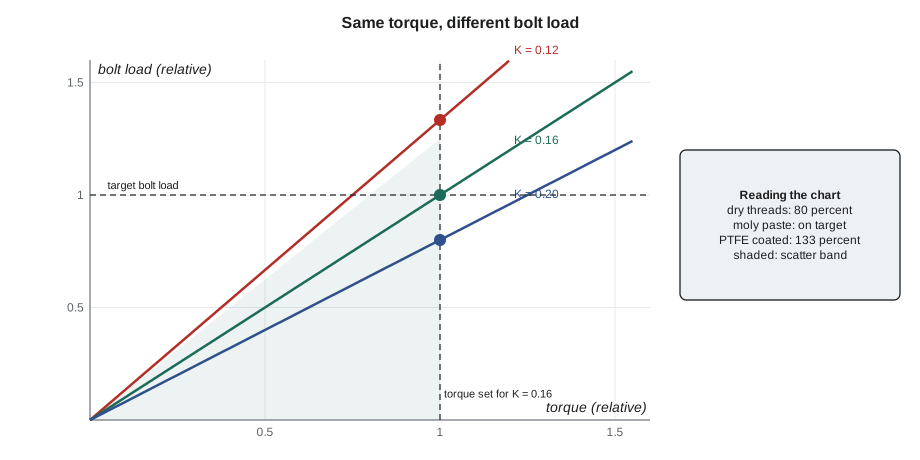
Here T is the torque, D is the nominal bolt diameter and F is the bolt load. With D in metres and F in newtons, T is in newton-metres. K has no units. For steel bolts it is about 0.20 for dry, plain threads, about 0.16 with a good anti-seize or molybdenum disulphide paste, and around 0.12 for some PTFE-coated studs. The value for a particular lubricant and fastener comes from the lubricant maker's data or from testing, and the joint's torque table is only correct for the lubricant it was made for.
Desmond's bolting table for Northgate's reboiler joint is built from a target bolt stress. The joint's engineer set a target of 50 ksi, about 345 MPa (50,000 psi), on the stress area of each 1 1/8 in B7 stud, which is a common target for a joint of this class and gasket type. The code below turns the target into a torque for three values of K, then shows what happens to the bolt load if the torque set for one lubricant is used on studs with a different one.
# Bolt load from torque, and torque from a target bolt stress (metric, illustrative)
d_in = 1.125                 # 1 1/8 in studs, nominal diameter
area_in2 = 0.763             # tensile stress area of 1 1/8-8 UN thread, in2
target_ksi = 50           # target bolt stress, ksi
F_lb = target_ksi * 1000 * area_in2

for K, what in ((0.20, "dry, plain"), (0.16, "moly paste"), (0.12, "PTFE coated")):
    T = K * d_in * F_lb / 12               # ft-lb
    print(f"K = {K:.2f} ({what:12}): {T * 1.3558:,.0f} N·m for {F_lb * 4.4482 / 1000:,.0f} kN per stud")

# What the same torque does if the lubricant is not the one assumed
T_set = 0.16 * d_in * F_lb             # in-lb, set for K = 0.16
for K in (0.12, 0.16, 0.20, 0.24):
    F = T_set / (K * d_in)
    print(f"actual K {K:.2f}: bolt load {F * 4.4482 / 1000:,.0f} kN = {F / F_lb:.0%} of target")

# Hydraulic tensioner: load lost when the nut takes the load (load transfer factor)
ltf = 1.25
print(f"Tool load for the target with a load transfer factor of {ltf}: {F_lb * ltf * 4.4482 / 1000:,.0f} kN")K = 0.20 (dry, plain ): 970 N·m for 170 kN per stud K = 0.16 (moly paste ): 776 N·m for 170 kN per stud K = 0.12 (PTFE coated ): 582 N·m for 170 kN per stud actual K 0.12: bolt load 226 kN = 133% of target actual K 0.16: bolt load 170 kN = 100% of target actual K 0.20: bolt load 136 kN = 80% of target actual K 0.24: bolt load 113 kN = 67% of target Tool load for the target with a load transfer factor of 1.25: 212 kN
The joint's target torque for moly paste is 776 N·m, which Desmond rounds to 775 N·m on the joint tag. If the same torque is applied to studs that were cleaned but not lubricated, with a nut factor of 0.20, the bolt load is only 80 percent of the target; on rusty, dry threads at 0.24, it is 67 percent, and the joint may leak at its first pressure-up. If a crew applies the same torque to PTFE-coated studs, the bolt load is a third higher than intended, which can crush the gasket's windings or overstress the bolts. This is why PCC-1 insists that the lubricant be specified, that it be applied to the threads and the nut faces every time, and that the torque table say which lubricant it was made for.
Scatter: why torque is not exact
Even with the right lubricant, torque tightening is not precise. Friction varies from bolt to bolt with small differences in thread finish, burrs, dirt and how the lubricant was spread. Typical scatter in bolt load from torque tightening is in the range of plus or minus 25 percent or more, unless the method is carefully controlled. PCC-1 deals with this in two ways: by picking a target bolt stress that sits comfortably between the minimum the gasket needs and the maximum the flange, gasket and bolts can take, so that the whole scatter band falls inside the acceptable range; and by tightening in patterns and passes, so that the bolts end up as even as possible. Where the scatter cannot be tolerated, other methods are used.
| Method | How it controls bolt load | Typical use |
|---|---|---|
| Manual torque wrench | Torque, with K and scatter | Small bolts, general flanges |
| Hydraulic torque wrench | Torque from hydraulic pressure on a calibrated tool | Large bolts, many flanges |
| Hydraulic tensioner | Stretches the stud directly, then the nut is run down | Large studs, critical joints, anchor bolts |
| Ultrasonic elongation measurement | Measures the bolt's actual stretch | Critical joints, verification, research |
| Direct tension indicator or tension-control bolt | Shows or sets tension mechanically | Structural joints |
Tools and their calibration
Hand torque wrenches are calibrated on a schedule, and their calibration is checked if they are dropped. Hydraulic torque wrenches are calibrated as a set with their pump and gauge, and the pressure to set for a given torque is read from the tool's own calibration chart, not from a chart for a different tool of the same model. Every tool's identification number goes on the joint tag. Before the Northgate turnaround, Desmond checks every torque wrench on Ironbridge's bolting trailer against the calibration records and takes two out of service.
Torque must be applied smoothly to the nut, with the reaction arm of a hydraulic tool braced against a solid surface such as the next nut, never against a flange face or a pipe that could be damaged, and never in a way that puts a hand or a finger in the pinch point. Hydraulic hoses at high pressure are inspected before use and kept out of the way. A failed hose fitting at the pressure these tools use can inject oil through the skin.
Hydraulic tensioning
A hydraulic tensioner does not turn the nut under load. It fits over the end of a stud that is long enough to stick out above its nut, grips the threads, and pulls the stud with a hydraulic piston, stretching it directly. While the stud is stretched, the nut is run down by hand onto the flange or base plate. When the pressure is released, the stud tries to shrink and is held by the nut, so the stud keeps a tension close to the pulled load. Because no friction is involved in the stretching, tensioning is far more accurate than torque.
Some load is lost when the nut takes up the load, as the threads and the nut seat settle slightly. The tool load is set higher than the target by a load transfer factor, which depends on the stud's length-to-diameter ratio and comes from the tool maker's data or testing. For the Northgate studs, the code above shows that with a factor of 1.25 the tool must pull 212 kN to leave 170 kN in each stud. Tensioners are often used on every second stud at once, called 50 percent coverage, followed by the other half and a check pass, or on all studs at once with a full set of tools.
At Riverbend, the stack's anchor bolts are tensioned this way. They are long rods cast into the foundation, and their designer specified a tension rather than a torque, because the friction under a large anchor nut on a grouted base plate is too uncertain to rely on. Dale's crew tensions them in two rounds around the bolt circle, in a pattern like a flange's, and checks the final round with the tool to confirm that the nuts no longer lift.
After tightening
Bolt load falls a little after tightening, as the gasket creeps and the threads and contact surfaces settle. PCC-1 describes an optional check pass a few hours after assembly, at the target torque, to pick up this relaxation. Some joints are also retightened after they first reach operating temperature, but only under a written procedure for hot work on a live joint, because tightening a joint that is in service, or loosening one, carries obvious risk. Desmond's rule is that nobody touches a bolt on a pressurized joint without a permit and a procedure that has been reviewed for that joint.
Worked problem
Torque from a target load
A 7/8 in stud has a stress area of 0.462 in2. The target bolt stress is 50 ksi and the lubricant gives K = 0.16. What torque is needed?
Show solution
- Bolt load: 50,000 × 0.462 = 23,100 lb, about 103 kN.
- Torque: 0.16 × 0.875 × 23,100 = 3,234 in-lb, or 270 ft-lb.
- In metric units: 270 × 1.356 = about 366 N·m.
Answer: About 366 N·m.
A joint tag and what it records
Every joint Desmond's crew makes up at Northgate gets a tag wired to one of its studs. The tag is the joint's record in the field, and its data goes into the refinery's bolting database. It shows the joint number from the turnaround list, the flange size and rating, the gasket type, the stud grade and size, the lubricant, the target torque or tension, the tool and its identification number, the passes made and their values, the assembler's name and qualification number, and the date. If the joint leaks at start-up, the tag tells the investigation exactly what was done, and the database lets the refinery see whether leaks cluster on one gasket type, one tool or one crew. Kiera fills in her first tags under Desmond's eye and learns that a tag with a blank is treated as a joint not done.
PCC-1 also describes how assemblers are trained and qualified, with classroom instruction, a written test and a practical demonstration on a test joint, and how senior assemblers and instructors are qualified above that. Northgate accepts only qualified assemblers on its critical joints, and Kiera starts the qualification course in the fall.
Desmond ends the training with a rule of thumb he wants Kiera to carry for the rest of her career: if a joint leaks, do not tighten it harder. A leak means something in the assembly was wrong, the gasket, the faces, the alignment, the lubricant or the pattern, and more torque on a leaking joint usually crushes the gasket on the tight side without fixing the loose side. The right response is to isolate the joint, take it apart, find out why it leaked and make it up again properly.
Common mistakes
MistakeUsing a torque table without knowing which lubricant it assumes.
InsteadThe torque is only correct for the nut factor of the specified lubricant; use that lubricant.
MistakeLubricating only the threads.
InsteadLubricate the nut face too; friction under the nut is a large part of the torque.
MistakeBracing a hydraulic wrench's reaction arm on the flange face.
InsteadBrace it on a solid point such as the next nut, away from hands and fragile surfaces.
MistakeRetightening a joint in service without a procedure.
InsteadWork on a live joint only under a permit and a reviewed written procedure.
Summary and key terms
- Torque measures turning effort, most of which goes into friction; only a small part stretches the bolt.
- T = K D F; the nut factor K depends strongly on the lubricant and the thread condition.
- The same torque with a different lubricant can give a bolt load far above or below the target.
- Torque tightening scatters by about ±25 percent; targets and patterns are chosen to tolerate it.
- Hydraulic tensioners stretch studs directly and are more accurate; the load transfer factor allows for the load lost when the nut seats.
- Tools are calibrated and recorded; live joints are worked only under a permit and a procedure.
- Nut factor
- The factor K that relates torque to bolt load, including friction and geometry.
- Target bolt stress
- The bolt stress chosen for a joint, between what the gasket needs and what the joint can take.
- Scatter
- The spread in bolt load produced by the same torque on similar bolts.
- Hydraulic tensioner
- A tool that stretches a stud directly while its nut is run down.
- Load transfer factor
- The ratio of tensioner load to the residual bolt load after the nut seats.
- Relaxation
- The loss of bolt load after tightening as the gasket and contact surfaces settle.
Practice problems
Work each problem on paper first, then reveal the answer to check.
Why did the lubricated stud reach almost twice the load of the dry one at the same torque?
Show answer
Lubrication lowers the friction under the nut and in the threads, so more of the torque goes into stretching the stud.
A joint's torque was set for K = 0.16 but the studs are dry, with K = 0.20. What fraction of the target load do they reach?
Show answer
0.16 ÷ 0.20 = 80 percent.
Why is a hydraulic tensioner more accurate than a torque wrench?
Show answer
It stretches the stud directly without relying on friction; the only correction is the load transfer factor.
What is the risk of reusing a torque chart from a different hydraulic wrench?
Show answer
Each tool's pressure-to-torque relationship is calibrated individually; another tool's chart can give the wrong torque.
Lesson quiz · 5 questions
Score 60% or more to complete this lesson.
Create a free account to save your progress, take quizzes and earn a certificate.