
BAS-120 · Lesson 7 of 12 · 23 min
Control valves: types, sizing and characteristics
▶ Video coming soon A video version of this lesson is on the way.
On Wednesday, October 28, Declan Kilbride asked Callie to sit in while he and Sophie Aubertin worked through the valve schedule for Ninefield's retro-commissioning quote. BAS-110 had explained why the plant suffered from low delta-T: two of the penthouse air handlers still had three-way chilled water valves, left over from before the plant went to variable-speed pumping. The spring 2027 project would replace them with two-way valves. Declan wanted the new valves sized properly, not copied from the old ones, and he wanted Callie to understand why. "A control valve is the most important part of a water coil's control loop," Sophie said, "and it's the part most often chosen badly."
This lesson explains the control valves found in building water systems: the main body types, two-way and three-way arrangements, how valves are sized with a flow coefficient, what valve authority means, and why valves have different flow characteristics. It ends with valve actuators and the checks a technician makes on a valve that does not control well.
Valve body types
Globe valves have a plug that moves up and down against a seat. They are the traditional control valve, available in two-way and three-way patterns, with good control and tight shut-off, and they are still common in larger sizes and on steam. Ball valves have a rotating ball with a hole through it, turned a quarter turn by the actuator. A plain ball valve has a poor control characteristic, but a characterized ball valve has a shaped disc or a contoured opening in the ball that gives it a controlled characteristic, and these have become the most common control valves in small and medium sizes because they are compact, inexpensive and seal tightly. Butterfly valves have a disc that rotates in the pipe; they are used in large sizes, for isolation, for chiller and tower isolation and for two-position duties, and in some cases for modulating control of large flows. Pressure-independent control valves (PICVs) combine a control valve with a built-in regulator that holds a constant pressure difference across the control element, so that the flow at each position stays the same as other valves in the system open and close.
| Valve type | Movement | Typical use | Notes |
|---|---|---|---|
| Globe | Linear stroke of a plug against a seat | Coils, steam, larger sizes | Good control; larger actuators |
| Characterized ball | Quarter turn | Most coils in small and medium sizes | Compact, tight shut-off, controllable |
| Butterfly | Quarter turn of a disc | Large pipes, isolation, chillers and towers | Limited modulating range |
| Pressure-independent (PICV) | Quarter turn or stroke, with a pressure regulator | Variable-flow systems with many coils | Flow at each position is independent of system pressure |
Two-way and three-way valves
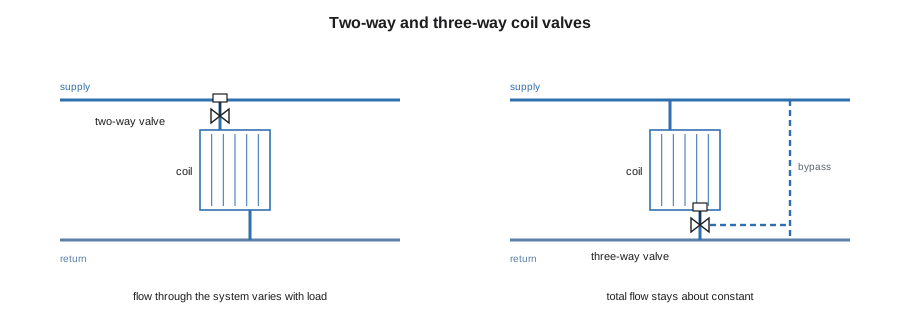
A two-way valve throttles flow to a coil: as it closes, less water flows through the coil and through the system. Two-way valves make the system's total flow vary with load, which is what variable-speed pumping needs. A three-way valve has three ports. A mixing three-way valve combines two inlet streams into one outlet; a diverting valve splits one inlet into two outlets. Used at a coil, a three-way valve sends water either through the coil or around it through a bypass, so the total flow in the system stays roughly constant whatever the coil's load. That suited the old constant-flow systems, but in a variable-flow system it sends unused supply water straight back to the return, which lowers the return temperature and causes exactly the low delta-T syndrome that Ninefield suffered.
Flow coefficients and sizing
Lesson 4 introduced the flow coefficient for devices that measure flow by pressure drop. A control valve is rated the same way, by the flow it passes when fully open at a standard pressure drop: Kv, the flow in cubic metres per hour at a pressure drop of 1 bar (100 kPa). Valve schedules list the Kv or Cv of each valve. Sizing a valve means choosing a Kv or Cv that gives the design flow at a chosen pressure drop across the fully open valve.
Choosing that pressure drop is the important decision. A valve that is too large drops very little pressure when fully open; most of its travel then does almost nothing to the flow, and all the control happens in the first few degrees of opening, so the loop hunts. A valve that is too small drops so much pressure that the pump must work harder, and the coil may never reach full flow. A common rule for modulating coil valves is to size the valve so that its fully open pressure drop is about equal to the drop across the coil and its piping branch.
Valve authority
Valve authority is the share of the controlled circuit's pressure drop that the fully open valve takes. If a valve drops 40 kPa and the coil, piping and fittings in its branch drop another 40 kPa, its authority is 0.5. Authority matters because, as a valve closes, the pressure across it rises: the coil and piping drop less pressure at lower flow, so more of the available pressure appears across the valve. A valve with low authority is overwhelmed by this effect and its installed behaviour becomes very different from its rated characteristic. An authority of about 0.5 is a common design target; values much below about 0.25 usually give poor control.
Worked problem
Sizing a two-way valve for a Ninefield air handler
The new two-way valve for a penthouse AHU coil must pass 6.5 L/s (23.4 m³/h) at design. The coil and its branch drop 40 kPa at that flow. Size the valve for a 40 kPa drop, choose from standard Kv values of 25, 40 and 63, and work out the actual drop and authority.
Show solution
- Kv needed: 23.4 ÷ √0.40 = 23.4 ÷ 0.632 = 37.0.
- Choose the next standard size up: Kv 40.
- Actual drop at design flow: (23.4 ÷ 40)² = 0.343 bar, or about 34 kPa.
- Authority: 34 ÷ (34 + 40) = about 0.46.
Answer: A Kv 40 valve with an authority of about 0.45, close to the 0.5 target. The next size down would drop too much pressure; the next size up would have an authority near 0.2 and control poorly.
Callie noticed that the valve Declan chose was smaller than the pipe. That is normal. A control valve is usually one or two sizes smaller than the line it sits in, because the line is sized for low pressure drop and the valve must drop enough pressure to control. A valve the same size as the pipe is often a sign that someone sized it by the pipe instead of by the flow.
Flow characteristics
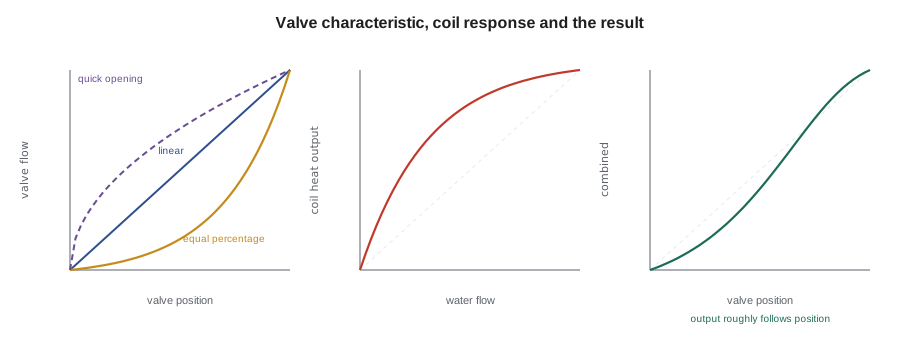
A valve's inherent characteristic describes how its flow changes with its position at constant pressure drop. A linear valve passes flow in proportion to its opening: half open gives half flow. An equal percentage valve passes very little flow near closed, and each equal step of opening increases the flow by the same proportion of the flow already passing, so most of the flow comes in the last part of the stroke. A quick-opening valve passes most of its flow in the first part of the stroke and suits two-position duties.
The reason for equal percentage valves lies in the coil. A water coil's heat output rises quickly at low flow and then levels off: half the design flow may give around 80 in 100 of the design heat transfer for a heating coil with a typical temperature drop. An equal percentage valve's slow start offsets the coil's fast start, so that the coil's heat output rises roughly in step with the valve position. That combined, more nearly linear response makes the control loop stable across the whole range. For that reason equal percentage valves are the normal choice for modulating water coils, while linear valves suit three-way bypass duties and some steam applications.
Sizing a VAV reheat valve
Worked problem
A small reheat valve
BAS-110's room 108 box, VAV-1-08, has a hot water reheat coil that must deliver 3.8 kW with an 11 K water temperature drop. The coil branch drops 20 kPa. Size its valve for a 20 kPa drop and choose from Kv 0.4, 0.63 and 1.0.
Show solution
- Water flow: 3.8 ÷ (4.19 × 11) = 0.082 L/s, which is 0.295 m³/h.
- Kv needed: 0.295 ÷ √0.20 = 0.295 ÷ 0.447 = 0.66.
- Kv 0.63 is a close match, giving a drop of (0.295 ÷ 0.63)² = 0.22 bar, about 22 kPa.
Answer: A Kv 0.63 valve. Reheat valves are small, and a valve one size too large on a small coil is a common cause of hunting reheat.
Valve actuators and close-off
Valve actuators are rotary for ball and butterfly valves and linear for globe valves. Like damper actuators they may be floating or modulating, spring return or not, and their signal range must match the controller. A valve actuator must also be strong enough to close the valve against the system's pressure difference. This is the valve's close-off rating: the largest pressure difference across the valve at which the actuator can still close it tightly. A valve on a coil near the pumps of a variable-speed system may see a much higher pressure when other valves are closed, and if the close-off rating is too low, the valve leaks through when commanded shut, wasting energy and contributing to low delta-T.
The spring-return position matters too. Heating coil valves exposed to freezing air usually fail open, so that hot water flows through the coil when power is lost; chilled water valves usually fail closed or stay put. The design documents state the required fail position, and the actuator must be mounted and set to match it.
Checking a valve that does not control
- Compare command and feedback, then look at the valve: does the stem or shaft move with the actuator, or has the coupling slipped, as in room 108?
- Check that the actuator's signal range and direction match the controller.
- Check the water temperatures across the coil at full and zero command. A coil that still heats or cools with the valve commanded closed suggests a leaking seat, a close-off rating too low for the system pressure, or a slipped coupling.
- Trend the valve command and the controlled temperature. A valve that swings between nearly closed and wide open while the temperature oscillates may be oversized or have too little authority; tuning alone will not fix it.
- Check strainers and isolation valves upstream; a blocked strainer looks like a valve that will not open.
Pressure-independent valves in practice
Sophie suggested pricing pressure-independent control valves as an alternative for the Ninefield conversion. A PICV is set to its design maximum flow with a dial or through its actuator, and its built-in regulator holds that flow at full open however the pressure in the loop changes. Each position of the valve then gives a predictable flow, so the valve's authority is effectively one, and one coil's valve opening or closing no longer upsets the flow to its neighbours. PICVs also remove the need for a separate balancing valve on each coil, which saves time at commissioning.
They have limits too. Each PICV needs a minimum pressure difference across it, often stated on its data sheet as something like 25 to 35 kPa, before its regulator can work; below that it behaves like an ordinary valve. The pump's differential pressure setpoint must leave enough pressure at the most remote PICV, which is one more reason the sensor location in lesson 3 matters. PICVs cost more than characterized ball valves, and their small internal passages can clog in dirty systems, so strainers and water treatment matter.
Declan put both options in the quote: characterized ball valves with balancing valves, and PICVs at a higher cost but with less balancing time. Ilona would choose after seeing the prices. Whichever she chose, the new valves would be two-way, which was the change that mattered for the plant's delta-T.
Common mistakes
MistakeSizing a control valve to match the pipe.
InsteadSize it from the flow and a chosen pressure drop; it is usually smaller than the pipe.
MistakeKeeping three-way valves in a variable-flow system.
InsteadConvert to two-way valves, keeping a minimum-flow bypass where the pumps or chillers need one.
MistakeChoosing a linear valve for a modulating coil.
InsteadUse an equal percentage characteristic for coils.
MistakeIgnoring close-off rating.
InsteadCheck that the actuator can close the valve against the highest pressure it will see.
MistakeRetuning a loop that hunts because the valve is oversized.
InsteadFix the valve size or authority; tuning cannot fix a valve that does all its work in the first few degrees.
MistakeSetting a heating valve to fail closed where the coil can freeze.
InsteadFollow the design fail position; heating coils usually fail open.
Summary and key terms
- Globe, characterized ball, butterfly and pressure-independent valves are the main types.
- Two-way valves vary system flow; three-way valves keep it constant and cause low delta-T in variable-flow systems.
- Valves are sized by Kv: the flow at a standard pressure drop when fully open.
- A common rule sizes the valve's open pressure drop about equal to the coil branch's drop, giving an authority near 0.5.
- Equal percentage valves suit coils because they offset the coil's fast rise in output at low flow.
- Actuators must match the signal, close the valve against the system pressure and fail to the right position.
- Control valve
- A valve positioned by an actuator to control the flow of water or steam.
- Characterized ball valve
- A ball valve shaped to give a controlled flow characteristic.
- Pressure-independent control valve
- A control valve with a built-in regulator so that flow at each position does not change with system pressure.
- Flow coefficient
- Kv: flow in cubic metres per hour at a 1 bar drop, fully open.
- Valve authority
- The fully open valve's share of the pressure drop in its controlled circuit.
- Equal percentage characteristic
- A characteristic in which each equal step of opening increases flow by the same proportion of the flow already passing.
- Close-off rating
- The largest pressure difference against which an actuator can close a valve tightly.
- Three-way valve
- A valve with three ports that mixes or diverts flow, keeping total flow roughly constant.
Practice problems
Work each problem on paper first, then reveal the answer to check.
A valve must pass 10 m³/h at a 25 kPa drop. What Kv is needed?
Show answer
10 ÷ √0.25 = 10 ÷ 0.5 = 20.
A valve drops 20 kPa open and the rest of its branch drops 60 kPa. What is its authority?
Show answer
20 ÷ 80 = 0.25, which is low.
Why do three-way coil valves cause low delta-T in a variable-flow system?
Show answer
They send unused supply water around the coil straight to the return.
Why are equal percentage valves used on coils?
Show answer
They offset the coil's fast rise in output at low flow, so output follows valve position more evenly.
A coil still heats with its valve commanded shut. Name two causes.
Show answer
A leaking seat or a close-off rating too low; also a slipped coupling.
Lesson quiz · 5 questions
Score 60% or more to complete this lesson.
Create a free account to save your progress, take quizzes and earn a certificate.