
AWS-119 · Lesson 9 of 12 · 22 min
Commonly confused AI services
▶ Video coming soon A video version of this lesson is on the way.
When Noor sorted Jonah's diagnostic mistakes, five of his thirteen misses had the same cause: he picked a real AWS service that did something close to what the scenario needed, but not the thing itself. That is the most common way candidates lose points on AIF-C01, because the distractors are rarely nonsense. This lesson is a collection of neighbours, the services and terms people mix up, each with the one deciding difference that separates them. Noor's advice was simple: "For every pair, learn one sentence. If you can say what makes them different in one sentence, you will not be fooled by either."
Language and documents
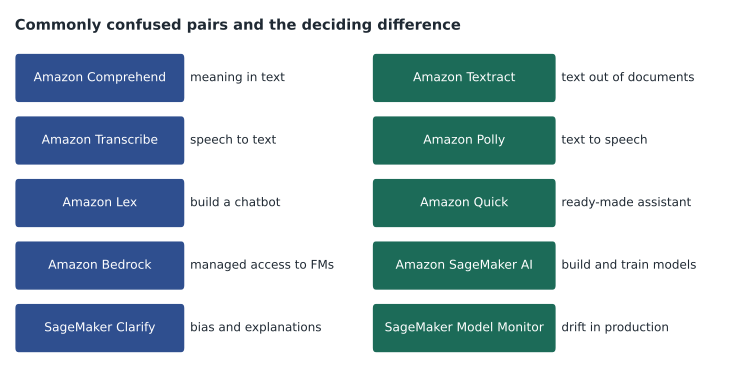
Amazon Comprehend and Amazon Textract are the classic pair. Textract extracts printed and handwritten text, forms and tables from scanned documents and images. Comprehend analyzes text that already exists to find sentiment, key phrases, entities such as names and places, the language and topics; Amazon Comprehend Medical does the same for medical text in supported languages and Regions. If the scenario starts with a scanned lab report, Textract comes first; if it starts with typed review comments, Comprehend is the answer. A pipeline may use both, Textract then Comprehend, and an ordering question could ask you to place them.
Amazon Translate translates text between languages. Amazon Transcribe converts speech to text, and Amazon Polly converts text to speech. The directions are easy to reverse under pressure, so tie each to an example: Transcribe turns the after-hours call recordings into text, with the caller's consent; Polly reads appointment reminders aloud in a natural voice. Amazon Lex builds conversational interfaces, chatbots and voice bots, using the same technology as Alexa; it manages the conversation, intents and slots, and can call Polly and Transcribe for voice. If a scenario wants a bot that books appointments by conversation, Lex is the builder's tool.
Assistants and platforms
Amazon Lex and Amazon Q are confused because both talk to people. Lex is a tool for developers to build their own bot with defined intents. Amazon Q is a family of ready-made generative AI assistants: Amazon Q Business answers employees' questions from the organization's own connected content and can take actions, while Amazon Q Developer helps developers write code and manage AWS. Amazon Q Business is now closed to new customers, and AWS recommends Amazon Quick for new projects, so newer questions may name Amazon Quick in the same role. If the requirement is a ready-made assistant for staff over company documents with little development, Amazon Quick (or Amazon Q Business on older items) fits; if it is a custom booking bot with a defined flow, Lex fits.
Amazon Bedrock and Amazon SageMaker AI are the most important pair. Bedrock provides managed, serverless access to foundation models from Amazon and other providers through one API, with built-in features for knowledge bases, agents, guardrails, evaluation and some customization. SageMaker AI is the full platform to build, train, tune, deploy and monitor your own machine learning models, including traditional models such as the no-show classifier. If the scenario says the team wants to use a foundation model without managing infrastructure, choose Bedrock. If it says the team wants to train a custom model on its own tabular data, or needs full control over training, choose SageMaker AI. SageMaker JumpStart sits in between: a hub within SageMaker AI to deploy and fine-tune pre-trained models, including open foundation models, on infrastructure you manage through SageMaker.
Amazon Quick, Kiro, Strands Agents and Amazon Bedrock AgentCore are newer names in the guide. Amazon Quick serves business users with analytics, research and agents in one workspace. Kiro is an AI-assisted development environment for developers. Strands Agents is an open-source framework for writing agents in code. AgentCore provides services to run, secure and observe agents in production. If you remember them by audience, business user, developer writing code, developer building agents, and team operating agents, you will rarely confuse them.
Responsible AI and operations tools
SageMaker Clarify detects bias in data and models and explains predictions. SageMaker Model Monitor watches a deployed model for drift in data and model quality over time. Both relate to trust, but Clarify answers "is this model fair and why did it predict this?" while Model Monitor answers "is this model still performing as it did when we deployed it?" Clarify can be used with Model Monitor to watch for bias drift, which is a possible exam twist. Amazon Bedrock Guardrails is different again: it filters content in prompts and responses for generative applications. Amazon Augmented AI (A2I) adds human review to predictions. SageMaker Model Cards document a model.
| If the scenario needs | Choose | Not |
|---|---|---|
| Bias detection and explanations for predictions | SageMaker Clarify | Model Monitor |
| Alerts when production data drifts | SageMaker Model Monitor | Clarify alone |
| Blocking harmful or off-topic chatbot replies | Bedrock Guardrails | Clarify |
| Human review of low-confidence predictions | Amazon Augmented AI (A2I) | Guardrails |
| Documenting intended use and risks | SageMaker Model Cards | CloudTrail |
| Recording who called which API | AWS CloudTrail | Model Cards |
Techniques that are easy to mix up
Several pairs are about techniques rather than services. Fine-tuning and continued pre-training both train an existing model further, but fine-tuning uses labelled examples for a task, while continued pre-training uses unlabelled text from a domain. Fine-tuning and RAG both make a model more useful for your organization, but fine-tuning changes the model's behaviour and style, while RAG supplies current facts at request time without changing the model. Prompt engineering and fine-tuning both improve outputs, but prompting changes only the input and costs nothing to set up. Zero-shot and few-shot prompting differ only in whether examples are included. Prompt injection and poisoning are both attacks, but injection manipulates input at request time and poisoning corrupts data used for training or retrieval.
Metric pairs matter too. Precision and recall are the classic confusion: precision asks how many flagged items were right, recall asks how many right items were flagged. ROUGE and BLEU both measure overlap with reference text, but ROUGE is associated with summarization and BLEU with translation. Accuracy is a model metric; return on investment is a business metric. Bias in the statistical sense, underfitting, is different from bias in the fairness sense, unequal treatment of groups.
| Pair | Deciding difference |
|---|---|
| Fine-tuning versus continued pre-training | Labelled task examples versus unlabelled domain text |
| Fine-tuning versus RAG | Changes the model versus supplies facts at request time |
| Precision versus recall | Of the flagged, how many right versus of the right, how many flagged |
| ROUGE versus BLEU | Summaries versus translations |
| Prompt injection versus poisoning | Manipulated input versus corrupted training or retrieval data |
| Real-time versus batch inference | One request at a time versus many records on a schedule |
| Overfitting versus underfitting | Memorizes training data versus misses real patterns |
Signpost phrases
Some words in a stem point strongly to one answer. "Without managing infrastructure" with a foundation model points to Bedrock. "Custom model on our own data" points to SageMaker AI. "Most up-to-date company information" points to RAG or a knowledge base. "Filter harmful content" or "block a topic" points to Guardrails. "Explain why the model made this prediction" points to Clarify. "Scanned forms" points to Textract. "Audit evidence from AWS" points to Artifact. "Who did what, when" points to CloudTrail. Signposts are not a substitute for understanding, because the exam sometimes uses them in a distractor, but they help you decide quickly between plausible options.
More managed services worth separating
A few more services appear in practice material and are worth one sentence each. Amazon Rekognition analyzes images and video, for example detecting objects, text or unsafe content; it would be the managed option for checking whether a radiograph image is blurry if a suitable feature existed, though the group judged that a custom model might be needed. Amazon Personalize builds recommendation systems from interaction data. Amazon Kendra is an intelligent enterprise search service that can serve as a retriever for RAG. Amazon Forecast was AWS's managed time-series forecasting service, but AWS has stopped offering it to new customers and points them to SageMaker AI, so treat it carefully in older practice material. If you meet an older practice question that relies on a retired service, learn the concept and the current alternative, not the old name.
Comprehend and Bedrock can also look similar, because a foundation model can do sentiment analysis too. The deciding difference is purpose and cost: Comprehend is a specialized, inexpensive service for standard language tasks with no prompt engineering, while a foundation model is flexible but costs more per request and needs prompting. If the scenario is a standard task at high volume with no need for generated text, Comprehend is often the more cost-effective answer.
Building your own confusion list
The pairs in this lesson are the common ones, but your list should come from your own mistakes. Every time a practice item fools you with a neighbour, add the pair to a single page with its deciding sentence. Jonah's page had nine pairs by the end of November; after a week of drills, he could recite all nine from memory, and he will rebuild the list after each practice set in his plan. A short personal list beats a long generic one, because it targets the confusions you actually make.
Interleaving helps here more than anywhere else. If you study Transcribe on Monday and Polly on Thursday, you never practise telling them apart. If you study them side by side, with mixed questions, you build the discrimination the exam tests. That is why lesson 10 recommends mixed sessions rather than one domain at a time.
When two services work together
Some options name two services together, and both may be right. A pipeline that turns call recordings into summaries uses Transcribe and then a foundation model through Bedrock. A pipeline that reads scanned lab reports and flags abnormal values uses Textract and then Comprehend Medical or a custom model. A voice booking bot uses Lex with Transcribe and Polly behind it. When an ordering or multiple-response question involves a pipeline, picture the data flowing from raw input to final output: audio to text to summary, image to text to meaning. Each step needs the service that transforms one form into the next, and the order follows the data.
As a final check on this lesson, try saying each pair aloud without looking: Textract and Comprehend, Transcribe and Polly, Lex and Amazon Q, Bedrock and SageMaker AI, Clarify and Model Monitor. If any one-sentence difference does not come quickly, that pair belongs on your page.
Remember too that names change. Services are renamed, merged or retired, and a confusing pair today may become a single service tomorrow. Check the current exam guide in the final weeks, note any renamed services, and learn the new name alongside the old one so that neither version of a question can surprise you.
Worked problem
Separating two plausible answers
A practice item reads: a hospital group wants employees to ask questions about its internal policies in plain language and get answers with links to the source documents, with as little development as possible. The options include Amazon Lex and Amazon Quick, the successor to Amazon Q Business. Which fits better and why?
Show solution
- Both can hold a conversation, so that is not the deciding difference.
- Lex requires developers to design intents and connect data sources themselves.
- Amazon Quick is a ready-made assistant that connects to company content and cites sources, as Amazon Q Business did before it closed to new customers.
- The constraint is as little development as possible.
Answer: Amazon Quick (Amazon Q Business on older practice items), because it is a ready-made assistant over company content, which meets the minimal-development constraint.
pairs = {
    "Comprehend": "meaning in existing text", "Textract": "text out of scanned documents",
    "Transcribe": "speech to text", "Polly": "text to speech",
    "Clarify": "bias and explanations", "Model Monitor": "drift in production",
}
need = "text out of scanned documents"
print([s for s, d in pairs.items() if d == need])['Textract']
What this code does
A small lookup pairs six AWS AI services with what each one does. It then searches for the service whose description matches the need of pulling text out of scanned documents. The answer returned is Textract.
Common mistakes
MistakeReversing Transcribe and Polly.
InsteadTranscribe turns speech into text; Polly turns text into speech.
MistakeChoosing Comprehend for scanned forms.
InsteadTextract extracts the text first; Comprehend analyzes text that already exists.
MistakeChoosing SageMaker AI when no model needs training.
InsteadBedrock gives managed access to existing foundation models.
MistakeUsing Lex where a ready-made assistant fits.
InsteadAmazon Quick, the successor to Amazon Q Business, is the ready-made assistant over company content.
MistakeUsing Clarify to monitor drift.
InsteadModel Monitor watches drift; Clarify detects bias and explains predictions, and can feed bias drift monitoring.
Summary and key terms
- Textract extracts text from documents; Comprehend analyzes existing text.
- Transcribe is speech to text; Polly is text to speech; Translate translates; Lex builds bots.
- Amazon Quick (formerly Amazon Q Business) is a ready-made assistant; Lex is for building custom bots.
- Bedrock gives managed access to foundation models; SageMaker AI builds and hosts your own models.
- Clarify explains and detects bias; Model Monitor detects drift; Guardrails filters content; A2I adds human review.
- Learn one deciding sentence for each pair and watch for signpost phrases.
- Amazon Textract
- Extracts text, forms and tables from documents and images.
- Amazon Comprehend
- Finds sentiment, entities, key phrases and topics in text.
- Amazon Lex
- A service for building conversational bots.
- Amazon Quick
- A ready-made generative AI assistant over an organization's content; it succeeds Amazon Q Business, which is closed to new customers.
- SageMaker Model Monitor
- Watches deployed models for drift.
- Signpost phrase
- A phrase in a stem that points strongly to one kind of answer.
Practice problems
Work each problem on paper first, then reveal the answer to check.
Which service reads appointment reminders aloud?
Show answer
Amazon Polly.
Which service finds sentiment in typed comments?
Show answer
Amazon Comprehend.
Which service would you use to build a custom booking chatbot?
Show answer
Amazon Lex.
Which tool alerts you to drift in production?
Show answer
SageMaker Model Monitor.
What is the deciding difference between fine-tuning and RAG?
Show answer
Fine-tuning changes the model; RAG supplies facts at request time.
Which phrase points to Bedrock?
Show answer
Using a foundation model without managing infrastructure.
Lesson quiz · 5 questions
Score 60% or more to complete this lesson.
Create a free account to save your progress, take quizzes and earn a certificate.