
AWS-119 · Lesson 1 of 12 · 22 min
How the AIF-C01 exam works
▶ Video coming soon A video version of this lesson is on the way.
On Tuesday, November 10, 2026, Noor Siddiqui's weekly AI hour at Cascade Ridge Veterinary Partners in Calgary looked different. For two months Noor, the data scientist the group hired for its AI assessment, had used the hour to teach Jonah Petrakis, the client services and scheduling analyst, how machine learning and generative AI work. Jonah had followed the whole series: the no-show model, the after-hours call summaries, the image-quality idea and the long discussion about where AI must stop and a veterinarian must decide. This time Noor pushed a single sheet of paper across the table. "You know this material," she said. "Now you need to know the exam." Jonah plans to sit the AWS Certified AI Practitioner exam, code AIF-C01, in April 2027. This course is the bridge between knowing the subject and passing the test, and it follows the twelve-part study guide Noor wrote for him that afternoon.
An exam readiness course does three jobs. It explains how the exam is built, so nothing on test day is a surprise. It reviews every content domain against the official exam guide, so you can find what you have forgotten. And it teaches strategy: how to read questions, how to manage time and how to plan the last weeks. You should already have completed AWS-111 to AWS-114, or have equivalent knowledge. If a review lesson here mentions an idea that feels new, go back to the course that teaches it properly before you carry on.
What the certification is for
AWS describes the AI Practitioner certification as a foundational credential. It is aimed at people who use or work around AI and machine learning on AWS without necessarily building models themselves: business analysts, project managers, product owners, sales and marketing staff, IT support and managers who must make sound decisions about AI. The target candidate is someone with up to about six months of exposure to AI and machine learning technologies on AWS, who uses those solutions but does not necessarily build them. That describes Jonah well. He will never train a large language model, but he will help decide whether the no-show pilot is worth keeping, what the after-hours summaries may and may not do, and how client data is protected along the way.
The certification does not test coding, mathematics beyond simple ratios, or the internals of neural networks. It tests whether you understand concepts precisely, whether you can match a business need to the right kind of AI and the right AWS service, and whether you recognize risks and the controls that address them. The exam guide also lists topics that are out of scope, such as developing or coding AI models, implementing data engineering or feature engineering techniques, tuning hyperparameters and building pipelines. Knowing what is out of scope saves study time.
The facts that matter on the day
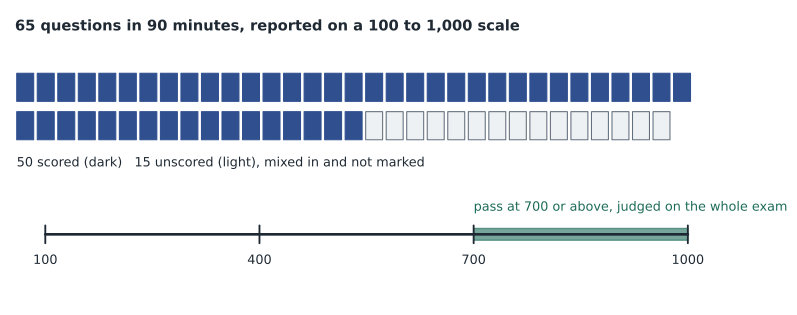
Noor's sheet listed the facts AWS publishes, checked against the AWS certification page and the AIF-C01 exam guide on November 10, 2026. The exam lasts 90 minutes and has 65 questions. Fifty of them are scored and 15 are unscored. The unscored questions are ones AWS is testing for future use, and they are not marked, so you must treat every question as if it counts. The registration fee is 100 US dollars, and depending on where you live, taxes or currency conversion may change what you actually pay. You can sit the exam at a Pearson VUE testing centre or online with a remote proctor. The exam is offered in a dozen languages, including English, French, Japanese and several others; check the current list if you would prefer to test in French.
Results are reported as a scaled score from 100 to 1,000, and the minimum passing score is 700. A scaled score is not the number of questions you answered correctly. AWS converts your raw result to the scale so that different versions of the exam, which may differ slightly in difficulty, are treated fairly. The exam uses a compensatory scoring model, which means you need to pass the exam as a whole, not each domain separately. A weak domain can be made up by a strong one. Unanswered questions are scored as incorrect, and there is no penalty for guessing, so you should never leave a question blank.
| Item | What AWS publishes | What it means for you |
|---|---|---|
| Length | 90 minutes | About 80 seconds per question, with time left to review |
| Questions | 65: 50 scored, 15 unscored | Treat every question as scored |
| Score | Scaled 100 to 1,000; pass at 700 | Not a raw count; do not try to convert it |
| Scoring model | Compensatory | A strong domain can make up for a weak one |
| Blanks | Scored as incorrect; no guessing penalty | Always choose something |
| Fee | 100 US dollars | Taxes or exchange may apply |
| Delivery | Pearson VUE testing centre or online proctored | Choose the setting where you focus best |
| Validity | Three years | Plan how you will keep it current |
The five content domains
The exam guide divides the scored content into five domains, each with a weight. Domain 1, Fundamentals of AI and ML, carries 20 of every 100 scored points. Domain 2, Fundamentals of generative AI, carries 24. Domain 3, Applications of foundation models, carries 28, the most of any domain. Domain 4, Guidelines for responsible AI, carries 14. Domain 5, Security, compliance and governance for AI solutions, also carries 14. With 50 scored questions, those weights work out to roughly 10, 12, 14, 7 and 7 questions, although the exact count on your form may vary a little.
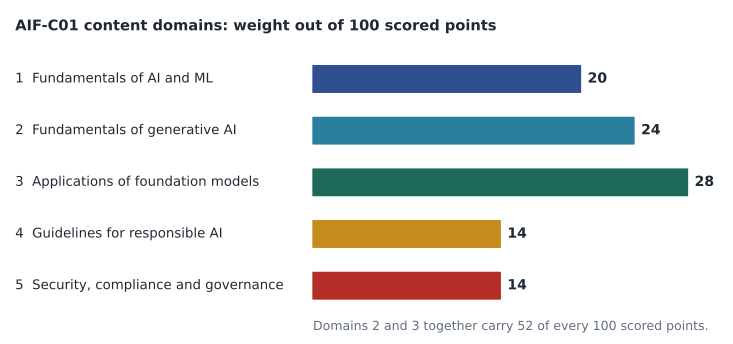
Noor pointed out what the weights mean for study time. Domains 2 and 3 together carry 52 of every 100 points, so more than half of the exam is about generative AI and how applications are built on foundation models. That matches the courses: AWS-112 covered domain 2 and AWS-113 covered domain 3, while AWS-111 covered domain 1 and AWS-114 covered domains 4 and 5. In this course, lessons 3 to 8 review the domains in order. Domain 3 gets two lessons because it is the heaviest: one for design, prompting and retrieval, and one for customization and evaluation.
| Domain | Weight | Course that teaches it | Review lesson here |
|---|---|---|---|
| 1 Fundamentals of AI and ML | 20 | AWS-111 | Lesson 3 |
| 2 Fundamentals of generative AI | 24 | AWS-112 | Lesson 4 |
| 3 Applications of foundation models | 28 | AWS-113 | Lessons 5 and 6 |
| 4 Guidelines for responsible AI | 14 | AWS-114 | Lesson 7 |
| 5 Security, compliance and governance | 14 | AWS-114 | Lesson 8 |
Task statements: the real syllabus
Each domain is broken into task statements, and each task statement lists the skills it expects. Domain 3, for example, has four task statements: design considerations for foundation model applications, prompt engineering techniques, the training and fine-tuning process, and evaluating foundation model performance. Under each, the guide lists specific items, such as the selection criteria for a model, the meaning of inference parameters like temperature, and evaluation metrics such as ROUGE, BLEU and BERTScore. Noor calls the task statements the real syllabus. "If a term appears in a task statement, assume a question can be built on it," she told Jonah. "If it does not appear anywhere, do not spend an evening on it."
The guide also names AWS services. Some appear as examples of a category, such as Amazon OpenSearch Service, Amazon Aurora, Amazon Neptune and Amazon RDS for PostgreSQL as places to store embeddings. Others are central, such as Amazon Bedrock, Amazon SageMaker AI and Amazon Bedrock Guardrails. Newer names appear too, including Amazon Bedrock AgentCore, Strands Agents, Kiro and Amazon Quick. Services are renamed and launched often, so check the current guide in the weeks before your exam and note anything that has changed since you studied. The exam is written to the guide that is current when you sit it.
How AWS writes the questions
Every question has a stem, which is the scenario and the question itself, and a set of options. On multiple-choice questions, one option is correct and three are distractors, wrong answers designed to look reasonable to someone with partial knowledge. Distractors are rarely absurd. A typical distractor is a real AWS service that does something related but not what the scenario needs, or a real technique that would work but costs far more than the scenario allows. That is why lesson 9 of this course is devoted to commonly confused services: much of the difficulty of this exam is telling neighbours apart.
Many stems contain a constraint that decides the answer: the least operational overhead, the lowest cost, without managing infrastructure, without retraining the model, or with the most up-to-date information. Noor teaches Jonah to underline the constraint before reading the options. In lesson 2 you will practise this, along with the newer question types that AIF-C01 uses.
Delivery: testing centre or online
Jonah has to choose where to sit the exam. At a Pearson VUE testing centre, the centre provides the computer, the quiet room and the supervision, and you bring government-issued identification that matches the name on your registration exactly. Online proctored delivery lets you test from home or an office, but the room must meet the rules: a clear desk, no other people, no notes, a working webcam and microphone, and a stable internet connection. Before booking an online exam, you run a system test on the same computer and network you will use on the day. Problems with company laptops are common, because security software or blocked ports can stop the testing application, so a personal computer is often the safer choice.
Jonah lives about twenty minutes from a testing centre in Calgary and prefers to test away from home, where the dog and the doorbell cannot interrupt. Noor agreed. "Pick the setting where you will think most clearly," she said. "The exam is the same either way." He plans to book in January 2027 for a weekday morning in April, when he is usually most alert, and to leave a margin of a few weeks before the June storage-array deadline that will keep the infrastructure team busy.
Policies worth knowing before you book
AWS publishes its testing policies on its certification pages, and they apply to every exam, including AIF-C01. Three are worth knowing now. If you do not pass, you must wait 14 calendar days before you can sit the same exam again, and each attempt requires the full registration fee; there is no limit on the number of attempts. Final results are posted to your AWS Certification account within five business days, even though the exit screen at the end of the exam gives you information about your result. And once you pass an exam, you cannot sit the same exam again for two years. Rules can change, so read the current policy pages when you book, but none of these are likely to surprise you if you plan around them.
The certification is valid for three years. Noor reminded Jonah that renewal is part of the plan, not an afterthought. Lesson 12 covers the options for keeping the credential current and choosing a next step, such as an associate-level certification for people who build AI solutions.
Worked problem
Using the weights to plan study time
Jonah expects to have about 40 hours of study between January and early April 2027, after finishing the four courses. Roughly how many hours should he give to domain 3 if he divides time in proportion to the weights?
Show solution
- Domain 3 carries 28 of every 100 scored points.
- Twenty-eight out of 100 of 40 hours is 0.28 times 40.
- 0.28 times 40 is 11.2 hours.
- He should then adjust for his own weak spots, which lesson 11 will show.
Answer: About 11 hours, before adjusting for the gaps a diagnostic reveals.
weights = {"D1": 20, "D2": 24, "D3": 28, "D4": 14, "D5": 14}
hours = 40
scored = 50
for d, w in weights.items():
print(d, "study hours:", round(hours * w / 100, 1), "| expected scored questions:", round(scored * w / 100, 1))D1 study hours: 8.0 | expected scored questions: 10.0 D2 study hours: 9.6 | expected scored questions: 12.0 D3 study hours: 11.2 | expected scored questions: 14.0 D4 study hours: 5.6 | expected scored questions: 7.0 D5 study hours: 5.6 | expected scored questions: 7.0
What this code does
It takes the exam's five domain weights, which add up to 100, and uses each as a share of 40 study hours and of the 50 scored questions. It prints the suggested study hours and the expected number of scored questions for each domain. Domain 3 carries the most weight, so it gets the most study time.
The output above is a starting point, not a rule. Jonah's diagnostic, reviewed in lesson 11, shows that he needs more time on domain 5 than its weight alone suggests, and less on domain 1, which he knows well from building the no-show analysis with Noor.
Common mistakes
MistakeThinking the scaled score is the number of questions right.
InsteadA scaled score converts your raw result to a 100 to 1,000 scale; 700 is the minimum passing score.
MistakeSkipping questions you are unsure of.
InsteadBlanks are scored as incorrect and there is no guessing penalty, so always answer.
MistakeStudying every AWS service in depth.
InsteadStudy what the task statements name; the exam targets concepts and service fit, not configuration.
MistakeAssuming you must pass every domain.
InsteadScoring is compensatory: the exam is passed as a whole.
MistakeTrying to spot the unscored questions.
InsteadThey are not identified; treat every question as scored.
Summary and key terms
- AIF-C01 is a foundational exam for people who use or work around AI on AWS, not for model builders.
- It has 65 questions in 90 minutes: 50 scored and 15 unscored, which are not marked.
- Scores are scaled from 100 to 1,000; 700 passes; scoring is compensatory; blanks count as wrong.
- Domain weights are 20, 24, 28, 14 and 14; domains 2 and 3 carry more than half.
- Task statements in the exam guide are the real syllabus; check the current guide before test day.
- Scaled score
- A result converted to a fixed scale, here 100 to 1,000, so different exam versions are comparable.
- Compensatory scoring
- A model in which you pass on your overall result rather than on each section.
- Unscored question
- A question included to gather data for future exams; it does not affect your score.
- Task statement
- An item in the exam guide that describes a skill the exam measures.
- Distractor
- A wrong option written to look plausible to someone with partial knowledge.
- Stem
- The scenario and question text that come before the options.
Practice problems
Work each problem on paper first, then reveal the answer to check.
How many AIF-C01 questions are scored?
Show answer
Fifty of the 65.
What is the minimum passing scaled score?
Show answer
700 on a scale of 100 to 1,000.
Which domain carries the most weight?
Show answer
Domain 3, Applications of foundation models, with 28.
Is there a penalty for guessing?
Show answer
No. Unanswered questions are scored as incorrect.
What does compensatory scoring mean?
Show answer
You pass on the overall result, not domain by domain.
Where can you sit the exam?
Show answer
At a Pearson VUE testing centre or online with a remote proctor.
Lesson quiz · 5 questions
Score 60% or more to complete this lesson.
Create a free account to save your progress, take quizzes and earn a certificate.