
AWS-119 · Lesson 10 of 12 · 21 min
Building a study plan
▶ Video coming soon A video version of this lesson is on the way.
A good study plan turns a vague intention, "I will study for the exam", into specific sessions with specific goals, built around the exam's weights and your own gaps. Noor wrote Jonah's plan on November 10, 2026, at the end of the session in which he sat her 40-item diagnostic. The plan runs from mid-November to his exam in April 2027. Everything in it after November 12 is a plan, not a record: none of it has happened yet, and the point of this lesson is how to build such a plan, not to report how his went.
Start from three inputs
Noor builds every study plan from three inputs. The first is the exam guide: the domains, their weights and the task statements. The second is the candidate's evidence: a diagnostic, practice results and a log of mistakes, which shows where the gaps really are rather than where the candidate feels weak. The third is the calendar: how many weeks remain, how many hours a week are realistic around work and family, and which weeks are already lost to other commitments. For Jonah, the calendar includes the clinics' busy holiday season and, in the infrastructure team's world, the spring cutover of the practice system, which will take some of his evenings in March.
Jonah estimates he can give about four hours a week from January to early April, plus the remaining work on AWS-113 and AWS-114 before the holidays. That is roughly 40 hours of exam-focused study after the courses are finished. Lesson 1 showed how to divide that time by weight. The plan then adjusts for the diagnostic: Jonah lost the most points in domains 3 and 5, so those get more time than their weights alone would give, and domain 1, where he made only one mistake, gets less.
weights = {"D1": 20, "D2": 24, "D3": 28, "D4": 14, "D5": 14}
missed  = {"D1": 1,  "D2": 3,  "D3": 5,  "D4": 1,  "D5": 3}   # from the 40-item diagnostic
items   = {"D1": 8,  "D2": 10, "D3": 11, "D4": 5,  "D5": 6}
hours = 40
# blend: half by exam weight, half by share of points missed
miss_rate = {d: missed[d] / items[d] for d in weights}
total_w, total_m = sum(weights.values()), sum(miss_rate.values())
for d in weights:
    share = 0.5 * weights[d] / total_w + 0.5 * miss_rate[d] / total_m
print(d, "hours:", round(hours * share, 1))D1 hours: 5.6 D2 hours: 8.6 D3 hours: 11.4 D4 hours: 5.3 D5 hours: 9.1
What this code does
It plans 40 hours of study by blending two shares for each domain: half based on the exam weight and half based on the share of diagnostic questions missed in that domain. It prints the hours for each domain. Domain 5 gets far more time than its weight alone would give because the learner missed half of its questions.
The blended allocation is only a guide. Noor rounds it to whole sessions and keeps two rules: every domain gets at least one review session, because the exam samples all of them, and the last two weeks are reserved for mixed practice and rest rather than new material.
The shape of the plan
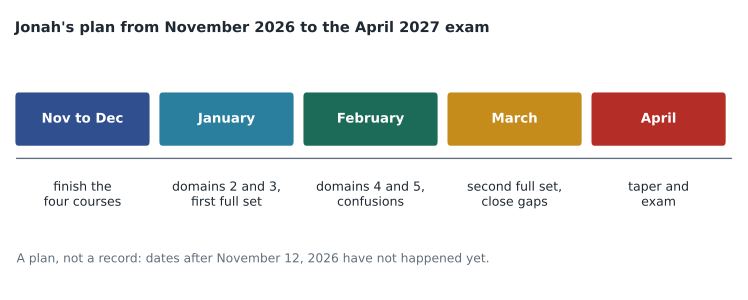
The plan has five phases. In November and December, Jonah finishes AWS-113 and AWS-114 and keeps a mistakes log from each quiz. In January, he reviews domains 2 and 3 using lessons 4 to 6 of this course, rebuilds his flashcards for the confused pairs, and sits his first full-length practice set under timed conditions at the end of the month. In February, he reviews domains 4 and 5 using lessons 7 and 8, with extra time on the governance services that tripped him up, and drills the pairs from lesson 9. In March, he sits a second full practice set, analyzes it the way lesson 11 describes, and spends the remaining sessions closing the specific gaps it shows. In April, he tapers: lighter review, the logistics checks in lesson 12, and rest.
| Phase | Focus | Evidence produced |
|---|---|---|
| November to December | Finish AWS-113 and AWS-114 | Mistakes log from course quizzes |
| January | Domains 2 and 3; flashcards | First full practice set, timed |
| February | Domains 4 and 5; confused pairs | Pair drills, updated log |
| March | Close gaps from second practice set | Second full set and analysis |
| April | Taper, logistics, rest | Exam-day checklist complete |
Choosing study materials
AWS provides free and paid preparation material through AWS Skill Builder, including an official practice question set and, in some subscriptions, an official practice exam, as well as exam prep courses for AIF-C01. The exam guide itself is free and is the most important document of all. Third-party practice tests vary widely in quality; some are excellent, and some contain wrong answers or outdated service names. Use practice questions to find gaps and to get used to the formats, not as a source of truth. When a practice answer conflicts with the exam guide or the AWS documentation, trust the official source.
Avoid any material that claims to contain real exam questions. Sharing or using actual exam content breaks the AWS Certification candidate agreement and can lead to a revoked certification and a ban from future exams. It is also a poor strategy: real questions change, and memorized answers do not build the understanding that the scenario questions test. Every practice item in this program was written for the program.
Active study beats rereading
Rereading notes feels productive but builds little lasting memory. Noor asks Jonah to use active methods instead. Retrieval practice means answering questions from memory before checking, which strengthens recall. Spaced repetition means revisiting material at increasing intervals, which is what flashcard apps do automatically. Interleaving means mixing domains within a session, rather than doing one domain at a time, which better matches the exam and helps you learn to tell similar ideas apart. Explaining an idea aloud, as if teaching it, exposes gaps quickly. Jonah's version is to explain each confused pair to Andre Leclerc, the operations manager, who knows nothing about AI and asks excellent questions.
Each session in the plan has a goal written as an action, not a topic. "Review domain 5" is a topic. "Explain the five scopes of the Scoping Matrix from memory and match six governance services to needs in under five minutes" is a goal you can check. At the end of each session, Jonah writes one line in his log: what he got wrong and what he will do about it.
A sample week from the plan
Noor wrote one week of the plan in full so Jonah could see what a session looks like. The week chosen is the second week of February 2027, which is set aside for domain 5. On Monday evening, for 45 minutes, he writes from memory one sentence for each governance and security service named in the guide, checks them against lesson 8 and fixes any that are wrong. On Wednesday, for an hour, he works through ten original scenario items on domain 5 and five mixed items from earlier domains, timing himself at about 80 seconds per item, then logs every miss with its cause. On Saturday morning, for an hour and a half, he explains the Scoping Matrix and the shared responsibility model aloud, then answers a twelve-card matching set of needs and services twice, and finishes with a short review of his confused-pairs page. The week totals a little over three hours, inside his four-hour budget, with room to spare if a clinic emergency takes an evening.
Every session in the sample week mixes in some earlier material. That is interleaving and spacing working together: each domain comes back several times across the plan, at growing intervals, rather than being studied once and left. Noor's rule of thumb is that at least a fifth of every session should revisit something from an earlier week.
Planning around your life
A plan that ignores real life will be abandoned. Jonah's role means the holiday weeks are busy, and the spring practice-system cutover will take some evenings in March, so the plan puts lighter work in those weeks and heavier work in January and February. Some people study best early in the morning, others late at night; the best time is the one you will actually keep. Short, regular sessions beat long, rare ones: four sessions of an hour each week build more lasting knowledge than one four-hour marathon on a Sunday. If you have a long commute, flashcards on a phone turn dead time into spaced repetition.
Telling someone about the plan helps too. Jonah told Andre Leclerc, the operations manager, and Lorraine Beaudry, the chief financial officer, who approved the exam fee from the training budget. A plan that other people know about is harder to drop quietly.
Measuring progress without fooling yourself
The plan includes checkpoints that produce evidence: the first full practice set in January, a domain 4 and 5 quiz in February and the second full set in March. Between them, Jonah tracks two simple numbers each week: how many items from his confused-pairs page he can answer from memory, and how many new misses he logged. If the first number rises and the second falls, the plan is working. Feelings of confidence are not evidence; they rise with rereading even when knowledge does not. That is why the plan keeps returning to timed, closed-book practice and to the mistakes log.
Finally, the plan has an exit test. If, by the end of March, Jonah's analysis of the second practice set shows only scattered misses with no pattern, he is ready to sit the exam as booked. If it still shows a cluster of knowledge gaps in one domain, he will use the buffer week there. And if the gaps are wide across several domains, the honest choice is to move the exam date, within AWS's rescheduling rules, and extend the plan by a few weeks. Choosing to delay on evidence is part of a good plan, not a failure of one.
Last, keep the plan visible. Jonah printed the five phases and taped them inside a cupboard door at his desk, with each completed session ticked off. Seeing progress accumulate is motivating, and seeing a gap in the ticks is an early warning that the plan needs adjusting before it is too late to recover the time.
Above all, a plan should be simple enough to follow on a tired evening. If a session goal takes longer to read than to do, it is too complicated; if a week's plan does not fit on an index card, it is probably too ambitious.
Worked problem
Turning a gap into a session
Jonah's diagnostic shows he confused AWS Artifact with AWS CloudTrail and did not know what Amazon Macie does. Write a 45-minute session goal that would close this gap.
Show solution
- Start with retrieval: write from memory one sentence for Artifact, CloudTrail, Config, Inspector, Macie and Trusted Advisor.
- Check each sentence against lesson 8 and the AWS documentation, correcting any that are wrong.
- Build a six-card matching set of needs and services, and match it twice under a two-minute limit.
- Finish with three original scenario items, answered before checking.
Answer: A goal such as: match six governance services to six needs without error in two minutes, and explain each in one sentence from memory.
Protecting the plan
Plans fail for predictable reasons: a busy month, illness, or simple fatigue. Noor builds in a buffer week in March that has no assigned content, so a lost week does not push everything back. She also recommends booking the exam early, because a fixed date makes the plan real, but not so early that there is no room for the buffer. If the second practice set in March shows the candidate is far from ready, it is better to reschedule within AWS's rules than to sit the exam unprepared. Rescheduling rules and deadlines are set by AWS and its testing partner, so check them when you book.
Common mistakes
MistakeAllocating time only by how weak a domain feels.
InsteadUse the exam weights and evidence from a diagnostic or practice set.
MistakeRereading notes as the main study method.
InsteadUse retrieval practice, spacing, interleaving and explaining aloud.
MistakeTrusting every practice test answer.
InsteadWhen a practice answer conflicts with the exam guide or documentation, trust the official source.
MistakeUsing material that claims to contain real exam questions.
InsteadIt breaks the candidate agreement and does not build understanding.
MistakePlanning new material for the final week.
InsteadReserve the last stretch for mixed practice, logistics and rest.
Summary and key terms
- Build a plan from the exam guide, evidence of your gaps and a realistic calendar.
- Allocate time by blending exam weights with your own miss rates; give every domain at least one session.
- Use the exam guide and official AWS Skill Builder material first; treat third-party answers with care.
- Never use real exam content.
- Study actively: retrieval, spacing, interleaving and explaining aloud.
- Write each session goal as a checkable action and keep a buffer week.
- Diagnostic
- An early practice set used to find gaps rather than to predict a score.
- Retrieval practice
- Answering from memory before checking, to strengthen recall.
- Spaced repetition
- Reviewing material at increasing intervals.
- Interleaving
- Mixing topics within a study session.
- Buffer week
- A week with no planned content, kept to absorb disruption.
Practice problems
Work each problem on paper first, then reveal the answer to check.
What are Noor's three inputs to a study plan?
Show answer
The exam guide, evidence of gaps and the calendar.
Why should every domain get at least one session?
Show answer
The exam samples all domains.
What is interleaving?
Show answer
Mixing domains within a session.
What should you do if a practice answer conflicts with the exam guide?
Show answer
Trust the exam guide and AWS documentation.
Why keep a buffer week?
Show answer
To absorb a lost week without pushing the whole plan back.
Why avoid material claiming to have real exam questions?
Show answer
It breaks the candidate agreement and does not build understanding.
Lesson quiz · 5 questions
Score 60% or more to complete this lesson.
Create a free account to save your progress, take quizzes and earn a certificate.