
AWS-112 · Lesson 5 of 12 · 19 min
Capabilities and limitations of generative AI
▶ Video coming soon A video version of this lesson is on the way.
Dr. Simone Kaur, the medical director, came to the fifth AI hour with a printout of twenty overnight call summaries that Jonah had produced in a test using anonymized old notes. She had marked them with a red pen. Fifteen were, in her words, "better than what a tired technician writes at four in the morning". Three were fine but wordy. Two had problems: one turned "the dog may have eaten a sock" into "the dog ate a sock", and one left out that the owner had already given an antacid.
"So it is good," she said, "until it is not, and it does not tell you which is which." Noor said that was the best one-sentence summary of generative AI she had heard. This lesson sets out what generative AI does well, where it falls short, and how to weigh the two for a business problem, using the advantages and disadvantages named in the AWS Certified AI Practitioner exam guide.
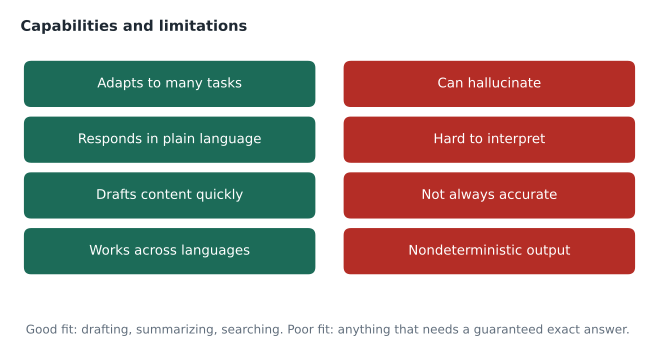
Advantages
The exam guide names several advantages. Each showed up in Jonah's test.
- Adaptability. One model handles many tasks with no retraining: summarizing call notes, drafting a client letter, classifying a complaint, extracting fields from a referral. Changing the task means changing the instructions, not building a new model.
- Responsiveness. Answers arrive in seconds, so a summary can be ready by the time the morning team starts its handover.
- Conversational capability. People use the model in plain language and can ask follow-up questions, so no special training or query language is needed. Dr. Kaur asked the test system to "list only the cases that might come back today" and it did.
- Content generation. The model produces first drafts, rewrites, summaries and variations quickly, which saves staff time on writing.
Other strengths follow from these. Models work across many languages, which matters for letters in French. They handle unstructured text that older systems struggled with, such as free-form notes full of abbreviations. They can be put to work quickly, because an organization can use a provider's model instead of collecting training data and building its own.
Disadvantages
The guide names four disadvantages specifically: hallucinations, limited interpretability, inaccuracy and nondeterminism. Dr. Kaur's red pen had found examples of three of them.
- Hallucination. The model states something that is not supported by its input or by fact, fluently and confidently. Turning "may have eaten a sock" into "ate a sock" is a small hallucination with real clinical weight. Lesson 6 is devoted to it.
- Inaccuracy. Even without inventing anything, the model can be wrong: leaving out the antacid, misreading a dose, or summarizing the less important half of a note. Accuracy varies by task, by model and by how the input is written.
- Limited interpretability. It is hard to explain why a model produced a particular output. A transformer's billions of parameters do not map to reasons a person can read, so you cannot point to the rule that caused a mistake the way you could with a written procedure.
- Nondeterminism. The same input can produce different outputs, as lesson 3 explained. Two runs of the same note might mention the antacid once and miss it once, which makes testing harder: one good result does not prove the next one will be good.
Noor added further limitations that the exam covers elsewhere or that every business meets in practice.
- Knowledge cutoff and missing private knowledge. The model knows nothing after its training date and nothing about the organization's own records unless they are supplied.
- Bias. Models learn from human-written data and can reproduce stereotypes or treat groups unequally. The responsible AI course in this program covers this in depth.
- Context limits. Very long inputs may not fit, and important details in the middle of a long input can be overlooked.
- Prompt injection and misuse. Text inside the input, such as a client message, can try to override the model's instructions. Applications need guardrails, covered in later courses.
- Cost and latency at scale. A few cents a request is cheap until it is a million requests; large models are also slower.
- Intellectual property and data questions. Who owns generated content, whether it resembles copyrighted material, and where input data goes all need policy answers before wide use.
Judging the fit for a business problem
Advantages and limitations matter only in relation to a specific task. Noor gave Jonah four questions to ask about any proposed use.
| Question | Good sign for generative AI | Red flag |
|---|---|---|
| What happens when it is wrong? | A person reviews the output and errors are cheap to catch | The output acts directly on a client, a patient or money |
| Is there a single correct answer? | Many acceptable answers, such as a draft or a summary | One exact answer, such as a dose or a balance |
| Is the needed knowledge available? | General knowledge, or documents that can be supplied | Private facts the model cannot see |
| Can quality be measured? | A test set and a reviewer can score outputs | Nobody can tell good output from bad |
Applied to the overnight call summaries, the answers were mostly encouraging. The summaries are reviewed by the morning vet, so errors can be caught. Many phrasings are acceptable. The needed knowledge is in the note itself. And Dr. Kaur had just shown that quality can be scored. The two flagged problems pointed to a design rule rather than a reason to stop: the summary must keep the caller's hedges, such as "may have" and "possibly", and must list every medication mentioned. The full note stays one click away.
Applied to the rejected idea of letting clients ask an AI about symptoms, the answers were all warning signs: no review step, clinical consequences, and no way for the model to examine the animal. That idea stayed rejected.
Measuring instead of guessing
Because outputs vary and errors are not flagged by the model itself, the only reliable way to judge a generative AI system is to test it on realistic examples and count the results. Noor turned Dr. Kaur's red-pen review into a simple scoring sheet, and Jonah wrote a few lines of Python to tally it.
# Dr. Kaur's review of 20 test summaries, one label each.
reviews = (["good"] * 15) + (["wordy"] * 3) + ["hedge lost", "medication missed"]
serious = {"hedge lost", "medication missed"}

total = len(reviews)
usable = sum(1 for r in reviews if r in ("good", "wordy"))
problems = sum(1 for r in reviews if r in serious)
print("summaries reviewed:", total)
print("usable as written:", usable, "of", total)
print("serious problems:", problems, "of", total)
print("serious problems per 100 summaries:", round(100 * problems / total))summaries reviewed: 20 usable as written: 18 of 20 serious problems: 2 of 20 serious problems per 100 summaries: 10
What this code does
It tallies a vet's review of 20 AI-written summaries, each given one label. It counts the summaries usable as written and the ones with serious problems, such as a lost hedge or a missed medication, and turns the serious count into a rate per 100 summaries. A rate of 10 in 100 serious problems is too high to use without human review, which is the point of measuring before deploying.
Ten serious problems per hundred summaries was far too many to rely on without review, but it was a baseline. After the next round of changes, the same twenty notes plus thirty new ones would be scored the same way. Noor pointed out that the number would never reach zero, which is exactly why the vet review step had to stay. The question for the pilot was whether summaries plus review saved time compared with reading every full note, and whether the review reliably caught the misses.
# Nondeterminism check: the same note summarized five times (outputs recorded by hand).
runs = [
    "Beagle ate raisins ~2 h before call; no vomiting; owner en route.",
    "Beagle, raisin ingestion about 2 h ago, not vomiting, coming in now.",
    "Beagle ate raisins; owner bringing in now.",
    "Beagle ate raisins ~2 h ago; no vomiting yet; en route.",
    "Raisin ingestion in beagle ~2 h prior; no vomiting; owner on the way.",
]
must_mention = ["raisin", "vomit", "2 h"]
for i, r in enumerate(runs, 1):
    missing = [m for m in must_mention if m not in r.lower()]
print(i, "OK" if not missing else "missing: " + ", ".join(missing))1 OK 2 OK 3 missing: vomit, 2 h 4 OK 5 OK
What this code does
It checks five summaries of the same call note, recorded by hand because a model gives different wording each time, against three facts every summary must mention. Each summary is marked OK or listed with the facts it dropped. One of the five omits the vomiting status and the timing, showing why outputs must be tested more than once.
Run three dropped two key facts even though the input never changed. That is nondeterminism in practice, and it is why the team tests each change on many examples, not one.
Capabilities improve; the review principle stays
Hannah asked whether a newer, bigger model would make the problems go away. Noor's answer was measured. Newer models make fewer errors on many tasks, handle longer inputs and follow instructions better. None of them guarantees correctness, and all of them can still hallucinate. The pattern the exam rewards, and the one Cascade Ridge adopted, is to use generative AI where it saves time on drafting and summarizing, design the workflow so a qualified person checks anything consequential, and measure quality continually rather than assuming it.
Common mistakes
MistakeConcluding from one good output that a system works.
InsteadOutputs vary between runs; test on many realistic examples and count the results.
MistakeExpecting the model to flag its own uncertainty.
InsteadModels usually sound equally confident when right and when wrong.
MistakeAssuming a bigger model removes the need for review.
InsteadLarger models err less often on many tasks but can still hallucinate.
MistakeListing interpretability as a strength of large language models.
InsteadExplaining why an LLM produced an output is difficult; limited interpretability is a disadvantage.
Where generative AI adds the most value
Looking across the use cases Cascade Ridge had considered, Noor pointed out a pattern that matches what many organizations report. Generative AI tends to add the most value where three conditions meet: there is a lot of unstructured text that people currently read or write by hand; the output is a draft or a summary that a person will use rather than a final decision; and an error, if it happens, will be noticed before it causes harm. Overnight call summaries, answers from the procedure manual and first drafts of client letters all fit. Invoice amounts, drug doses and triage priorities do not.
A second pattern concerns who benefits. The largest time savings often go to experienced staff, who can check a draft quickly because they know what a good one looks like. New staff gain help too, but they are also least able to spot an error. That is one reason Dr. Kaur insisted that summaries be reviewed by the morning vet rather than by a new technician, and that training for new staff include examples of summaries that went wrong.
Limitations that are easy to miss
Some limitations show up only after a system has been in use for a while. Model providers update and retire versions, so behaviour can change. Staff may begin to rely on a tool for tasks it was never tested on, a pattern called scope creep; someone might start pasting lab reports into the summary tool simply because it is convenient. And outputs written in a confident, polished style can carry more authority than they deserve, especially when they come from a tool the organization has approved. The group's response was procedural rather than technical: a short list of approved uses for each tool, a request route for new uses, and periodic checks of how tools are actually being used. None of these limitations is a reason to avoid generative AI. Each is a reason to manage it like any other system that affects clients and patients.
Jonah summarized the lesson for his own study notes in a way that also suits the exam. Know the four advantages and the four disadvantages by name. For any scenario, ask what happens when the output is wrong and who will notice. If the answer is that nobody will notice until a client or patient is affected, the scenario is describing a poor fit, or a design that needs a review step before it can be used.
Worked problem
Weighing a proposal
Andre Leclerc, the operations manager, proposes that a generative model automatically reply to every client email about invoices, using the invoice data, and send the reply without review. Using the four fit questions, should Cascade Ridge do this?
Show solution
- When wrong, the reply goes straight to a client about money: a warning sign.
- Invoice amounts have one exact correct answer: a warning sign.
- The data is available, but the model could still restate amounts inaccurately.
- Quality could be measured, but unreviewed errors would reach clients first.
Answer: Not as proposed. A safer design has the model draft replies that quote amounts straight from the billing system, with staff approving before sending.
Summary and key terms
- Generative AI is adaptable, responsive, conversational and good at generating content, which makes it useful for drafting, summarizing, classifying and searching unstructured text in many languages.
- Its main disadvantages are hallucination, inaccuracy, limited interpretability and nondeterminism; it also has a knowledge cutoff, no access to private data unless supplied, possible bias, context limits, exposure to prompt injection, and costs that grow with volume.
- Whether it fits a task depends on the cost of errors, whether one exact answer is needed, whether the knowledge is available and whether quality can be measured.
- Because models do not flag their own mistakes and outputs vary, organizations test on many examples, keep qualified people reviewing consequential output, and keep measuring.
- Hallucination
- Output that is fluent and confident but not supported by the input or by fact.
- Interpretability
- How well people can understand why a model produced its output.
- Nondeterminism
- Producing different outputs for the same input on different runs.
- Baseline
- A measured starting level of quality or effort to compare later results against.
- Human review
- A qualified person checking AI output before it is acted on.
- Prompt injection
- Input text crafted to override a model's instructions.
Practice problems
Work each problem on paper first, then reveal the answer to check.
Name the four disadvantages the exam guide lists for generative AI.
Show answer
Hallucinations, interpretability, inaccuracy and nondeterminism.
Why is one good test output not enough?
Show answer
Outputs vary from run to run, so quality must be measured over many examples.
What design rule came from Dr. Kaur's review?
Show answer
Summaries must keep the caller's hedges, list every medication, and link to the full note for vet review.
Lesson quiz · 5 questions
Score 60% or more to complete this lesson.
Create a free account to save your progress, take quizzes and earn a certificate.