
AUTO-320 · Lesson 7 of 12 · 21 min
Engine cooling and heater systems
The summer rush ends and, by the first cold mornings of October, the complaints at Ridgeline have turned around. Marcus Bell, driving courier van 2 this week while van 1 is in the shop, comes in at the end of his route with his hands tucked under his arms. "The heater blows warm-ish on the highway," he says, "and when I'm stopping and starting on deliveries it's barely warm at all. The engine temperature gauge sits in the middle like normal." Hal Osei approves a diagnosis, and Kiran starts on the part of climate control that has nothing to do with refrigerant: the engine's cooling system and the heater core it feeds.
This lesson explains how the engine cooling system works, how its heat is used to warm the cabin, what the coolant, thermostat, pump and pressure cap each do, why air in the system causes heater complaints, and how to measure a heater core's performance instead of guessing. Electric vehicles, which have no engine heat to borrow, are covered in Lesson 10.
The engine cooling system
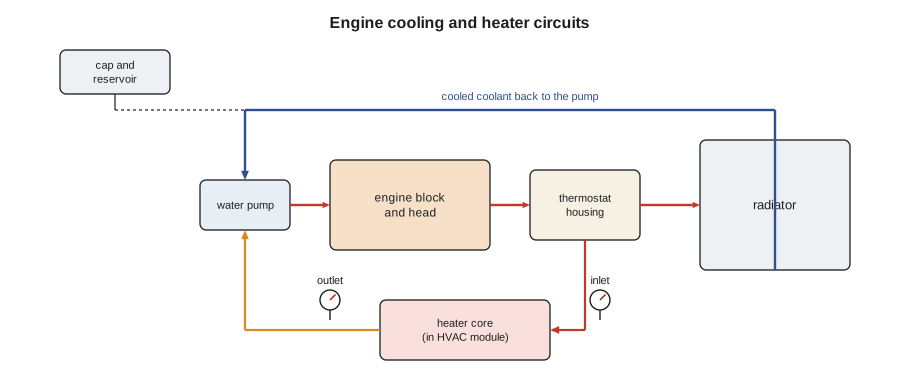
A gasoline engine turns only about a third of its fuel's energy into work at the crankshaft. Much of the rest leaves through the exhaust, and a large share passes into the cylinder walls and heads, from which the cooling system must remove it. Coolant, a mixture of water and antifreeze, is pushed by the water pump through passages in the block and head, where it picks up heat. It then flows to the radiator, where outside air removes the heat, and back to the pump. A thermostat in the circuit stays closed while the engine is cold, so that coolant circulates only through the engine and the heater core and the engine warms up quickly, and opens progressively as the coolant reaches its operating temperature, often about 90 to 105 °C (195 to 220 °F), sending coolant through the radiator.
The cooling system is sealed and pressurized. A pressure cap, on the radiator or on a coolant reservoir, holds the system at a set pressure above the outside air, commonly about 100 to 140 kPa (15 to 20 psi). Pressure raises the coolant's boiling point, which lets the engine run hot enough for good efficiency and emissions without boiling. Antifreeze raises the boiling point further and lowers the freezing point, and it carries additives that prevent corrosion of the aluminum, iron, copper and solder in the system. At Ridgeline's altitude, the outside air pressure is lower, so the coolant's boiling point at any given cap pressure is a little lower than at sea level.
# Coolant boiling point: cap pressure, altitude and mixture (illustrative approximation)
import math
def boil_c(abs_kpa, glycol_pct):
    # water boiling point from pressure (Antoine-style fit), plus a glycol elevation
    t_water = 1730.63 / (8.07131 - math.log10(abs_kpa * 7.50062)) - 233.426
    return t_water + 0.12 * glycol_pct
atm_here = 89.4
for cap in (0, 100, 140):
    for mix in (0, 50):
        t = boil_c(atm_here + cap, mix)
print(f"cap {cap:3} kPa, {mix:2} % antifreeze: boils at about {t:5.1f} C")cap 0 kPa, 0 % antifreeze: boils at about 96.5 C cap 0 kPa, 50 % antifreeze: boils at about 102.5 C cap 100 kPa, 0 % antifreeze: boils at about 118.4 C cap 100 kPa, 50 % antifreeze: boils at about 124.4 C cap 140 kPa, 0 % antifreeze: boils at about 124.5 C cap 140 kPa, 50 % antifreeze: boils at about 130.5 C
Coolants are not all the same. Makers specify a coolant type, such as an organic acid technology coolant or a hybrid formula, often by their own specification number, and colour is not a reliable guide because different brands use different dyes. Mixing incompatible coolants can reduce corrosion protection and, with some combinations, form a gel or sludge that settles in the narrowest passages in the system. The narrowest passages are usually the heater core's.
The heater core and how it is controlled
The heater core is a small radiator inside the HVAC module, behind or beside the evaporator. Hot coolant from the engine flows through it, usually from a hose near the thermostat housing, and back to the pump inlet. Air from the blower that passes through the heater core is warmed. On most vehicles, coolant flows through the heater core all the time, and the cabin temperature is controlled by the blend door, which decides how much of the air goes through the core and how much bypasses it; Lesson 8 explains the doors. Some vehicles also have a heater control valve that shuts off coolant flow to the core for maximum cooling. Vehicles with engine stop-start, and hybrids such as Ines Moreau's, often add an electric auxiliary coolant pump that keeps coolant flowing through the heater core while the engine is stopped, so that the cabin stays warm at a traffic light.
The heater's output depends on three things: the temperature of the coolant reaching the core, the rate at which coolant flows through it, and the amount of air passing through it. A cold engine gives a cold heater; a thermostat stuck open keeps the engine below temperature and gives a lukewarm heater, especially on the highway in winter. Low coolant flow through the core, from a restriction, an air pocket or a weak pump, gives a heater that is warm when the engine speed is high and cool at idle, because the pump's flow falls with engine speed. Too little air through the core, from a clogged cabin filter or a weak blower, gives hot but feeble air. Marcus's description, warm on the highway and cool in stop-and-go driving, points at coolant flow.
Measuring the heater core
Kiran starts with the basics. The coolant level in the reservoir is at the cold mark, and the coolant looks clean but is a slightly different colour from the coolant the maker specifies. The engine reaches its normal temperature on the scan tool and the thermostat opens on time, so the engine is warm enough. The cabin air filter is clean; she replaced it in June. The blower works on every speed, and the blend door moves fully to hot, which she confirms with the scan tool and by feel.
Next she measures the heater core's two hoses where they pass through the firewall, using an infrared thermometer aimed at the same spot on each and confirmed with a clamp-on probe. With the engine warm, the heater on full hot and the blower on high, the inlet hose should be close to engine temperature and the outlet hose a little cooler, because the core has given up some heat to the air. A large difference between the hoses, with an inlet that is hot and an outlet that is much cooler, means the coolant is flowing slowly through the core and giving up almost all its heat before it leaves: a restriction. Two hoses that are both only warm can mean the coolant is not reaching the core at all, from an air pocket or a closed valve.
# Heater core: inlet and outlet hose temperatures and the vent air temperature, engine warm, full heat, blower high
engine_coolant = 98
readings = [("highway speed (2,200 rpm)", 92, 62, 51), ("idle (700 rpm)", 88, 41, 34)]
for label, inlet, outlet, vent in readings:
    drop = inlet - outlet
    verdict = "restricted flow through the core" if drop > 15 else "flow normal"
print(f"{label:<26} inlet {inlet} C, outlet {outlet} C, drop {drop:2} C, vent {vent} C: {verdict}")highway speed (2,200 rpm) inlet 92 C, outlet 62 C, drop 30 C, vent 51 C: restricted flow through the core idle (700 rpm) inlet 88 C, outlet 41 C, drop 47 C, vent 34 C: restricted flow through the core
The pattern is clear. Even on the highway, the coolant leaves the core 30 °C (54 °F) cooler than it entered, and at idle, when the pump turns slowly, the drop is nearly 50 °C (84 °F) and the vent air is only lukewarm. A healthy core with good flow would typically show a drop of perhaps 5 to 15 °C (10 to 27 °F) at these settings, although the maker's figures govern. Coolant is getting into the core but crawling through it.
Air pockets and bleeding
Before blaming the heater core, Marty has Kiran rule out air. Air trapped in a cooling system rises to the highest point, which on many vehicles is the heater core or its hoses. An air pocket there blocks coolant flow and gives exactly Marcus's symptom: a heater that comes and goes, often with a gurgling sound behind the dashboard. Air gets in when a system is drained and refilled without proper bleeding, when the coolant level is low, or when a head gasket leaks combustion gas into the coolant. Vehicles have specific bleeding procedures: some have bleed screws on hoses or the thermostat housing, some require the front of the vehicle to be raised, and many need a vacuum fill, in which a tool pulls a vacuum on the system and then draws coolant in, leaving almost no air. Some vehicles also require the scan tool to run the electric auxiliary pumps during filling.
The van has no record of a recent coolant service, there is no gurgling, and the level has not dropped. Kiran pressure-tests the cooling system with a hand pump and adapter at the cap pressure, and it holds for ten minutes with no external leak, which also argues against a head gasket problem. She performs a vacuum fill anyway, as the first and cheapest step, and repeats the hose measurement. Nothing changes. The restriction is in the core.
Restricted heater cores
A heater core restricts when its narrow tubes collect deposits: scale from hard water used instead of the specified premixed coolant, corrosion products from coolant whose additives are exhausted, sealant from a cooling system stop-leak product, or gel from mixed coolants. The van's coolant is the wrong type; somebody topped it up from a jug of a different chemistry, and the shop's coolant test strip shows its protection is poor. Hal's records show the vans are topped up by drivers at a fuel station when the warning comes on.
There are two remedies. Flushing the heater core, by disconnecting its hoses and running water or an approved cleaner through it, often in the reverse direction to normal flow, can loosen soft deposits and restore flow. Replacing the core, which on many vehicles means removing the dashboard, is the permanent cure when deposits are hard or the core is corroded. Marty's rule is to try a flush when the deposits are likely to be soft, measure the result, and recommend replacement if the flush does not restore the temperature drop to normal. Kiran back-flushes the core with clean water at low pressure. Brown sludge comes out in the first few litres, then the water runs clear. She flushes the whole cooling system, refills it with the maker's specified coolant at the correct mixture, vacuum-fills it and measures again.
# Heater output from the air side: airflow times air density times specific heat times temperature rise
airflow_m3_per_min = 6.5      # blower on high, from the maker's data (illustrative)
rho, cp = 1.05, 1.006         # air density at Ridgeline's altitude and specific heat of air, SI units
inlet_air = 2           # air entering the core (outside air)
for label, vent in (("before flushing, idle", 34), ("after flushing, idle", 58)):
    rise = vent - inlet_air
    kw = airflow_m3_per_min / 60 * rho * cp * rise
print(f"{label:<22} vent {vent} C, rise {rise} C: heater output about {kw:4.1f} kW")before flushing, idle vent 34 C, rise 32 C: heater output about 3.7 kW after flushing, idle vent 58 C, rise 56 C: heater output about 6.4 kW
After the flush, the hose temperature drop at idle falls to about 12 °C (22 °F), the vent air at idle rises to about 58 °C (136 °F), and the heater's output rises by about three quarters. Simone writes the cause on the repair order as incompatible and depleted coolant restricting the heater core, and adds a recommendation that Hal stock the correct premixed coolant for his drivers. Marty adds a note to recheck the core's temperature drop at the next service: if it creeps up again, the core is too badly coated and will need replacing.
Cooling fans and the A/C
The engine cooling system and the air conditioning share the cooling fan and the space in front of the engine. With the air conditioning on, the condenser heats the air before it reaches the radiator, so the engine's cooling system works harder; and when the engine runs hot, many vehicles switch off the compressor to protect the engine. Electric fans are usually commanded by the engine control module using the coolant temperature and the air conditioning high-side pressure, so a fault in the pressure sensor can leave the fan off when the air conditioning needs it, or running when it does not. A fan that does not run at idle with the air conditioning on is one of the most common causes of a system that cools on the highway and not in town, as the capstone in Lesson 12 will show.
Worked problem
Two warm hoses
With the engine at operating temperature and full heat selected, both heater hoses read about 45 °C and the heater blows cool. The engine coolant temperature reads 95 °C. What should be checked?
Show solution
- Both hoses equally warm, well below engine temperature, means little hot coolant is reaching the core at all.
- Check the coolant level and look for an air pocket at the high point; bleed or vacuum-fill as specified.
- Check any heater control valve and its command, and any auxiliary pump.
- If flow cannot be restored, look for a blocked hose or core inlet.
Answer: Low flow into the core, most often air or a closed valve, rather than a restricted core.
Common mistakes
MistakeReplacing a heater core without measuring hose temperatures.
InsteadMeasure the inlet and outlet; the drop shows flow through the core.
MistakeTopping up with whatever coolant is at hand.
InsteadUse the maker's specified coolant; incompatible mixes can form sludge.
MistakeRefilling a cooling system without bleeding it.
InsteadFollow the bleed procedure or vacuum-fill to remove air.
MistakeBlaming the heater for a thermostat stuck open.
InsteadConfirm the engine reaches normal temperature first.
MistakeIgnoring the shared fan when diagnosing the A/C.
InsteadA fan that does not run at idle affects both engine cooling and A/C.
Summary and key terms
- The cooling system removes engine heat through coolant, a pump, a thermostat, a radiator and a pressure cap.
- Pressure and antifreeze raise the boiling point; altitude lowers it slightly.
- Use the specified coolant type; mixed or depleted coolant can restrict the heater core.
- Heater output depends on coolant temperature, coolant flow through the core and airflow.
- A large drop between heater core inlet and outlet means restricted flow through the core.
- Air pockets block heater flow; bleed or vacuum-fill as specified.
- Flush a restricted core and measure; replace it if flow is not restored.
- Thermostat
- A valve that keeps coolant in the engine until it reaches operating temperature, then opens to the radiator.
- Pressure cap
- A cap that holds the cooling system at a set pressure to raise the boiling point.
- Heater core
- A small radiator in the HVAC module that warms the cabin air with engine coolant.
- Auxiliary coolant pump
- An electric pump that keeps coolant flowing when the engine is stopped.
- Vacuum fill
- A method of filling a cooling system after pulling a vacuum, leaving almost no air.
- Air pocket
- Trapped air at a high point in the cooling system that blocks coolant flow.
- Heater control valve
- A valve that shuts off coolant flow to the heater core on some vehicles.
Practice problems
Work each problem on paper first, then reveal the answer to check.
Why does a heater that is restricted get worse at idle?
Show answer
The water pump's flow falls with engine speed, so less coolant passes through the core.
What does a thermostat stuck open do to heater output?
Show answer
The engine runs cool, so the coolant and the heater are only lukewarm, especially in cold weather.
What is the benefit of a vacuum fill?
Show answer
It removes nearly all air, avoiding air pockets at the heater core.
Why should coolants not be mixed?
Show answer
Incompatible chemistries can reduce corrosion protection or form gel that blocks narrow passages.
Lesson quiz · 5 questions
Score 60% or more to complete this lesson.
Create a free account to save your progress, take quizzes and earn a certificate.