
AUTO-320 · Lesson 1 of 12 · 23 min
Climate control and comfort
The first hot week of summer always arrives at Ridgeline the same way. On Monday morning the phone starts ringing before the doors open, and by noon there are four vehicles in the lot with notes on their repair orders that say "A/C blows warm", "A/C weak in the back" or "smells like a gym bag". Kiran Dhaliwal begins her climate control term in the middle of it. Gord Haney's pickup cools on the highway and not in town. The Lindqvists' minivan is cold in the front seats and warm in the third row, where the children sit. One of Hal Osei's courier vans has a driver, Marcus Bell, who says his windshield fogs on rainy mornings and will not clear. And Dr. Amara Singh wants to know why her electric car's range drops so much in January and whether the heat pump she was promised is working.
Marty Kowalchuk takes Kiran out to the lot before she touches a gauge set. "Every one of these is a comfort complaint," he says, "and comfort is more than a cold vent. Before you put a gauge on anything, ask what the customer feels and when. A system can be charged perfectly and still leave a driver hot, and a system can be low on refrigerant and still blow cold on a cool morning. You fix what the customer feels, and you prove it with numbers."
This lesson explains what a vehicle climate control system has to do, how people experience heat and cold, where the heat in a cabin comes from, and why defogging and defrosting are safety functions as well as comfort ones. It introduces the parts that the rest of the course takes one at a time: the refrigeration system, the heater, the air distribution system and the controls.
What the climate control system has to do
A modern climate control system does six jobs, often at the same time. It cools the air in the cabin on hot days. It heats the air on cold days. It removes moisture from the air, which is why the air conditioning compressor often runs in defrost mode even in winter. It moves fresh air through the cabin so that carbon dioxide from the occupants' breath does not build up, and it can recirculate cabin air instead when the outside air is dirty or very hot. It filters the air through a cabin air filter, removing dust, pollen and, with an activated carbon filter, some odours. And it clears the windshield and side glass of fog and frost so that the driver can see.
The last job is the one that makes climate control a safety system. Federal motor vehicle safety standards in both Canada and the United States set minimum performance for windshield defrosting and defogging on passenger vehicles, so a defroster that cannot clear the glass is not just an annoyance. Marcus's foggy windshield is the most urgent of the four complaints, and Simone moves his van to the front of Kiran's list.
The system's parts fall into four groups. The refrigeration system, the air conditioning, moves heat out of the cabin and dumps it outside. The heating system uses waste heat from the engine's coolant, or on an electric vehicle an electric heater or a heat pump. The air distribution system, the box behind the dashboard known as the HVAC module, contains the blower, the evaporator, the heater core and the doors that blend and direct the air. And the control system, from a simple panel of knobs to an automatic climate control module with sensors, decides what the other three do.
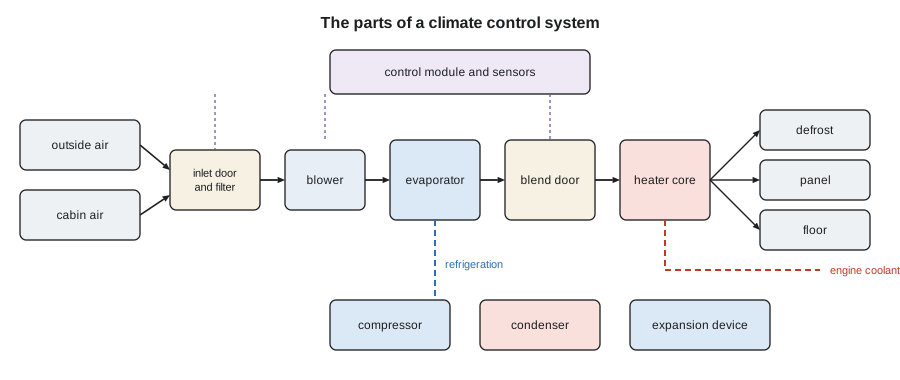
How people feel heat and cold
People do not sense temperature directly. They sense how quickly their skin gains or loses heat, which depends on four things: the air temperature, the humidity, how fast the air is moving over them, and radiant heat from hot or cold surfaces around them. A driver sitting in a car parked in the sun feels far hotter than the air temperature alone suggests, because the seats, dashboard and roof have been soaked in solar radiation and are radiating heat back. A driver on a winter morning feels colder than the air because the glass and the door panels are radiating heat away from the body. That is why a cabin can measure a comfortable temperature at the vent and still feel uncomfortable.
Humidity matters because the body cools itself by evaporating sweat. In dry air, such as the air in Calgary on most summer days, sweat evaporates quickly and people feel comfortable at a higher temperature. In humid air, sweat evaporates slowly and the same temperature feels sticky and oppressive. The air conditioning system dries the air as it cools it, because water condenses on the cold evaporator and drains out under the vehicle. That small puddle under a parked car on a hot day is a sign of a healthy system, not a leak, and Kiran will see customers worried about it all summer.
Most people are comfortable with cabin air at about 21 to 24 °C (70 to 75 °F), moderate humidity and gentle air movement. On a hot day a good system brings the cabin down from a heat-soaked 50 °C (122 °F) or more to that range within a few minutes, first by blowing cold air hard on the occupants' faces and upper bodies, then by slowing the blower and mixing in warmer air as the cabin cools. On a cold day it works the other way: warm air goes to the feet first, because warm air rises, with some air to the windshield to keep it clear.
Where the heat in a cabin comes from
To cool a cabin, the air conditioning must remove heat at least as fast as it comes in. That heat arrives from several directions at once, and together they are called the heat load. The biggest on a sunny day is solar radiation through the glass: sunlight passes through the windshield and windows, is absorbed by the seats and dashboard, and is re-radiated as heat that cannot escape through the glass as easily as the sunlight entered. Heat also conducts through the roof, doors and floor from the hot outside air and the hot road, and from the engine compartment and the exhaust under the floor. Each occupant gives off around 100 watts at rest. And when the system draws in fresh outside air, that air must be cooled and dried as well, which on a hot, humid day is a large part of the load.
# Rough heat load on a cabin parked in the sun, then driving (illustrative values)
loads = {
    "sunlight through the glass": 1800,
    "heat through roof, doors and floor": 900,
    "occupants (2 at rest)": 2 * 100,
    "fresh air brought in and cooled": 1100,
    "engine bay and exhaust": 400,
}
total = sum(loads.values())
for name, w in loads.items():
    print(f"{name:<36} {w:6,.0f} W  {100 * w / total:4.0f} %")
print(f"{'total heat load':<36} {total:6,.0f} W = {total / 1000:.1f} kW")
print("a typical light-vehicle A/C removes about 4 to 6 kW at full output")sunlight through the glass 1,800 W 41 % heat through roof, doors and floor 900 W 20 % occupants (2 at rest) 200 W 5 % fresh air brought in and cooled 1,100 W 25 % engine bay and exhaust 400 W 9 % total heat load 4,400 W = 4.4 kW a typical light-vehicle A/C removes about 4 to 6 kW at full output
The total, about 4.4 kW, is in the range a car air conditioner can remove at full output, which is why the first few minutes in a heat-soaked car are the hardest. Marty points out what the numbers suggest to a customer. Parking in the shade, using a windshield sunshade and opening the windows for the first minute to dump the hottest air all reduce the load before the system even starts. Recirculation mode, once the cabin air is cooler than the outside air, saves the system from cooling hot fresh air over and over. None of these replaces a working system, but they explain why the same car can feel fine one day and struggle on another.
Fog, frost and the dew point
Marcus's van fogs because of a simple physical fact. Air can hold only so much water vapour, and the amount falls as the air cools. The temperature at which a particular parcel of air becomes saturated, and at which water begins to condense on a surface, is its dew point. On a rainy morning, the van's cabin air is warm and damp from wet clothing and breath. The windshield is cold. Wherever the glass is colder than the cabin air's dew point, water condenses on it as fog. On a cold enough morning it freezes as frost.
There are two ways to clear the glass, and a good defrost mode uses both. Warming the glass above the dew point stops condensation. Drying the air lowers its dew point. That is why most vehicles run the air conditioning compressor in defrost mode whenever the outside temperature is above freezing: the evaporator chills the incoming air below its dew point, removing water, and the heater core then rewarms the dry air before it reaches the windshield. Recirculation is the enemy of a clear windshield on a wet day, because it keeps recycling the damp cabin air, and most systems switch to fresh air automatically in defrost.
# Dew point from air temperature and relative humidity (Magnus approximation)
import math
def dew_point_c(t_c, rh):
    a, b = 17.62, 243.12
    g = math.log(rh / 100) + a * t_c / (b + t_c)
    return b * g / (a - g)
cabin = [(18, 85), (18, 60), (18, 40)]      # cabin air temperature in C and relative humidity in %
glass_c = 8                                 # windshield inner surface on a cool, rainy morning
for t, rh in cabin:
    dp = dew_point_c(t, rh)
    state = "fogs" if glass_c < dp else "stays clear"
print(f"cabin {t} C at {rh} % RH: dew point {dp:5.1f} C, glass at {glass_c} C {state}")cabin 18 C at 85 % RH: dew point 15.4 C, glass at 8 C fogs cabin 18 C at 60 % RH: dew point 10.1 C, glass at 8 C fogs cabin 18 C at 40 % RH: dew point 4.2 C, glass at 8 C stays clear
The calculation shows how much drying matters. With damp cabin air at 85 percent relative humidity, the dew point is far above the glass temperature and the windshield fogs heavily. Dry the same air to 40 percent and its dew point falls below the glass temperature and the fog clears, even without warming the glass. If Marcus's defrost is not drying the air, either the compressor is not running in defrost mode, the system is in recirculation, or the evaporator's drain is blocked and the water it removes is evaporating straight back into the airstream.
Kiran finds the cause in ten minutes. With the van in defrost, the compressor runs and the vent air is cold before the heater core, so the refrigeration side is working. But the fresh-recirculation door stays in recirculation in every mode, and the cabin air filter, when she pulls it, is black and damp, with leaves packed against one end. The door actuator has a fault that Lesson 8 will deal with; for now Marty asks her to note it, replace the filter and check the evaporator drain, which is clear. Hal approves the actuator for the next day. Marcus is told to open a window briefly on a wet morning until then.
Cabin air filters and odours
The cabin air filter sits in the air intake, usually behind the glove box or under the cowl at the base of the windshield. It catches dust, pollen, leaves and, in an activated carbon version, some exhaust odours. A clogged filter reduces airflow, which reduces both cooling and heating, makes the blower louder and can cause the evaporator to freeze up on a hot, humid day because too little warm air flows over it. Makers give a replacement interval, often between 15,000 and 30,000 km (10,000 and 20,000 miles) or once a year, and the interval is shorter for vehicles driven on dusty gravel roads or in heavy traffic. Hal's vans drive both.
The "gym bag" smell that one of Monday's customers described usually comes from the evaporator itself. The evaporator is cold and wet whenever the air conditioning runs, and dust and spores that get past a tired filter settle on its fins and grow there. The smell is strongest in the first minute after starting. Treatments include replacing the filter, cleaning the evaporator with a product approved by the vehicle maker sprayed through the drain or the blower opening, and on many vehicles a setting that runs the blower for a few minutes after the engine is switched off to dry the evaporator. Kiran adds a filter inspection to every climate control job from now on, because a dirty filter can make a healthy system look weak.
# Cabin air filter interval: distance or time, whichever comes first, shorter for severe use
normal_interval = 24000        # km
months = 12
severe_factor = 0.5             # dusty roads, heavy traffic, poor air
vehicles = [("Gord's pickup", 18500, 14, False), ("courier van 2", 15200, 7, True), ("Lindqvist minivan", 9800, 13, False)]
for name, since, months_since, severe in vehicles:
    limit = normal_interval * (severe_factor if severe else 1)
    due = since >= limit or months_since >= months
print(f"{name:<18} {since:6,} km / {months_since:2} months since change: {'replace now' if due else 'not yet due'}")Gord's pickup 18,500 km / 14 months since change: replace now courier van 2 15,200 km / 7 months since change: replace now Lindqvist minivan 9,800 km / 13 months since change: replace now
A plan for every climate complaint
Marty's order for climate control complaints is the same each time, and the rest of the course fills in each step. First, listen to the customer and verify the complaint under the conditions they describe: hot vents at idle, warm air in the third row, fog on rainy mornings. Second, look at the simple things: the cabin air filter, the condenser for leaves and bugs, the cooling fans, the drive belt and the controls. Third, measure: vent temperatures, the ambient temperature and humidity, and, if the refrigeration side is suspect, the system pressures read with a manifold gauge set or a service machine. Fourth, compare what you measured with what the system should do, using the maker's performance chart. Only then decide whether the fault is in the refrigeration system, the heater, the air distribution or the controls.
That order keeps Kiran from reaching for a refrigerant bottle. Marty is blunt about it. "Adding refrigerant to a system you haven't diagnosed is how you end up with an overcharged system, a damaged compressor, or refrigerant that leaks straight back out into the atmosphere. And it's against the rules unless you know where the leak is." Lesson 4 explains those rules, and Lesson 11 shows how a system is recovered, evacuated and recharged by weight. For the rest of Monday, Kiran works through the lot, measuring before she does anything else.
Worked problem
Reading a performance check
On a 30 °C day with 40 percent humidity, a car's centre vent reads 9 °C after five minutes on maximum with the doors closed and the engine at 1,500 rpm. The maker's chart allows 6 to 11 °C at these conditions. What does that say?
Show solution
- Record the ambient temperature and humidity, because the chart depends on both.
- Run the test exactly as the chart describes: doors, windows, blower, mode, recirculation and engine speed.
- Compare the vent reading with the chart's range for those conditions.
- A reading inside the range means the refrigeration system performs normally; look elsewhere for the complaint.
Answer: The system performs within the maker's range; a comfort complaint would point to airflow, controls or the customer's expectations.
Common mistakes
MistakeTreating a weak A/C complaint as low refrigerant without measuring.
InsteadVerify, inspect and measure before adding anything.
MistakeIgnoring the cabin air filter.
InsteadA clogged filter reduces airflow and can make a healthy system look weak.
MistakeLeaving a foggy windshield in recirculation mode.
InsteadUse fresh air and the A/C to dry the air; defrost is a safety function.
MistakeWorrying about water under a car with the A/C on.
InsteadCondensate draining from the evaporator is normal.
MistakeJudging cooling by feel alone.
InsteadMeasure vent, ambient and humidity, and compare with the maker's chart.
Summary and key terms
- Climate control cools, heats, dries, ventilates, filters and clears the glass.
- Defrost and defog performance is a safety requirement, not only a comfort feature.
- Comfort depends on air temperature, humidity, air movement and radiant heat.
- The heat load on a cabin comes mainly from the sun, the hot surroundings, fresh air and the occupants.
- Fog forms where the glass is colder than the cabin air's dew point; drying the air clears it.
- A clogged cabin air filter reduces airflow and can cause odours and weak performance.
- Diagnose in order: verify, inspect, measure, compare, then decide where the fault is.
- Heat load
- The total rate at which heat enters the cabin and must be removed.
- Dew point
- The temperature at which air becomes saturated and water condenses on a surface.
- Relative humidity
- The amount of water vapour in air as a percentage of the most it could hold at that temperature.
- Recirculation
- A mode that reuses cabin air instead of drawing in outside air.
- Cabin air filter
- A filter in the HVAC air intake that removes dust, pollen and some odours.
- HVAC module
- The housing behind the dashboard that contains the blower, evaporator, heater core and doors.
- Performance chart
- A maker's table of expected vent temperatures and pressures at given test conditions.
Practice problems
Work each problem on paper first, then reveal the answer to check.
Why does the A/C compressor often run in defrost mode in winter?
Show answer
To dry the incoming air on the cold evaporator so it clears the glass.
Name three sources of heat load on a parked car.
Show answer
Sunlight through the glass, heat through the body from the hot air and road, and hot engine bay and exhaust.
Cabin air is 20 °C (68 °F) with a dew point of 12 °C (54 °F). The glass is 10 °C (50 °F). Does it fog?
Show answer
Yes; the glass is colder than the dew point.
What can a badly clogged cabin air filter do to the evaporator on a humid day?
Show answer
Reduce airflow so much that the evaporator freezes up.
Lesson quiz · 5 questions
Score 60% or more to complete this lesson.
Create a free account to save your progress, take quizzes and earn a certificate.