
AUTO-320 · Lesson 10 of 12 · 21 min
Heat pumps and electric compressors in hybrids and EVs
Dr. Amara Singh has kept a log. Every day since she bought her electric car she has written down the distance she drove, the outside temperature and the energy the car reported using. In July her car used about 15 kWh per 100 km (24 kWh per 100 miles). In January, on a run of mornings at −15 °C (5 °F), it used nearly 24 kWh per 100 km (39 kWh per 100 miles), and her usable range fell by more than a third. The salesperson had told her the car's heat pump would make winter range "much better", and she wants to know whether it is working. Earlier in the year Ines Moreau asked a related question about her hybrid: why does its engine keep running at red lights when the air conditioning is on full?
Both questions are about the newest part of vehicle climate control: systems that do not depend on an engine. This lesson explains electric air conditioning compressors, how hybrids and electric vehicles heat their cabins with electric heaters and heat pumps, how a heat pump works and why its efficiency falls in the cold, how the cabin and the battery share the thermal system, and what a general service technician may and may not do on these vehicles. Work on the high-voltage system itself requires the training covered in AUTO-410.
High voltage: what this lesson does and does not cover
Electric compressors and electric heaters in hybrids and electric vehicles are powered from the high-voltage battery, at several hundred volts, through orange cables. Contact with those circuits can kill. Marty's rule for Kiran is absolute: until she has completed the high-voltage training in AUTO-410, she may diagnose climate control on these vehicles with a scan tool, measure temperatures and pressures at the service ports with the vehicle shut down as the maker specifies, and replace low-voltage parts such as sensors and actuators, but she does not disconnect, open or test any orange cable, connector or high-voltage component. Recovery, evacuation and charging are allowed with the vehicle in the state the service information specifies, using the specified oil, because the refrigerant circuit is separate from the electrical one. If a job needs the high-voltage system disabled, it goes to Dale, who holds that training.
Oil matters here more than anywhere. Lesson 3 explained that an electric compressor's oil touches its high-voltage motor windings and must be a specified insulating oil, often POE. A service machine that has been used with ordinary PAG oil can contaminate an electric compressor's system with enough of it to lower the high-voltage insulation resistance and set an isolation fault. Ridgeline keeps a separate oil injector for electric compressors and flushes the machine's oil circuit, or uses a machine with a dedicated circuit, as the machine maker directs.
Electric compressors
An electric compressor is usually a scroll compressor with a built-in high-voltage motor and an inverter, a power electronics unit that turns the battery's direct current into the alternating current the motor needs at any speed. The climate control module, or a thermal management module, commands the compressor's speed over the network. Because it does not depend on the engine, an electric compressor can run at full speed at idle, at a stop, or with the engine off, and its speed can be matched exactly to the cooling needed. It can also cool the cabin before the driver gets in, from a phone app or a timer, and on electric vehicles it cools the battery.
Ines's question has a simple answer. Her hybrid's compressor is electric, so it can keep cooling with the engine stopped, but its energy comes from the hybrid battery. On a very hot day with the air conditioning on maximum, the compressor draws several kilowatts, and if the battery's charge falls below the level the hybrid system wants to hold, the engine starts to charge it. The engine also runs when the system wants maximum heat, because the engine's coolant is the hybrid's main source of cabin heat. Neither is a fault. Using a moderate setting, or the economy climate mode some hybrids offer, lets the engine stop more often.
Electric heaters
An electric vehicle has no engine heat to borrow, so it must make its own. The simplest way is a resistance heater, usually a positive temperature coefficient, or PTC, heater: ceramic elements whose resistance rises sharply above a design temperature, so they limit their own current and cannot overheat. Some PTC heaters sit in the HVAC case and heat the air directly; others heat a coolant loop that feeds a heater core and, on many vehicles, the battery as well. A resistance heater turns one kilowatt of battery energy into one kilowatt of heat. That is efficient by the standards of an engine, which wastes far more, but on a cold day a cabin heater can draw five kilowatts or more, which is a large share of what the car uses to drive at city speeds.
Heat pumps
A heat pump is the air conditioning system run in reverse. In cooling mode, the refrigerant absorbs heat from the cabin air in the evaporator and rejects it to the outside air at the front heat exchanger. In heating mode, valves redirect the refrigerant so that it absorbs heat from the cold outside air at the front heat exchanger, which now acts as the evaporator, and rejects it to the cabin air through an interior condenser in the HVAC case, or into a coolant loop that heats the cabin. Even cold air contains heat; a heat pump moves it uphill, using compressor work, exactly as an air conditioner does. Most electric vehicle heat pumps can also collect waste heat from the drive motor, the inverter and the battery through a chiller, a refrigerant-to-coolant heat exchanger, which makes them much more effective in cold weather.
The measure of a heat pump is its coefficient of performance, the heat delivered divided by the electrical power used. A resistance heater has a coefficient of 1. A heat pump on a mild day might deliver 3 kilowatts of heat for every kilowatt it uses. As the outside air gets colder, the heat pump must lift heat across a larger temperature difference, its refrigerant flow falls, and its coefficient drops; at very low temperatures it can approach 1, and many vehicles then add PTC heat or switch to it entirely. Waste heat from the drivetrain and battery helps, which is why a heat pump works best on longer drives.
# Cabin heating: heat pump against a resistance heater at several outside temperatures (illustrative)
heat_needed_kw = {5: 2.5, -5: 3.5, -15: 4.5, -25: 5.5}     # cabin heat needed at each outside temperature
cop = {5: 3.0, -5: 2.3, -15: 1.7, -25: 1.3}                # heat pump coefficient of performance
for t, q in heat_needed_kw.items():
    hp_power = q / cop[t]
    ptc_power = q / 1.0
print(f"{t:4} C: need {q} kW heat; heat pump uses {hp_power:4.2f} kW (COP {cop[t]}), resistance heater uses {ptc_power:4.2f} kW")5 C: need 2.5 kW heat; heat pump uses 0.83 kW (COP 3.0), resistance heater uses 2.50 kW -5 C: need 3.5 kW heat; heat pump uses 1.52 kW (COP 2.3), resistance heater uses 3.50 kW -15 C: need 4.5 kW heat; heat pump uses 2.65 kW (COP 1.7), resistance heater uses 4.50 kW -25 C: need 5.5 kW heat; heat pump uses 4.23 kW (COP 1.3), resistance heater uses 5.50 kW
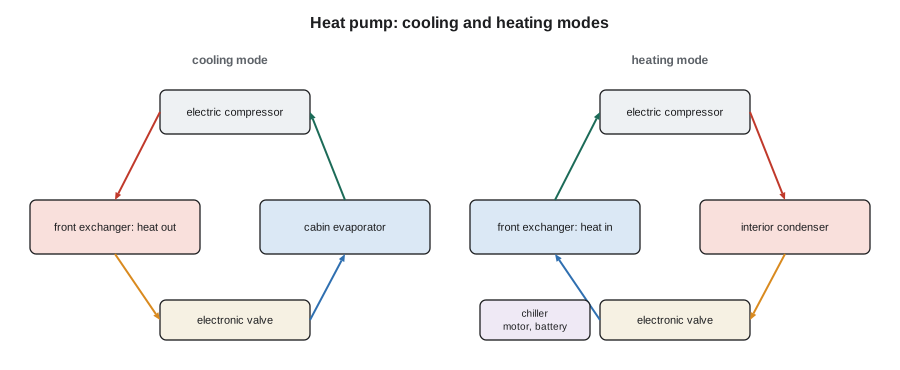
Heat pumps use more valves than a simple air conditioning system: electronic expansion valves, which a module drives with stepper motors to exact positions, solenoid or motor-driven valves that switch the refrigerant's path between modes, and often several coolant valves and pumps. Many electric vehicles combine all of these into one integrated thermal module. Diagnosis relies heavily on the scan tool, which shows the heat pump mode, each valve's commanded and actual position, compressor speed and power, refrigerant pressures and temperatures at several points, and the coolant temperatures of each loop.
The battery shares the system
An electric vehicle's battery must be kept within a temperature range to perform well and last. In hot weather and during fast charging, the thermal system cools it, usually by sending refrigerant through the chiller to cool the battery's coolant loop; the compressor may therefore run during charging even with nobody in the car. In cold weather, the battery's internal resistance rises, it cannot accept fast charging or regenerative braking at full rate, and its usable energy falls slightly, so the system may heat it with a PTC heater, with the heat pump, or with heat generated deliberately in the motor. Some of the extra winter energy use Dr. Singh logged is battery heating, not cabin heating.
Preconditioning, warming or cooling the cabin and the battery while the car is still plugged in, uses grid power instead of battery power for the hardest part of the job: bringing a cold-soaked cabin and battery up to temperature. It is one of the most effective ways to protect winter range. Seat and steering wheel heaters are another: they warm the people directly, using a fraction of the energy needed to heat the whole cabin, so the cabin can be set a few degrees cooler.
Checking Dr. Singh's car
Kiran's job is to find out whether the car's heat pump is working, not to argue with physics. With Dale beside her, she connects the scan tool on a cold morning and drives the car for twenty minutes with the data recording. The thermal module reports the heat pump in heating mode with the chiller collecting drivetrain heat, the compressor running at a steady speed, the interior condenser outlet at a healthy temperature, and the electronic expansion valves following their commands. At −12 °C (10 °F) outside, the module's own estimate of the heat pump's coefficient of performance is about 1.9, in line with the illustrative curve above, and the PTC heater is used only for the first few minutes while the system warms up. There are no codes in the thermal or high-voltage modules. The heat pump is working.
# Where Dr. Singh's winter energy went (illustrative split for a 20-minute city commute)
summer_kwh_per_100 = 15.0
winter_kwh_per_100 = 23.8
extra = winter_kwh_per_100 - summer_kwh_per_100
shares = {"cabin heating": 0.45, "battery heating and cold battery losses": 0.30, "denser cold air, winter tires, snow": 0.25}
print(f"winter uses {extra:.1f} kWh per 100 km more than summer ({100 * extra / summer_kwh_per_100:.0f} % more)")
for name, f in shares.items():
    print(f"  {name:<40} {extra * f:4.1f} kWh per 100 km")
battery_kwh = 72
for label, rate in (("summer", summer_kwh_per_100), ("winter", winter_kwh_per_100)):
print(f"{label} range on {battery_kwh} kWh usable: about {battery_kwh / rate * 100:4.0f} km")winter uses 8.8 kWh per 100 km more than summer (59 % more) cabin heating 4.0 kWh per 100 km battery heating and cold battery losses 2.6 kWh per 100 km denser cold air, winter tires, snow 2.2 kWh per 100 km summer range on 72 kWh usable: about 480 km winter range on 72 kWh usable: about 303 km
The rough split shows why a heat pump helps but cannot keep winter range equal to summer range. Short trips are the hardest case: the cabin and battery must be warmed from cold every time, and the drivetrain never produces much waste heat for the heat pump to collect. Kiran writes up her findings for Simone to explain: the heat pump and thermal system are working normally; the range loss is typical for short trips in severe cold. She adds three recommendations: schedule preconditioning while the car is plugged in at home before her morning drive, use the seat and steering wheel heaters with the cabin set a few degrees lower, and keep the tires at the cold pressures on the door label. Dr. Singh tries them for two weeks and logs a winter consumption about 15 percent lower.
Servicing hybrid and EV climate systems
Refrigerant service on electrified vehicles follows the same rules as any other vehicle, with additions from the service information. The vehicle is usually placed in a service mode or shut down with the high-voltage system inactive before the refrigerant circuit is opened, so that the compressor cannot start. Heat pump systems have more refrigerant, more valves and sometimes several service ports, and some require the scan tool to open their electronic valves during evacuation and charging so that every part of the circuit is reached; without that step, a section of the system can stay full of air or short of refrigerant. Charge amounts are exact, and some systems need a specific refrigerant temperature or a scan tool routine to confirm the charge. Oil type and amount are critical, as above. Systems that use R-744 need their own equipment entirely.
Worked problem
Compressor will not run on an electric vehicle
An electric vehicle's air conditioning gives no cooling. The scan tool shows the compressor commanded at 3,000 rpm and reporting 0 rpm, with an inverter fault code. What may a technician without high-voltage training do?
Show solution
- Record the codes, freeze frame data and the commanded and actual values.
- Check low-voltage items: the compressor inverter's low-voltage supply fuse, its network communication, and the refrigerant pressure the module reads.
- Do not disconnect or test the compressor's high-voltage connector or cables.
- Refer the vehicle to a technician with high-voltage training to follow the maker's procedure.
Answer: Gather data and check low-voltage circuits only; high-voltage testing goes to a trained technician.
Common mistakes
MistakeTouching or disconnecting orange high-voltage cables without training.
InsteadLeave high-voltage work to trained technicians following the maker's procedure.
MistakePutting PAG oil into an electric compressor system.
InsteadUse the specified insulating oil and a dedicated injector or machine circuit.
MistakeExpecting a heat pump to give summer range in winter.
InsteadIts efficiency falls in the cold; preconditioning and seat heaters help most.
MistakeEvacuating a heat pump system without opening its valves as specified.
InsteadUse the scan tool routine so every part of the circuit is reached.
MistakeTreating a hybrid's engine running at a stop with A/C on as a fault.
InsteadThe engine runs to recharge the battery or supply heat.
Summary and key terms
- Electric compressors run from the high-voltage battery and can run at any engine speed or with no engine.
- Only trained technicians work on high-voltage circuits; others use the scan tool and low-voltage checks.
- Electric compressors need the specified insulating oil.
- Resistance heaters give one kilowatt of heat per kilowatt; heat pumps give more, but less as it gets colder.
- Heat pumps reverse the refrigerant flow and can collect drivetrain and battery waste heat.
- The battery shares the thermal system; cold batteries use energy and perform less well.
- Preconditioning on grid power and seat heaters protect winter range.
- Electric compressor
- An A/C compressor driven by its own high-voltage motor and inverter.
- PTC heater
- A resistance heater whose elements limit their own current as they heat up.
- Heat pump
- A system that moves heat from outside air or waste heat into the cabin using the refrigeration cycle.
- Coefficient of performance
- Heat delivered divided by the electrical power used.
- Chiller
- A heat exchanger between the refrigerant and a coolant loop, used to cool or collect heat from the battery and drivetrain.
- Electronic expansion valve
- A stepper-motor valve that a module positions to meter refrigerant.
- Preconditioning
- Heating or cooling the cabin and battery before driving, ideally while plugged in.
- Isolation fault
- A loss of electrical insulation between the high-voltage system and the vehicle body.
Practice problems
Work each problem on paper first, then reveal the answer to check.
Why does a heat pump's coefficient of performance fall in very cold weather?
Show answer
It must lift heat across a larger temperature difference and its refrigerant flow falls.
Why may an electric vehicle's compressor run while it is charging?
Show answer
To cool the battery through the chiller.
What two driver habits most protect winter range?
Show answer
Preconditioning while plugged in and using seat and steering wheel heaters with a lower cabin setting.
Why must electric compressor systems use a specified oil?
Show answer
The oil contacts the high-voltage motor windings and must insulate them.
Lesson quiz · 5 questions
Score 60% or more to complete this lesson.
Create a free account to save your progress, take quizzes and earn a certificate.