
AUTO-230 · Lesson 8 of 12 · 19 min
Evaporative emission systems
The Lindqvists' minivan is back for the third time with the same code: P0456, evaporative emission system, very small leak detected. Two years ago, in AUTO-110, a worn fuel cap was the cause, and a new cap fixed it. This spring the lamp came on again, Erik bought another new cap at a parts store, and three weeks later the lamp returned. He is annoyed, and so is Simone, who has to explain why a car that runs perfectly needs a diagnosis. Marty takes the call himself. "Your van is telling us that fuel vapour is getting out somewhere," he tells Erik. "It's a small hole, smaller than a pinhead. We'll find it, and we won't guess at it."
This lesson covers the evaporative emission (EVAP) system: why it exists, how it stores and burns fuel vapour, how the engine computer tests it for leaks, the codes it sets, and how technicians find leaks with a smoke machine and scan tool tests. EVAP faults are among the most common reasons for a lit malfunction lamp on a vehicle that drives normally.
Why fuel vapour matters
Gasoline evaporates easily. On a warm day, a vehicle's fuel tank breathes out vapour as the fuel warms and draws air back in as it cools, and every refuelling pushes a tankful of vapour out of the filler neck. Before evaporative controls, a parked car could release more hydrocarbons in a hot day than it did from its tailpipe while driving. Those hydrocarbons help form ground-level ozone. Since the 1970s, vehicles have captured the vapour and burned it in the engine instead, and since the late 1990s their on-board diagnostics have had to check that the system is sealed. In the US, the system must detect a leak equivalent to a round hole about 1.0 mm (0.040 in) across on early OBD-II vehicles and about 0.5 mm (0.020 in) on vehicles from about 2000 on; Canadian rules generally align with the US requirements. A loose fuel cap is a much larger leak than either.
Most vehicles built since the late 1990s and early 2000s also have onboard refuelling vapour recovery (ORVR). During refuelling, the fuel flowing down a narrow filler neck forms a liquid seal, and the vapour displaced from the tank is routed to the charcoal canister instead of out of the filler. This is why fuel nozzles should not be topped off after they click: extra fuel can flood the canister with liquid, which damages it and can cause hard starting after a fill-up.
The parts of the system
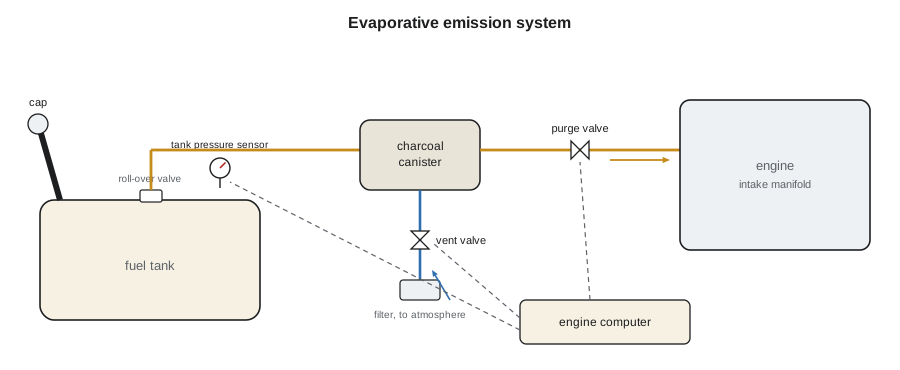
The fuel tank is sealed, and its vapour space connects through roll-over and vent valves to a charcoal canister, usually mounted near the tank or in the engine bay. The canister is filled with activated carbon, which adsorbs hydrocarbon molecules onto its huge internal surface area while letting air pass through. The canister's other end opens to the atmosphere through a vent valve, also called a canister vent solenoid, and a filter, so that the tank can breathe air in and out while the vapour stays in the carbon.
When the engine is running and warm, the engine computer opens the purge valve, a solenoid valve between the canister and the intake manifold, usually with a pulse-width-modulated signal. Manifold vacuum draws fresh air in through the vent, across the carbon, and into the engine, carrying the stored vapour with it to be burned. The computer purges gradually and watches the upstream oxygen or air-fuel sensor while it does, reducing injector pulse width to allow for the extra fuel arriving as vapour. On turbocharged engines, which have little manifold vacuum under boost, a second purge path uses a venturi in the intake ahead of the turbocharger. A fuel tank pressure sensor, sometimes on the tank and sometimes in the line or the canister, measures small pressures and vacuums in the system for the leak tests.
How the system tests itself
OBD-II requires the computer to check the EVAP system for leaks and for correct purge flow. The tests run only when conditions allow an accurate result, so the monitor is non-continuous: it waits for the right fuel level, usually between about a quarter and three-quarters of a tank, the right ambient and fuel temperatures, often between about 4 and 35 °C (40 and 95 °F), a cold soak of several hours since the vehicle was last driven, and steady driving or idle without large disturbances. At high altitude, many computers also check barometric pressure before running the test, because a thinner atmosphere changes how the fuel boils. These are the reasons an EVAP monitor can take days to complete after codes are cleared.
Manufacturers use several methods. In the vacuum decay method, common on many makes, the computer closes the vent valve and opens the purge valve while the engine runs, pulling a small vacuum on the whole system, then closes the purge valve and watches the tank pressure sensor. If vacuum decays faster than expected, there is a leak; the rate of decay indicates its size. If vacuum cannot be pulled at all, the computer sets a large-leak or purge-flow code. In engine-off natural vacuum systems, used by several manufacturers, the computer wakes up after the engine has been shut off and watches the pressure in the sealed tank as the fuel cools: a sealed system develops a measurable vacuum, and a leaky one does not. Other designs use a small pump in the vent module to pressurize the system or pull it down through a reference orifice of the regulated size and compare the pump's current. All of them compare the system with a hole of a known size.
# Vacuum decay leak test (illustrative): pull down, seal, and watch the pressure for 30 s
start = 1500               # Pa vacuum after pull-down
readings = {"sealed system": 1380, "0.5 mm-class leak": 820, "loose cap": 0}
limit_decay = 300           # Pa allowed loss in 30 s for a pass (illustrative)
for name, end in readings.items():
    decay = start - end
    if decay <= limit_decay:
        verdict = "pass"
    elif end > 0:
        verdict = "small leak"
    else:
        verdict = "large leak: no vacuum held"
print(f"{name:<20} {start:6.0f} -> {end:6.0f} Pa, decay {decay:6.0f}: {verdict}")sealed system 1500 -> 1380 Pa, decay 120: pass 0.5 mm-class leak 1500 -> 820 Pa, decay 680: small leak loose cap 1500 -> 0 Pa, decay 1500: large leak: no vacuum held
EVAP codes and what they mean
The generic EVAP codes include P0440, system malfunction; P0441, incorrect purge flow; P0442, small leak, usually the larger of the two test sizes; P0455, large leak, which often means a missing or loose cap or a disconnected hose; P0456, very small leak, the smallest size the system must find; P0446, vent control circuit or performance; and P0451 to P0453, tank pressure sensor faults. Many vehicles also have a separate fuel cap warning on the dash, which lights before or instead of the malfunction lamp when the computer finds a large leak right after refuelling.
EVAP faults do not affect how a vehicle drives, with one important exception. A purge valve that sticks open lets manifold vacuum draw on the tank and canister all the time. After refuelling, when the canister is loaded with vapour, the engine is flooded with extra fuel at start-up and may crank long, run rough or stall; fuel trims go strongly negative at idle; and on some vehicles a stuck-open purge valve can pull enough vacuum on the tank to collapse it slightly or make the fuel gauge read wrongly. A vent valve stuck closed causes the opposite trouble: the tank cannot breathe in, the fuel pump struggles, and refuelling becomes difficult because the nozzle keeps clicking off.
Finding a leak
A technician never assumes that a very small leak code means a bad cap, even though caps are a common cause. The first step is to inspect the cap and filler neck: the cap's seal should be soft, clean and uncracked, and the filler neck's sealing surface free of rust, dents and dirt. Cap testers pressurize the cap on an adapter and check that it holds. The second step is a smoke test. An EVAP smoke machine fills the system with a dense, harmless vapour, usually made by heating a mineral oil, at a regulated very low pressure, and often with nitrogen instead of air so that there is no oxygen to burn. On most vehicles, the computer must be commanded to close the vent valve with a scan tool first, so that the system is sealed. The machine's flow gauge shows whether the system is leaking and roughly how much, and a bright light shows where the smoke escapes. Many machines have a calibrated orifice that lets the technician compare the system's leak with a reference hole of the test size.
Smoke from a 0.5 mm (0.020 in) leak can be very faint, and Ridgeline uses an ultraviolet dye that the machine adds to the smoke: it leaves a bright mark at the leak that a UV light shows clearly. Leaks are often found at the filler neck and its seals, at cracked hoses and quick-connect O-rings near the tank, at the canister, at the vent and purge valves, and at the seal of the fuel pump module's lock ring, which is sometimes disturbed when a pump is replaced.
The minivan's tiny leak
Kiran reads the freeze frame first: the code set at a fuel level of about 40 percent and an ambient temperature of 18 °C, after an overnight soak, which fits the van's natural-vacuum test. The fuel cap Erik bought is a correct part and holds pressure on the tester. With the scan tool commanding the vent closed, the smoke machine's flow gauge sits just above the reference mark for a 0.5 mm (0.020 in) orifice, confirming a small leak. Five minutes of searching with the light under the van finds nothing. Then she adds dye and waits ten minutes, and the UV lamp finds a bright mark on the top of the filler neck, under the body near the left rear wheel well, where a short rubber vent hose joins the neck. The hose has a fine crack at the clamp, invisible until it is flexed.
She replaces the vent hose and its clamp with the manufacturer's parts, rechecks the system with smoke, and finds it sealed below the reference orifice. Because the van's monitor will not run until the conditions are right, she uses the scan tool's EVAP service test, which runs the system's own leak test on demand, and it passes. She explains to Erik that the cap had been a good guess two years ago and was not the cause this time; she also notes on the repair order that the second parts-store cap is fine and has been left on the vehicle. Simone adds a line Marty insists on for every EVAP repair: that the system's own monitor may take several days of normal driving to complete, which matters if the vehicle is due for an emissions inspection, as Lesson 11 explains.
Worked problem
Which code fits?
After a fill-up, a vehicle cranks for a long time, then idles roughly with long-term fuel trim at −22 percent. After a few minutes of driving, it runs normally. The computer has set P0441. What is the most likely fault?
Show solution
- After refuelling, the canister is loaded with fresh vapour.
- A purge valve stuck open draws that vapour into the engine at start-up, flooding it.
- Negative trims show the computer removing fuel to compensate.
- P0441, incorrect purge flow, fits a valve that does not close when commanded.
Answer: A purge valve stuck open; test it by commanding it closed and checking for vacuum at the canister side.
Common mistakes
MistakeReplacing the fuel cap every time a small-leak code appears.
InsteadTest the cap and smoke test the system; caps are a common cause, not the only one.
MistakeSmoke testing without closing the vent valve.
InsteadCommand the vent closed with the scan tool so the system is sealed.
MistakeUsing shop air to pressurize an EVAP system.
InsteadUse a regulated EVAP smoke machine at very low pressure; high pressure can damage valves and seals.
MistakeClearing an EVAP code and telling the customer it is fixed.
InsteadVerify with a smoke test or the scan tool service test; the monitor may not run for days.
MistakeTopping off the tank after the nozzle clicks.
InsteadOverfilling can push liquid fuel into the canister and damage it.
Summary and key terms
- The EVAP system captures fuel vapour from the tank and burns it in the engine.
- The charcoal canister stores vapour; the purge valve sends it to the engine; the vent valve lets the system breathe.
- ORVR routes refuelling vapour to the canister.
- OBD-II checks for leaks equivalent to holes of about 1.0 mm (0.040 in) and 0.5 mm (0.020 in).
- The EVAP monitor needs specific fuel level, temperature and soak conditions, so it can take days to run.
- A purge valve stuck open causes hard starts after refuelling and rich trims.
- Leaks are found with a cap test, a smoke machine, a reference orifice and UV dye.
- Evaporative emission (EVAP) system
- The system that captures and burns fuel vapour from the tank.
- Charcoal canister
- A container of activated carbon that stores fuel vapour.
- Purge valve
- A computer-controlled valve that lets the engine draw vapour from the canister.
- Vent valve
- A valve that opens the canister to the atmosphere and closes it for leak tests.
- ORVR
- Onboard refuelling vapour recovery, which routes refuelling vapour to the canister.
- Smoke machine
- A tool that fills a system with visible vapour at low pressure to find leaks.
- Non-continuous monitor
- An OBD-II test that runs only when its enable conditions are met.
Practice problems
Work each problem on paper first, then reveal the answer to check.
An EVAP monitor has not run in a week. The tank has been nearly full every morning. Why?
Show answer
Many monitors run only between about a quarter and three-quarters of a tank.
What code would you expect from a missing fuel cap?
Show answer
P0455, large leak, often with a fuel cap warning.
Why is nitrogen used in some smoke machines?
Show answer
It contains no oxygen, so there is nothing to support combustion in a system containing fuel vapour.
Refuelling is difficult because the nozzle keeps clicking off. Which EVAP part might be at fault?
Show answer
A blocked vent valve or vent filter, or a saturated canister.
Lesson quiz · 5 questions
Score 60% or more to complete this lesson.
Create a free account to save your progress, take quizzes and earn a certificate.