
AUTO-210 · Lesson 6 of 12 · 22 min
Steering linkages and rack-and-pinion gears
Two jobs on Wednesday's board both start with the same word: steering. Hal Osei says van 2 “feels loose” on the highway and needs constant small corrections to keep it in its lane. And Theo's partner, Jess, has found the compact SUV she wants to buy, a 2015 model with 164,000 km, and Theo has asked Kiran to do the pre-purchase inspection while he is busy in the tire bay. Marty gives Kiran both jobs and a reminder: “Loose steering is never one part until you've proved it is.”
This lesson explains how the driver's turn of the steering wheel reaches the front wheels: the steering column and intermediate shaft, rack-and-pinion and recirculating-ball steering gears, the parallelogram linkage of older trucks, and the tie rods that connect them all to the knuckles. It covers steering ratio and the geometry that makes the inside wheel turn more sharply than the outside one, how to inspect a steering system for play, and how to replace a tie rod end so that the alignment stays close.
From the steering wheel to the gear
The steering wheel is splined to a steering shaft that runs down inside the steering column. The column carries the turn signal and wiper switches, the ignition lock on older vehicles, and the clock spring, a coiled ribbon cable that keeps the airbag and steering wheel switches connected while the wheel turns. Columns are designed to collapse in a crash so that the driver's chest does not hit a rigid shaft; a column that has collapsed, even partly, is replaced, never repaired. Many columns also tilt and telescope for the driver's comfort, and on electric power steering systems the column may carry the assist motor and its torque sensor, which Lesson 7 covers.
Below the column, an intermediate shaft with one or two universal joints carries the turn to the steering gear, around the engine and through the firewall. The intermediate shaft is often made in two parts that slide on splines, so that it can change length as the engine and body move. Worn joints or dry splines are a common cause of a clunk felt in the steering wheel over bumps or when the wheel is turned slowly while parked, and many manufacturers publish service bulletins about lubricating or replacing them. The shaft must be reassembled in its original position on its splines; installing it one spline off leaves the steering wheel crooked, and on vehicles with electric power steering it can confuse the steering angle sensor.
Rack-and-pinion steering
Almost every car, crossover and light pickup built today uses a rack-and-pinion steering gear. The pinion, a small gear on the end of the input shaft, meshes with a rack, a straight bar with teeth cut along part of its length. Turning the pinion slides the rack left or right inside its housing. At each end of the rack, an inner tie rod with a ball joint connects to an outer tie rod end, which in turn connects to the steering arm on the knuckle. The rack housing is bolted to the subframe or the crossmember through rubber bushings, and flexible bellows boots at each end keep water and grit away from the inner tie rods and the rack.
A rack-and-pinion gear is light, compact and precise, and it has few joints to wear. Inside, a spring-loaded yoke, sometimes called a rack guide or rack bearing, presses the rack against the pinion to remove backlash. On some racks the yoke can be adjusted; on most modern racks it is set at the factory, and a worn rack is replaced as an assembly. Hydraulic power racks have a piston on the rack and seals that wear; Lesson 7 covers them.
Recirculating-ball gears and parallelogram linkages
Heavy-duty pickups, large vans and many older trucks use a recirculating-ball steering gear. The input shaft turns a worm, a steel shaft with a spiral groove, inside a ball nut. Steel balls roll in the groove between the worm and the nut, reducing friction, and return to the start of the groove through a tube, which is why they are said to recirculate. The ball nut has gear teeth on one side that mesh with a sector gear on the output shaft, so as the nut moves along the worm, the sector rotates. A pitman arm on the sector shaft swings back and forth.
The pitman arm drives a parallelogram linkage: a centre link, also called a drag link or relay rod, runs across the vehicle from the pitman arm to an idler arm bolted to the frame on the other side. Tie rods run from the centre link to each knuckle, with threaded adjusting sleeves in the middle of each tie rod to set toe. The parallelogram linkage has many joints, and each one wears: the idler arm's bushing is a classic source of wander, because it lets the far end of the centre link move. A recirculating-ball gear is strong, isolates road shock well and suits heavy vehicles, but its many joints make it less precise. On solid-axle trucks, a single drag link runs from the pitman arm to one knuckle, and a tie rod joins the two knuckles.
Steering ratio
The steering ratio is the number of degrees the steering wheel turns for each degree the front wheels turn. A ratio of 15 to 1 means the steering wheel turns 15 degrees to turn the wheels 1 degree. Low ratios, quick steering, mean less turning of the wheel for a given turn of the road, which suits sports cars; high ratios, slow steering, give lower effort and more stability, which suits heavy trucks. Most cars fall between about 13 and 18 to 1. The number of turns from lock to lock follows from the ratio and the maximum wheel angle.
Many racks have a variable ratio, made by shaping the rack teeth so that the ratio is slower near the centre, for stability on the highway, and quicker toward the locks, for less arm work when parking. Some vehicles go further with active steering systems that change the ratio electronically, and some steer the rear wheels a few degrees, opposite to the front wheels at low speed for a tighter turn and with them at high speed for stability.
# Steering ratio and turns lock to lock
UNITS = "metric"
vehicles = [
    # name, steering ratio, maximum road wheel angle at the inside wheel (degrees)
    ("compact SUV (variable rack, average)", 15.2, 36.0),
    ("courier van", 17.8, 38.0),
    ("Gord's pickup", 17.0, 35.0),
]
for name, ratio, wheel_max in vehicles:
    sw_degrees = ratio * wheel_max * 2            # from full left to full right
    turns = sw_degrees / 360
    print(f"{name:<38} {ratio:4.1f} to 1: about {turns:3.1f} turns lock to lock")
print("a slower ratio means more turns of the steering wheel")compact SUV (variable rack, average) 15.2 to 1: about 3.0 turns lock to lock courier van 17.8 to 1: about 3.8 turns lock to lock Gord's pickup 17.0 to 1: about 3.3 turns lock to lock a slower ratio means more turns of the steering wheel
Ackermann geometry: why the wheels turn by different amounts
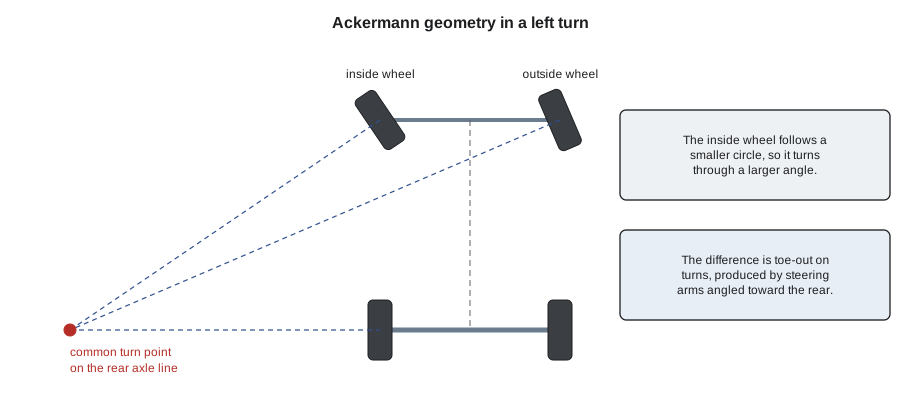
When a vehicle turns, its wheels follow circles around a common centre point on the line of the rear axle. The inside front wheel is closer to that centre than the outside front wheel, so it follows a smaller circle and must turn through a larger angle. If both front wheels turned by the same angle, one of them would be dragged sideways through every turn, squealing and wearing. The geometry that makes the inside wheel turn more is named after the engineer who patented it, Rudolph Ackermann, though the idea is older.
It is built into the steering arms. Seen from above, the steering arms on the knuckles angle inward toward the rear axle, so that as the linkage moves, the inside arm swings through a larger angle than the outside one. The difference is called toe-out on turns, and it is one of the angles an alignment machine can check. A bent steering arm changes it, causing tire squeal and scrub in turns even when the straight-ahead toe is correct. The code calculates the ideal angles for a given wheelbase and track.
Here delta sub o and delta sub i are the outside and inside wheel angles, w is the distance between the steering axes at the ground, close to the track width, and L is the wheelbase. Real vehicles use a little less than full Ackermann, because the tires' slip angles in a fast turn change the ideal, but the shape is the same.
# Ideal Ackermann angles: cot(outside) - cot(inside) = w / L
import math
UNITS = "metric"
L = 2.64          # wheelbase
w = 1.55          # distance between steering axes
for inside in (10, 20, 30, 35):
    cot_o = 1 / math.tan(math.radians(inside)) + w / L
    outside = math.degrees(math.atan(1 / cot_o))
    radius = L / math.sin(math.radians(outside))       # turning radius of the outside front wheel
print(f"inside {inside:2d} deg -> outside {outside:4.1f} deg, toe-out on turns {inside - outside:3.1f} deg, outside wheel radius {radius:5.1f} m")inside 10 deg -> outside 9.1 deg, toe-out on turns 0.9 deg, outside wheel radius 16.7 m inside 20 deg -> outside 16.7 deg, toe-out on turns 3.3 deg, outside wheel radius 9.2 m inside 30 deg -> outside 23.3 deg, toe-out on turns 6.7 deg, outside wheel radius 6.7 m inside 35 deg -> outside 26.4 deg, toe-out on turns 8.6 deg, outside wheel radius 5.9 m
Bump steer
As a front wheel moves up and down, its tie rod swings in an arc around its inner pivot, while the knuckle's steering arm follows the arc set by the control arms. If the two arcs do not match, the wheel's toe changes as it moves, so the vehicle steers itself over bumps. That is bump steer. Engineers place the rack and tie rods to keep it small. A bent tie rod, a rack whose mounting bushings have worn or shifted, a lifted or lowered vehicle, or a rack installed with the wrong spacers can all bring it back. Drivers describe it as darting over bumps or a twitch when one wheel hits a pothole.
Inspecting the steering system
Kiran starts van 2 with the dry-park check from Lesson 1: van on the floor, engine running, wheels straight. While she rocks the steering wheel through a small arc, Marty watches from underneath. The steering wheel moves almost 25 mm (1 in) at its rim before the front wheels move, more than the manufacturer allows. The intermediate shaft joints are tight. At the rack, Marty squeezes the left bellows boot and feels the inner tie rod's ball joint knock in its socket each time the rack reverses. The outer tie rod ends are tight, and the rack housing does not move in its bushings.
On the hoist, inner tie rods are checked by squeezing the boot and feeling the joint, or by pushing and pulling the tire in and out with the steering locked and watching for movement at the inner joint. Outer tie rod ends are checked for vertical play by lifting under the joint and for side play by rocking the tire at the front and rear. Rack mounting bushings are checked by watching the housing while a helper rocks the wheel. A torn boot lets water into the inner tie rod and the rack and is replaced at once; a boot with fluid in it on a hydraulic rack means the rack's internal seals are leaking.
On Jess's SUV the left outer tie rod end has a torn boot and a little vertical play, the right rack boot is split, and the rack housing has a damp film of power steering fluid at the left end. Kiran writes it all on the inspection sheet, with photographs. The rack seals are beginning to leak, so a rack will be needed sooner or later, and the outer tie rod end needs replacement now. Theo uses the list to negotiate the price down.
Replacing a tie rod end
Outer tie rod ends thread onto the inner tie rods, and the length of the combined rod sets that wheel's toe. Replacing one carefully keeps the toe close enough to drive the vehicle to the alignment rack. Kiran marks the threads where the jam nut sits, loosens the jam nut, removes the outer end's nut and cotter pin, and breaks the taper loose from the steering arm with a tie rod puller. Then she counts the number of turns it takes to unscrew the old end and threads the new one on the same number of turns, or measures from the end of the inner rod to the centre of the stud and matches it. The stud is seated in the steering arm, its nut torqued and a new cotter pin fitted, and the jam nut is tightened against the outer end while the end is held at the angle that lets the joint move freely through its full travel.
# How much does one turn of a tie rod end change toe?
import math
UNITS = "metric"
pitch = 1.5                 # mm per turn of the thread (M14 x 1.5, typical)
arm = 150.0                 # mm, steering arm length from the steering axis to the tie rod stud
tire_diameter = 690.0       # mm, for converting toe angle to a distance at the tire
for turns in (0.5, 1, 2):
    change = turns * pitch                                  # mm change in rod length
    toe_deg = math.degrees(math.atan(change / arm))
    toe_at_tire = tire_diameter * math.tan(math.radians(toe_deg))
    if UNITS == "metric":
        print(f"{turns:3.1f} turn: {toe_deg:4.2f} deg of toe, about {toe_at_tire:4.1f} mm across the tire")
    else:
print(f"{turns:3.1f} turn: {toe_deg:4.2f} deg of toe, about {toe_at_tire / 25.4:4.2f} in across the tire")0.5 turn: 0.29 deg of toe, about 3.5 mm across the tire 1.0 turn: 0.57 deg of toe, about 6.9 mm across the tire 2.0 turn: 1.15 deg of toe, about 13.8 mm across the tire
Even half a turn makes a large change in toe, which is why the count matters and why every tie rod replacement is followed by an alignment. Van 2 gets a new left inner tie rod, and because the right one shows the same wear when compared side by side, both are replaced, with new boots. The van then goes to the alignment rack.
Worked problem
Is the free play within the limit?
The service information for van 2 allows steering wheel free play of up to 12 mm (0.5 in) at the rim of its 380 mm (15 in) steering wheel. Kiran measured 25 mm (1 in). How many degrees of play is that, and is it acceptable?
Show solution
- The rim's circumference is π × 380 ≈ 1,194 mm.
- Free play in degrees is the measured movement divided by the circumference, times 360.
- 25 / 1,194 × 360 ≈ 7.5 degrees.
- The allowance is about half that, so the play is more than twice the limit.
Answer: About 7.5 degrees, twice the allowed play; the worn inner tie rods account for it.
Common mistakes
MistakeReplacing a tie rod end without counting turns or measuring.
InsteadCount turns or measure so the toe stays close, then align.
MistakeReassembling an intermediate shaft one spline off.
InsteadMark the shaft and yoke before removal and reinstall them in the same position.
MistakeBlaming loose steering on the gear before checking the joints.
InsteadCheck every joint from the steering wheel to the knuckles; the gear is usually last.
MistakeHeating a knuckle to free a tie rod taper.
InsteadUse a puller or the correct fork, and never heat steering parts.
MistakeIgnoring a torn rack boot.
InsteadReplace it at once, before water and grit damage the inner tie rod and rack.
Summary and key terms
- The column, intermediate shaft and joints carry the steering wheel's turn to the gear; collapsed columns are replaced.
- A rack-and-pinion gear turns rotation into side-to-side motion of the rack and tie rods.
- Recirculating-ball gears with parallelogram linkages suit heavy vehicles but have many joints that wear.
- Steering ratio is steering wheel degrees per road wheel degree; it sets turns lock to lock.
- Ackermann geometry turns the inside wheel more than the outside wheel; the difference is toe-out on turns.
- Bump steer is a toe change as the wheel moves, caused by mismatched tie rod and control arm arcs.
- Tie rod ends are replaced by counting turns or measuring, and always followed by an alignment.
- Clock spring
- A coiled ribbon cable in the column that connects the airbag and switches while the wheel turns.
- Rack-and-pinion
- A steering gear in which a pinion drives a toothed rack side to side.
- Recirculating-ball gear
- A steering gear in which balls roll between a worm and a ball nut that drives a sector.
- Idler arm
- The frame-mounted arm that supports the far end of the centre link in a parallelogram linkage.
- Steering ratio
- Degrees of steering wheel rotation per degree of road wheel rotation.
- Toe-out on turns
- The difference between the inside and outside front wheel angles in a turn.
- Bump steer
- A change in toe as the wheel moves up and down.
Practice problems
Work each problem on paper first, then reveal the answer to check.
A vehicle has a 16 to 1 ratio and 34° of wheel travel each way. How many turns lock to lock?
Show answer
16 × 34 × 2 / 360 ≈ 3.0 turns.
Why does the inside front wheel turn more than the outside one?
Show answer
It follows a smaller circle around the same turn centre.
What does fluid inside a rack boot mean?
Show answer
The rack's internal seals are leaking; the rack needs replacement.
An outer tie rod end took 14 turns to remove. How is the new one installed?
Show answer
Thread it on 14 turns, or to the measured length, then align the vehicle.
Lesson quiz · 5 questions
Score 60% or more to complete this lesson.
Create a free account to save your progress, take quizzes and earn a certificate.