
AUTO-210 · Lesson 2 of 12 · 23 min
Springs, dampers and ride height
Hal Osei's courier vans are back. Van 1, the one driven by Marcus Bell, has been running heavy since a new customer started shipping cases of bottled water, and Marcus says the back end “hits bottom” on the speed bumps at the depot and the headlights point at the tops of the trees. Van 3 has an oily film down the inside of both rear tires. Hal wants to know whether he needs new springs, new shocks or both, and why the vans keep wearing out the same parts.
This lesson explains how springs carry a vehicle's weight and how their stiffness is described, the main kinds of spring used in cars and light trucks, how the leverage of a suspension changes the stiffness felt at the wheel, why a suspension bounces at a natural frequency, how dampers control that bouncing, and how ride height is measured and why it matters for everything else in the course. It follows both vans from complaint to repair.
Springs and spring rate
A spring stores energy as it is compressed and gives it back as it extends. For the springs used in suspensions, the force needed to compress the spring rises in proportion to how far it is compressed, at least over its working range. The ratio of force to deflection is the spring rate, measured in newtons per millimetre or pounds per inch. A spring with a rate of 50 N/mm needs 50 newtons for every millimetre it is compressed, so 500 newtons compresses it 10 millimetres.
Here F is the force on the spring, k is the spring rate and x is the deflection. A stiffer spring has a higher rate and gives a firmer ride with less body movement; a softer spring gives a smoother ride but lets the body roll, dive and squat more and uses up its travel sooner when the vehicle is loaded. Many springs are made with a progressive or variable rate, by winding the coils closer together at one end: the close coils touch each other first and stop working, so the spring becomes stiffer as it is compressed. That gives a soft ride when the vehicle is lightly loaded and resists bottoming when it is full.
Coil springs are the most common. They are made of a round steel bar wound into a helix, and their rate depends on the bar diameter, the diameter of the coil, the number of working coils and the stiffness of the steel. Because the bar diameter appears to the fourth power, a small change in bar size makes a large change in rate.
In this formula G is the shear modulus of the spring steel, about 79,000 N/mm², d is the bar diameter, D is the mean coil diameter and n is the number of active coils, the coils that are free to flex. The code below uses it to show why replacement springs must be the correct part, not just one that fits.
# Coil spring rate from its dimensions: k = G d^4 / (8 D^3 n)
UNITS = "metric"
G = 79000.0                           # N/mm2, shear modulus of spring steel
springs = [
    # name, bar diameter mm, mean coil diameter mm, active coils
    ("pickup front, standard", 17.0, 115.0, 5.5),
    ("pickup front, thicker bar", 18.0, 115.0, 5.5),
    ("hybrid front strut", 12.5, 140.0, 5.0),
]
for name, d, D, n in springs:
    k = G * d ** 4 / (8 * D ** 3 * n)    # N/mm
    if UNITS == "metric":
        print(f"{name:<31} {k:5.1f} N/mm")
    else:
        print(f"{name:<31} {k * 5.71:5.0f} lb/in")
print("a bar only about 6 % thicker gives a spring about 26 % stiffer")pickup front, standard 98.6 N/mm pickup front, thicker bar 123.9 N/mm hybrid front strut 17.6 N/mm a bar only about 6 % thicker gives a spring about 26 % stiffer
Leaf springs are stacks of curved steel strips clamped together at the centre and attached to the frame at each end, one end through a fixed bushing and the other through a swinging shackle that lets the spring lengthen as it flattens. They are used at the rear of pickups and vans because they carry heavy loads, locate the axle without separate links and spread the load over the frame. Their rate depends on the number, thickness and length of the leaves. Many have a short helper leaf, or an overload spring, that only comes into contact when the vehicle is heavily loaded. The friction between the leaves damps some motion, but it also makes the ride harsh on small bumps.
Torsion bars are straight steel bars that twist instead of bending. One end is fixed to the frame and the other to a control arm, so that the arm's movement twists the bar. They were common at the front of older four-wheel-drive pickups because they leave room for the front drive axle, and on many of them the ride height is set by turning an adjusting bolt at the frame end. Air springs, covered in Lesson 5, are rubber bags filled with compressed air whose rate and height can be changed while the vehicle is moving.
Wheel rate and motion ratio
On most suspensions the spring is not mounted directly above the tire. On a short-and-long-arm front suspension like Gord's, the coil spring sits partway along the lower control arm, between the frame pivot and the ball joint. When the wheel rises 10 millimetres, the spring may compress only 6 or 7. That leverage is described by the motion ratio, the spring's movement divided by the wheel's movement.
The leverage works twice. The spring moves less than the wheel, and the force it produces is also multiplied by the same ratio when it reaches the wheel. As a result, the stiffness felt at the wheel, the wheel rate, is the spring rate multiplied by the square of the motion ratio. A spring with a rate of 80 N/mm on an arm with a motion ratio of 0.65 gives a wheel rate of only about 34 N/mm. On a MacPherson strut, where the spring sits almost over the wheel, the motion ratio is close to 0.9 to 1.0.
This is why the spring rate printed on a box means little until you know where the spring is mounted, and why springs from a different model, even if they fit, can make a vehicle sit and ride quite differently.
Natural frequency: why a vehicle bounces
A mass on a spring, pushed and released, bounces at a natural frequency that depends only on the stiffness and the mass. A vehicle's body on its springs is such a system, and so is each wheel between its spring and its tire. The body's natural frequency, called the ride frequency, decides how the vehicle feels. Passenger cars are usually tuned for ride frequencies of roughly 1.0 to 1.5 bounces per second, a rate that most people find comfortable; sports cars are stiffer, and loaded trucks vary widely. The unsprung mass, bouncing between the spring and the stiff tire, has a much higher natural frequency, around 10 to 15 per second, which is the wheel hop you feel on washboard gravel.
In this formula f is the natural frequency in hertz, cycles per second, k is the wheel rate in newtons per metre, and m is the sprung mass carried by that corner in kilograms. The tire's own stiffness acts in series with the spring and lowers the result slightly; the code ignores it to keep the calculation simple.
# Wheel rate and ride frequency for one corner
import math
UNITS = "metric"
corners = [
    # name, spring rate N/mm, motion ratio, sprung mass on this corner kg
    ("pickup front (spring on lower arm)", 80.0, 0.65, 560),
    ("hybrid front (strut)", 26.0, 0.95, 330),
    ("van rear, empty (leaf)", 70.0, 1.00, 520),
    ("van rear, loaded (leaf)", 70.0, 1.00, 1040),
]
for name, ks, mr, m in corners:
    kw = ks * mr ** 2                       # N/mm at the wheel
    f = math.sqrt(kw * 1000 / m) / (2 * math.pi)
    if UNITS == "metric":
        print(f"{name:<36} wheel rate {kw:5.1f} N/mm, ride frequency {f:4.2f} Hz")
    else:
print(f"{name:<36} wheel rate {kw * 5.71:5.0f} lb/in, ride frequency {f:4.2f} Hz")pickup front (spring on lower arm) wheel rate 33.8 N/mm, ride frequency 1.24 Hz hybrid front (strut) wheel rate 23.5 N/mm, ride frequency 1.34 Hz van rear, empty (leaf) wheel rate 70.0 N/mm, ride frequency 1.85 Hz van rear, loaded (leaf) wheel rate 70.0 N/mm, ride frequency 1.31 Hz
The van's rear is the interesting case. Empty, its rear corner bounces at about 1.8 times a second, which feels stiff and jittery. Loaded with twice the mass, it bounces at about 1.3, which feels much better. Its springs were chosen for the load it is meant to carry. Load it beyond that, as Marcus's new customer does, and the springs use up their travel and the axle hits the bump stops.
Dampers
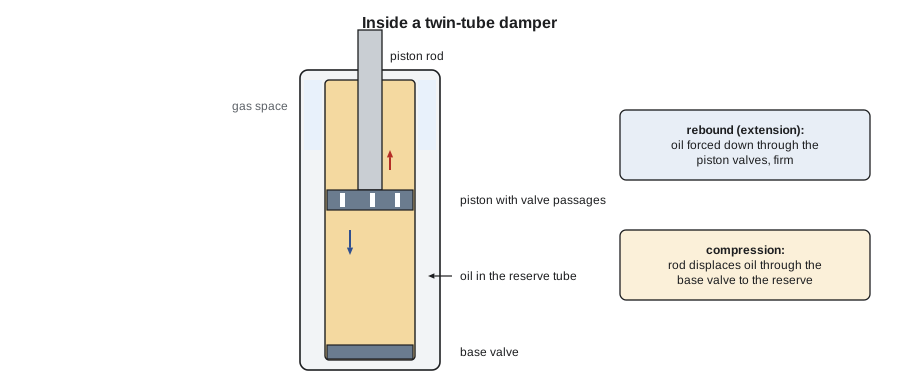
A spring alone would let the body bounce for a long time after a bump, each bounce a little smaller than the last. A damper turns that motion into heat so that it dies away in one or two cycles. Most dampers are hydraulic: a piston moves through oil inside a tube, and the oil is forced through small holes and spring-loaded valves in the piston. The faster the piston moves, the more force it takes to push the oil through, so a damper resists velocity, not position. A damper does not hold the vehicle up; that is the spring's job.
Dampers are usually stiffer in extension, called rebound, than in compression. A soft compression stroke lets the wheel move up over a bump without jolting the body; a firmer rebound stroke stops the body from springing back up and the wheel from bouncing off the road. The valves are also designed so that the force rises steeply at low piston speeds, which controls body roll and pitch, and less steeply at high speeds, so that a sharp pothole does not send a jolt through the vehicle.
# Damper force versus piston speed (illustrative valving, digressive curve)
UNITS = "metric"
def force(v_ms, stroke):
    # v_ms: piston speed in m/s; stiff low-speed region up to the knee, softer above it
    knee = 0.10
    c_low, c_high = (3500, 1100) if stroke == "rebound" else (1400, 500)   # N per m/s
    if v_ms <= knee:
        return c_low * v_ms
    return c_low * knee + c_high * (v_ms - knee)
for v in (0.05, 0.10, 0.30, 0.60, 1.00):
    r, c = force(v, "rebound"), force(v, "compression")
    if UNITS == "metric":
        print(f"piston {v:4.2f} m/s: rebound {r:5.0f} N, compression {c:5.0f} N")
    else:
print(f"piston {v * 39.37:4.1f} in/s: rebound {r * 0.2248:4.0f} lbf, compression {c * 0.2248:4.0f} lbf")piston 0.05 m/s: rebound 175 N, compression 70 N piston 0.10 m/s: rebound 350 N, compression 140 N piston 0.30 m/s: rebound 570 N, compression 240 N piston 0.60 m/s: rebound 900 N, compression 390 N piston 1.00 m/s: rebound 1340 N, compression 590 N
Two main designs are used. A twin-tube damper has an inner working tube and an outer reserve tube; oil displaced by the piston rod flows into the reserve, which usually holds a low-pressure gas charge to reduce foaming. A monotube damper has a single tube with a floating piston separating the oil from a high-pressure gas charge. Monotubes cool better and resist fade on rough roads but cost more. A strut, which Lesson 3 covers, is a damper that is also a structural part of the suspension, carrying side loads and the spring.
Inspecting springs and dampers
Springs are inspected for breaks, cracks and sag. Coil springs often break near an end, where corrosion from road salt eats into a chip in the coating; the broken piece may stay in place and only show as a clunk or a lean. Leaf springs can crack, shift on their centre bolt, wear through their insulators, or lose their curve. A broken or sagging spring always lowers that corner, so ride height measurement is the first test.
Dampers are inspected for leaks, damage and performance. A light film of oil, misting, on the body of a damper is normal, because the seal lets a trace of oil out to lubricate the rod. A wet damper, with oil running down the body and collecting dirt, has a failed seal and has lost oil. Bent rods, dented bodies, worn or broken mounts and missing bushings are also reasons to replace a damper. The bounce test catches badly worn dampers, but modern gas dampers can fail the road test long before they fail a bounce test, so the road test matters: body float on undulating roads, nose dive in stops, wheel hop on rough pavement and cupped tire wear all point to worn dampers. Dampers and springs are replaced in pairs on an axle.
On van 3, both rear dampers are wet from top to bottom, and the inner faces of the rear tires have the scalloped, cupped wear of wheels that have been bouncing. Kiran replaces both dampers with the fleet's heavy-duty part, torques the lower bolts with the van's weight on its wheels, and notes the cupped tires on the repair order; they will not wear smooth again, and Theo will rotate them to the front axle of another van only if the service information and Hal's fleet policy allow it. Hal decides to replace them at the next tire change.
Ride height
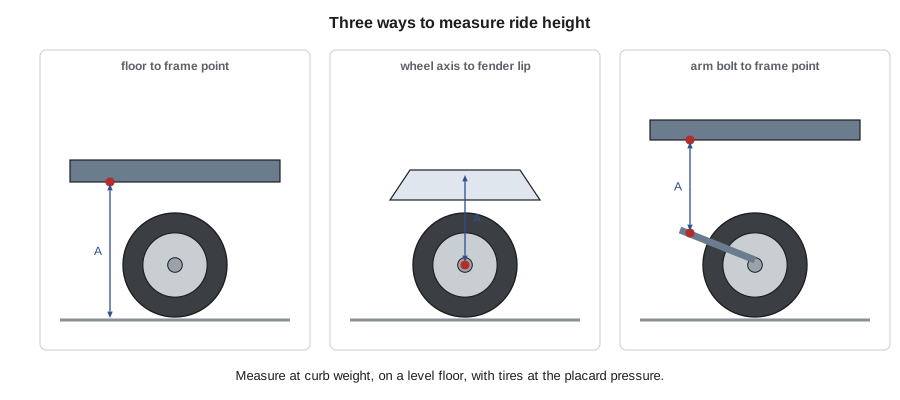
Ride height, sometimes called trim height or curb height, is the height of the body or a suspension point above the floor with the vehicle at curb weight: full fluids, no passengers and no cargo. Every manufacturer specifies how and where to measure it: from the floor to a point on the frame, from the centre of a wheel to the edge of the fender opening, or between two points on the suspension itself. Ride height is checked before every alignment, because the alignment specifications assume the correct height. A vehicle that sits low at one corner will have its camber and toe out of specification, and correcting them with adjustments only hides the real problem.
Ride height also affects the vehicle's other systems. A sagging rear points the headlights up, which dazzles other drivers, and changes the aim of radar and camera sensors used by driver assistance systems. On vehicles with automatic headlight levelling or adaptive suspension, a ride height sensor reports the body's position, and those sensors may need to be calibrated after a suspension repair, as Lesson 5 explains.
# Ride height check against specification
UNITS = "metric"
spec, tol = ((1015, 1045), 15)                 # specification and allowed difference
readings = {"left front": 1012, "right front": 1010, "left rear": 996, "right rear": 1002}
for corner, h in readings.items():
    diff = h - spec[0 if "front" in corner else 1]
    flag = "ok" if abs(diff) <= tol else "OUT OF RANGE"
    print(f"{corner:<12} {h:6.0f} {'mm'}  ({diff:+.0f})  {flag}")
side = readings["left rear"] - readings["right rear"]
print(f"rear side to side difference {side:+.0f} {'mm'}")left front 1012 mm (-3) ok right front 1010 mm (-5) ok left rear 996 mm (-49) OUT OF RANGE right rear 1002 mm (-43) OUT OF RANGE rear side to side difference -6 mm
Van 1, measured empty on the level floor of bay 3 with tires at the placard pressure, is close to specification at the front but low at both rear corners, by about 45 mm. Its leaf springs have taken a set: the steel has been loaded past its design so often that it has permanently lost some of its curve. Hal has two choices. New springs of the original rate will restore the height but will sag again under the same overloads. Springs with a higher rate, or an extra leaf, will carry the heavier load but make the van ride harshly when empty and may change its rated load. Kiran checks the van's door label: its gross vehicle weight rating and rear axle rating are what the law allows it to carry, and stiffer springs do not raise them. Marty tells Hal that the real fix is to stop overloading the van, and the shop installs new original-rate springs, U-bolts and shackle bushings.
Worked problem
How far does van 1's rear axle sink under the water load?
Each of van 1's rear leaf springs has a rate of 70 N/mm (400 lb/in). The bottled water adds 900 kg (1,980 lb) over the rear axle. How far do the springs compress under that extra load?
Show solution
- The load is shared by two springs: 450 kg (990 lb) each.
- In force, 450 × 9.81 ≈ 4,415 N per spring.
- Deflection is force divided by rate: 4,415 / 70 ≈ 63 mm.
- With the springs already sagging, that is enough to bring the axle onto its bump stops over every speed bump.
Answer: About 63 mm (2.5 in), more than the van's remaining travel once its springs have sagged.
Common mistakes
MistakeCalling a misting damper leaking.
InsteadA light film is normal; replace dampers that are wet with running oil or are damaged.
MistakeJudging dampers by a bounce test alone.
InsteadRoad test for float, dive and wheel hop, and look at the tire wear.
MistakeAligning a vehicle without checking ride height.
InsteadMeasure ride height first; sag changes camber and toe.
MistakeFitting a spring that only looks the same.
InsteadSpring rate depends strongly on bar size and coil count; use the correct part.
MistakeThinking stiffer springs raise a vehicle's load rating.
InsteadThe gross vehicle and axle weight ratings on the label do not change.
Summary and key terms
- Spring rate is force divided by deflection; progressive springs get stiffer as they compress.
- Coil, leaf, torsion bar and air springs all carry the load in different ways.
- Wheel rate is the spring rate times the square of the motion ratio.
- Every suspension has a natural ride frequency, set by wheel rate and sprung mass.
- Dampers resist velocity, are firmer in rebound, and turn motion into heat.
- Wet, damaged or ineffective dampers and broken or sagging springs are replaced in pairs.
- Ride height is measured at curb weight on a level floor and must be correct before an alignment.
- Spring rate
- The force needed to compress a spring by one unit of distance.
- Progressive spring
- A spring whose rate rises as it is compressed.
- Motion ratio
- The spring or damper movement divided by the wheel movement.
- Wheel rate
- The stiffness of the suspension measured at the wheel.
- Ride frequency
- The natural frequency at which the sprung mass bounces on its springs.
- Rebound
- The extension stroke of a damper or suspension.
- Ride height
- The specified height of the body or a suspension point at curb weight.
Practice problems
Work each problem on paper first, then reveal the answer to check.
A spring compresses 25 mm under 2,000 N. What is its rate?
Show answer
2,000 / 25 = 80 N/mm.
A spring of 60 N/mm sits on an arm with a motion ratio of 0.7. What is the wheel rate?
Show answer
60 × 0.7² = 29.4 N/mm.
Why are dampers made firmer in rebound than in compression?
Show answer
To let the wheel rise over a bump softly while stopping the body and wheel from springing back.
A rear corner sits 30 mm below specification. What should be done before any alignment?
Show answer
Find and correct the cause, usually a sagging or broken spring, so the alignment is set at the correct height.
Lesson quiz · 5 questions
Score 60% or more to complete this lesson.
Create a free account to save your progress, take quizzes and earn a certificate.