
AUTO-210 · Lesson 4 of 12 · 21 min
Rear suspension designs
Dr. Amara Singh's electric hatchback is in for its spring tire changeover, and Theo calls Kiran over to the tire bay before he mounts the summer set. The winter tires he has just taken off the rear wheels are worn smooth on their inner edges, almost to the wear bars, while their outer edges still have plenty of tread. The car has covered less than 20,000 km on them. “Fronts look fine,” he says. “It's the back. Same thing happened to her summers last year.” Kiran writes the tread depths on the repair order, and Marty adds a line: inspect rear suspension, check alignment.
This lesson describes the rear suspension designs Kiran will meet: solid axles on leaf springs and on coil springs and links, the twist beam, trailing-arm designs and the multilink independent rear suspensions of most modern cars and electric vehicles. It covers rear wheel bearings and rear adjustments, introduces the thrust angle that Lesson 10 explains in full, and follows the diagnosis of Dr. Singh's rear tire wear.
Why the rear is different
The rear wheels of most cars do not steer, so their suspension can be simpler than the front. It still has to carry its share of the load, keep the tires on the road, control the body and hold the wheels at the right camber and toe. On rear-wheel-drive and all-wheel-drive vehicles it must also carry the drive torque, and on vans and pickups it must carry loads that vary from an empty cargo box to the maximum the axle is rated for. The rear wheels also decide which way the vehicle actually goes: if they point a little to one side, the vehicle travels crab-wise and the driver has to steer against it to keep it straight. That is the thrust angle.
Solid axles on leaf springs
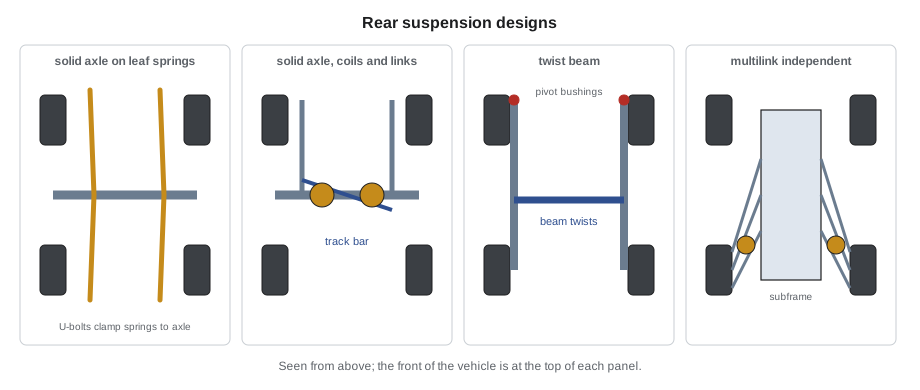
The simplest and toughest rear suspension is a solid axle on two leaf springs, sometimes called a Hotchkiss design. Each spring is clamped to the axle by U-bolts near its centre and attached to the frame at both ends, one end through a fixed eye bushing and the other through a shackle. The springs carry the load, locate the axle front to back and side to side, and resist the axle's tendency to rotate under drive and braking torque. Gord's pickup and Hal's vans use this design because it carries heavy loads, is cheap and is easy to repair.
Its weaknesses show up under hard use. Drive torque tries to twist the axle housing, winding the springs into an S shape, called axle wrap; on a loaded truck accelerating hard on a slippery surface, the springs can wind up and release repeatedly, causing violent wheel hop. Leaf springs also sag with age and overloading, as van 1's did, and their bushings and shackles wear. The U-bolts must be tightened to specification and in a crossing pattern, and many manufacturers require new U-bolts whenever they are removed, because they stretch.
Solid axles on coils and links
Many SUVs, some pickups and older rear-wheel-drive cars use a solid axle on coil springs. Because coil springs cannot locate the axle, separate links do it: two lower trailing arms and either two upper arms angled inward, called a four-link, or two upper arms and a lateral link. A track bar, also called a Panhard rod, is a single diagonal link from one side of the axle to the opposite side of the frame that keeps the axle centred; because it swings in an arc, the axle moves slightly sideways as the body rises and falls. A Watts linkage, a pair of short links joined by a pivoting centre piece, keeps the axle centred without that side shift. All these links pivot on bushings that wear, and worn link bushings cause clunks on acceleration and braking and a vague, wandering feel.
The twist beam
Many small front-wheel-drive cars and some minivans use a twist beam, also called a torsion beam. Two trailing arms, each carrying a wheel hub at its rear end, pivot on bushings at their front ends, and the arms are joined by a cross beam, usually an open steel section that twists. When both wheels move together, the beam simply swings; when one wheel moves more than the other, the beam twists like a stabilizer bar. The design is compact, light and cheap, leaves room for a fuel tank or spare tire, and holds the wheels at nearly constant camber.
A twist beam has almost no adjustments. Its camber and toe are set by the shape of the beam and the hub mounting, so if they are out of specification, the beam is bent or the hub is damaged. Some aftermarket kits use tapered shims between the hub and the beam to correct small errors, but a bent beam from hitting a curb is replaced. The Lindqvists' minivan has a twist beam, and Kiran will meet it again in the capstone.
Trailing arms and multilink independent rears
In an independent rear suspension each wheel is carried on its own knuckle. The older trailing-arm and semi-trailing-arm designs use a single arm per side pivoting at the front; a semi-trailing arm pivots on an axis set at an angle, which changes the wheel's camber and toe as it moves. Most modern cars, crossovers and electric vehicles use a multilink rear: the knuckle is located by three, four or five links, each carrying force mainly in one direction, along with a coil spring and damper. The links let engineers set how the wheel's toe and camber change as it moves, so that, for example, the outside rear wheel toes in slightly in a turn or under braking, which keeps the vehicle stable.
Multilink rears are usually mounted on a subframe, a separate frame that bolts to the body through large rubber mounts. The subframe isolates noise and vibration from the body and lets the factory build the whole rear suspension as one unit. Its mounts wear and can let the whole subframe shift, which changes the rear alignment of both wheels at once.
Multilink rears are usually adjustable. One or more of the links has an eccentric cam bolt, a bolt with an offset washer or a cam-shaped head that moves the link's inner end as it is turned, to set camber, and another sets toe. Those adjustments are covered in Lesson 11. Because they are cams in slotted holes, they can slip if the nuts are not tight or if the vehicle hits something hard.
Rear wheel bearings and hubs
Most modern rear wheels turn on a sealed hub bearing unit, a double-row ball or tapered roller bearing built into a flange that bolts to the knuckle or axle. The unit cannot be adjusted or greased; when it is worn, it is replaced. Many units include the wheel speed sensor's tone ring, so a damaged unit can also cause anti-lock and stability faults, as van 3's rusted sensor did in AUTO-130. Solid drive axles use axle shafts supported by bearings at the outer ends of the housing, lubricated by the differential oil. A worn wheel bearing hums or growls, and the noise usually changes as the vehicle turns, getting louder when the load moves onto the bad bearing. Lesson 9 covers how to tell a bearing hum from a tire noise.
Rear axle loads
Every vehicle's door label lists a gross axle weight rating, GAWR, for each axle: the maximum load that axle's suspension, tires, wheels and bearings are designed to carry. A loaded van or a pickup carrying a heavy load of gravel or towing a trailer with a heavy tongue can exceed its rear rating easily. Exceeding it overloads the springs, the tires, the wheel bearings and the brakes, and changes how the vehicle steers, because weight comes off the front tires. Kiran weighs van 1 on the municipal scale with a full load of water to show Hal what the numbers look like.
# Axle loads against their ratings (from the door label)
UNITS = "metric"
vans = [
    # name, front axle load kg, rear axle load kg, front rating kg, rear rating kg
    ("van 1, empty", 1610, 1090, 1950, 2400),
    ("van 1, water load", 1660, 2580, 1950, 2400),
    ("van 2, normal parcels", 1680, 1720, 1950, 2400),
]
for name, f, r, fr, rr in vans:
    if UNITS == "metric":
        print(f"{name:<22} front {f:5d} of {fr} kg ({f / fr * 100:3.0f} %), rear {r:5d} of {rr} kg ({r / rr * 100:3.0f} %)")
    else:
        print(f"{name:<22} front {f * 2.205:5.0f} of {fr * 2.205:5.0f} lb ({f / fr * 100:3.0f} %), rear {r * 2.205:5.0f} of {rr * 2.205:5.0f} lb ({r / rr * 100:3.0f} %)")
print("any figure over 100 % means the axle is overloaded")van 1, empty front 1610 of 1950 kg ( 83 %), rear 1090 of 2400 kg ( 45 %) van 1, water load front 1660 of 1950 kg ( 85 %), rear 2580 of 2400 kg (108 %) van 2, normal parcels front 1680 of 1950 kg ( 86 %), rear 1720 of 2400 kg ( 72 %) any figure over 100 % means the axle is overloaded
With the water load, van 1's rear axle is at about 108 percent of its rating, while its front axle has hardly changed. Hal now has a number to take to his new customer: the water has to be spread over two vans.
Rear toe, camber and thrust
Two rear alignment angles matter most. Rear camber is the tilt of the rear wheels in or out at the top; a small amount of negative camber, top tilted in, is normal on many cars and helps cornering grip. Rear toe is whether the rear wheels point in or out at the front; most cars have a little toe-in at the rear, so that the rear wheels push the vehicle straight. Too much negative camber concentrates the load on the inner edges of the tires; too much toe, in or out, scrubs the tires sideways as they roll, which wears them quickly and leaves a feathered edge.
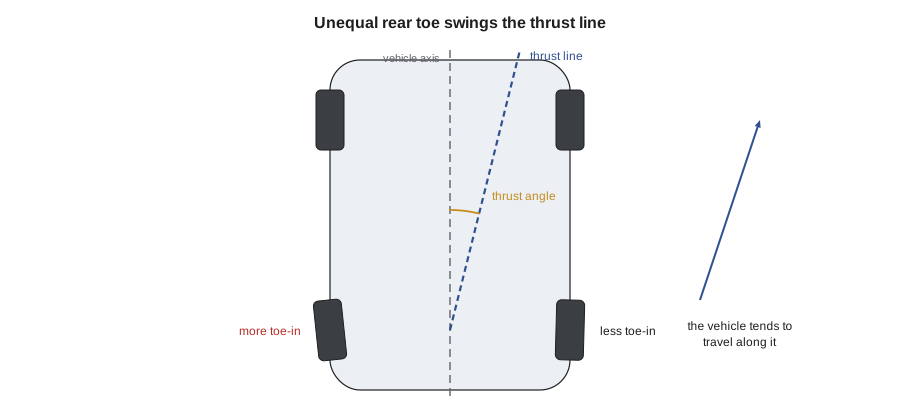
The thrust line is the direction the rear wheels are pointing, taken as the line halfway between their two toe angles. If the rear wheels have equal toe, the thrust line runs along the vehicle's centreline. If one rear wheel has more toe-in than the other, the thrust line swings to one side, and the vehicle tries to steer itself. The angle between the thrust line and the centreline is the thrust angle.
In this convention individual toe-in is positive, and a positive thrust angle points the thrust line to the right of the centreline. A driver whose rear axle steers right has to hold the steering wheel slightly to the left to drive straight, so the steering wheel looks crooked even though the front toe is correct. Lesson 10 explains how a four-wheel alignment uses the thrust line.
# Thrust angle from the individual rear toe readings (toe-in positive, degrees)
cars = [
    ("Dr. Singh's EV, as found", 0.42, 0.08),
    ("Dr. Singh's EV, after repair", 0.12, 0.10),
    ("van 2 (solid axle)", 0.02, -0.03),
]
for name, left, right in cars:
    total = left + right
    thrust = (left - right) / 2
    side = "straight" if abs(thrust) < 0.02 else "right" if thrust > 0 else "left"
print(f"{name:<28} total toe {total:+.2f} deg, thrust angle {thrust:+.2f} deg (rear points {side})")Dr. Singh's EV, as found total toe +0.50 deg, thrust angle +0.17 deg (rear points right) Dr. Singh's EV, after repair total toe +0.22 deg, thrust angle +0.01 deg (rear points straight) van 2 (solid axle) total toe -0.01 deg, thrust angle +0.03 deg (rear points right)
Diagnosing Dr. Singh's rear tires
Dr. Singh's car has a multilink rear suspension on a subframe, with adjustable camber links and toe links. Its battery pack fills the floor, so it is heavy for its size, and its powerful motor drives the rear wheels hard from a stop. Both facts make its tires wear faster than a gasoline car's of the same size; owners of electric vehicles commonly report shorter tire life for the same reasons, weight and instant torque. But the even, gradual wear that weight and torque cause does not explain a pair of tires worn only on their inner edges.
On the rack, Kiran inspects every rear link and bushing. The left rear toe link's inner bushing is torn, and the link moves when she pries it, so the left wheel's toe changes as the car accelerates and brakes. The paint on the left camber cam bolt has a crescent-shaped mark beside the washer: the cam has rotated from where the factory set it. Dr. Singh remembers hitting a deep pothole on her way home in January. The alignment readings confirm the picture: the left rear has more negative camber and much more toe-in than the right, giving a thrust angle of about 0.17 degrees to the right, and the car's steering wheel sits slightly off centre to the left.
The repair is a new left toe link, torqued at ride height, and a full four-wheel alignment, which Lesson 11 describes. Marty also points Kiran to one more thing: the car's driver assistance camera and radar aim along the thrust line, and the service information for this car requires a calibration check after any change to the rear toe. Lesson 11 shows how that is handled, and AUTO-420 covers the calibration itself.
Worked problem
How far off is the car tracking?
With a thrust angle of 0.17 degrees, how far sideways would Dr. Singh's car drift over 100 m (330 ft) if the driver held the steering wheel straight in line with the vehicle's centreline?
Show solution
- Sideways drift is the distance times the tangent of the angle.
- tan 0.17° ≈ 0.0030.
- Over 100 m, that is 0.30 m.
- The driver corrects without noticing by steering slightly left, which is why the steering wheel looks crooked.
Answer: About 30 cm (12 in) every 100 m (330 ft), enough that the driver unconsciously holds the wheel off centre.
Common mistakes
MistakeBlaming inner-edge wear on an electric vehicle's weight alone.
InsteadWeight and torque cause faster even wear; one-edge wear points to camber or toe.
MistakeAdjusting a twist beam's camber with a pry bar.
InsteadA twist beam has no adjustment; a bent beam or hub is replaced or shimmed as the service information allows.
MistakeReusing U-bolts that the manufacturer says to replace.
InsteadU-bolts stretch when torqued; fit new ones and tighten them in a crossing pattern.
MistakeIgnoring a crooked steering wheel when the front toe is correct.
InsteadCheck the rear toe and thrust angle.
MistakeForgetting the sensor calibration after a rear alignment.
InsteadCheck the service information for driver assistance calibration requirements.
Summary and key terms
- Solid axles on leaf springs carry heavy loads simply but suffer axle wrap and sag.
- Coil-sprung solid axles need trailing arms and a track bar or Watts linkage to locate them.
- A twist beam joins two trailing arms with a beam that twists and has almost no adjustment.
- Multilink independent rears locate the knuckle with several links, are often adjustable and mount on a subframe.
- Gross axle weight ratings set the maximum load on each axle.
- The thrust line bisects the rear toe angles; a thrust angle makes the vehicle track crooked and the steering wheel sit off centre.
- Hotchkiss suspension
- A solid axle located and sprung by two leaf springs.
- Axle wrap
- The S-shaped winding of leaf springs under drive or braking torque.
- Track bar
- A diagonal link that keeps a solid axle centred under the vehicle; also called a Panhard rod.
- Twist beam
- A rear suspension with two trailing arms joined by a beam that twists.
- Subframe
- A separate frame, bolted to the body through rubber mounts, that carries the suspension.
- GAWR
- Gross axle weight rating, the maximum load an axle is designed to carry.
- Thrust angle
- The angle between the thrust line of the rear wheels and the vehicle centreline.
Practice problems
Work each problem on paper first, then reveal the answer to check.
What locates a solid axle on leaf springs?
Show answer
The leaf springs themselves, clamped to the axle with U-bolts.
Why does a twist beam have almost no alignment adjustment?
Show answer
Its camber and toe are fixed by the shape of the beam and the hub mounting.
Left rear toe is +0.30° and right rear is +0.10°. What is the thrust angle?
Show answer
(0.30 − 0.10) / 2 = +0.10°: the left wheel points further right than the right wheel points left, so the thrust line points 0.10° to the right.
A van's rear axle carries 2,300 kg and is rated for 2,150 kg. What percentage of its rating is that?
Show answer
2,300 / 2,150 × 100 ≈ 107 percent; it is overloaded.
Lesson quiz · 5 questions
Score 60% or more to complete this lesson.
Create a free account to save your progress, take quizzes and earn a certificate.